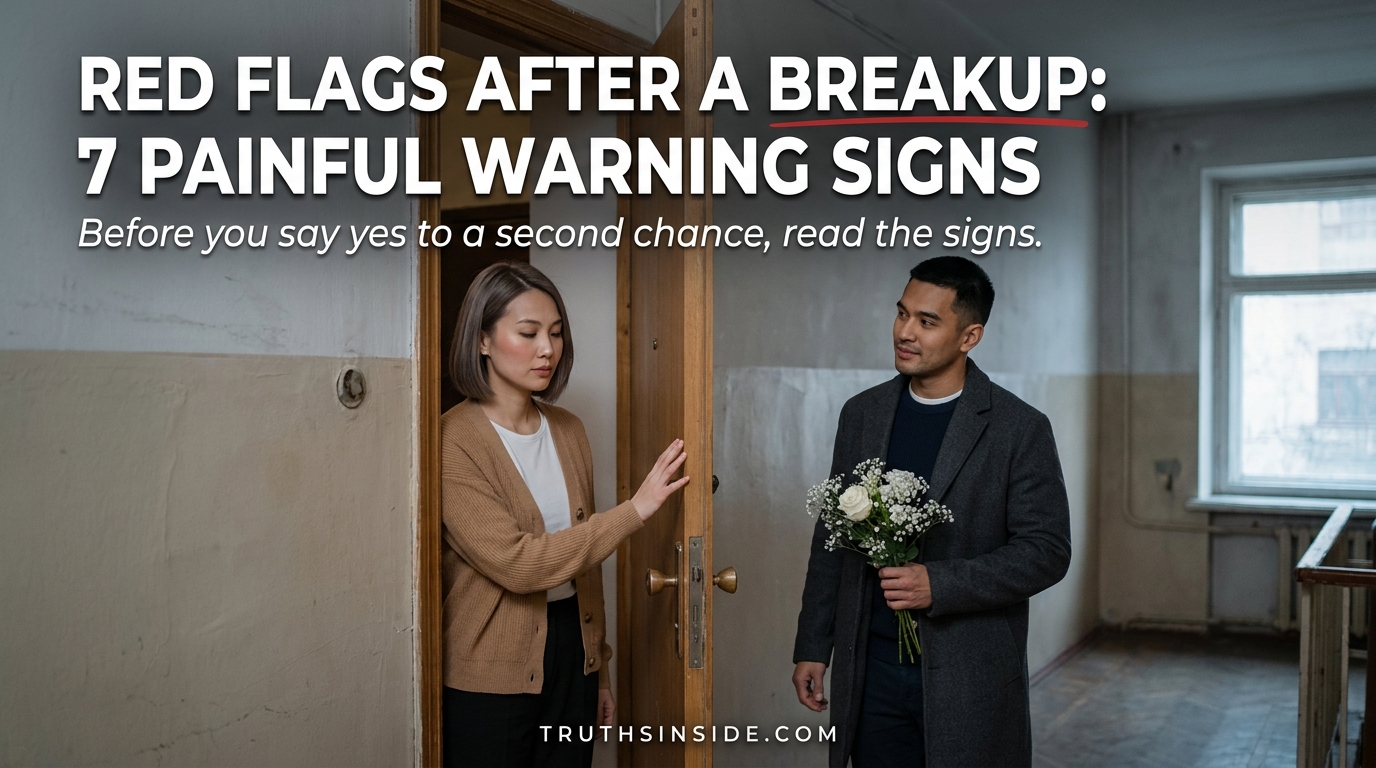
Red Flags After a Breakup: Signs Getting Back Together Will Be a Mistake
Red flags after a breakup are easy to miss when your heart is aching and your ex suddenly seems willing to change. A late-night text, a heartfelt apology, a flood of good memories, and the question arrives: what if we try again? Research on on-again, off-again couples by Rene Dailey and colleagues suggests that this cycle is common, and that partners who repeatedly break up and reunite tend to report more uncertainty and lower relationship quality.
If you are in that tender, confusing place, you are not foolish. You miss them. The quiet feels heavy. Part of you believes they have finally understood what went wrong. Second chances can work, particularly when real change has happened. The challenge is telling the difference between genuine change and a hopeful performance, and that is exactly where red flags after a breakup become useful.
In this guide, you will learn why reunions are so tempting, which red flags after a breakup matter most, and seven warning signs that getting back together may repeat the same pain. You will also see what real change looks like, how to test a possible reunion, and how to protect your healing if the answer is no. Read it as a map, not a verdict.
“A second chance should be built on changed behavior, not renewed longing.”
Why Getting Back Together Feels So Tempting
Heartbreak is not only emotional. In a brain-imaging study, anthropologist Helen Fisher and colleagues scanned people who had recently been rejected in love and found activity in regions linked to reward, craving, and attachment. In plain terms, wanting your ex can feel like wanting something your brain has learned to depend on. That pull is real, but it is not proof that reuniting is wise.
Memory adds its own bias. Psychologists describe rosy retrospection, the tendency to remember past events more positively than we experienced them. After a breakup, the arguments blur and the best weekends glow. Add loneliness, shared friends, and the effort you already invested, and going back can feel safer than moving on, even when the original problems are still there. This is why noticing red flags after a breakup early matters so much.
The Sunk-Cost Pull
The longer you were together, the harder it feels to walk away from the investment. Years, memories, and plans all seem like reasons to try again. But time spent is not a reason to spend more. When you weigh a reunion, ask what the relationship will be like going forward, not how much you have already put in. Learning to spot red flags after a breakup helps you separate attachment from evidence.
📃 Related article: Red Flags During Conflict: 7 Dangerous Signs
What Research Says About On-Again, Off-Again Relationships
Studies of relationship cycling, including work by Rene Dailey, Amber Vennum, and their colleagues, suggest that on-again, off-again relationships are common among adults, not just teenagers. Cyclical couples often describe more uncertainty about the relationship’s future and more conflict over unresolved issues. That does not mean every reunion fails. It means the reasons you separated deserve serious weight.
Many relationship therapists observe that reunions fare better when the breakup came from circumstances, such as distance or bad timing, and worse when it came from patterns, such as disrespect, dishonesty, or poor communication. Patterns do not disappear because two people miss each other. They change only when someone does something different, consistently, for long enough to be trusted. That is why red flags after a breakup should be weighed against the reasons you separated, not against how much you miss them.

7 Red Flags After a Breakup That Getting Back Together Will Be a Mistake
None of these signs automatically means you must walk away, but each one deserves honesty. The more of them you see, and the longer they last, the stronger the warning. Read them as questions, not verdicts, and notice what you feel in your body as you read.
Red Flag 1: The Reason You Broke Up Has Not Changed
The most important of all red flags after a breakup is simple: the core problem is still there. If you separated because of dishonesty, disrespect, infidelity, or unmet needs, and nothing concrete is different, a reunion will likely bring you back to the same place. Love was never the missing ingredient. Behavior was. Ask yourself what, specifically, has changed, and whether you can point to evidence rather than promises.
Feelings of missing someone are not evidence of change. Neither is a sincere tone of voice. Evidence is a new habit, a new boundary respected, or a new skill practiced over months, whether that is attending therapy, ending a pattern of lying, or learning to communicate without contempt.
Red Flag 2: They Apologize With Words but Not With Actions
A real apology names what happened, acknowledges the harm, and is followed by changed behavior. A hollow one is vague (“I’m sorry for everything”), conditional (“I’m sorry if you felt hurt”), or quickly turns into a request (“so can we try again?”). Watch for apologies that focus on how bad your ex feels rather than on how you felt.
Words are cheap right after a breakup because emotions are high and the stakes feel urgent. The better test is time. Does the apology stay consistent when the pressure is off, and does it come with action you can see? Inconsistency here is one of the quieter red flags after a breakup.
Red Flag 3: They Return Only When It Suits Them
Some exes reappear at predictable moments: when they are lonely, when a new relationship ends, when you post a happy photo, or when you finally stop responding. Their interest follows their own needs rather than a sincere wish to rebuild. Among red flags after a breakup, this one often feels flattering at first, because being wanted is comforting.
Ask what triggered the message. If they come back whenever you start to heal, and fade when you respond warmly, you may be serving as a safety net, not a partner. Genuine interest shows up steadily, with respect for your pace, rather than in bursts.
Red Flag 4: Love Bombing and Pressure to Decide Fast
Grand gestures, intense promises, and urgent deadlines can feel like proof of devotion. Counselors often call a flood of affection used to regain access love bombing. It may include surprise visits, dramatic declarations, and statements like “I can’t live without you” or “if you don’t answer now, I’m done.” Intensity is not the same as commitment.
Healthy reconciliation is calm. It allows you time to think, respects your boundaries, and welcomes your questions. Among the red flags after a breakup, pressure is especially telling, because someone who cares about your long-term wellbeing does not need you to decide before you feel ready.

Red Flag 5: They Blame You or Rewrite the Story
Listen to how your ex describes the breakup. If every account makes you the villain, or minimizes their own part, they have not done the self-reflection that change requires. You may hear “You pushed me away,” “You were too sensitive,” or “It wasn’t that bad.” Rewriting history is one of the clearest red flags after a breakup, because it removes any reason for them to change.
Responsibility sounds different. It says, “Here is what I did, here is how it affected you, and here is what I am doing about it.” Without that, reconciliation tends to mean you carry the burden of making the relationship work, again.
Red Flag 6: The Old Cycle Starts Within Days
Reunions often begin with a honeymoon. Then, slowly or quickly, the same arguments, silences, or disappointments return. If the first week back already feels like the last month before the breakup, treat that as information. Old patterns are powerful, and good intentions rarely defeat them without new skills and honest effort from both people.
Track the reality, not the promise. Notice whether the first conflict after the reunion is handled differently than before. If it is handled the same way, the relationship may be repeating its loop, which is one of the more reliable red flags after a breakup that a second attempt will end in a second breakup.
Red Flag 7: Your Body Tells You It Is Not Safe
Pay attention to how you feel around your ex. A tight chest, dread when your phone lights up, walking on eggshells, shrinking your opinions, relief when plans fall through: these are signals. Your body often registers danger or disrespect before your mind finishes making excuses. Calm, steady relief after seeing them is a good sign. Chronic anxiety is not.
Of all the red flags after a breakup, a body that feels unsafe deserves the most respect. This matters most when the relationship involved control, intimidation, or fear. If that describes your past, please read the safety section below. Missing someone and being safe with them are separate questions, and safety comes first.
“If going back feels like holding your breath, listen to that.”
Digital Red Flags After a Breakup: Texts, Breadcrumbs, and Mixed Signals
Modern breakups continue on screens, so many red flags after a breakup now arrive as texts and likes. Late-night “thinking of you” messages, likes on old photos, and vague “we should talk sometime” texts can keep you hovering in uncertainty. Breadcrumbing means giving just enough attention to keep you interested without offering real commitment. If your ex keeps one foot in the door while dating others, or never proposes an actual plan, you are being kept on the line.
Consider how they respond to a clear boundary, such as “I’m taking time to heal, so please don’t contact me for a while.” Someone who respects that is showing care. Someone who ignores it, tests it, or punishes you for it adds another entry to your list of red flags after a breakup.
What Real Change Looks Like When Red Flags After a Breakup Fade
To balance all this, it helps to know what genuine change looks like, because it does exist. It is consistent over months, not days. It shows up in behavior you can observe. Your ex can describe the specific pattern they are working on, accepts consequences without defensiveness, and does not ask you to carry the effort. They respect your boundaries, including your pace and your no.
Often, real change comes with outside support, such as therapy, honest conversations with trusted friends, or counseling as a couple. It also includes a shared plan: what will we do differently when the old problem appears? Couples who reunite successfully tend to have new agreements, not just renewed feelings.
Notice that real change is the mirror image of the red flags after a breakup described above: responsibility instead of blame, patience instead of pressure, and consistency instead of bursts of attention.
When Red Flags After a Breakup Are a Safety Concern
Some red flags after a breakup are safety issues, not relationship problems. If your past relationship involved intimidation, threats, stalking, control, or physical harm, reconciliation carries real risk. Advocates note that the period around separation can be one of heightened danger, and promises to change do not remove that risk. Please talk with a trained advocate before making any decision. In the United States, the National Domestic Violence Hotline offers free, round-the-clock support at 1-800-799-7233, and you can text START to 88788. If you are in immediate danger, call 911.
How to Decide When You See Red Flags After a Breakup
You do not have to decide today. These five steps help you slow down and look at the evidence with clear eyes.
Step 1: Give Yourself Real Space
Decisions made in the first rush of loneliness are rarely your best. Give yourself time, often weeks to months, with limited or no contact, so that grief can settle and you can think. Notice who you are when you are not waiting for a reply.
Step 2: List the Reasons You Broke Up
Write down every reason, honestly. Next to each, note what has concretely changed. If most lines read “nothing yet” or “they say they will,” you have your answer for now. This list turns vague hope into something you can examine, and it keeps red flags after a breakup from fading in the glow of nostalgia.
Step 3: Ask Someone You Trust
Friends, family, or a therapist can notice patterns you may be too close to see. Tell them the whole story, including the parts that are hard to admit. A trusted outsider can help you name red flags after a breakup that you have been explaining away.
Step 4: Set Conditions and Watch the Response
If you are considering reconciling, state clear conditions: counseling, honesty, a slower pace, specific changes. Watch how your ex responds. Welcoming structure is a sign of seriousness. Resistance or irritation is another of the red flags after a breakup.
Step 5: If the Answer Is No, Protect Your Healing
Mute or unfollow, delete late-night message threads, lean on friends, and fill the empty hours with things that restore you. Missing them will arrive in waves, and each wave you ride out without reaching back weakens its grip. Choosing yourself is not a failure of love. It is a decision to wait for love that feels safe.

A Quick Self-Check for Red Flags After a Breakup
Answer honestly, and consider sharing your answers with someone you trust.
- Can I name specific, observable changes, not just promises?
- Do I feel calm or anxious when they contact me?
- Do they respect my pace and my boundaries?
- Do they take responsibility without blaming me?
- Am I considering this because I miss them, or because I trust them?
- Would I give this advice to a friend in my situation?
If most answers are reassuring, a reunion may deserve a careful, slow try. If several are no, you are seeing red flags after a breakup in your own answers. Treat that as meaningful information, not a failure of nerve.
📃 Related article: Spiritual Bypassing: 9 Painful Red Flags to Spot
Frequently Asked Questions
What are the biggest red flags after a breakup?
The biggest red flags after a breakup include unchanged core problems, apologies without changed behavior, pressure to decide quickly, blame and rewritten history, love bombing, contact only when it suits them, and feeling anxious or unsafe around your ex. Patterns matter more than any single moment.
How do I know if my ex has really changed?
Look for consistent, observable behavior over months: specific responsibility, respect for your boundaries, willingness to get help, and a different response when old problems appear. Promises and emotional speeches are not proof on their own. Time and actions are. Genuine change is the opposite of the red flags after a breakup described above.
Is it ever a good idea to get back with an ex?
Sometimes, yes. Reunions can work when the breakup came from circumstances, when both people have done real work on the patterns that hurt the relationship, and when red flags after a breakup are absent. A good reunion is slow, honest, and built on new agreements. If safety was ever a concern, speak with an advocate first.
Why do I keep going back to my ex?
Familiarity, loneliness, nostalgia, attachment, and fear of starting over all pull people back. Your brain also learns to crave a former partner much as it craves other rewards. Understanding these forces, and noticing red flags after a breakup, can help you choose deliberately instead of reacting.
How do I stop wanting my ex back?
Limit contact, mute or unfollow reminders, build routines and friendships that nourish you, and let grief move through you instead of fighting it. Therapy can help, especially if the relationship was painful. The longing usually softens with time, distance, and care for yourself.
Final Thoughts
Wanting a second chance does not make you naive, and noticing red flags after a breakup does not make you cynical. It makes you someone who values their own peace. The right reunion, if there is one, can survive questions, time, and clear conditions. If it cannot, the answer is already telling you something. Trust the evidence, be gentle with your heart, and choose the love that lets you exhale.
Found this helpful? Save this article for the night you are tempted to reply, share it with a friend who is standing at the same crossroads, and follow Truthsinside.com for more honest relationship insights every week.
🎵 Music
Maren Lull is a singer-songwriter who writes from the places most people don’t talk about out loud.
Not the dramatic grief. Not the obvious heartbreak. The quiet kind — the ordinary Tuesday emptiness, the habit of reaching for someone who isn’t there anymore, the particular exhaustion of being strong for so long that the strength itself wears thin.
Her music lives at the intersection of emotional honesty and soft beauty — breathy vocals over gentle piano, slow tempos, lyrics that feel less like songs and more like something you wrote in a private notebook at two in the morning and never showed anyone.
Maren Lull writes for the people who feel everything deeply and say very little about it. For the ones who listen to sad music not because they want to feel worse — but because being understood, even by a song, makes the feeling easier to carry.
📱 Follow Maren Lull:
→ Spotify
→ Apple Music
→ Youtube
→ Audiomack