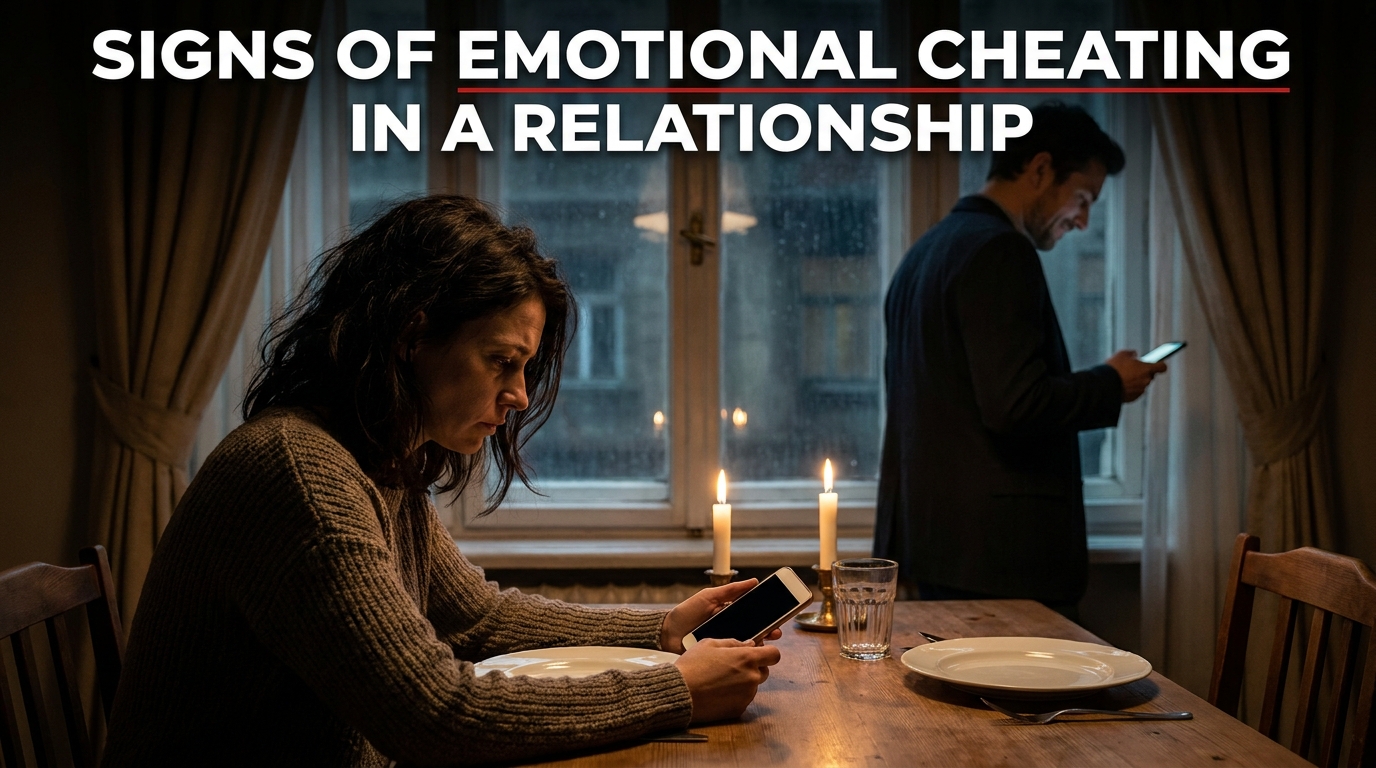
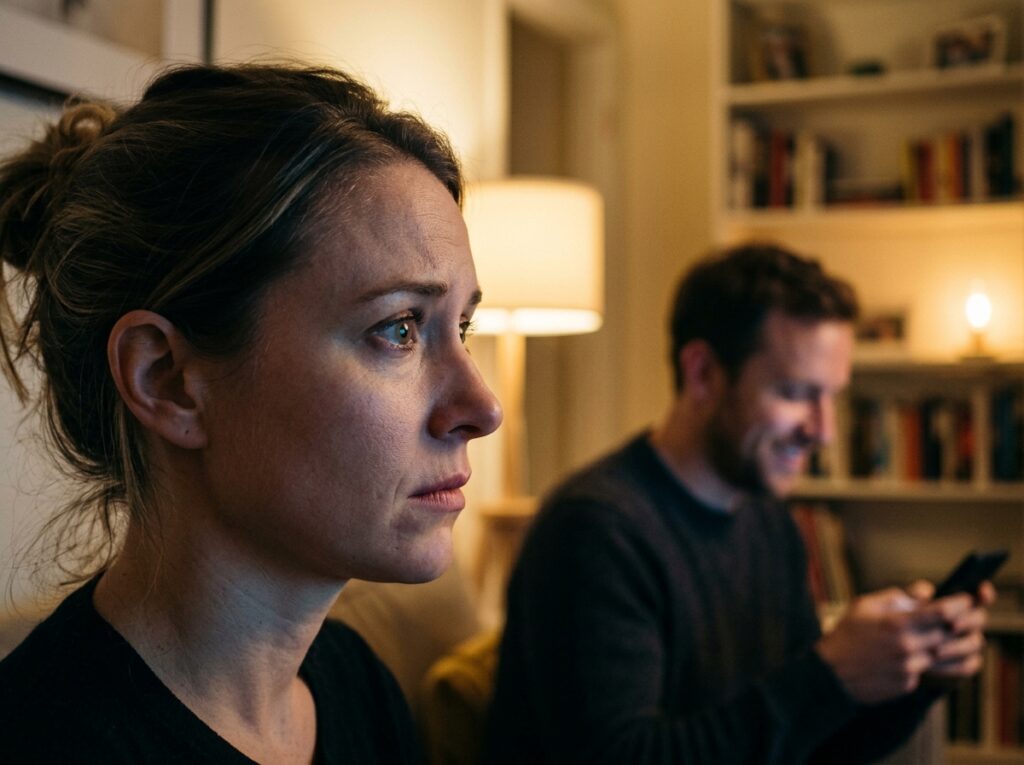
The signs of emotional cheating are not always visible. They do not leave lipstick on a collar or hotel receipts in a jacket pocket. They leave something far quieter and in many ways far more devastating — a feeling. A persistent, stomach-dropping sense that the person you love is somehow elsewhere, even when they are standing right beside you.
Emotional cheating is one of the most misunderstood and underacknowledged forms of relational betrayal in modern relationships. It does not require physical contact. It does not require a single lie that can be fact-checked. What it requires is the transfer of emotional intimacy — the vulnerability, the attention, the private inner world — from the primary relationship to someone else.
And that transfer, research shows, can be just as damaging as a physical affair — sometimes more so.
A study published in the Journal of Sex and Marital Therapy found that women rated emotional infidelity as more distressing than sexual infidelity, and that both men and women reported significant psychological trauma — including symptoms consistent with post-traumatic stress — following the discovery of a partner’s emotional affair. The pain is real. The damage is documented. And the signs, once you know what to look for, are unmistakable.
This article is about learning to see them clearly.

What Is Emotional Cheating?
Before identifying the signs of emotional cheating, it is essential to define what emotional cheating actually is — because it exists on a spectrum, and the line between a deep friendship and an emotional affair is one that matters enormously.
Emotional cheating — also called emotional infidelity or an emotional affair — occurs when a person in a committed relationship develops a deep emotional bond with someone outside that relationship that crosses the boundaries of friendship and begins to fulfill the emotional and intimacy needs that should be met within the primary relationship.
The defining characteristics are not the feelings themselves — people can have deep, genuine, entirely appropriate connections outside their romantic relationships. The defining characteristics are the secrecy, the prioritization, and the substitution.
Secrecy: the connection is deliberately hidden from the primary partner, or its true nature is minimized and misrepresented.
Prioritization: the outside connection receives emotional energy, time, and attention that the primary partner is being quietly deprived of.
Substitution: the emotional needs — for understanding, for excitement, for feeling seen and valued — that are not being sought or found in the primary relationship are being sought and found in the outside connection instead.
When all three of these elements are present, what exists is not a close friendship. It is an emotional affair. And the person on the receiving end of the substitution — the partner left behind in the primary relationship — often senses it long before they can name it.
Why Emotional Cheating Is So Difficult to Recognize
One of the most psychologically complex aspects of emotional cheating is how effectively it conceals itself — both from outside observers and, critically, from the person engaging in it.
Unlike physical infidelity, which has clear, definable boundaries, emotional cheating exists in a gray zone that is easy to rationalize. “We are just friends.” “Nothing physical has happened.” “I am allowed to have close friendships.” These rationalizations are not always dishonest in the literal sense — but they are frequently incomplete.
The person engaged in an emotional affair is often the last to recognize it for what it is. Because they are not crossing the lines they consciously think of as lines, they genuinely believe they are not doing anything wrong. The intimacy deepens gradually, the secrecy increases incrementally, and the emotional substitution happens so slowly that by the time it is fully established, it has become normalized.
For the partner being betrayed, the experience is equally disorienting. There is nothing concrete to point to. The person they love has not technically lied — or has lied only by omission. The behavior that triggers their intuition is subtle: a phone guarded too carefully, a name mentioned too casually, a quality of emotional absence that has no visible cause.
This gap between what is felt and what can be proven is one of the most psychologically destabilizing aspects of being in a relationship where emotional cheating is occurring. It produces self-doubt, anxiety, and a gradual erosion of confidence in one’s own perception — which is why naming the signs clearly and specifically matters so much.
“Emotional cheating does not begin with a decision to betray someone. It begins with a decision to keep a connection private — and everything that follows from that first small secrecy.”

14 Unmistakable Signs of Emotional Cheating
These signs are not presented as proof of emotional cheating in isolation — context always matters. But when multiple signs appear together in a sustained pattern, they deserve to be taken seriously, examined honestly, and addressed directly.
1. They Guard Their Phone With Unusual Intensity
Everyone is entitled to privacy. But there is a meaningful difference between reasonable personal privacy and the specific, anxious guardedness of someone who has something to hide. If your partner has recently begun placing their phone face-down whenever you are near, taking calls in other rooms, immediately closing messages when you enter the space, changing passwords without explanation, or flinching visibly when you are near their screen — pay attention.
The phone is where emotional affairs live. Text threads, messaging apps, social media DMs — the intimate, private communication that defines an emotional affair almost always runs through a device. The intensity with which that device is guarded is often directly proportional to what it contains.
2. A Specific Person’s Name Appears Constantly — Then Disappears Entirely
There is a recognizable arc in how a person involved in an emotional affair manages references to the other person. In the early stages, the name may appear frequently and casually — enthusiastically, even — as the person tries to normalize the connection in the relationship’s social landscape.
Then, as they become aware that the connection has crossed into something more significant, the name either disappears entirely or becomes conspicuously absent. Questions about how that person is doing are deflected. The name that was once mentioned constantly becomes a name that is never mentioned at all. That disappearance is itself a signal — things that are genuinely innocent do not need to be hidden.
3. They Are Emotionally Absent From the Relationship
Emotional presence — genuine engagement, curiosity about your inner world, responsive attunement to your emotional state — is one of the foundational requirements of a healthy romantic relationship. When it fades, the relationship feels hollow in a way that is difficult to articulate but impossible to ignore.
A partner engaged in an emotional affair is directing their emotional energy elsewhere. The attentiveness, the interest, the quality of presence that once characterized their engagement with you becomes directed at someone else. What you receive instead is the performance of presence — the physical proximity without the genuine engagement that makes proximity feel like connection.
4. They Become Defensive When You Ask About the Other Person
Defensiveness, in the context of relationship psychology, is almost always a response to perceived threat. When a direct, reasonable question about another person — “How is your friendship with [name] going?” or “You two have been talking a lot lately — what do you connect about?” — is met with disproportionate defensiveness, irritation, or accusations that you are being paranoid or controlling, that response is itself information.
Innocent connections do not require defensive protection. The intensity of the defense is often a direct measure of the significance of what is being defended.
5. They Share Relationship Problems With the Other Person Instead of With You
In a healthy relationship, the primary relationship is where significant emotional processing happens — where fears are shared, frustrations are expressed, and vulnerabilities are offered in the knowledge that they will be received with care.
In an emotional affair, this processing shifts. Your partner begins to share their relationship dissatisfactions, their personal struggles, their most vulnerable emotional content with the other person rather than with you — or in addition to you, in ways they actively keep from you. The other person becomes their emotional confidant in the space that was yours.
This is one of the most significant signs of emotional cheating because it represents exactly the substitution that defines an emotional affair: the primary relationship’s emotional function being fulfilled outside it.
6. They Become Critical of You in New and Specific Ways
A subtle but telling sign of emotional cheating is a shift in how your partner perceives and relates to you — specifically, the emergence of new criticisms that often reflect unfavorable comparisons, even if those comparisons are never stated explicitly.
When a person has developed an idealized emotional connection with someone else, the contrast between that idealized connection and the ordinary, imperfect reality of a long-term relationship can make the real relationship feel inadequate. You may find your partner suddenly critical of things that were never issues before — your sense of humor, your ambitions, your habits, your appearance. These criticisms often reflect not an actual decline in your qualities but a shift in your partner’s internal comparative framework.
7. They Light Up Differently Around or About This Person
Human emotional response is difficult to fully mask. A person who has developed a significant emotional connection with someone else will typically show it — in the way their energy shifts when that person’s name comes up, in the quality of attention they give to their phone during what you can now guess is communication with that person, in the specific brightness that appears in their affect around or about this individual.
This is not the warmth of someone describing a valued friend. It is a qualitatively different quality of aliveness — something your nervous system will register before your conscious mind has identified it. Trust that registration.
8. Your Relationship’s Emotional and Physical Intimacy Has Declined Simultaneously
The withdrawal of emotional energy from a primary relationship in favor of an outside connection almost always manifests in multiple dimensions simultaneously. Both emotional and physical intimacy decline — because both are expressions of the same underlying emotional investment, and that investment has been redirected.
If you have noticed a simultaneous reduction in genuine emotional connection and physical intimacy — and particularly if this has occurred alongside the emergence or deepening of a specific outside connection — that simultaneous decline is significant.
9. They Are Dishonest About the Amount of Contact They Have With This Person
Minimizing and misrepresenting the nature and frequency of contact with the other person is one of the behavioral signatures of emotional cheating. “We only talk occasionally” when the phone record tells a different story. “It was just a work thing” when the conversation you accidentally glimpsed was intensely personal. The active effort to manage your perception of the connection’s significance is itself evidence of the significance being managed.
10. They Defend the Other Person With Disproportionate Loyalty
If you express concern or discomfort about the outside connection and your partner responds by defending the other person with a passion and loyalty that feels dissonant — more intensely than the situation seems to warrant — pay attention to that disproportionality.
Defending a friend from a partner’s unfair criticism is reasonable. Defending the other person’s character, motivations, and relationship with your partner with the specific heat of someone whose own emotional investment is being questioned is a different thing entirely.
11. They Seem Happier — But Not Because of You or Your Relationship
One of the most quietly painful signs of emotional cheating is watching your partner become visibly happier, more energized, and more emotionally alive — and realizing that the source of that happiness has nothing to do with you or with anything happening in your relationship.
The emotional infusion of a new connection — the dopamine of novelty, the oxytocin of new intimacy, the serotonin of feeling seen and valued by someone new — can genuinely make a person more emotionally vibrant. If that vibrancy disappears when the phone is put away and returns when it lights up again, the source is visible even when its content is hidden.
12. Important Relationship Milestones or Conversations Are Avoided
A partner engaged in an emotional affair often becomes avoidant of conversations or commitments that would deepen or solidify the primary relationship. Discussions about the future, about moving in together, about long-term plans — these become uncomfortable, deflected, or actively avoided.
This avoidance is not always conscious. But it reflects a genuine internal conflict: the emotional investment that would normally drive enthusiasm for the relationship’s future has been divided, and the part of it that is elsewhere makes genuine forward movement in the primary relationship feel complicated or even impossible.
13. They Bring Up the Other Person’s Opinions and Perspectives Frequently
When a significant emotional connection forms, the other person’s perspective begins to carry disproportionate weight. You may notice your partner frequently referencing what this other person thinks, believes, or recommends — in ways that reveal an ongoing, intimate, substantive conversation happening between them that goes well beyond casual acquaintance.
“[Name] actually said something really interesting about that.” “[Name] and I were talking about exactly this the other day.” The frequency and intimacy of these references reveal the depth of the emotional investment they are meant to normalize.
14. Your Gut Has Been Sending You the Same Message Repeatedly
The human nervous system is an extraordinarily sensitive social instrument. It detects changes in a partner’s emotional availability, attention, and energy long before the conscious mind has assembled the evidence into a coherent narrative. The persistent, recurring sense that something is wrong — even when you cannot identify exactly what — is not paranoia. It is your nervous system accurately reading a pattern.
The fact that you cannot prove it yet does not make it wrong. The fact that your partner denies it does not make it wrong. Your gut is pattern recognition built from thousands of hours of intimate knowledge of another person. When it sends the same message repeatedly, that message deserves to be taken seriously.
The Difference Between a Close Friendship and an Emotional Affair
Because this distinction matters enormously — both for accuracy and for fairness — it deserves clear, honest examination.
Not every close friendship outside a relationship is an emotional affair. Human beings need connection beyond their romantic partnerships, and healthy relationships are not designed to be entirely self-contained. Deep, meaningful friendships are not only acceptable — they are important for individual and relational health.
The difference between a close friendship and an emotional affair is not the depth of feeling. It is the architecture of secrecy, substitution, and prioritization.
A genuine friendship is one your partner knows about, is comfortable with, and does not feel threatened by — not because they have been conditioned to accept it but because the friendship genuinely does not encroach on the primary relationship’s emotional territory.
A genuine friendship does not involve sharing relationship dissatisfactions and vulnerabilities with the friend that are being withheld from the partner. It does not involve a private emotional world that is actively hidden. It does not make the primary partner feel like an outsider in their own relationship.
When those elements are present — the secrecy, the substitution, the emotional prioritization — the friendship has crossed into something that, regardless of what it is called, functions as an emotional affair. The label matters less than the impact. And the impact on the primary partner is the most reliable measure of where the line has been crossed.
“The question is not whether they have feelings for someone else. The question is whether those feelings are being protected from you — and what is being taken from your relationship to feed them.”

How Emotional Cheating Damages a Relationship
The damage caused by emotional cheating is not hypothetical or abstract. It is specific, documented, and in many cases, long-lasting.
The Destruction of Emotional Safety
The most fundamental damage of emotional cheating is what it does to the emotional safety of the primary relationship. Emotional safety — the confidence that your partner is emotionally present, honest, and genuinely available to you — is the foundation on which all relational intimacy rests.
When emotional cheating is discovered or even sensed, that safety collapses. The partner who was betrayed begins to question everything: the conversations they were not part of, the emotional unavailability they interpreted as stress or busyness, the quality of connection they thought they shared. The past is retroactively reinterpreted through the lens of the betrayal, and very little of it survives the reinterpretation unchanged.
The Gaslighting Dynamic
Because emotional cheating is so difficult to prove and so easy to deny, the partner raising concerns is frequently told they are paranoid, insecure, controlling, or imagining things. This systematic denial of the betrayed partner’s accurate perception is a form of gaslighting — and it compounds the original harm enormously.
Being told, repeatedly, that what you are accurately perceiving is not real causes a specific and serious form of psychological harm: the erosion of trust in your own perception of reality. The betrayed partner may ultimately doubt their own instincts, apologize for raising legitimate concerns, and become more anxious and emotionally destabilized as a direct result of having their accurate perception denied.
The Intimacy Deficit
Because emotional cheating redirects intimacy — both emotional and often eventually physical — from the primary relationship, the partner being betrayed experiences a progressive intimacy deficit without understanding its cause. They reach for connection and find distance. They initiate vulnerability and receive distraction. They feel lonely inside a relationship with someone they love — and cannot understand why.
That specific loneliness — the loneliness of being with someone who is emotionally somewhere else — is one of the most painful human experiences. And it is, in the context of emotional cheating, being inflicted deliberately or negligently by someone who chose to be there.
The Long-Term Trust Damage
Even when a relationship survives the discovery of emotional cheating — through honest confrontation, therapeutic support, and genuine recommitment — the trust that was damaged does not automatically restore itself. Rebuilding trust after emotional infidelity is a long, nonlinear process that requires consistent, demonstrated behavioral change over an extended period of time.
Research from the Journal of Family Psychology found that couples who successfully rebuilt trust after emotional infidelity reported that the process took an average of two to four years — and required sustained therapeutic support, complete transparency going forward, and the betraying partner’s genuine accountability for the harm caused.
What to Do If You Recognize These Signs
Recognizing the signs of emotional cheating in your relationship is not the end of the road. It is the beginning of a process that — however painful — leads somewhere more honest than where you currently are.
Have the Conversation
Avoiding the confrontation because you fear the answer keeps you in a state of chronic uncertainty that is itself deeply harmful. Prepare yourself emotionally. Choose a calm, private moment. Speak from your own experience rather than leading with accusations: “I have noticed some things that have made me feel disconnected from you, and I need to talk about them honestly.”
The response you receive — the openness, the defensiveness, the honesty or the denial — will itself be important information.
Trust Your Perception
You have the right to take your own instincts seriously. You do not need proof that would hold up in a courtroom to raise a concern about something that is affecting your emotional experience of your relationship. Your feelings are data. Your observations are valid. You are allowed to name what you see.
Seek Professional Support
Whether individually or as a couple, a therapist can provide the structure, safety, and professional guidance that this kind of conversation genuinely requires. Emotionally Focused Therapy has a strong evidence base for helping couples navigate infidelity — including emotional infidelity — and rebuild genuine connection where both partners are committed to doing so.
Define Your Own Boundaries
Only you can determine what is acceptable to you in a relationship. What constitutes emotional cheating for you — where your personal boundary is — is something worth knowing and articulating clearly, both to yourself and to your partner. Relationships require explicit conversation about boundaries far more than most people are taught to expect.
Take Care of Yourself First
Regardless of what your partner chooses to do with the truth you have named, your first responsibility is to your own emotional and psychological wellbeing. Whether the path forward involves working through this together or making the decision to leave, do that from a place of genuine self-respect and clarity — not from fear, not from shame, and not from the distorted self-perception that emotional gaslighting tends to leave behind.

You Deserve Full Presence, Not a Divided Heart
Here is what all of this comes down to — the truth beneath every sign, every pattern, every quietly devastating experience this article has described:
You deserve a partner whose emotional world is genuinely, openly, fully present in your relationship. Not a partner who reserves their most intimate self for someone else and offers you the remainder. Not a partner who lights up for someone else and saves their emotional exhaust for you.
You deserve full presence. Consistent, honest, chosen presence — the kind that does not have to be monitored or suspected or decoded.
The signs of emotional cheating are painful to recognize. But recognizing them is not the worst thing that can happen to you in a relationship. Living indefinitely in a relationship where your emotional reality is being denied — where your instincts are being called paranoia, where you are reaching for a connection that is being quietly given to someone else — that is what costs you the most.
Seeing clearly is the beginning of everything. It is the beginning of an honest conversation. The beginning of a real decision. The beginning of reclaiming the relationship you deserve — either by rebuilding what was broken with someone who is genuinely willing, or by choosing yourself and walking toward the love that will not require you to compete for a piece of a heart that should have been entirely yours.
You are not asking for too much. You are asking for what love is supposed to be.
Frequently Asked Questions
Q1: Can emotional cheating occur without the person realizing they are doing it?
Yes — and this is one of the most psychologically important aspects of emotional infidelity. Because the line between a deep friendship and an emotional affair is not always clearly defined in popular culture, many people cross it gradually and unconsciously, rationalizing each incremental step. The person may genuinely not identify their behavior as cheating — because no physical contact has occurred and because the emotional connection felt innocent at its origin. However, unconscious origin does not reduce the harm caused to the primary partner, and it does not exempt the person from accountability for the patterns they have allowed to develop.
Q2: Is emotional cheating as serious as physical cheating?
Research consistently indicates that emotional infidelity is experienced as equally or more seriously damaging than physical infidelity by a significant proportion of people — particularly those who prioritize emotional intimacy as the core of their relationship. The relative severity is ultimately a personal determination, shaped by individual values and relationship agreements. What the research is unambiguous about is that emotional infidelity causes real, significant, and lasting psychological harm — and deserves to be taken as seriously as any other form of relational betrayal.
Q3: What should I do if my partner denies the emotional affair despite clear signs?
Denial is one of the most common responses to confrontation about emotional cheating. If your partner denies what you are observing despite a consistent pattern of signs, you face a choice: accept the denial and continue in the relationship as it currently exists, insist on couples therapy as a condition of staying, or make decisions about the relationship based on the pattern of behavior you have observed rather than on the explanation being offered for it. You do not require your partner’s admission to validate your experience. Your perception and your needs are real regardless of whether they are acknowledged.
Q4: Can a relationship recover from emotional cheating?
Yes — but recovery requires specific conditions. The person who engaged in the emotional affair must take genuine, undefensive accountability for the harm caused, end all inappropriate contact with the other person completely and transparently, and commit to sustained therapeutic work individually and as a couple. The betrayed partner must be willing to engage with the healing process without indefinitely weaponizing the betrayal. And both people must genuinely want the relationship to continue — not out of obligation or fear, but out of authentic recommitment. Where all of these conditions are met and consistently sustained, recovery is genuinely possible.
Q5: How do I know if my own close friendship has crossed into emotional cheating territory?
The most honest test involves three questions. First: Is this connection something you openly share with your partner, or something you minimize, conceal, or misrepresent? Second: Are you sharing emotional content — relationship frustrations, personal vulnerabilities, intimate feelings — with this person that you are not sharing with your partner? Third: Does this connection fulfill emotional needs that your primary relationship is not meeting — and have you chosen to seek those needs there rather than addressing them in your relationship? If your honest answers to any of these questions trouble you, the friendship may have crossed into territory that deserves honest examination — and possibly an honest conversation with your partner.
Save This. Share This. Follow For More.
💾 Save this article — because these signs are worth knowing before you need them, and worth returning to when something in your relationship does not feel quite right.
📤 Share this with someone who has been told their instincts are paranoia. You might give them the validation and clarity that changes everything.
👉 Follow Truthsinside.com for more honest, research-backed content on relationship signs, emotional health, psychology, and the truths about love that deserve to be said out loud.
📃 Related article: Signs He Likes You But Is Scared: 18 Behaviors Men Show When Afraid to Commit
Because you deserve a relationship where you never have to wonder if you have all of someone’s heart.
🎵 Music
Maren Lull is a singer-songwriter who writes from the places most people don’t talk about out loud.
Not the dramatic grief. Not the obvious heartbreak. The quiet kind — the ordinary Tuesday emptiness, the habit of reaching for someone who isn’t there anymore, the particular exhaustion of being strong for so long that the strength itself wears thin.
Her music lives at the intersection of emotional honesty and soft beauty — breathy vocals over gentle piano, slow tempos, lyrics that feel less like songs and more like something you wrote in a private notebook at two in the morning and never showed anyone.
Maren Lull writes for the people who feel everything deeply and say very little about it. For the ones who listen to sad music not because they want to feel worse — but because being understood, even by a song, makes the feeling easier to carry.
📱 Follow Maren Lull:
→ Spotify
→ Apple Music
→ Youtube
→ Audiomack