
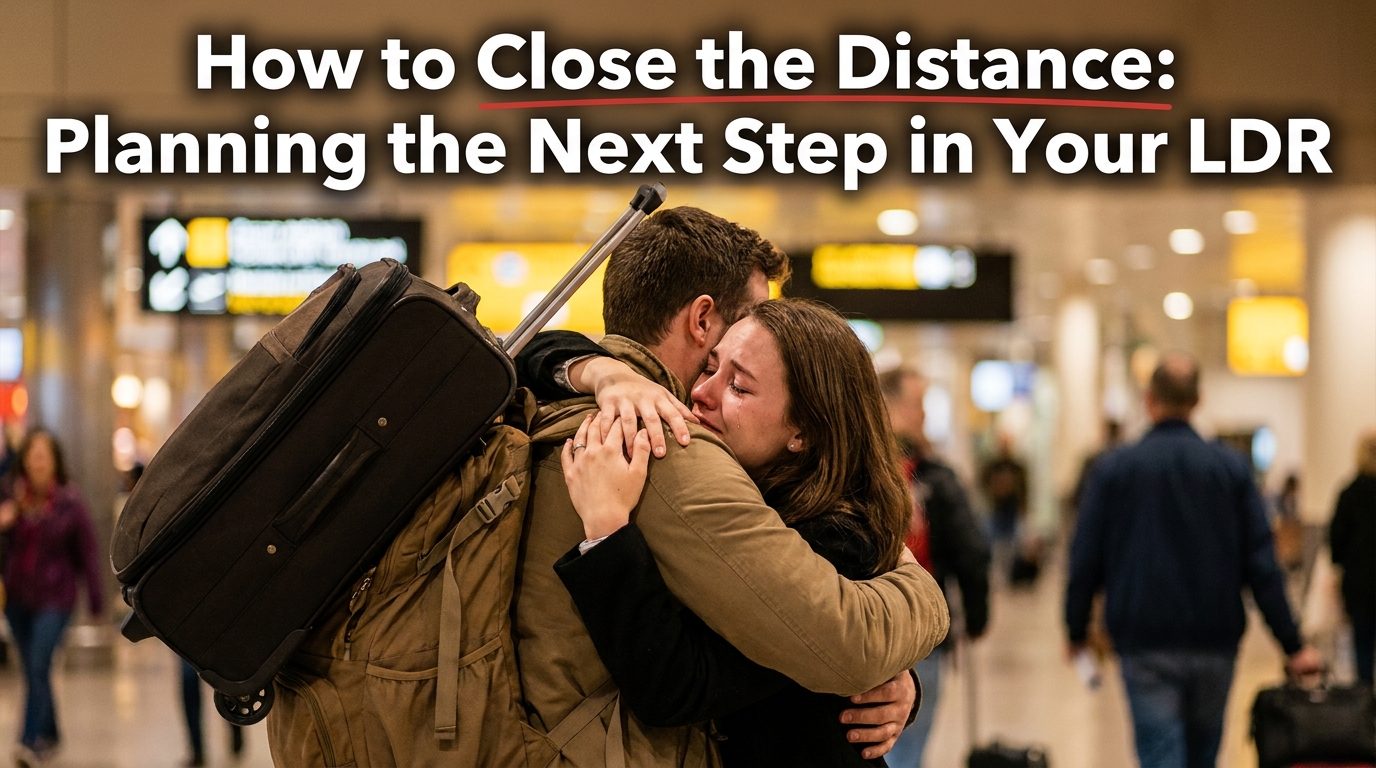
Closing the distance in your LDR is not just a logistical decision — it is one of the most emotionally significant transitions a couple can make. And for most long-distance couples, it is simultaneously the thing they want most and the thing they feel least prepared to actually plan.
You have survived the missing. The late-night calls across time zones. The airport goodbyes that never get easier. The countdown timers and the care packages and the way certain songs became unbearable because they belonged to the person who was not there.
You have done all of that. And now you are standing at the edge of something different — the possibility of the distance actually closing. Of the same city. The same street. The same morning.
Research from the Journal of Communication found that long-distance couples who had a clearly defined plan and timeline for closing the distance reported significantly higher relationship satisfaction and lower anxiety than those who were living in an open-ended, undefined long-distance situation. The plan itself — the existence of a concrete roadmap — functions as a stabilizing emotional anchor for both partners.
This article is that roadmap. Built not just from hope, but from the honest, specific, practical steps that actually move a long-distance relationship from the waiting room into real, shared life.

Before You Plan the Logistics: Have the Real Conversations First
The most common mistake long-distance couples make when beginning to close the distance is jumping straight to logistics — who moves, where, when — before having the deeper conversations that determine whether the logistics even make sense.
Closing the distance is not just about geography. It is about two people with separate lives, separate routines, separate support systems, and separate visions of what daily life looks like deciding to merge those lives into something shared. And that merging requires honest conversation about dimensions of life that long-distance relationships rarely test.
When you are long-distance, the relationship exists in a kind of protected emotional space. Visits are intentional and romanticized. Conflict is managed with more care because time together is precious. The ordinary friction of shared daily life — the disagreements about household habits, finances, social needs, alone time — has never been sustained over more than a visit.
Closing the distance means entering that ordinary, unromanticized daily life for the first time. And the couples who navigate that transition most successfully are the ones who talk honestly about what that life is going to look like before they are inside it.
These are the conversations that need to happen first.
The 7 Essential Conversations Before Closing the Distance
Conversation 1: Who Moves — And Why
This is the first and most practically significant question, and it is one that carries more emotional weight than it might appear to on the surface. The person who moves is the person who leaves — their city, their support network, their career connections, their familiar geography, perhaps their family.
That sacrifice is real, and it needs to be acknowledged as such — not minimized as “just logistics.” Research on long-distance relationship transitions published in the Journal of Social and Personal Relationships found that the partner who relocated reported significantly higher levels of adjustment difficulty and resentment risk when they felt their sacrifice had not been fully seen or appreciated by the partner who stayed.
The conversation about who moves needs to include an honest examination of both partners’ career flexibility, family obligations, visa or immigration considerations, financial stability, and social support systems in each location. It needs to include a genuine acknowledgment of what the moving partner is giving up — and a genuine discussion of how both partners will support that person’s rebuilding of their life in the new location.
In some cases, neither partner moves to the other’s existing location. Both move to a new, mutually chosen city — a third option that creates shared ownership of the transition and avoids the imbalance of one partner being on their home territory while the other starts from zero. This option deserves serious consideration, particularly for couples where both partners have significant lives established in their respective locations.
Conversation 2: What Does the Timeline Look Like — Specifically
Vague timelines are the enemy of closing the distance. “Soon,” “when things settle down,” and “probably next year” are not timelines. They are the language of indefinite deferral — and after months or years of long-distance, indefinite deferral is one of the most emotionally damaging things a couple can perpetuate.
A real timeline has specific milestones. It identifies what needs to happen before the move is feasible — a visa application, a job search, a lease ending, a savings goal — and assigns realistic timeframes to each of those milestones. It has a target date for the move itself, even if that date is provisional and subject to adjustment.
Both partners need to agree on the timeline, contribute to its creation, and hold each other accountable to it. A timeline that only one partner is invested in is not a shared plan — it is a wish held by one person and passively agreed to by another. That imbalance will create problems before and after the move.
Conversation 3: What Are Your Financial Realities
Money is one of the leading sources of conflict in cohabiting relationships — and it is a dimension of life that long-distance relationships rarely test honestly. When you only see each other for visits, finances tend to exist in a kind of temporary, visit-mode economy where normal spending patterns do not apply.
Closing the distance means confronting financial reality in full: the cost of the move itself, the potential period of unemployment for the relocating partner, the question of whose name is on the lease, how shared expenses will be divided, what each partner’s savings situation looks like, and whether there are existing financial obligations — debt, family support, student loans — that will affect the shared financial picture.
These conversations are not romantic. They are necessary. And couples who have them honestly before the move avoid the financial conflict that tends to compound the already significant adjustment stress of the transition.
Conversation 4: What Does Living Together Actually Look Like
For many long-distance couples, the transition to closing the distance also means the first experience of living together. And living together is an entirely different relationship skill set from the one long-distance has developed.
The habits that were charming during a weekend visit — the way they organize the kitchen, their sleep schedule, their need for alone time, how they handle housework — become the daily texture of shared life. And daily texture, unlike visits, cannot be sustained on best behavior.
Before moving in together, both partners need to honestly discuss practical cohabitation realities. Who does what in the household. How alone time and social time will be balanced. What happens when one partner needs space. How conflict will be managed when you cannot hang up the phone to decompress. What the expectations are around friends, family, and individual social lives within the shared living context.
These conversations do not need to produce perfect answers. They need to produce honest ones — and the willingness to keep talking as the reality of shared life reveals things that the conversations did not anticipate.
Conversation 5: What Happens to Each Partner’s Support Network
One of the most underestimated emotional challenges of closing the distance is the impact on the support networks that sustained both partners through the long-distance period.
For the person who moves, this may mean leaving behind friends, family, colleagues, and community structures that provided essential emotional grounding during the time the relationship was long-distance. Rebuilding those structures in a new city takes time — often significantly more time than people expect. And in the interim, the relocating partner may find themselves in a new city where their primary and often only close relationship is their partner — creating a dependency pressure that can stress even a genuinely strong relationship.
For the person who stays, closing the distance may require integrating a partner into an existing social life in ways that require navigation and adjustment — managing the expectations of existing friends and family, finding the balance between time with the partner and time with the pre-existing support network.
Both partners need to acknowledge these realities honestly and plan for them intentionally — including discussing how the relocating partner will actively build new community in the new city, and how the couple will manage the inevitable period of adjustment before that community exists.
Conversation 6: What Are Your Individual Goals Within the Shared Future
Long-distance relationships, by their nature, require both partners to maintain significant independence — separate careers, separate ambitions, separate visions of individual life that are simply held alongside the relationship rather than fully integrated into it.
Closing the distance requires a transition from parallel individual lives to a genuinely integrated shared life — and that integration means both partners’ individual goals, ambitions, and non-negotiables need to be explicitly discussed and genuinely respected in the planning process.
Does one partner plan to pursue further education that may require relocation? Does one partner have a career trajectory that is location-dependent in ways that limit where the couple can realistically settle long-term? Does one partner have a strong desire to be near family that the other needs to honestly engage with?
These are not obstacles to closing the distance. They are the honest ingredients of the life being built — and building something real requires knowing what you are working with.
Conversation 7: What Happens if the Transition Is Harder Than Expected
This is the conversation most couples skip entirely — because it feels like planning for failure, and nobody in the hopeful energy of finally making the move wants to entertain the possibility that it might be hard.
But the transition from long-distance to shared life is, statistically, one of the more challenging relationship transitions a couple can make. Research consistently shows that a significant proportion of long-distance couples who successfully close the distance experience unexpected difficulty in the adjustment period — conflict they did not anticipate, needs that the long-distance relationship structure had kept quiet, and an emotional complexity that the romanticized vision of “finally being together” did not prepare them for.
Agreeing in advance that difficulty does not mean failure — that both partners will seek support if needed, that couples therapy is a resource and not a last resort, that the adjustment period will be navigated with patience and communication rather than alarm — is one of the most protective conversations a couple can have before the move.
“The couples who close the distance most successfully are not the ones who planned for everything to go perfectly. They are the ones who planned for the reality — and chose each other anyway.”

The Practical Roadmap: Step by Step to Closing the Distance
Once the essential conversations have happened, the logistics can begin. Here is a practical, sequenced roadmap for moving from long-distance to shared life.
Step 1: Establish the Legal and Immigration Reality
For international long-distance couples, this step is non-negotiable and often the most time-sensitive. Visa applications, work permits, immigration processes, and legal residency requirements have timelines that cannot be rushed — and failing to address them early is one of the most common reasons closing-the-distance plans fall apart.
Research the specific immigration pathway available to your situation — whether that is a partner visa, a work visa, a spousal visa, or another route — and begin the process immediately. Immigration timelines are almost always longer than expected, and the emotional cost of a plan being delayed by a preventable legal oversight is significant.
For couples who are both citizens of the same country but in different cities or regions, this step may be simpler — but employment authorization, professional licensing in a new state or province, and any professional certification transfers still deserve early attention.
Step 2: Align the Career Plans
For most couples, career is the most complex logistical dimension of closing the distance — because careers are not easily relocated, and the professional sacrifice required by closing the distance is one of the most significant contributors to post-move resentment if it is not planned for honestly.
The relocating partner needs to begin their job search in the destination city well before the move date — ideally three to six months in advance. Remote work options, if available, can provide a valuable bridge period. Networking in the new city should begin before the physical move — through online professional communities, industry connections, and any relationships that can be leveraged in the new location.
The partner who is staying needs to actively support this process — researching opportunities, making introductions where possible, and genuinely acknowledging the professional risk the relocating partner is taking.
Step 3: Sort the Housing Plan
Housing requires early, practical decision-making — particularly in competitive rental markets where good options disappear quickly.
The first question is whether you are moving in together immediately or whether one partner moves first and the couple transitions to cohabitation after an adjustment period. Both approaches have merit. Moving in together immediately maximizes the feeling of the distance finally closing, but removes the option of individual adjustment time in the new city. Moving separately first creates more logistical complexity and cost, but allows each partner to establish individual footing before merging daily lives.
If moving in together, both partners need to be on the lease wherever possible — creating equal legal and financial ownership of the shared space. A home where only one partner is legally present is a home where only one partner has full security, and that imbalance creates a vulnerability that is worth avoiding from the beginning.
Research neighborhoods that meet both partners’ needs — proximity to potential employment, community amenities, social infrastructure. Visit the city together before the move if at all possible to make housing decisions with shared, in-person knowledge of the options.
Step 4: Build the Financial Bridge
The period immediately surrounding the move — the move itself, the security deposit and first month’s rent, the potential gap period of unemployment for the relocating partner, the cost of furnishing a new shared space — is typically the most financially demanding phase of closing the distance.
Both partners should work toward a shared savings goal for this transition period well in advance. Financial advisors typically recommend having three to six months of shared living expenses saved before the move — a buffer that provides security during the adjustment period and reduces the financial stress that compounds every other adjustment challenge.
Discuss and agree on the financial framework for the shared household before the move: how rent, utilities, groceries, and shared expenses will be divided. Whether a joint account makes sense for shared expenses while individual accounts are maintained for personal spending. What the plan is if the relocating partner’s job search takes longer than anticipated.
Step 5: Set a Move Date and Make It Official
Once the legal, career, housing, and financial foundations are sufficiently in place, set a specific move date and commit to it with the same seriousness you would bring to any significant life milestone.
Tell your families. Tell your friends. Book the moving logistics. Give notice at the current residence. Begin the tangible, irreversible steps that make the plan real rather than perpetually provisional.
The move date matters psychologically for both partners — it transforms the abstract aspiration of closing the distance into a specific, concrete, approaching reality. It marks the end of the countdown and the beginning of the next chapter.

The Emotional Reality of the Transition Period
Here is what nobody tells long-distance couples who are about to close the distance: the first weeks and months of finally being together are not always the magical, uncomplicated joy that the anticipation promised.
This is not a sign that something is wrong. It is a sign that something significant is happening — that two lives that were lived in parallel are now being integrated into something genuinely shared, and that integration takes time, negotiation, and patience that the long-distance relationship never required.
The Adjustment Curve
Most couples who close the distance experience what psychologists call an adjustment curve — a period that may include unexpected conflict, individual identity disorientation, and moments of genuine difficulty that feel alarmingly inconsistent with how much they love each other.
The relocating partner may grieve their previous life more than they expected — the friendships, the independence, the familiar geography of a life they knew. That grief does not mean the move was wrong. It means the move was real.
The partner who stayed may feel unexpected pressure from being someone’s entire social world in a new city — a pressure that requires honest, compassionate communication to navigate without resentment building on either side.
Both partners may discover, in the unromanticized ordinariness of daily shared life, habits and needs in each other that visits never revealed — and may need to negotiate those discoveries with the same patience they brought to the long-distance itself.
The Identity Recalibration
Long-distance relationships require both partners to develop a significant capacity for independence — the ability to sustain individual life, individual identity, and individual emotional functioning across the distance. That capacity is a genuine strength. But it can also become a challenge when the distance closes, as the established patterns of independence need to be recalibrated into a new pattern of genuine daily interdependence.
Both partners may need time to find the right balance between the togetherness they longed for and the individual space that independence made comfortable. That finding is a process — one that benefits from honest conversation, patience, and the shared understanding that needing some individual space is not a rejection of the person you moved across the world to be with.
The Loneliness That Surprises
One of the most commonly reported and least expected experiences of the post-LDR transition is a specific, disorienting loneliness that persists even after the distance has closed.
This loneliness is not about the partner — it is about the broader social world that the long-distance relationship existed within. Friends who were sources of support during the LDR period. Family who provided daily community. The social fabric of a life that is now geographically behind you.
Rebuilding that social fabric in a new city takes time — more time than most people expect. And during that rebuilding period, even a genuinely loving, genuinely present partner cannot fully substitute for a complete social world.
Acknowledging this reality in advance — and actively planning for it through intentional community-building in the new location — is one of the most important things a couple can do to support the wellbeing of the person who relocated.
“Closing the distance is not the end of the story. It is the first chapter of a story that has never been written before — one that requires just as much courage and intention as surviving the miles did.”

How to Support Each Other Through the Transition
Closing the distance successfully is not just about surviving the logistics. It is about actively supporting each other through one of the most significant life transitions either of you will make.
Acknowledge the Sacrifice Openly and Often
If your partner moved for you — or if you both made significant sacrifices to make this happen — say so. Not once, not in the moving truck on the way to the new city, but regularly and specifically. “I know what you gave up to be here, and I don’t take it lightly” is one of the most protective things you can say in the early months of the post-LDR transition.
Feeling genuinely seen in their sacrifice is one of the strongest predictors of the relocating partner’s adjustment success. And feeling genuinely appreciated for a sacrifice you made freely does not diminish the sacrifice — it makes it feel like the right choice.
Build Community Together and Individually
Make building a social life in the new city a shared priority — not something that happens passively over time, but something you actively invest in together. Join things. Accept invitations. Create occasions for meeting people. Both together and individually — because the relocating partner needs friendships of their own in this new city, not just a shared social life that is entirely dependent on the staying partner’s existing network.
Maintain Individual Space and Identity
Resist the understandable temptation to be together constantly in the early weeks — the overcorrection for years of distance. Both partners need time and space that is genuinely their own — for individual interests, individual decompression, individual processing of the enormous transition they are both navigating.
Building healthy individual space from the beginning creates a shared life that is sustainable and mutually nourishing — rather than an intensity that is initially intoxicating and eventually overwhelming.
Check In Honestly and Regularly
The communication skills that long-distance developed in both of you — the ability to articulate emotional needs clearly, to have the important conversations even when they are uncomfortable — are exactly the skills the transition period requires. Use them.
Build in regular, intentional check-ins where both partners can honestly share how the adjustment is going — what is working, what is harder than expected, what needs to be negotiated differently. Make those check-ins a norm rather than a crisis response.
Seek Couples Therapy Proactively
Couples therapy is not a resource for relationships that are failing. It is a resource for relationships that are navigating significant transitions — and closing the distance after a long-distance relationship is one of the most significant transitions a couple can navigate.
Working with a therapist during the transition period provides both partners with a structured, supported space to process the adjustment, identify emerging patterns before they become entrenched problems, and build the communication and cohabitation skills that the long-distance period never required. Starting therapy before you need it is far more effective than starting it after you are already in crisis.

When You Are Not Both Ready at the Same Time
One of the most painful realities of closing the distance is that both partners are not always ready at the same time — and that asymmetry, if not addressed honestly, can become one of the most damaging sources of resentment in a long-distance relationship.
If you are ready to close the distance and your partner is not — or if you are the one who is not yet ready — that difference needs to be addressed with the same honesty and courage as every other difficult conversation this article has described.
Not being ready is not the same as not wanting the relationship. It may be a genuine career constraint, a family obligation, a financial reality, a personal growth process that is not yet complete. These are legitimate realities — and they deserve honest acknowledgment rather than minimization.
What they do not justify is the absence of a real, specific, timeline-based plan. If closing the distance is genuinely the shared intention of both partners, that intention needs to be expressed not just in words but in the concrete planning steps that demonstrate real commitment to making it happen.
If one partner is indefinitely not ready — if the conversation about closing the distance consistently produces vague reassurance rather than specific planning — that pattern is worth examining honestly. Because in the context of a long-distance relationship, the willingness to plan for closing the distance is one of the most tangible expressions of genuine commitment available.
You Have Already Done the Hardest Part
Here is something worth saying clearly, to every person reading this who has been in a long-distance relationship and is now standing at the edge of closing the distance:
You have already done the hardest part.
You loved someone across miles and time zones. You chose them on the days when the distance felt impossible, on the nights when you would have given anything just to sit in the same room. You built something real under conditions that most relationships would not survive.
The planning ahead of you — the conversations, the logistics, the timeline, the adjustment — is real and it requires effort. But it is not harder than what you have already done. It is just different.
And on the other side of all of it is the thing you have been building toward through every call, every visit, every goodbye that led to another hello:
A shared life. A shared morning. A shared ordinary Tuesday that feels like everything you were waiting for.
Make the plan. Have the conversations. Do the work.
And then go home to each other — finally, fully, for good.
Frequently Asked Questions
Q1: How do we decide who moves when both partners have established careers and lives?
This is one of the most genuinely difficult decisions in closing the distance, and it rarely has a clear, obvious answer. The most effective approach is a structured, honest comparison of both partners’ situations across multiple dimensions: career flexibility and remote work options, family obligations and proximity needs, visa and immigration requirements, financial stability, and the strength of each partner’s existing social support network in their current location. Some couples find that a neutral third option — both moving to a new, mutually chosen city — resolves the impasse by creating shared ownership of the transition rather than requiring one person to carry all of its cost.
Q2: How long does it typically take to adjust after closing the distance?
Research and clinical experience consistently suggest that the adjustment period after closing the distance ranges from three months to over a year, depending on the length of the long-distance relationship, the degree of life disruption involved in the move, and the quality of communication and support between partners during the transition. Most couples report that the adjustment feels significantly more settled after six months of shared life — and that the first two to three months are typically the most challenging. Knowing this in advance helps both partners approach the adjustment with patience rather than alarm.
Q3: Should we live together immediately when closing the distance, or should we wait?
Both approaches have genuine merit and genuine risks, and the right answer depends on your specific circumstances. Moving in together immediately maximizes the sense of finally being together and is often financially more practical. However, it removes the option of individual adjustment time and can create an intensity that is difficult to sustain if the adjustment is harder than expected.
If both partners are emotionally and practically ready for cohabitation — and have had the real conversations about what living together will require — moving in together from the start is a reasonable and often wonderful choice. If either partner has significant reservations, a transitional period of living separately while rebuilding individual lives in the new city is a legitimate and sometimes healthier option.
Q4: What if the transition is much harder than we expected and we start having serious conflict?
Difficulty and conflict in the post-LDR transition period is common and does not mean the relationship is failing. It means two lives are being integrated under conditions of significant stress — and integration of any kind involves friction. The most important response to unexpected conflict in this period is seeking support rather than catastrophizing. Couples therapy, individually or together, provides a structured space to process the conflict without allowing it to set entrenched negative patterns. Identifying the source of the conflict — adjustment stress, unmet expectations, communication breakdowns — and addressing it directly is almost always more productive than interpreting the difficulty as evidence that closing the distance was a mistake.
Q5: How do we keep the relationship strong during the transition period when everything feels chaotic?
Maintain the intentional connection practices that sustained you through the long-distance period — just adapted for shared life. Regular dedicated time together that is genuinely present and device-free. Honest, regular check-ins about how both partners are feeling in the transition. Physical affection and intimacy as a consistent reinforcement of the emotional bond. And the explicit, ongoing acknowledgment of each other’s sacrifice, courage, and commitment in making this happen. The transition period is chaotic almost by definition — but the relationship within it can remain a consistent source of warmth, safety, and joy if both partners continue to choose it with the same intentionality that got them through the distance.
Save This. Share This. Follow For More.
💾 Save this article — come back to it every time you need a reminder of what you are working toward and how to get there.
📤 Share this with your long-distance partner right now. Read it together. Start the conversations it opens. Make the plan.
👉 Follow Truthsinside.com for more honest, practical, and deeply human content on relationships, love, psychology, and every step of the journey from where you are to where you want to be.
📃 Related article: What Does It Actually Feel Like to Fall in Love? Science + Real Stories
Because the distance was never the final chapter. It was always just the beginning of the story you are about to start living — together, in the same city, finally home.
🎵 Music
Maren Lull is a singer-songwriter who writes from the places most people don’t talk about out loud.
Not the dramatic grief. Not the obvious heartbreak. The quiet kind — the ordinary Tuesday emptiness, the habit of reaching for someone who isn’t there anymore, the particular exhaustion of being strong for so long that the strength itself wears thin.
Her music lives at the intersection of emotional honesty and soft beauty — breathy vocals over gentle piano, slow tempos, lyrics that feel less like songs and more like something you wrote in a private notebook at two in the morning and never showed anyone.
Maren Lull writes for the people who feel everything deeply and say very little about it. For the ones who listen to sad music not because they want to feel worse — but because being understood, even by a song, makes the feeling easier to carry.
📱 Follow Maren Lull:
→ Spotify
→ Apple Music
→ Youtube
→ Audiomack