
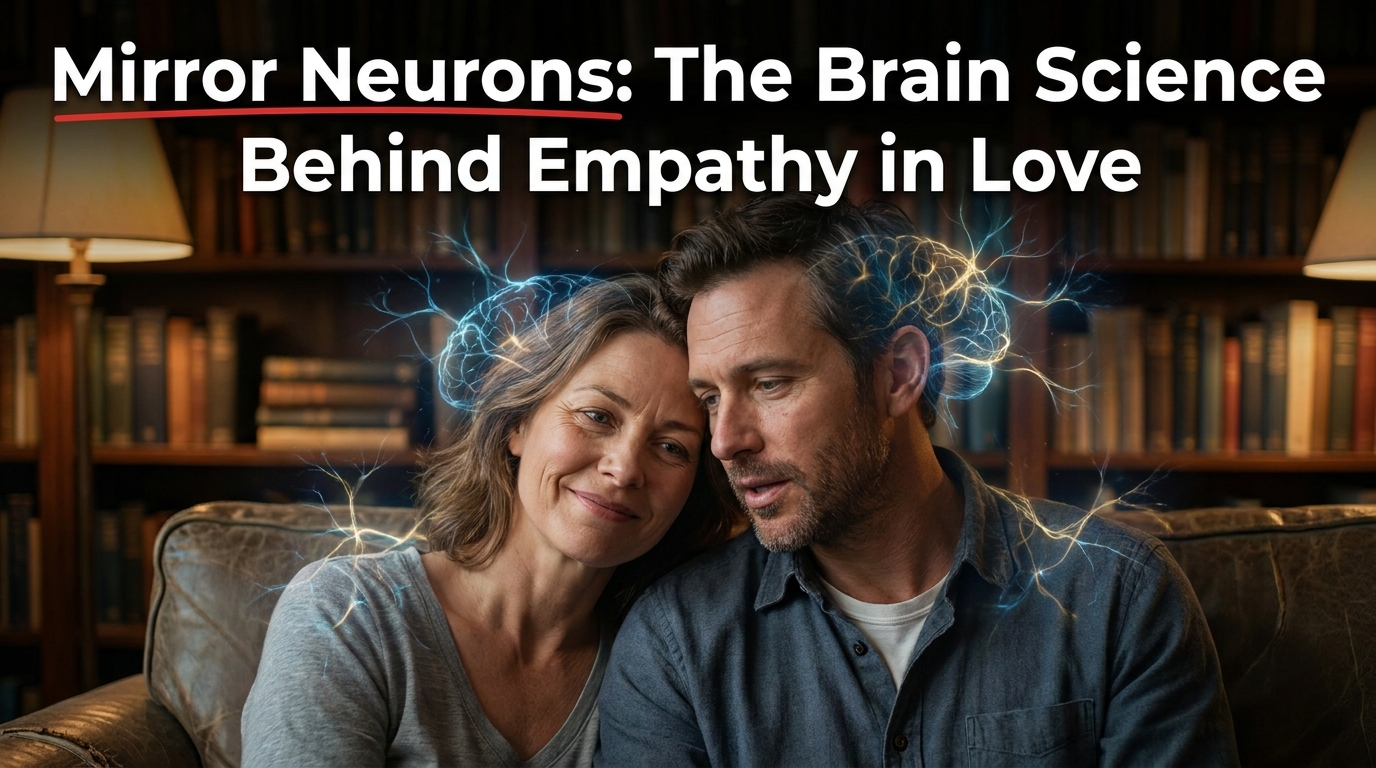
Mirror neurons and empathy in love are connected in ways that neuroscience is only beginning to fully understand — and what that science reveals about why we feel what the people we love feel is one of the most extraordinary stories in modern brain research.
You have felt it before. Your partner comes home carrying something heavy — stress, grief, quiet anxiety — and without a single word being spoken, you feel it too. Not because they told you. Not because you reasoned your way to it. But because something in your body simply registered it, the way a tuning fork registers the vibration of a matching note across the room.
Or you watch someone you love experience joy — real, uncomplicated joy — and your own chest opens with something that is not quite your joy and not quite separate from it either. You feel it with them. Through them. As if the line between their emotional experience and yours has become genuinely permeable.
This is not poetic metaphor. This is neuroscience.
A landmark study published in Science by Giacomo Rizzolatti and his team at the University of Parma identified a class of neurons — later named mirror neurons — that fire both when an individual performs an action and when they observe the same action being performed by another. The discovery, initially made in macaque monkeys and subsequently documented in human brains through neuroimaging studies, fundamentally changed our understanding of how human beings experience social connection, empathy, and emotional attunement.
And its implications for how we understand love are profound.

The Discovery That Changed Everything: What Mirror Neurons Actually Are
The story of mirror neurons begins in a neuroscience laboratory in Parma, Italy, in the early 1990s — and it begins, as many of science’s most significant discoveries do, with an accident.
Giacomo Rizzolatti and his team were studying the premotor cortex of macaque monkeys — specifically, the neurons that fired when the monkeys performed intentional actions like reaching for food. The electrodes monitoring individual neurons were sensitive enough to register the firing of single cells.
One day, a researcher reached for his own food while a monkey sat in the experimental setup, electrodes still attached. The monkey’s neurons — the exact neurons that fired when the monkey itself reached for food — fired in response to watching the researcher’s action.
The monkey’s brain, in other words, was running a neural simulation of the action it was observing — as if it were performing the action itself.
Further research confirmed the finding was not anomalous. A specific class of neurons in the premotor and parietal cortex fired both during self-generated action and during the observation of the same action in others. Rizzolatti named them mirror neurons — and the discovery sent reverberations through neuroscience, psychology, philosophy, and linguistics that have not yet fully settled.
In humans, direct single-neuron recording of mirror neurons is ethically constrained — but neuroimaging studies using fMRI have documented mirror neuron system activity in the premotor cortex, the inferior frontal gyrus, and the inferior parietal lobule during both action execution and action observation. The human mirror neuron system is broader and more complex than in primates — and its reach extends beyond motor actions into the domain of emotions.
This extension into emotional mirroring is where the science of mirror neurons and empathy in love becomes most extraordinary.
Mirror Neurons and Emotional Contagion: Feeling What Another Feels
The most significant expansion of mirror neuron research beyond motor action involves the discovery that the mirror neuron system is activated not just by observed actions, but by observed emotional expressions.
Research led by Christian Keysers at the Netherlands Institute for Neuroscience found that observing another person experience an emotion activates the same neural circuits in the observer’s brain that would be activated if the observer were experiencing that emotion themselves. When you watch someone you love feel pain, your brain’s pain-processing regions activate. When you watch them experience disgust, your brain’s disgust-processing regions respond. When you watch them feel joy, your reward circuitry responds.
You are not just understanding their emotion intellectually. Your brain is running a first-person simulation of it.
This neural simulation is the biological foundation of empathy — and it explains why empathy, at its most genuine, does not feel like an intellectual exercise. It feels like something that happens to you in response to someone else’s experience. Because at the neural level, in a meaningful sense, it is.
For romantic relationships specifically, this has implications that are both beautiful and complex.
“Empathy in love is not a choice you make to understand your partner. It is a biological process your brain initiates automatically — every time you look at the person you love with genuine attention.”

How Mirror Neurons Shape Love and Intimate Relationships
The implications of mirror neuron research for romantic relationships are extensive, scientifically grounded, and genuinely illuminating. Understanding how the mirror neuron system operates within love relationships changes not just how we understand empathy — it changes how we understand connection itself.
Emotional Attunement: The Invisible Language of Intimate Partnership
In established romantic relationships, the mirror neuron system contributes to what relationship researchers call emotional attunement — the capacity of one partner to sense, track, and respond to the emotional state of the other with a sensitivity and accuracy that often feels almost telepathic.
Dr. John Gottman, whose research on relationship dynamics is among the most comprehensive in the field, identified emotional attunement as one of the strongest predictors of long-term relationship satisfaction and stability. Partners who demonstrate high emotional attunement — who notice shifts in each other’s affect, who respond to emotional bids with appropriate sensitivity, who seem to know what the other needs before it is articulated — show measurably higher relationship quality across virtually every dimension studied.
The mirror neuron system provides the neural infrastructure for this attunement. When one partner looks at the other with genuine attention — not the distracted half-presence of a shared space, but real, engaged attention — the mirror neuron system activates. The partner’s emotional state is registered not just visually but neurologically, generating a resonance that informs the attuned partner’s response with a precision that purely cognitive processing could not match.
Why Touch Feels Different With Someone You Love
Physical touch in romantic relationships activates a cascade of neurochemical responses — oxytocin release, cortisol reduction, activation of the reward circuitry. But the mirror neuron system adds another layer to why touch feels qualitatively different with a deeply loved partner.
When your partner touches you with genuine tenderness, your mirror neuron system registers not just the physical sensation but the emotional intention behind the touch. The neural simulation your brain runs includes the emotional state from which the touch originates — and this allows a loving touch to communicate not just physical contact but the emotional content that animates it.
This is why the same physical action — a hand on a shoulder, a forehead against a forehead — can feel profoundly comforting from a deeply loved partner and simply neutral or even uncomfortable from a stranger. The mirror neuron system is reading the emotional context, not just the physical event.
Emotional Regulation Through Co-Regulation
One of the most practically significant applications of mirror neuron research to romantic relationships is what it reveals about co-regulation — the way one partner’s calm emotional state can literally help regulate the nervous system of the other.
Research from the field of interpersonal neurobiology, particularly the work of Daniel Siegel, documents the phenomenon of neural coupling — the way that the nervous systems of two people in close, attuned relationship begin to influence each other bidirectionally. When one partner is in a state of genuine emotional calm and safety, the other partner’s nervous system registers and responds to that state through mirror neuron activation, reducing their own arousal and creating a shared neurological calm.
This explains a phenomenon that most people in love relationships have experienced but rarely have language for: the feeling of being genuinely calmed by proximity to the person you love. The racing thoughts that slow when they hold your hand. The anxiety that diminishes when you hear their voice. The specific quality of safety that comes not from anything they have said or done, but from their regulated, present, attentive being.
This is co-regulation. And it is not metaphorical. It is neurological.
Mirroring Behavior and Relationship Synchrony
Beyond emotional experience, the mirror neuron system also underlies the behavioral mirroring that characterizes deeply connected intimate relationships — the way partners gradually adopt each other’s speech patterns, gesture styles, posture habits, and even facial expressions over years of shared life.
Research published in the journal Motivation and Emotion found that behavioral synchrony — the degree to which partners unconsciously mimic each other’s movements, expressions, and rhythms — was significantly correlated with relationship quality and reported feelings of closeness. The couples who moved through space most synchronously, who matched each other’s pace and rhythm most naturally, reported the deepest sense of connection.
This synchrony is not something that can be consciously manufactured. It is the behavioral expression of a deeply resonant mirror neuron relationship — the visible evidence that two nervous systems have become genuinely attuned to each other.

The Dark Side of Mirror Neurons: Emotional Contagion and Empathic Distress
For all its beauty, the mirror neuron system’s role in love relationships is not without complexity. The same neurological capacity that allows you to feel your partner’s joy with them also means you feel their suffering with them — and that has significant implications for emotional wellbeing in intimate relationships.
Empathic Distress and Emotional Flooding
Research distinguishes between two responses to observing another person’s pain: empathic concern — a feeling of compassion and motivation to help — and empathic distress — a self-focused emotional response in which the observer becomes overwhelmed by the other person’s pain and shifts focus from the other’s need to managing their own distress.
Empathic distress is more likely to occur in individuals with highly activated mirror neuron systems and insufficient emotional regulation capacity — specifically, in people with anxious attachment styles, high neuroticism, or a history of trauma that has sensitized their threat-response system.
In romantic relationships, empathic distress can manifest as a partner becoming so overwhelmed by the other’s emotional pain that they become focused on escaping their own distress rather than providing genuine support. This is not a failure of love — it is a neurological response that overwhelms the regulatory capacity of the nervous system. But it does require conscious awareness and, in some cases, therapeutic support to manage effectively.
Emotional Contagion in High-Conflict Relationships
The mirror neuron system’s automatic quality — its operation below the threshold of conscious control — means that emotional contagion in intimate relationships is not limited to positive emotional states. In relationships characterized by chronic anxiety, depression, rage, or emotional volatility, the mirror neuron system faithfully transmits those states to both partners.
Research published in the Journal of Family Psychology found that emotional contagion — the automatic transmission of emotional states between partners — was significantly more pronounced in high-conflict relationships than in low-conflict ones. Partners in high-conflict relationships showed measurably stronger physiological responses to each other’s negative emotional expressions, suggesting that the mirror neuron system becomes hypersensitized in the context of chronic relational threat.
This has a practical implication that is both sobering and important: prolonged exposure to a partner’s chronic negative emotional states does not just feel emotionally exhausting. It is neurologically taxing — activating stress response systems repeatedly in ways that have documented long-term consequences for both physical and mental health.
The person who says “being in this relationship is making me sick” may be describing something more literally accurate than they realize.
The Empathy Fatigue Reality
For highly empathic individuals — those with particularly responsive mirror neuron systems — sustained intimate relationships can sometimes generate what researchers call empathy fatigue: a depletion of the neurological and emotional resources that empathic processing requires, leading to reduced emotional responsiveness, withdrawal, and a kind of compassion numbness that can be misread as indifference.
Empathy fatigue in romantic relationships is most common in partnerships where the emotional demands are significantly asymmetrical — where one partner is consistently in distress and the other is consistently in the role of absorbing and responding to that distress. Without sufficient replenishment of the empathic partner’s own emotional resources — through self-care, individual support, and boundaries around the absorptive role — empathy fatigue can erode the very attunement capacity that made the relationship feel so connected.
“Empathy is not an infinite resource. It is a capacity that requires care — the same care you extend to the people you love with it.”

Cultivating the Mirror Neuron Relationship: How to Deepen Empathy With Your Partner
Understanding mirror neurons is not just intellectually fascinating — it is practically actionable. The neuroscience of empathy points directly toward specific behaviors and practices that strengthen emotional attunement, deepen connection, and build the kind of resonant, genuinely understanding intimate relationship that most people are seeking when they seek love.
Practice Genuine, Undistracted Attention
The mirror neuron system requires real attentional presence to function at its fullest capacity. When you look at your partner with genuine, undistracted attention — phone away, other thoughts set aside, eyes and awareness genuinely directed at them — you are creating the neurological conditions for deep empathic registration.
The quality of attention you bring to your partner in ordinary moments is not a small thing. It is the primary input variable for your mirror neuron system’s engagement with their emotional world. More attention means more resonance. More resonance means more genuine empathy. More genuine empathy means a relationship that feels more deeply understood and more deeply connected.
Engage in Shared Physical Experiences
Research consistently demonstrates that shared physical experiences — movement, exercise, dance, cooking, outdoor activities — generate behavioral synchrony and enhance mirror neuron system activation between partners. The physical co-regulation that shared activity produces strengthens the neural attunement that is the foundation of emotional closeness.
Practically, this means prioritizing the kind of shared doing that long-term relationships often sacrifice to the demands of parallel but separate domestic lives. The walk together. The class taken side by side. The physical activity that puts both nervous systems into shared rhythm and lets the mirror neuron system do what it evolved to do.
Practice Emotional Naming and Validation
When your partner expresses an emotion — even in muted, non-verbal ways — naming what you observe and validating it activates the full loop of the mirror neuron empathy response. “You seem really heavy tonight — is something weighing on you?” is not just a kind question. It is an invitation for the other person’s emotional experience to be fully received rather than simply registered and filed away.
Research on emotional validation in intimate relationships consistently shows that feeling accurately perceived and genuinely understood by a partner is one of the strongest predictors of relationship satisfaction and emotional security. The mirror neuron system gives you the raw material for this perception. Putting it into language and offering it to your partner is the relational act that transforms neural resonance into emotional intimacy.
Consciously Regulate Your Own Emotional State
Because co-regulation is bidirectional — because your nervous system affects your partner’s and theirs affects yours — the state you bring into your shared space matters enormously. A partner who actively manages their own emotional regulation brings a calming, stabilizing presence into the relationship that the mirror neuron system transmits to the other partner automatically.
This is not a prescription for emotional suppression or performed calm. It is a recognition that the work of emotional self-regulation — the therapy, the mindfulness, the exercise, the sleep, the self-awareness — is not just personal development. It is a direct contribution to the emotional quality of your relationship. Taking care of your own nervous system is an act of love toward your partner.
Minimize the Behaviors That Disable Mirror Neuron Attunement
Several common relationship behaviors specifically interrupt mirror neuron attunement — and awareness of them is the first step toward reducing their frequency.
Contemptuous expressions — eye-rolling, dismissive tones, expressions of disgust or superiority — activate the threat-response system in the observing partner’s brain, overriding the empathic resonance that the mirror neuron system would otherwise generate. The brain cannot be simultaneously in threat mode and empathy mode. Contempt shuts empathy down at the neurological level.
Chronic distraction — the habitual presence of screens and devices in shared space — reduces the quality of attentional presence that mirror neuron activation requires. You cannot empathically attune to someone you are not genuinely looking at.
And emotional stonewalling — the complete withdrawal of emotional responsiveness during conflict — deprives the other partner of the emotional signals that their mirror neuron system needs to maintain connection. Stonewalling does not just feel like abandonment. At the neural level, it is a form of connection deprivation.

Mirror Neurons, Love, and the Science of Being Truly Known
There is a question that lives at the heart of most people’s deepest longing in love: to be truly known. Not just liked, not just desired, but genuinely, accurately, deeply known — the inner world seen, the emotional experience received, the complexity of who you are met with real understanding rather than projection or assumption.
Mirror neurons are, at the neural level, the biological mechanism through which this knowing becomes possible.
When your partner looks at you with genuine attention, their brain is running a simulation of your emotional experience — feeling, in a neurologically real sense, something of what you are feeling. When they respond to your grief with a specific quality of sadness, when their face softens in response to your vulnerability, when they reach for you at the exact moment you needed to be reached for — that is not coincidence or magical intuition.
That is a brain doing precisely what it evolved to do: closing the distance between self and other, building the bridge of felt understanding across the space between two separate nervous systems.
Love, in this light, is not just an emotion. It is a neurological event — one that involves the continuous, automatic, bidirectional resonance of two nervous systems that have become genuinely attuned to each other. The feeling of being truly known by someone who loves you is the felt experience of that resonance.
And the cultivation of that resonance — through attention, through presence, through the daily, unglamorous work of genuine attunement — is not just romantic. It is one of the most neurologically significant things a human being can do for another.
The Relationship Between Empathy and Relationship Longevity
Research on long-term relationship satisfaction consistently identifies empathy — the felt capacity to understand and share another’s emotional experience — as one of the strongest predictors of relationship longevity and quality. More than physical attraction. More than shared interests. More than compatibility on the dimensions that dating profiles measure.
The feeling of being genuinely understood — and of genuinely understanding — is what sustains a relationship through the inevitable seasons of difficulty, change, and accumulated ordinary life that erode relationships built on thinner foundations.
And now we know that this capacity for genuine understanding has a biological substrate. It is not randomly distributed. It is not purely a personality trait. It is a neurological capacity that can be cultivated, strengthened, and deepened — or weakened, numbed, and eroded — by the quality of attention, presence, and emotional engagement we bring to our most important relationships.
The neuroscience of mirror neurons does not reduce love to biology. It reveals something even more profound: that the biology was built for love. That the brain evolved toward connection with a specificity and sophistication that suggests relationship — genuine, attentive, empathically resonant relationship — is not just one of the things human beings do.
It is one of the things human beings are.
Frequently Asked Questions
Q1: Do some people have more active mirror neuron systems than others, and does this affect their capacity for empathy in relationships?
Yes — research suggests significant individual variation in mirror neuron system responsiveness, influenced by both genetic factors and developmental experience. Individuals with highly responsive mirror neuron systems tend to show greater natural empathic attunement — they pick up on emotional cues more automatically and with greater accuracy. People with certain neurological conditions, including some forms of autism spectrum disorder, show differences in mirror neuron system functioning that affect empathic processing, though the relationship between mirror neurons and autism is more complex than early research suggested. Importantly, mirror neuron responsiveness is not entirely fixed — research suggests it can be enhanced through deliberate empathic practice, mindfulness training, and therapeutic work that builds emotional attunement capacity.
Q2: Can mirror neuron research explain why some relationships feel emotionally exhausting while others feel energizing?
Yes — this is one of the most practically significant implications of mirror neuron research for relationship choice and wellbeing. Relationships with partners who are chronically anxious, emotionally volatile, or in persistent distress activate the mirror neuron system’s stress-response pathways repeatedly — generating chronic low-grade emotional and neurological activation that is genuinely exhausting over time. Relationships with emotionally regulated, warm, and genuinely present partners activate the mirror neuron system’s reward and bonding pathways — generating a felt sense of calm, safety, and positive resonance. The experience of a relationship as either draining or nourishing is, in part, a direct report of what your mirror neuron system is processing in that person’s emotional field.
Q3: How do mirror neurons relate to the concept of emotional intelligence in relationships?
Mirror neuron functioning provides the neural substrate for emotional intelligence’s most fundamental capacity: the ability to accurately perceive and empathically respond to another person’s emotional state. High emotional intelligence in relationships — the ability to read a partner’s affect accurately, to respond with appropriate sensitivity, to regulate one’s own emotional response while remaining open to the other’s — relies significantly on the mirror neuron system’s real-time processing of social and emotional information. Emotional intelligence training and therapy-based empathy work may, at least in part, function by enhancing the integration of mirror neuron system outputs with higher-level cognitive and regulatory brain regions.
Q4: Is it possible to rebuild empathic attunement in a relationship where it has been lost?
Yes — and this is one of the most hopeful findings in the intersection of neuroscience and relationship therapy. Emotional attunement is not a fixed trait of a relationship. It is a state that is continuously generated or disrupted by the quality of attention, presence, and emotional engagement between partners. Couples therapy — particularly approaches like Emotionally Focused Therapy — works in significant part by recreating the conditions of safe, attuned emotional contact that allow the mirror neuron system to re-engage its empathic functions.
Research on EFT outcomes consistently shows that couples who complete therapy report significant improvements in felt understanding and emotional connection — suggesting that the neural attunement that empathy requires can be rebuilt when both partners are willing to genuinely show up for the process.
Q5: What is the connection between mirror neurons and the experience of loneliness in a relationship?
Relational loneliness — the specific, painful experience of feeling unseen, unheard, and emotionally unknown by a partner — may be understood, through the lens of mirror neuron research, as the felt experience of insufficient empathic attunement. When a partner is chronically distracted, emotionally unavailable, contemptuous, or stonewalling, the mirror neuron system is being deprived of the attentional and emotional input it requires to generate empathic resonance. The result — at the neurological level — is a state of social disconnection that the brain registers with the same neural response as physical pain. Loneliness in a relationship is not just an emotional experience. It is a neurological state — and it is one that genuine, sustained empathic attunement can directly address and relieve.
Save This. Share This. Follow For More.
💾 Save this article — because understanding the neuroscience behind empathy will change the way you show up in every relationship you have from this moment forward.
📤 Share this with someone who has ever made you feel truly understood — and let them know that what they do for you has a name, a science, and a profound beauty.
👉 Follow Truthsinside.com for more deeply researched, compassionately written content on psychology, brain science, love, and the extraordinary neuroscience of human connection.
📃 Related article: Anxious Attachment: Signs, Causes, and How to Heal
Because the brain that loves you is doing something genuinely remarkable — and it deserves to be understood.
🎵 Music
Maren Lull is a singer-songwriter who writes from the places most people don’t talk about out loud.
Not the dramatic grief. Not the obvious heartbreak. The quiet kind — the ordinary Tuesday emptiness, the habit of reaching for someone who isn’t there anymore, the particular exhaustion of being strong for so long that the strength itself wears thin.
Her music lives at the intersection of emotional honesty and soft beauty — breathy vocals over gentle piano, slow tempos, lyrics that feel less like songs and more like something you wrote in a private notebook at two in the morning and never showed anyone.
Maren Lull writes for the people who feel everything deeply and say very little about it. For the ones who listen to sad music not because they want to feel worse — but because being understood, even by a song, makes the feeling easier to carry.
📱 Follow Maren Lull:
→ Spotify
→ Apple Music
→ Youtube
→ Audiomack