
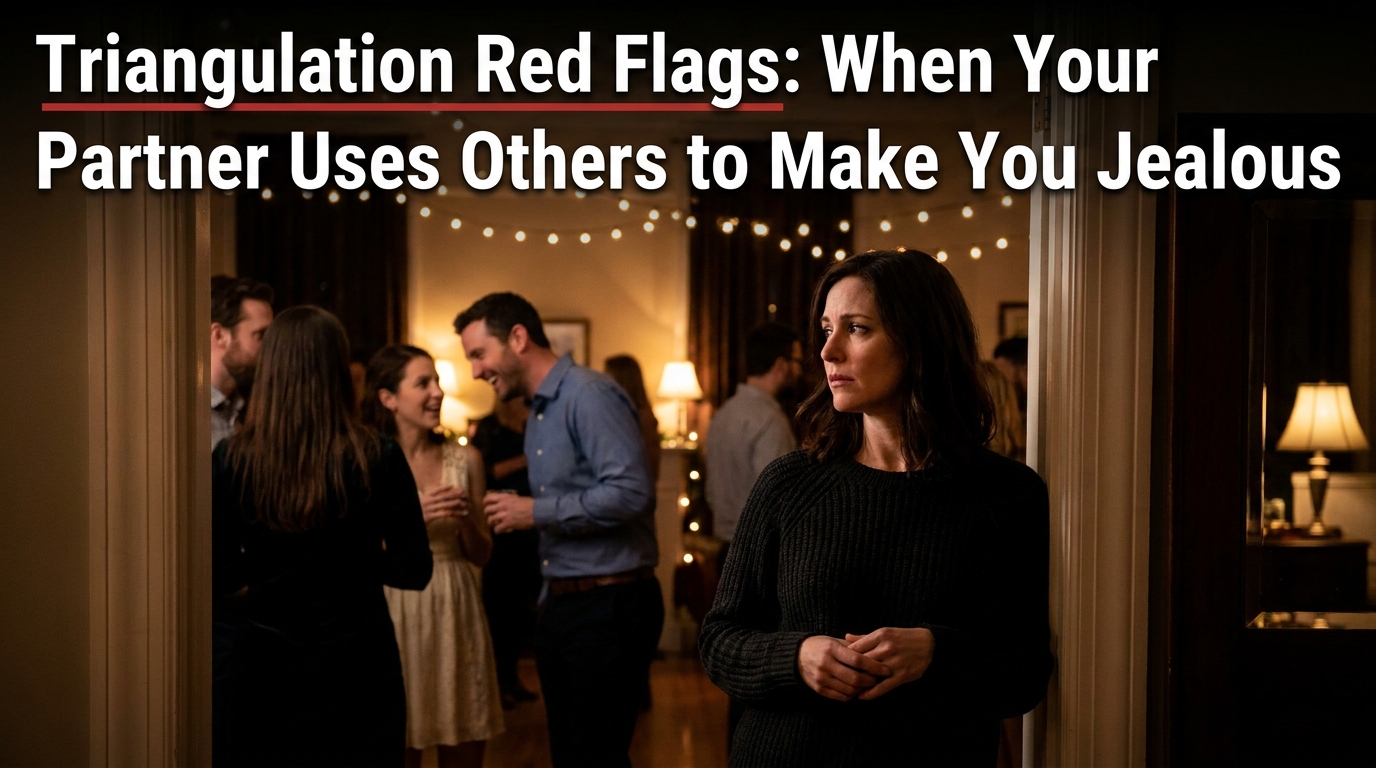
Triangulation red flags are among the most psychologically sophisticated forms of manipulation in intimate relationships — and among the most difficult to identify, because they work most effectively on the people who love most deeply.
Here is what it looks like from the inside: your partner mentions, casually, that someone at work has been paying them attention. Or they bring up an ex with a frequency that never quite feels accidental. Or they compare you — subtly, plausibly deniably — to someone else who “really gets them.” And something in you tightens. You work harder. You become more attentive, more accommodating, more eager to prove yourself. And the relationship, momentarily, feels more intense.
That intensity is not connection. That is the manipulation working.
Research published in the Journal of Personality and Social Psychology found that deliberate jealousy induction — the intentional use of third parties to provoke insecurity in a romantic partner — was one of the most commonly reported manipulation tactics in intimate relationships, used by approximately 31 percent of study participants at some point in a relationship. More significantly, the same research found that deliberate jealousy induction was strongly correlated with lower relationship satisfaction, higher anxiety, and significantly elevated rates of emotional abuse in those relationships.
Triangulation red flags do not just make you feel bad in the moment. They restructure how you see yourself, how you value your place in the relationship, and how much of your emotional energy is consumed by managing a insecurity that was deliberately installed in you.
This article is about seeing the mechanism clearly — and never letting it work on you again.

What Is Triangulation in a Relationship?
Triangulation is a psychological and relational term that describes the introduction of a third party — a person, a perceived rival, an ex-partner, or even a general reference to others’ interest — into the dynamic between two people, with the purpose of destabilizing one partner’s sense of security and shifting the relational power balance in favor of the other.
The term originates in family systems theory, where it was used by psychiatrist Murray Bowen to describe the way anxiety in a two-person relationship is frequently managed by pulling in a third party — using that third person to diffuse, redirect, or manage the emotional tension that the original pair cannot resolve between themselves.
In the context of intimate relationships and emotional manipulation, triangulation takes on a more specifically strategic character. The third party — whether a real person, an ex, a colleague, a social media connection, or simply the implied existence of other interested parties — is used as a tool to create jealousy, insecurity, and competition in the targeted partner.
The effect is remarkably consistent: the targeted partner becomes less focused on their own needs and boundaries, more focused on securing the relationship, more willing to tolerate behavior they might otherwise challenge, and more emotionally dependent on the very person causing the insecurity.
This is not accidental. It is the intended outcome.
Triangulation can be conscious and deliberate — deployed with full awareness of its effect as a strategy of control. It can also be less conscious — a habitual relational pattern learned early in life where managing others through jealousy was modeled or rewarded. In either case, the impact on the targeted partner is structurally identical.
The Psychology of Why Triangulation Works
To understand triangulation red flags clearly, it is essential to understand why triangulation is so devastatingly effective — specifically why intelligent, self-aware people find themselves responding to it in ways that, viewed from outside, seem entirely against their own interests.
The Attachment System Hijack
Triangulation works most effectively on people with secure enough attachment to genuinely value their relationship and anxious enough attachment to respond intensely to perceived threats to it. The suggestion that another person is interested in your partner — or that your partner might be interested in someone else — does not land as a neutral piece of information. It lands as a threat signal in the attachment system.
The attachment system’s primary function is to detect and respond to threats to the proximity and availability of attachment figures. When that system is triggered by the perception of a rival, it generates the behavioral responses that were adaptive in the evolutionary context of genuine pair-bonding threats: increased proximity-seeking, increased attention and care-giving behavior, reduced focus on one’s own needs in favor of securing the attachment relationship.
In the context of deliberate triangulation, these adaptive responses are being triggered artificially — and they are being exploited by the very person who is supposed to be the safe harbor of the attachment relationship. The person your nervous system is trying to secure against the threat is the person generating the threat. This is one of the reasons triangulation is so psychologically damaging: it turns the attachment system against itself.
The Intermittent Reinforcement Connection
Triangulation does not create constant jealousy. It creates unpredictable jealousy — strategic spikes of insecurity interspersed with periods of warmth, reassurance, and apparent security. This unpredictable pattern engages the same intermittent reinforcement dynamic that makes on-again-off-again relationships so neurologically addictive.
When the triangulation spike occurs and the targeted partner responds with increased effort and attention, the manipulating partner typically provides a period of warmth and reassurance that functions as the reward in the reinforcement cycle. The targeted partner’s brain learns the pattern — insecurity followed by effort followed by reward — and becomes neurologically conditioned to it, interpreting the cycle as the natural rhythm of the relationship rather than as a manufactured control dynamic.
The Comparative Self-Evaluation Trap
When a third party is introduced into the relational dynamic — whether explicitly through reference or implicitly through behavior — the targeted partner’s self-evaluation system is involuntarily activated. They begin to assess themselves comparatively: Am I as interesting? Am I as attractive? Am I enough?
This comparative self-evaluation is precisely what the triangulating partner intends. Because a partner who is focused on measuring themselves against an implied rival is a partner who has shifted their attention from their own needs and standards to the question of whether they are adequate relative to someone else. That shift in focus is enormously useful to the person doing the triangulating — it redirects the relationship’s power dynamic from one of mutual worth assessment to one of anxious self-justification.
“Triangulation does not work because you are weak. It works because you love deeply enough to feel threatened by the possibility of losing someone — and that is not a flaw. It is the capacity for genuine attachment being weaponized against you.”

13 Triangulation Red Flags You Need to Recognize
These signs do not exist in isolation — look for the pattern, not just the individual incident. And look honestly, because the most effective triangulation is the kind that always has a plausible innocent explanation ready.
1. They Mention Other People’s Interest in Them With Suspicious Regularity
It comes up casually, often after a conflict or during a period when the relationship has felt slightly more distant than usual. Someone at work said something flattering. An old friend texted, apparently out of nowhere, to say how much they miss them. Someone on social media has been particularly attentive. Each individual mention is presentable as innocent sharing. The pattern of mentions — their timing, their frequency, their relationship to moments of relational tension — is what reveals the strategy.
2. They Compare You to Others, Even Subtly
“My ex used to handle things like this so differently.” “My friend’s partner never makes this kind of issue.” “[Name] is just really easy to be around — no drama.” These comparisons are delivered as observations, but they function as evaluations — and the implicit message is always the same: you are being measured against someone else, and the measurement is not in your favor.
Healthy partners do not manage relationship issues by introducing the standards of other relationships or other people. They engage with the actual relationship in front of them.
3. They Are Strategically Vague About Certain Relationships
There is a person — or several — whose relationship with your partner is never quite clearly defined. They are described with enough warmth to register as significant but with enough vagueness to prevent you from raising legitimate concerns about them. When you ask direct questions, you receive deflection or gentle accusation: “Why are you so suspicious? I thought you trusted me.”
The vagueness is not accidental. Vagueness preserves the triangulating potential of the relationship — keeping the implied rival present enough to function as a destabilizer without being defined enough to be directly challenged.
4. They Use Social Media as a Triangulation Tool
They like the posts of specific people in ways that feel pointed — particularly after a conflict. They post photos that seem calculated to provoke your concern. They are publicly warm and engaged with certain individuals online in ways they are not in person, or in ways that are conspicuously visible to you. Social media has given triangulation an entirely new and remarkably effective theater of operation, because its ambiguity is built into the medium — any individual interaction can always be dismissed as meaningless, while the pattern across many interactions tells a very different story.
5. They Bring Up an Ex at Strategically Timed Moments
The ex who “still has feelings” for them. The ex who “keeps reaching out.” The ex who they ran into and who looked “really good.” The timing of these references — how consistently they appear at moments of relational tension, after conflict, or when you have expressed a need or boundary — reveals their strategic function.
A partner who is genuinely committed to your relationship does not manage that commitment by keeping their exes narratively present as implied rivals. They manage it by making the actual present relationship a clear and unambiguous priority.
6. They Escalate the Triangulation When You Pull Back
One of the clearest indicators that the triangulation is deliberate and strategic is the escalation pattern: when you respond to the jealousy induction by pulling back emotionally — by becoming less eager, less available, less focused on securing the relationship — the triangulation intensifies. More references to other people’s interest. More strategic vagueness. More pointed social media behavior.
The escalation when you withdraw is the manipulation revealing its own structure: the jealousy was designed to make you pursue, and when you stop pursuing, the mechanism is cranked up to restore the intended dynamic.
7. They Deny the Impact With Practiced Ease
When you raise concern about a specific incident — the mention of the ex, the comment about a colleague’s interest, the social media behavior — the response is smooth, confident, and immediately reframing: “You’re being insecure.” “I can’t believe you don’t trust me.” “I was just being honest with you — I thought that was what you wanted.” The denial is rarely stumbling or uncertain. It has the fluency of something that has been deployed before.
8. They Make You Feel Like Jealousy Is Your Problem to Manage
In a healthy relationship, if one partner expresses that something the other is doing is creating genuine distress, that concern is met with genuine engagement. In a relationship where triangulation is occurring, the response to the targeted partner’s distress is almost always to reframe the distress as the problem. You are too jealous. You are too insecure. You need to work on your trust issues. The discomfort that was deliberately created is presented as evidence of your psychological deficiency rather than as a reasonable response to their behavior.
9. They Are Warm and Reassuring Immediately After Provoking Insecurity
The cycle has a consistent rhythm: provoke insecurity, then provide reassurance. This rhythm is not coincidental — it is the structural core of the intermittent reinforcement dynamic that makes triangulation so effective. The reassurance that follows the triangulation spike is what conditions the targeted partner to interpret the entire cycle as the normal emotional texture of the relationship. “They love me — they just also make me feel this way sometimes” becomes the distorted lens through which the manipulation is normalized.
10. You Have Become More Focused on Keeping Them Than on Whether You Actually Want To
This is one of the most psychologically revealing consequences of sustained triangulation. When you examine your own experience honestly — when you ask yourself not “how do I keep this relationship” but “do I genuinely want this relationship, as it actually is” — the answer has become complicated. You are so focused on securing the relationship against the implied rivals that you have lost track of whether you would even choose this relationship if it felt secure.
Triangulation works by replacing your authentic evaluation of the relationship with a survival-mode focus on not losing. When you catch yourself entirely focused on the former and having forgotten to ask the latter, the manipulation has succeeded.
11. Other People Have Noticed and Said Something
Friends and family who observe your relationship from outside the emotional field of the triangulation often see the pattern more clearly than the person inside it. If people who love you and know you well have commented on the behavior — on how your partner talks about other people, on the effect it seems to have on you, on how you have changed in response to it — their observation is worth taking seriously.
The people who know you best are watching your mirror neuron system mirror the distress of the experience in ways you yourself may have normalized. Their concern is information.
12. The Jealousy Induction Is Followed by Increased Demands for Reassurance From You
Here is a specific and telling dynamic in many triangulating relationships: after provoking your insecurity, the triangulating partner then seeks reassurance from you — about the relationship, about your love for them, about your commitment. The person who just made you feel replaceable is now seeking comfort for their own apparent insecurity.
This dynamic reveals something important about the underlying psychology: triangulation is frequently driven not by genuine confidence but by its opposite — a deep anxiety about attachment adequacy that expresses itself as a need to constantly test and confirm a partner’s investment. Understanding this does not excuse the behavior. But it explains it — and explanation is the first step toward deprogramming its effect on you.
13. You Have Changed — And Not in Ways That Reflect Your Authentic Self
Perhaps the most important red flag of all is what sustained exposure to triangulation does to the person receiving it. If you can identify — looking honestly at who you were when the relationship began and who you are now — a meaningful drift toward anxiety, self-doubt, reduced confidence, increased need for reassurance, diminished sense of your own worth relative to the relationship, and decreased focus on your own needs and standards — you are experiencing the accumulated psychological cost of sustained triangulation.
That drift is reversible. But reversing it begins with seeing it clearly.

Who Uses Triangulation — and Why
Understanding the psychological profile of the person who uses triangulation does not excuse the behavior. But it does make the pattern comprehensible — and comprehensibility is protective.
Narcissistic Personality Traits
Triangulation is most extensively documented in individuals with narcissistic personality traits or narcissistic personality disorder. For narcissistic individuals, the management of romantic partners through jealousy serves several specific psychological functions simultaneously.
It secures narcissistic supply — the attention, devotion, and emotional investment of the partner — by keeping the partner in a perpetual state of insecurity that redirects their focus toward securing the narcissist’s affection. It maintains the narcissist’s sense of superiority and desirability by constructing a narrative in which they are always in demand. And it prevents the partner from developing the settled confidence that might lead them to raise needs, assert boundaries, or evaluate the relationship with clear eyes.
Research published in the journal Personality and Individual Differences found that narcissism scores were the strongest individual predictor of deliberate jealousy induction in romantic relationships — more predictive than attachment anxiety, relationship dissatisfaction, or prior history of infidelity.
Anxious Attachment and Insecurity Testing
As noted in the triangulation red flag pattern above, not all triangulation originates from narcissistic traits. A significant proportion of triangulating behavior is driven by attachment anxiety — the deeply rooted fear that one is not enough, not lovable enough, not secure enough in the relationship.
For an anxiously attached individual, the use of jealousy to test a partner’s investment is a maladaptive but psychologically understandable strategy: if the partner responds to the jealousy induction with increased attention and investment, it temporarily soothes the anxious partner’s fear of abandonment. The relief is real — but the method of securing it causes genuine harm, and the relief never lasts long enough to address the underlying attachment wound that generates the anxiety.
Learned Relational Patterns
For some individuals, triangulation was modeled in their family of origin — they grew up in households where one parent managed the other through jealousy, where affection was demonstrated through competition, where love was expressed as possession rather than security. These individuals may triangulate without recognizing it as manipulation because it is simply the relational pattern that was normalized in their developmental experience.
Understanding this developmental origin does not make the behavior acceptable. It makes it explainable. And for partners who care about the person using triangulation, understanding its origin can support compassionate clarity — the ability to see both the harm being caused and the wound that is driving it, without allowing either understanding to become a reason to accept the behavior indefinitely.
“Understanding why someone triangulates does not require you to continue accepting what triangulation does to you. Compassion and self-protection are not opposites — they are both necessary.”

The Long-Term Psychological Damage of Sustained Triangulation
Triangulation is not merely unpleasant in the moment. Extended exposure to it causes specific, documented psychological harm that persists long after the relationship ends.
Chronic Anxiety and Hypervigilance
Living in a relationship where jealousy is deliberately and unpredictably induced keeps the nervous system in a state of chronic low-grade threat activation. The targeted partner becomes hypervigilant — scanning their partner’s behavior, social media, interactions with others for signals that triangulation is imminent or occurring. This hypervigilance is exhausting, and it does not resolve when the relationship ends. It often transfers into subsequent relationships, causing the person to remain hypervigilant long after the source of genuine threat is gone.
Eroded Self-Worth
The consistent implied message of triangulation — that you are insufficient, that others are more desirable, that your position in the relationship is always provisional — gradually recalibrates how the targeted person sees themselves. Self-worth that was solid at the relationship’s beginning may be significantly eroded by its end. The person who could not understand why they were never quite enough has often been systematically conditioned to see themselves as less than they are.
Difficulty Trusting Future Partners
The specific form of trust violation in a triangulating relationship — being manipulated by the person who claimed to love you — creates a legacy of interpersonal suspicion that affects subsequent relationships. The person who was triangulated may find themselves hypervigilant about their next partner’s interactions with others, interpreting innocent behavior through the lens of the pattern they were conditioned to expect.
Identity Confusion
Sustained triangulation — particularly when accompanied by the gaslighting that the denial of its impact requires — can create genuine uncertainty about who you are and what you know. The comparative framework that triangulation installs can make it difficult to evaluate yourself outside of comparison with others. “Am I enough?” replaces “Who am I?” as the primary self-evaluative question — and answering “who am I” requires dismantling the comparative framework first.
How to Respond to Triangulation Red Flags
Seeing the pattern clearly is the necessary first step. These are the steps that follow.
Name It Without Accusation
When a triangulation incident occurs, address it directly and from your own experience: “When you mention [name/situation], I notice I feel insecure and uncertain in our relationship. I want to understand what’s happening between us, and I want to be honest about how that affects me.” This approach avoids the accusatory framing that the triangulating partner will use to deflect, while being completely honest about the impact.
Observe the Response
The response to your honest, non-accusatory naming of your experience is important data. A partner who is not deliberately triangulating — who does not recognize the impact of their behavior — will typically respond with genuine concern and a willingness to adjust. A partner who is deliberately or habitually triangulating will typically respond with deflection, denial, counter-accusation, or an intensified episode of triangulating behavior.
The response tells you more about what is happening than any explanation they offer.
Rebuild Your Internal Reference Point
One of the most important protective steps after recognizing triangulation is consciously rebuilding your self-evaluation on a basis that is not comparative. Your worth is not determined by how you measure against implied rivals. Your worth is inherent. Reconnecting with that inherent worth — through therapy, through the input of people who genuinely know and value you, through the deliberate reclamation of your own standards and perspective — is essential to breaking the comparative framework that triangulation installs.
Establish and Hold Firm Boundaries
Decide clearly — for yourself — what behavior is and is not acceptable to you in a relationship. Name that standard explicitly, calmly, and without ultimatum framing to your partner. Then observe whether the behavior changes, consistently, over a meaningful period of time. Not because they promise it will. Because it does.
Exit With Clarity If the Pattern Continues
If the triangulation continues after honest naming and clear boundary-setting — if the pattern persists regardless of how clearly and compassionately you have expressed its impact — the most self-respecting decision available to you is to leave. Not in anger. Not in the heat of the next incident. But from a place of clear, grounded, self-respecting recognition that you deserve a relationship in which your emotional security is not used as a lever of control.

You Were Never the Problem
Here is the truth that sustained triangulation works hardest to obscure — the truth that needs to be stated clearly, directly, and without qualification:
You were never the problem.
The insecurity you felt was not evidence of your inadequacy. It was evidence of a strategy being deployed against you — successfully, because you were someone who loved genuinely and deeply and therefore had something worth protecting.
The comparisons did not reveal your deficiencies. They revealed the other person’s need to create a hierarchy in which they would always occupy the top position — a need rooted in something about them, not about you.
The jealousy was not a sign that you were not enough. It was a sign that someone decided it was more useful to keep you uncertain than to love you securely.
Triangulation red flags are not warnings about your worth. They are warnings about someone else’s character. And the moment you see them clearly — really clearly, with the understanding of the mechanism and the psychology and the impact — they lose the power they held when they were invisible.
You are not competing with anyone for a place in a relationship that is genuinely yours. In a healthy relationship, there is no competition. There is just the consistent, unperformed, unstrategic reality of two people who choose each other clearly, every day, without requiring the other person to earn that choice against a rotating cast of implied rivals.
That is what you deserve. Not the performance of being chosen. The reality of it.
Frequently Asked Questions
Q1: How do I know if my partner is deliberately triangulating or just casually mentioning other people without manipulative intent?
The most reliable indicators are pattern, timing, and response to feedback. Innocent mention of other people is random in timing, consistent in nature, and does not cluster around moments of relational tension. Deliberate triangulation shows a consistent pattern of timing — mentions tend to increase after conflict, after you have expressed a need, or when you have pulled back emotionally. Additionally, a non-manipulative partner who learns their casual mentions are causing distress will respond with genuine care and adjust their behavior. A triangulating partner will deny, deflect, or intensify the behavior when it is named. The response to your honest expression of impact is often the clearest indicator of intent.
Q2: Can triangulation occur in friendships and family relationships, not just romantic ones?
Yes — triangulation as a psychological pattern occurs across all significant relationship types. In family systems, triangulation often involves one family member involving a third family member in a conflict between two people, using the third party to apply pressure or shift alliances. In friendships, it may manifest as one friend creating competition or comparison between friends. The specific jealousy-induction form described in this article is most characteristic of intimate romantic relationships, but the broader manipulation of a third-party relationship to manage a primary relationship occurs across all significant relational contexts.
Q3: Is it possible to maintain a relationship with someone who has triangulated, if they are willing to change?
Possible — but conditional on specific, non-negotiable evidence of genuine change. That evidence must be behavioral, not verbal. It must include the complete cessation of triangulating behaviors, genuine accountability for the harm caused, active engagement with the underlying psychological patterns that drove the behavior through individual therapy, and sustained demonstrated change over a meaningful period of time — not weeks, but months. If all of these conditions are met and maintained, the relationship can potentially shift. If any of them are absent — particularly the genuine individual therapeutic work — the pattern is overwhelmingly likely to recur, because the underlying psychology that drives it has not been addressed.
Q4: Why do I feel guilty for being upset about triangulation when each individual incident seems so small?
This is one of triangulation’s most effective features — the plausible deniability of each individual incident makes it extremely difficult to feel justified in your distress. This is why the pattern, not the individual incident, is the unit of analysis. Each mention of someone else’s interest may indeed be innocent in isolation. But ten such mentions, clustered around moments of relational tension, following a consistent pattern of provocation and reassurance, constitutes something structurally different from casual sharing. Your distress is not a response to any single incident. It is a response to the accumulated experience of a pattern — and that pattern is real, even when each of its components is individually deniable.
Q5: How do I rebuild my self-worth and trust in relationships after experiencing sustained triangulation?
Rebuilding after sustained triangulation typically requires three parallel processes. The first is therapeutic work — specifically with a therapist who understands emotional manipulation and attachment patterns — to identify and dismantle the comparative self-evaluation framework that triangulation installs. The second is deliberate reconnection with your own perspective, standards, and sense of inherent worth outside of any comparative framework. This often involves returning to relationships, activities, and aspects of identity that existed before the triangulating relationship and were gradually crowded out by it.
The third is a calibrated, gradual rebuilding of trust in the relational context — understanding that the hypervigilance triangulation leaves behind is a trauma response, not a permanent reality, and that not all partners are capable of what the triangulating partner was capable of.
Save This. Share This. Follow For More.
💾 Save this article — because the next time something in a relationship makes you feel like you are always competing for someone who should simply be choosing you, you deserve to have the language for what that is.
📤 Share this with someone who has ever been made to feel like they were not enough by someone who was supposed to make them feel like they were everything. You might give them the clarity that changes how they see their past — and protects their future.
👉 Follow Truthsinside.com for more honest, research-backed content on relationship red flags, emotional manipulation, psychology, and every truth about love that deserves to be said clearly and without apology.
📃 Related article: Gaslighting in Relationships: How to Recognize, Name, and Leave It
Because you deserve a relationship where your security is something your partner protects — not something they use.
🎵 Music
Maren Lull is a singer-songwriter who writes from the places most people don’t talk about out loud.
Not the dramatic grief. Not the obvious heartbreak. The quiet kind — the ordinary Tuesday emptiness, the habit of reaching for someone who isn’t there anymore, the particular exhaustion of being strong for so long that the strength itself wears thin.
Her music lives at the intersection of emotional honesty and soft beauty — breathy vocals over gentle piano, slow tempos, lyrics that feel less like songs and more like something you wrote in a private notebook at two in the morning and never showed anyone.
Maren Lull writes for the people who feel everything deeply and say very little about it. For the ones who listen to sad music not because they want to feel worse — but because being understood, even by a song, makes the feeling easier to carry.
📱 Follow Maren Lull:
→ Spotify
→ Apple Music
→ Youtube
→ Audiomack