
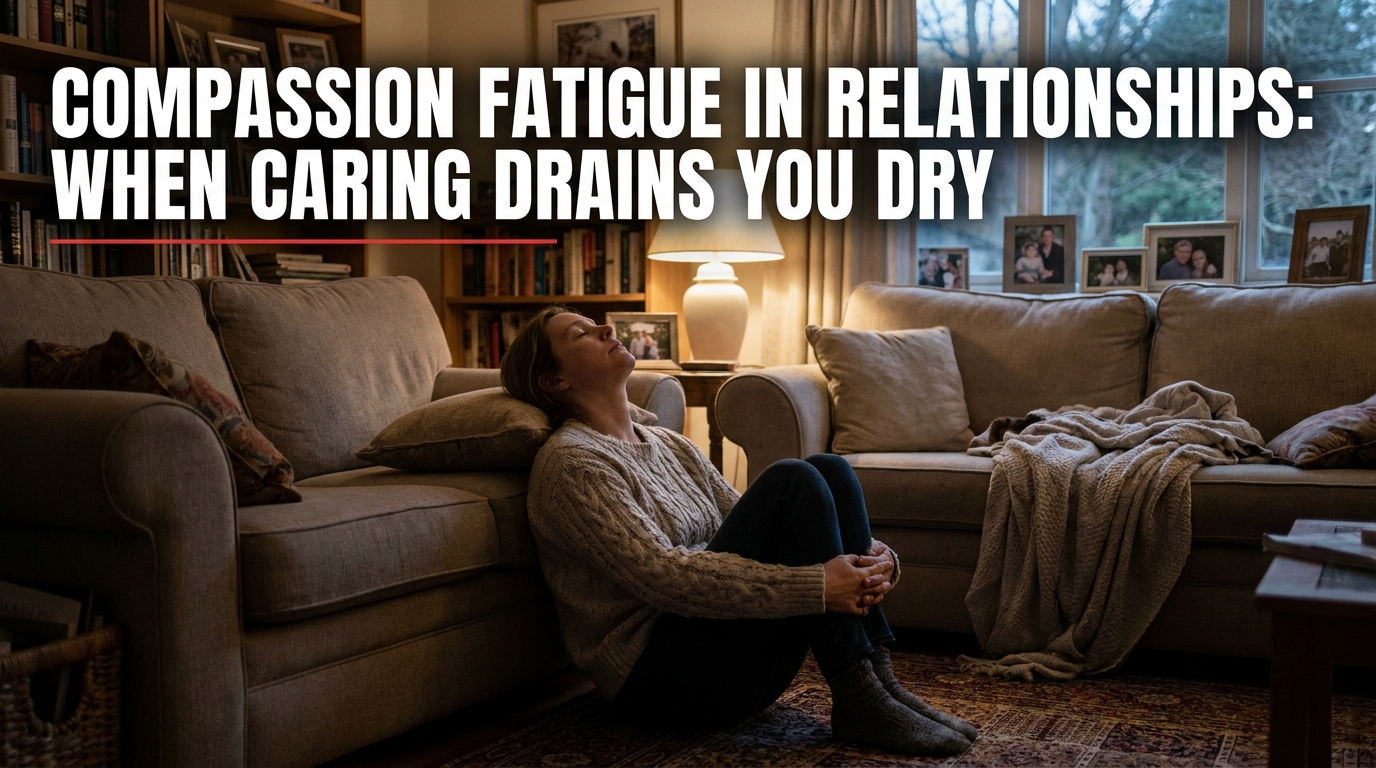
Compassion fatigue in relationships does not arrive the way most people expect a crisis to arrive. It does not announce itself with a dramatic breaking point or a clear moment of rupture you can point to afterward and say — there, that is where it happened.
It arrives the way erosion happens. Slowly. Invisibly. One day you are someone who loves with the kind of open-handed generosity that people describe as extraordinary. And then, somewhere across the months and years of showing up for someone else’s pain, someone else’s needs, someone else’s crisis after crisis — you realize you are still showing up. You are still physically present. But something essential has gone quiet inside you.
You are not sure when it left. You are only sure that it has.
Compassion fatigue — a term first developed by nurse Carla Joinson in 1992 and later extensively researched by trauma psychologist Charles Figley — was originally used to describe the emotional and psychological exhaustion experienced by professional caregivers: nurses, therapists, social workers, first responders. But research over the subsequent three decades has made increasingly clear that compassion fatigue is not confined to professional contexts.
It lives in relationships. In the partner who has been the emotional anchor through years of the other’s depression, addiction, chronic illness, or unresolved trauma. In the person who learned early that love meant absorbing other people’s pain and asking for nothing in return. In the deeply empathic individual whose mirror neuron system registers their partner’s suffering so acutely that the boundary between caring for someone and being consumed by them has become impossible to locate.
A study published in the journal Traumatology found that individuals in close relationships with partners experiencing chronic psychological distress showed measurable symptoms of secondary traumatic stress — the clinical foundation of compassion fatigue — at rates comparable to professional caregivers working in high-trauma environments.
You do not have to be a nurse to be running on empty. You just have to love someone whose needs have consistently outpaced what both of you together could replenish.

What Compassion Fatigue in Relationships Actually Is
Before exploring what compassion fatigue in relationships looks like in lived experience, it is worth being precise about what it actually is — because it is frequently confused with related but distinct experiences, and that confusion can prevent people from understanding and addressing what is happening to them.
Compassion fatigue is not simply being tired of your relationship. It is not the ordinary friction of long-term partnership, the frustration of conflict, or the natural ebbing of romantic intensity over time.
Compassion fatigue is specifically the depletion of your empathic and emotional resources that results from sustained, secondary exposure to another person’s suffering — the cost of caring, when that caring is chronic, asymmetrical, and inadequately replenished.
Charles Figley described compassion fatigue as “the cost of caring” — and that framing is important. The people who experience compassion fatigue in relationships are not people who stopped caring. They are people who cared so much, for so long, without sufficient replenishment of their own emotional resources, that the caring itself became a source of depletion rather than of meaning.
It is also distinct from burnout, though the two are frequently confused. Burnout is a response to chronic overwork and perceived futility in one’s efforts — it is characterized primarily by cynicism, detachment, and reduced efficacy. Compassion fatigue, by contrast, is specifically rooted in empathic engagement with another’s pain — and its primary feature is not cynicism but depletion. The compassion fatigued person often still cares deeply. They simply no longer have the internal resources to express that caring in the ways they once did.
Figley identified two primary components of compassion fatigue: secondary traumatic stress — the indirect trauma absorbed through sustained exposure to another person’s traumatic or distressing experiences — and burnout in its more specific relational form. Both components are present in relationship-based compassion fatigue, often simultaneously, and their combined effect on the empathic partner is both measurable and serious.
Who Is Most Vulnerable to Compassion Fatigue in Relationships
Compassion fatigue in relationships does not distribute itself randomly. Research consistently identifies specific characteristics that increase a person’s vulnerability to it — and understanding these characteristics is both practically useful and critically important for destigmatizing the experience.
Highly Empathic Individuals
People with naturally high empathic capacity — those whose mirror neuron systems register another person’s emotional experience with particular vividness and immediacy — are significantly more vulnerable to compassion fatigue than those with lower baseline empathic responsiveness.
This is one of the painful paradoxes at the heart of compassion fatigue: the very quality that makes someone an extraordinarily loving, attentive, and emotionally present partner also makes them the most vulnerable to the depletion that sustained empathic engagement with a suffering partner produces.
Highly empathic individuals do not just understand their partner’s pain. They feel it — in a neurologically real sense, their own emotional and physiological systems respond to their partner’s distress states in ways that, over time, generate their own cumulative cost. Being the most empathic person in a relationship is not always the privilege it appears to be.
People With Anxious Attachment and Caretaking Patterns
Individuals with anxious attachment styles — and particularly those who learned in childhood that love was something you earned by being useful, by managing other people’s emotions, by never having needs of your own — are disproportionately represented among people experiencing compassion fatigue in relationships.
For these individuals, caretaking is not just a behavior within the relationship. It is a relational identity — the primary way they have learned to earn safety and belonging in intimate contexts. Stepping back from caretaking, setting limits on emotional labor, prioritizing their own needs — these are not just difficult practical choices. They are experienced as identity threats, as potential losses of the role that makes them feel lovable and necessary.
This identity-level investment in caretaking makes it extraordinarily difficult for these individuals to moderate their empathic engagement even when it is clearly costing them more than they can sustain. The compassion fatigue builds while the caretaking continues — because stopping the caretaking feels more dangerous than continuing to empty themselves through it.
Partners of Individuals With Chronic Mental Health Conditions
Partners of individuals experiencing chronic depression, anxiety disorders, PTSD, borderline personality disorder, addiction, or other long-term mental health conditions are at elevated risk for compassion fatigue — not because loving someone with a mental health condition is impossible or inadvisable, but because the sustained, intensive emotional labor that such relationships often require creates the precise conditions under which compassion fatigue develops.
Research published in the Journal of Nervous and Mental Disease found that partners of individuals with major depression showed significantly elevated rates of secondary traumatic stress, emotional exhaustion, and reduced empathic capacity — all hallmarks of compassion fatigue — compared to a matched control group of partners without chronically distressed partners.
This does not mean these relationships cannot be healthy and mutual. It means that the compassion fatigue risk in these relationships is real, documented, and requires specific, active management — by both partners — to prevent the supporter from becoming a second casualty of the condition they are trying to help their partner navigate.
“Compassion fatigue is not a failure of love. It is what happens when love is asked to give without end, without witness, and without replenishment — and it keeps giving anyway, past the point where anything is left to give.”

The Signs of Compassion Fatigue in a Relationship
Because compassion fatigue develops gradually and its symptoms overlap with other experiences — depression, ordinary relationship difficulty, general life stress — it is frequently misidentified or missed entirely until it has reached a point of significant depletion. These signs, taken together as a pattern, are the clearest indicators that compassion fatigue is what is happening.
Emotional Numbness Toward Your Partner’s Pain
One of the earliest and most diagnostic signs of compassion fatigue is the emergence of emotional numbness in response to situations that previously would have generated a strong empathic response. Your partner shares something distressing and you notice — with guilt and confusion — that you feel very little. The response that once came automatically and genuinely now requires conscious effort to generate, and even the effort produces something that feels hollow compared to what you used to feel.
This numbness is not indifference. It is the empathic system’s protective response to overload — the same mechanism that allows emergency room physicians to function in environments of sustained human suffering. When the empathic system has been depleted past a certain threshold, it reduces its own responsiveness as a protective measure.
Recognizing this numbness as depletion rather than as a loss of love for your partner is critically important — because the shame and confusion that accompany it often prevent people from seeking the support that would allow them to recover.
Persistent, Pervasive Exhaustion That Sleep Does Not Fix
The exhaustion of compassion fatigue is qualitatively different from ordinary physical tiredness. It is not resolved by sleep. It is present even after rest. It has a specific heaviness that is emotional and psychological as much as physical — a depletion that exists at the level of the self’s resources rather than at the level of the body’s energy reserves alone.
This persistent exhaustion often becomes visible to others before the person experiencing it fully acknowledges it — in the quality of their presence, the flatness of their affect, the way they move through the world with a heaviness that was not previously there.
Dreading Contact With Your Partner
A specific and painful sign of advanced compassion fatigue in a relationship is the emergence of dread — the subtle but unmistakable reluctance to engage with your partner that arises not from dislike but from the knowledge that engagement will cost you something you do not currently have.
You see their name on your phone and your stomach drops slightly before you answer. You hear them coming home and notice the specific tension that means you are bracing yourself. You love them — and you are dreading being with them. The coexistence of these two facts is one of the most distressing and confusing experiences of compassion fatigue. It does not mean the love is gone. It means your resources for expressing that love have been exhausted.
Reduced Capacity for Empathy in Other Relationships
Compassion fatigue does not confine its effects to the primary relationship in which it developed. As the empathic resource pool is depleted, its effects spread — the person experiencing compassion fatigue finds that their capacity for genuine empathic engagement diminishes across all their significant relationships. Friends share difficulties and receive less than the person once gave. Family members reach out and encounter someone who is simply, wordlessly, not quite there in the way they used to be.
This generalization of empathic depletion beyond the primary relationship is one of the clearest indicators that what is happening is compassion fatigue rather than simply a difficult season in a specific relationship.
Physical Symptoms Without Clear Medical Cause
The body does not remain unaffected by sustained emotional depletion. Research consistently links compassion fatigue to a range of somatic symptoms: disrupted sleep, appetite changes, headaches, gastrointestinal complaints, reduced immune function, and an increased susceptibility to illness. These physical manifestations are not psychosomatic in the dismissive sense of the word — they are the body’s genuine physiological response to sustained stress-system activation and emotional resource depletion.
When physical symptoms cluster alongside the emotional symptoms of compassion fatigue, both deserve to be taken seriously as signals that the body and mind are communicating the same message: this is unsustainable.
Resentment That Has No Clean Single Cause
Resentment in the context of compassion fatigue is a specific and particularly complicated emotional experience. It is not the resentment of betrayal — there may be no single clear injury to point to. It is the resentment of depletion — the slow, accumulating weight of having given consistently more than you received, for long enough that the imbalance has become too heavy to ignore.
This resentment is often accompanied by significant guilt — because the person experiencing it knows their partner’s struggles are genuine, knows they did not deliberately set out to exhaust them, and feels that resentment toward a suffering person is a moral failure rather than a natural consequence of sustained, asymmetrical emotional labor.
The guilt about the resentment compounds the exhaustion of the compassion fatigue itself — creating a secondary layer of emotional labor in which the person experiencing compassion fatigue must also manage the shame of their own human response to their circumstances.
Loss of Your Own Identity and Sense of Self
One of the most quietly devastating long-term consequences of compassion fatigue in relationships is what it does to the sense of individual identity. When a person’s primary relational function has become the management and absorption of another person’s emotional world, their own inner world — their own needs, desires, creative impulses, social connections, individual joys — gradually gets crowded out.
The person experiencing compassion fatigue may find, when they try to identify what they want or need for themselves, that the answer does not come easily. They have been so long in the orientation of attending to someone else’s experience that their own has become foreign territory.
This loss of self is not immediate or dramatic. It is the slow, cumulative result of a thousand small moments in which their own inner life was deprioritized in favor of attending to their partner’s — until the pattern of deprioritization became the default setting, and the self that was deprioritized became genuinely difficult to locate.

The Relationship Dynamic That Generates Compassion Fatigue
Compassion fatigue in relationships does not develop in a vacuum. It develops within specific relational dynamics — patterns of interaction and emotional labor distribution that create the conditions for one partner’s depletion while the other’s needs continue to be met.
The Asymmetrical Emotional Labor Dynamic
Emotional labor — the work of managing, processing, expressing, and attending to emotions within a relationship — is in healthy relationships distributed with reasonable mutuality over time. Both partners bring their emotional needs to the relationship. Both partners provide support. The giving and receiving flow in both directions, not necessarily in equal measure at every moment, but with a rough reciprocity over time that ensures neither person is chronically depleted.
In the relational dynamic that generates compassion fatigue, this reciprocity is absent. One partner consistently provides the emotional support, holds space for the other’s distress, manages the relational emotional climate, and absorbs the other’s pain — while their own emotional needs go unattended, unrecognized, or actively minimized.
This asymmetry is not always the result of deliberate selfishness on the receiving partner’s part. It may be driven by their genuine psychological distress, by attachment patterns that make it difficult for them to attend to another’s needs while managing their own, by mental health conditions that consume their relational capacity. But the impact on the giving partner — the compassion fatigue it generates — is the same regardless of the origin of the asymmetry.
The Chronic Crisis Pattern
Another relational pattern that reliably generates compassion fatigue is what might be called the chronic crisis dynamic — a relationship characterized by a sustained succession of genuine crises, emergencies, and acute distress states in one partner, to which the other partner responds with consistent, intensive support.
Each individual crisis is real. Each individual supportive response is appropriate. But when crises are chronic rather than episodic — when the supportive partner never emerges from crisis-response mode because the crises never fully resolve before the next one arrives — the cumulative cost to the supportive partner becomes enormous.
The chronic crisis pattern is particularly insidious because it makes it genuinely difficult for the supportive partner to establish limits or prioritize their own needs without feeling that they are abandoning a partner in genuine need. Every time they try to attend to themselves, there is a crisis. Every time they consider setting a boundary, the timing feels impossible. The relationship’s structure prevents the replenishment that would allow sustainable support — and the compassion fatigue deepens.
The Invisible Need Dynamic
A third pattern involves the systematic invisibility of the supporting partner’s needs within the relationship. In these dynamics, the supporting partner’s own emotional experiences — their struggles, their grief, their fears, their needs for comfort and support — are consistently minimized, overlooked, or made to feel less valid than their partner’s.
Sometimes this happens explicitly, through active minimization. More often it happens through the simple structural reality that the distressed partner’s needs are visible and urgent while the supporting partner’s needs are quieter, less dramatic, and easier to defer — and so they are perpetually deferred, until deferral becomes the permanent pattern and the supporting partner has effectively stopped expecting to have their needs met at all.
The invisibility of their needs is, in itself, a source of accumulated grief — and that grief, layered on top of the depletion of empathic resources, contributes significantly to the full weight of compassion fatigue.
“You cannot be someone’s entire emotional world indefinitely and remain whole. At some point, a vessel poured from without being refilled simply becomes empty — and emptiness is not the same as not caring.”

How to Recover From Compassion Fatigue in a Relationship
Recovery from compassion fatigue is not a single act or a dramatic intervention. It is a process — one that requires honesty, boundary-setting, genuine self-prioritization, and often professional support. It is also, importantly, entirely possible.
Step 1: Name What Is Happening Without Shame
The first and most important step is naming compassion fatigue for what it is — not as a personal failure, not as evidence that you love your partner insufficiently, not as something you should simply push through with more effort, but as a legitimate psychological and emotional experience that has a documented cause, a documented progression, and a documented path toward recovery.
Shame prevents naming. And naming is what makes every subsequent step possible. You cannot address what you will not acknowledge — and you will not acknowledge what you believe reflects something shameful about you.
The exhaustion you feel is not a character flaw. It is a consequence of sustained, underreplenished emotional labor — and it deserves the same compassionate attention that you have been giving to everyone else.
Step 2: Conduct an Honest Assessment of the Relational Dynamic
Once you have named the experience, an honest examination of the relational dynamic that produced it is essential. This means asking — with as much clarity and as little self-protective distortion as possible — what the actual distribution of emotional labor in your relationship looks like.
Who typically provides support during distress? Whose needs are most consistently attended to? Whose needs are most consistently deferred? When you have had a difficult day, a genuine crisis, a significant emotional need of your own — what happens? Is that need met, partially met, or quietly set aside because there is always something more urgent on the other side of the relationship?
This assessment is not an exercise in assigning blame. It is an exercise in seeing the structural reality of the dynamic clearly — because structural change requires structural clarity.
Step 3: Rebuild the Boundary Between Empathy and Absorption
One of the most important practical skills in compassion fatigue recovery is learning the distinction between empathic engagement and empathic absorption — and rebuilding the boundary between them.
Empathic engagement means genuinely receiving and responding to another person’s emotional experience — being present, being caring, being attentive — while remaining sufficiently differentiated from that experience to maintain your own emotional equilibrium and resources.
Empathic absorption is what happens when that differentiation collapses — when your partner’s emotional state becomes your emotional state, when their suffering becomes your suffering in a way that eliminates the boundary between supporter and supported, and when the caring relationship becomes one in which two people are drowning rather than one person supporting another toward shore.
Rebuilding this boundary is not coldness. It is sustainability. A therapist — particularly one trained in approaches like Acceptance and Commitment Therapy or Dialectical Behavior Therapy — can be enormously helpful in developing the specific skills of differentiated empathy that compassion fatigue recovery requires.
Step 4: Prioritize Your Own Replenishment Actively and Unapologetically
Recovery from compassion fatigue requires the active, intentional, unapologetic prioritization of your own emotional replenishment. This is not selfishness. It is the practical prerequisite for continued giving — because you cannot give from empty, and pretending otherwise does not refill the vessel. It simply depletes it faster.
Replenishment looks different for different people. For some, it is time in nature, physical exercise, creative expression. For others, it is the specific restoration of connections — with friends, with family, with the parts of your individual life that were gradually surrendered to the relational caretaking role. For most people experiencing compassion fatigue, therapy — both individual and, where appropriate, couples — is an essential component of genuine replenishment, not an optional supplement.
Identify specifically what replenishes you. Not what should replenish you in theory, but what actually does — what genuinely restores your sense of self, your emotional resources, your capacity for joy that is not contingent on someone else’s wellbeing. And then protect time for those things with the same commitment you have been protecting time for everyone else’s needs.
Step 5: Have the Honest Conversation With Your Partner
Recovery from compassion fatigue ultimately requires a genuine, honest conversation with your partner about what has been happening — and about what needs to change. This conversation is not an accusation. It is an act of love for the relationship — and for both people in it.
A partner who genuinely cares about you and about the relationship will want to know that you have been depleted. They will want to understand the dynamic. They may not have realized the full cost of what has been occurring — not because they are indifferent, but because the gradual, invisible nature of compassion fatigue development makes it easy to miss from the outside.
Frame the conversation in terms of what you need and what the relationship needs — not in terms of what your partner has done wrong. “I have realized I have been giving everything and not attending to myself, and it has depleted me in ways I need to be honest with you about” is both true and non-blaming — and it opens the conversation to genuine mutual engagement rather than defensive response.
Step 6: Restructure the Relational Dynamic Together
If both partners are willing to engage honestly with the dynamic that produced the compassion fatigue, the restructuring of that dynamic is possible — and when it happens genuinely, it often creates a relationship that is significantly healthier than the one that existed before.
Restructuring means establishing a more reciprocal emotional labor distribution. It means creating explicit space for the previously depleted partner’s needs to be attended to. It means developing agreements about the limits of the supportive role that allow care to continue without requiring sacrifice of self. And it often means both partners engaging with individual therapeutic support to address the underlying patterns — the attachment wounds, the caretaking identity, the mental health challenges — that created the conditions for the compassion fatigue in the first place.
Step 7: Know When the Relationship Itself Is the Source
There is a final, painful step that compassion fatigue recovery sometimes requires: the honest assessment of whether the relationship itself — as it currently exists, with the partner as they currently are — is capable of becoming something genuinely mutual.
Some relationships can be restructured into reciprocity with genuine effort from both partners. Some cannot — because one partner is unwilling to engage with the restructuring, because the underlying conditions generating the asymmetrical dynamic cannot be adequately addressed, or because the compassion fatigue has already caused damage to the relationship that cannot be repaired within it.
When that is the honest assessment — arrived at not impulsively but through genuine reflection, therapeutic support, and a sincere attempt at honest conversation — the most loving thing available to both people may be the acknowledgment that the relationship, as it is, is not sustainable. And that both people deserve relationships that do not require one of them to disappear in the act of caring.

What Compassion Fatigue Is Trying to Tell You
Here is something that the experience of compassion fatigue, as painful as it is, is genuinely offering you — if you are willing to receive it.
It is telling you that you have limits. That your emotional resources, however abundant they may be, are not infinite. That sustainable love — love that lasts, that remains alive and genuine rather than becoming performance or obligation — requires reciprocity. That caring for yourself is not in opposition to caring for someone else. It is the prerequisite for it.
It is also telling you something about the relationship — specifically, about whether the relationship has space for your full humanity. Not just the giving, capable, emotionally available version of you. The full version. The version that also needs. That also struggles. That also deserves to be held sometimes, supported sometimes, attended to sometimes.
A relationship that only has room for you as caretaker is a relationship that only has room for part of you. And part of you is not enough to live in.
The exhaustion of compassion fatigue is real and it deserves real attention. But beneath the exhaustion, there is also important information — about what love requires to be genuinely sustainable, about what you have been accepting in place of reciprocity, and about what you deserve that you may have stopped expecting to receive.
Compassion fatigue is not the end of your capacity to love. It is a signal that the way love has been structured in your life needs to change — for your sake, for your partner’s sake, and for the sake of the relationship you are both trying to sustain.
Attend to that signal. It is one of the most important things your exhausted, generous, still-caring self has ever said.
Frequently Asked Questions
Q1: Is compassion fatigue in relationships the same as falling out of love?
No — and the distinction is critically important, both for how the experience is understood and for how it is addressed. Falling out of love typically involves a genuine diminishment of romantic feeling and emotional connection that is not primarily resource-driven. Compassion fatigue involves the depletion of emotional and empathic resources while the underlying love often remains — but becomes inaccessible beneath the exhaustion of sustained, underreplenished giving. Many people experiencing compassion fatigue fear they have fallen out of love, when what they have actually experienced is a temporary but serious depletion of the resources through which love is expressed. With genuine recovery — including replenishment, boundary restructuring, and relational rebalancing — the love that was always present often becomes accessible again.
Q2: Can a relationship survive compassion fatigue, or does it always signal the end?
A relationship can absolutely survive compassion fatigue — but survival requires genuine engagement with what produced it. If both partners are willing to honestly examine the relational dynamic, restructure the distribution of emotional labor, seek appropriate therapeutic support, and make sustained behavioral changes that create genuine reciprocity, the relationship can not only survive but become significantly stronger. The experience of compassion fatigue, when engaged with honestly by both partners, often creates the impetus for the kinds of deep relational conversations and structural changes that transform a relationship from a pattern of unsustainable sacrifice into one of genuine mutual care. Where only one partner is willing to engage with this work, the prognosis is significantly less certain.
Q3: How do I set limits on my emotional support without feeling like I am abandoning my partner?
This is one of the most painful practical challenges of compassion fatigue recovery, and it deserves a direct answer. Setting limits on emotional support is not abandonment. Abandonment is leaving someone without warning, without care, without alternative support. Setting limits is saying: “I love you, and I cannot be your only source of emotional support without it depleting me in ways that ultimately harm both of us and our relationship.” That is not abandonment. That is honesty in the service of sustainable love.
Practically, this means identifying specific limits — times when you are not available for intensive emotional support, types of support you can and cannot provide sustainably — and communicating those clearly and compassionately, while actively helping your partner identify and access additional sources of support beyond you alone.
Q4: What is the difference between compassion fatigue and enabling in a relationship?
Compassion fatigue and enabling can coexist in the same relationship, but they are distinct dynamics. Enabling involves behaviors that inadvertently allow or sustain a partner’s problematic patterns — typically by managing the consequences of those patterns in ways that remove the motivation to change them. Compassion fatigue is the exhaustion that results from sustained empathic engagement with a partner’s suffering, whether or not enabling is also present. In relationships where both are present — most commonly in partnerships involving addiction, chronic mental health conditions without active treatment engagement, or patterns of crisis generation — addressing enabling is often a component of the compassion fatigue recovery process, because reducing enabling behaviors reduces the sustained crisis input that drives compassion fatigue forward.
Q5: How long does recovery from compassion fatigue in a relationship typically take?
Recovery timelines vary significantly depending on the severity and duration of the compassion fatigue, the quality of support available, and the degree of change achieved in the relational dynamic that produced it. Research on compassion fatigue recovery in professional caregiving contexts suggests that meaningful symptom reduction with appropriate intervention typically occurs within three to six months — but that full recovery, particularly of empathic capacity and sense of self, can take considerably longer.
In relational contexts, recovery is also contingent on the relational dynamic itself changing — which adds a variable that purely individual recovery does not involve. Couples who engage in supported relational restructuring alongside individual recovery work tend to show faster and more complete recovery than those who address only the individual dimension without changing the dynamic that produced the depletion.
Save This. Share This. Follow For More.
💾 Save this article — because the next time you feel empty from loving someone and cannot understand why, you deserve to have the language for what is happening and the roadmap for what comes next.
📤 Share this with the most giving person you know — the one who always shows up for everyone else and never asks for anything in return. You might be giving them permission to finally attend to themselves.
👉 Follow Truthsinside.com for more honest, deeply researched content on love, emotions, relationship psychology, and the truths about human connection that deserve to be said with both compassion and clarity.
📃 Related article: The 5 Love Languages Explained: Which One Are You?
Because loving deeply is one of the most extraordinary things a human being can do. And the person who loves that deeply deserves to be loved — and replenished — in return.
🎵 Music
Maren Lull is a singer-songwriter who writes from the places most people don’t talk about out loud.
Not the dramatic grief. Not the obvious heartbreak. The quiet kind — the ordinary Tuesday emptiness, the habit of reaching for someone who isn’t there anymore, the particular exhaustion of being strong for so long that the strength itself wears thin.
Her music lives at the intersection of emotional honesty and soft beauty — breathy vocals over gentle piano, slow tempos, lyrics that feel less like songs and more like something you wrote in a private notebook at two in the morning and never showed anyone.
Maren Lull writes for the people who feel everything deeply and say very little about it. For the ones who listen to sad music not because they want to feel worse — but because being understood, even by a song, makes the feeling easier to carry.
📱 Follow Maren Lull:
→ Spotify
→ Apple Music
→ Youtube
→ Audiomack