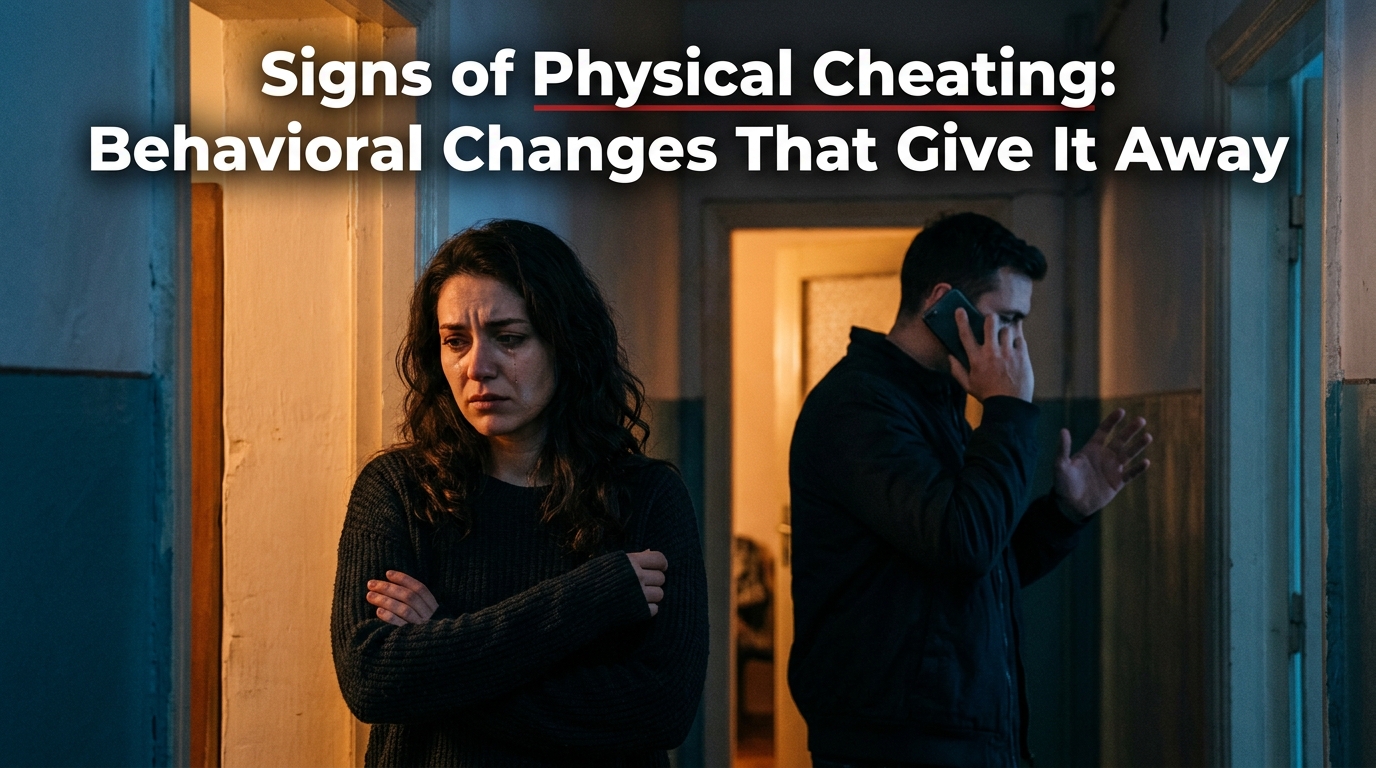
The signs of physical cheating rarely announce themselves in a single, undeniable moment. They accumulate. They layer themselves into the ordinary texture of daily life so gradually that the person experiencing them often spends weeks or months caught between what they feel and what they can prove — between the persistent, stomach-dropping sense that something is wrong and the desperate hope that they are misreading everything.
You are not misreading everything.
The human nervous system is an extraordinarily sensitive social instrument. It detects changes in a partner’s behavior, emotional availability, and relational energy long before the conscious mind has assembled those changes into a coherent narrative. The feeling that something has shifted — that the person sharing your life is somehow elsewhere even when they are physically present — is not paranoia. It is pattern recognition. And it deserves to be taken seriously.
Research published in the Journal of Sex Research found that behavioral change is the most commonly reported early indicator of physical infidelity — with partners reporting noticing shifts in routine, emotional availability, physical intimacy patterns, and communication quality an average of six to eight weeks before any concrete evidence of cheating was discovered. Your nervous system, in other words, is often working with accurate information long before your rational mind catches up.
This article is about catching up. About giving language and clarity to what you may have been sensing without being able to name. About understanding the specific behavioral changes that physical cheating reliably produces — so that you can see what is in front of you with clarity and move forward from a position of genuine knowledge rather than perpetual, destabilizing uncertainty.

Why Physical Cheating Produces Behavioral Changes
Before examining the specific signs, it is worth understanding why physical cheating so reliably produces observable behavioral changes in the person committing it — because understanding the mechanism helps you read the signs with greater accuracy and less self-doubt.
Physical infidelity creates what psychologists call cognitive dissonance — the psychological discomfort that arises when a person’s behavior is fundamentally inconsistent with their self-concept and values. Most people who cheat do not think of themselves as someone who would cheat. They carry a self-image that includes honesty, loyalty, and integrity — and the gap between that self-image and the reality of what they are doing creates persistent psychological tension.
This tension manifests outward. It changes how a person interacts with their partner — producing guilt-driven behaviors, defensiveness, withdrawal, and the specific emotional unavailability of someone managing a significant secret. It changes their relationship with their phone, their schedule, their appearance, and their physical intimacy with their primary partner. And it changes — often profoundly — the quality of their emotional presence in the relationship.
Additionally, physical infidelity involves the investment of emotional energy — attention, desire, romantic excitement — in an outside relationship, which inevitably reduces the supply of those resources available to the primary relationship. This depletion shows up behaviorally in ways that are consistent and, once you know what to look for, recognizable.
The person who is physically cheating is carrying a significant secret, managing significant guilt, investing significant energy in an outside relationship, and attempting to maintain the appearance of normalcy in the primary relationship simultaneously. That is an enormous psychological load — and it leaks. Consistently, specifically, and in ways that this article maps in detail.
The Behavioral Categories of Physical Cheating Signs
The behavioral changes associated with physical cheating cluster into several distinct categories, each reflecting a different dimension of the psychological and logistical reality of maintaining a secret outside relationship. Understanding these categories helps you see the signs not as isolated incidents but as the coherent pattern they form.
Category 1: Changes in Phone and Technology Behavior
Sudden, Intense Phone Guardedness
The most widely reported early behavioral change associated with physical cheating is a dramatic shift in how a partner relates to their phone. A person who previously left their phone face-up on the counter, who did not react when you glanced at their screen, who had no password or a shared one — suddenly becomes intensely protective of their device.
The phone is placed face-down whenever you are nearby. It is taken into the bathroom. It is never left unattended in your presence. New passwords appear without explanation. The screen dims immediately when you approach. The reaction when you accidentally pick it up or glance in its direction is disproportionate — a flash of panic, irritation, or the specific kind of controlled calm that is its own signal.
The phone is where physical affairs live in their day-to-day reality — in text threads, messaging apps, call logs, and location data. The intensity with which it is suddenly guarded is almost always directly proportional to what it contains.
New Apps, Deleted Messages, and Cleared Histories
Secondary to the guardedness itself, specific technological behaviors merit attention. The appearance of messaging apps — WhatsApp, Signal, Snapchat, Telegram — that were not previously used, particularly apps known for their privacy features or message-deletion capabilities. Call logs that are inexplicably incomplete. Browser histories that are regularly cleared. Photo albums with gaps that correspond to specific time periods.
None of these behaviors are individually conclusive. But their appearance in combination, particularly in conjunction with increased phone guardedness, is a consistent behavioral signature of someone managing a secret that lives primarily on their device.
Dramatic Increase in Phone Use During Specific Times
A pattern of significantly increased phone use during specific, recurring time windows — late at night after you have gone to sleep, during commutes, during time spent in another room, during bathroom visits of unusual duration — is a behavioral change that warrants attention.
The timing matters as much as the volume. Increased phone use that is random and contextually explained is different from increased phone use that consistently clusters around the same time periods — particularly periods when your partner has privacy and you have reduced visibility.

Category 2: Changes in Schedule, Routine, and Whereabouts
Unexplained Schedule Changes and New Commitments
Physical affairs require physical time. They require meetings, rendezvous, and hours that must be accounted for to the primary partner in some way — even if that accounting is false. One of the most reliable behavioral signatures of physical cheating is the emergence of schedule changes and new commitments that did not previously exist and whose explanations do not quite hold together under gentle scrutiny.
New work obligations that require staying late on a regular basis. Social events with friends you have never met or rarely hear about. Fitness routines that begin at unusual times or last longer than necessary. Errands that take significantly longer than they should. In each case, the activity itself may be entirely plausible — the issue is the pattern of emergence, the specificity of the timing, and the quality of the explanation offered.
A partner with nothing to hide does not typically offer elaborate, preemptive explanations for ordinary schedule changes. A partner managing a secret often does.
Increased Vagueness About Whereabouts
Alongside the emergence of new schedule commitments, a partner engaged in physical cheating often becomes notably vaguer about their whereabouts than they previously were. Questions that would previously have received specific, natural answers — “Where were you?” “Who were you with?” “How was the [event/meeting/evening]?” — now receive deflective, minimal, or evasive responses.
This vagueness is not casual. It is strategic — designed to minimize the number of specific claims that could later be fact-checked or that might contradict other claims. A partner who has nothing to hide typically answers questions about their day with easy, natural specificity. A partner managing a parallel narrative answers with as little specificity as possible.
Unexplained Gaps in Availability and Communication
Periods during which your partner is genuinely unreachable — not just slow to respond, but completely unavailable — that coincide with claimed activities where their phone should be accessible, or during which their explanations upon return feel incomplete or inconsistent.
These gaps are often the most disorienting behavioral change for the partner who is not cheating, because they typically involve direct deception — the partner either has their phone off or has been somewhere other than where they claimed to be, and the explanation for the unavailability does not satisfy because it cannot satisfy, because the true explanation is the one being withheld.
Category 3: Changes in Physical Appearance and Self-Care
Sudden, Unexplained Investment in Appearance
A meaningful and abrupt increase in attention to physical appearance — new clothing purchased without previous discussion, a new gym routine that emerged without apparent catalyzing event, significantly increased attention to grooming, hair, fragrance, or style — particularly when these changes are not oriented toward shared activities or occasions with the primary partner, is a behavioral change consistently associated with physical infidelity.
This does not mean every positive shift in self-care is suspicious. People recommit to physical wellbeing for many reasons. The specific pattern that merits attention is the combination of sudden emergence, specific orientation away from the primary relationship’s context, and the absence of a credible motivating explanation beyond the behavioral change itself.
Unfamiliar Scents, Physical Evidence, and Changed Physical Presentation
Physical affairs generate physical evidence — not always in the dramatic form that television suggests, but in smaller, more quotidian ways. A scent that does not belong to you or to any product you recognize. Hair that has been styled differently from how it was when they left. Clothing that is different from what they wore when they departed, or clothing that bears evidence of having been removed and replaced. Marks on the body that have no explanation consistent with what they described doing.
Each of these may have an innocent explanation. The pattern of their appearance — particularly when combined with other behavioral changes on this list — is what carries diagnostic weight.
Clothing That Goes Directly Into the Wash
A specific and notable behavioral change reported frequently in accounts of physical infidelity discovery is the emergence of a pattern where clothing — particularly clothing worn during the periods of unexplained absence or new schedule commitments — goes directly into the washing machine upon returning home, rather than following the previous laundry pattern. This behavior reflects the management of physical evidence and, when it represents a genuine departure from previous habits, merits attention as a behavioral data point.
“Behavior is the only honest language available in a relationship where verbal honesty has been suspended. Learn to read it — because it is always telling the truth, even when the words are not.”

Category 4: Changes in Emotional Availability and Relational Behavior
Emotional Withdrawal and Increased Distance
Physical affairs require emotional investment. The time, attention, excitement, and vulnerability that are directed toward the outside relationship come from a finite supply — and their redirection toward someone else creates a measurable depletion in their availability within the primary relationship.
Partners who are physically cheating frequently become emotionally withdrawn from their primary relationship in ways that are difficult to explain and that do not correspond to any identifiable external stressor. They are present but not quite there. They respond but without the quality of engagement that previously characterized their presence. The texture of daily emotional life with them changes — becomes thinner, more distracted, less reciprocally invested.
This emotional withdrawal is one of the most consistently painful aspects of the experience for the partner who is not cheating — because it creates the specific loneliness of being with someone who is emotionally somewhere else, while having no clear explanation for where that somewhere else is.
Increased Irritability and Picking Fights
A specific behavioral pattern documented in research on infidelity is an increase in irritability, criticism, and conflict initiation in the cheating partner — directed toward the primary partner without clear or proportionate cause.
This pattern has a psychological explanation rooted in cognitive dissonance management. The guilt and internal conflict generated by cheating require a psychological mechanism for resolution — and one of the most common such mechanisms is the unconscious construction of grievances against the primary partner that serve to justify the cheating behavior. If the primary partner can be framed — even only internally — as insufficient, difficult, or deserving of the distance, the guilt is partially alleviated.
The result is a partner who seems to have become more critical, more easily frustrated, and more likely to initiate conflict over things that previously would not have generated friction. The fights are real. The underlying driver of their increased frequency is not.
Guilt-Driven Overcompensation
The behavioral counterpart to irritability-based justification is guilt-driven overcompensation — a pattern in which the cheating partner oscillates between emotional distance and sudden, intense affection, generosity, or attentiveness that feels disconnected from anything specifically positive occurring in the relationship.
Unexpected gifts. Unprompted expressions of appreciation. Sudden warmth after a period of noticeable distance. These overcompensatory gestures are driven not by genuine relational wellbeing but by the guilt that the cheating behavior generates — a guilt that seeks temporary relief through acts of kindness that simultaneously allow the person to feel less definitively identified with the betrayal they are committing.
The experienced partner often finds these overcompensatory episodes dissonant rather than reassuring — sensing that the warmth is disconnected from anything they can identify as its cause.
Defensiveness to Ordinary Questions
A reliable behavioral marker of physical infidelity is a dramatic increase in defensiveness in response to ordinary, non-accusatory questions about schedule, whereabouts, or activities. Questions that would previously have been answered naturally and without friction — “How was your evening?” “Who else was there?” “What time do you think you’ll be home?” — are now met with a quality of defensive reaction that is disproportionate to the question itself.
This defensiveness is not always expressed as anger or irritation. It may manifest as an immediate counter-questioning — “Why do you always need to know where I am?” or “Don’t you trust me?” — that attempts to reframe the ordinary question as an accusation and the questioner as the problem. The reframing technique is itself a form of gaslighting — and its consistent deployment in response to ordinary relational questions is a significant behavioral indicator.
Category 5: Changes in Physical and Sexual Intimacy
Dramatic Decrease in Physical Intimacy
A sudden and sustained reduction in physical and sexual intimacy — without an identifiable cause such as illness, significant life stress, or a previously discussed relationship issue — is one of the most commonly reported behavioral signs associated with physical cheating.
The psychological mechanisms are several. Guilt about the infidelity may make physical intimacy with the primary partner feel conflicted or painful. Emotional energy and sexual desire are being invested in the outside relationship, reducing their availability within the primary relationship. And the emotional distance that the secret creates — the necessary psychological separation from the primary partner required to sustain the deception — naturally reduces the impulse toward physical closeness.
Changes in Physical Intimacy Behavior
Equally significant, though less discussed, are qualitative changes in physical intimacy rather than simply quantitative reductions. New preferences, new behaviors, or new techniques that emerge without explanation and without a natural reference point in the primary relationship’s history. A change in the emotional quality of physical intimacy — greater distance, reduced eye contact, less verbal affection, a quality of being physically present but emotionally absent.
Research published in the Archives of Sexual Behavior found that qualitative changes in sexual behavior within the primary relationship were reported by a significant proportion of partners who later confirmed physical infidelity — often preceding the discovery of the infidelity by several months.
Increased Criticism of Your Physical Appearance
A partner engaged in physical infidelity sometimes begins to direct increased critical attention toward the primary partner’s physical appearance — comparing, sometimes subtly and sometimes explicitly, in ways that were not previously characteristic of their behavior. This criticism often reflects the same cognitive dissonance management dynamic identified in increased irritability — the construction of a deficiency narrative about the primary partner that partially alleviates the guilt of seeking physical connection elsewhere.

Category 6: Changes in Social Behavior and Friend Group
New Friends You Are Never Introduced To
The emergence of new social connections — a new friend, a new colleague who is referenced with increasing frequency, a new social group whose existence was not previously mentioned — combined with a resistance to introducing you to these people or integrating them into any shared social context, is a behavioral pattern associated with infidelity.
In a relationship with nothing to hide, new social connections are typically introduced with relative ease and natural enthusiasm. When those connections are being kept deliberately separate from the primary relationship, the separation itself is a behavioral signal.
Secretive Social Media Behavior
Increased social media activity — posting more, engaging more frequently with specific accounts, maintaining social media presences that you are not aware of or are not connected to — combined with privacy around the content of that activity. The emergence of new followers or followings that are specifically not visible to you. The locking of previously public accounts. The creation of alternate accounts on platforms.
Social media has become a primary theater of emotional and, sometimes, physical affairs — and the specific behavioral changes associated with its covert use are consistent and recognizable.
Changed Behavior Around Mutual Friends
Physical infidelity sometimes produces observable changes in how the cheating partner behaves around mutual friends — particularly if any of those friends know about or suspect the infidelity. Increased anxiety in group social settings. Specific sensitivity to certain people’s presence. The avoidance of certain conversations or topics in group contexts. Reactions to mentions of certain names or places that are disproportionate to the innocent content of the mention.
Category 7: Inconsistencies in Stories and Explanations
Details That Do Not Hold Together
Physical infidelity requires the sustained construction and maintenance of a false narrative — a parallel account of time, whereabouts, and activities that covers the reality of what is actually occurring. Maintaining a false narrative consistently, across multiple conversations and over an extended period of time, is genuinely difficult. Details drift. Timelines contradict. Explanations that were offered in one conversation do not match the version offered in another.
These inconsistencies are rarely dramatic. They are small — a detail about who was at an event that does not match a previous account, a timeline that cannot quite accommodate the story being told, a name that appears in one account and is absent from the next. But they are the structural evidence of a narrative being constructed rather than recalled — and when they appear consistently, they are among the most reliable behavioral indicators of deception.
Excessive Explaining and Preemptive Justification
A partner who has nothing to hide rarely provides more explanation than is requested. A partner managing a secret often over-explains — providing preemptive justifications for their schedule, their whereabouts, their new connections, with a level of detail and a quality of defensive elaboration that exceeds what the situation naturally calls for.
This over-explanation — the unsolicited addition of alibi-quality detail to ordinary accounts of ordinary activities — is a behavioral signature of someone who is managing a narrative and working to preemptively close off the questions they fear being asked.
Catching Them in Specific Lies
The clearest and most unambiguous behavioral indicator of physical cheating is the direct discovery of specific falsehoods in what your partner has told you — not misrememberings or reasonable misunderstandings, but clear, factual falsehoods that correspond to the specific areas where infidelity would require deception: whereabouts, companions, timing, and the nature of specific relationships.
A single discovered lie in an otherwise honest relationship deserves explanation and honest engagement. A pattern of discovered lies, concentrated in the domains of schedule, companions, and communication, warrants a far more serious conversation.
“When behavior and explanation persistently contradict each other, believe the behavior. Behavior does not have the capacity to lie. It can only reveal.”

What to Do When You Recognize These Signs
Recognizing the signs of physical cheating does not automatically tell you what to do next. But it does give you something enormously valuable: clarity. And clarity, however painful, is always more workable than confusion.
Do Not Confront in the Heat of the Moment
The impulse to immediately confront, to demand answers in the moment of recognition, is understandable and deeply human. It is also, in most cases, counterproductive. A confrontation initiated in acute emotional distress typically produces either an escalating conflict that closes off honest communication or a denial that you are not yet equipped to navigate effectively.
Give yourself time to ground yourself. To gather your thoughts. To decide what you actually need to know and what you intend to do with what you learn.
Gather Your Own Clarity First
Before initiating any direct conversation, spend time with your own internal state. What do you actually believe is happening? What specific behaviors have you observed? What inconsistencies have you noticed? What does your gut, operating on the sum total of your knowledge of this person and this relationship, tell you?
Write it down if that helps. Not to build a case — to build clarity for yourself. You deserve to enter this conversation knowing what you have observed and what you need to understand.
Choose the Right Moment for an Honest Conversation
When you are ready to have the conversation, choose a time and context that allows for genuine communication — private, calm, without time pressure, and without the influence of alcohol or other factors that impair honest engagement. Approach from your own experience: “I have noticed some things that are making me feel uncertain and worried about our relationship, and I need to talk about them honestly.”
The response you receive — the openness, the defensiveness, the honesty or the escalation — is itself important information about both the situation and the person.
Trust Your Response to Their Response
A partner who has nothing to hide will typically respond to honest, non-accusatory concern with genuine engagement — concern for your worry, willingness to address the specific behaviors, openness to the conversation even when it is uncomfortable. A partner who is hiding something will typically respond with deflection, counter-accusation, minimization, or a quality of controlled denial that your nervous system will register as false even when you cannot immediately prove it.
Trust that registration. It is working with the same pattern-recognition capacity that identified the behavioral changes in the first place.
Seek Professional Support Regardless of the Outcome
Whether the conversation confirms your suspicions or does not, the period of recognizing these signs and navigating their implications is genuinely difficult — and professional support, both individual therapy and potentially couples therapy, provides the structure and safety that this situation genuinely requires.
A therapist can help you process what you are experiencing, navigate the conversation with your partner, and make decisions about the relationship from a position of genuine clarity rather than acute emotional distress.
Know Your Non-Negotiables
Before you have the conversation, and as you are processing what it reveals, it is worth knowing your own non-negotiables — the conditions without which the relationship cannot continue for you. What do you require in terms of honesty? In terms of accountability? In terms of what genuine repair would need to look like if repair is what you choose to pursue?
Knowing your non-negotiables is not an ultimatum. It is an act of self-respect — a way of ensuring that whatever decision you make going forward is made from your own values and standards rather than from fear, obligation, or the acute distress of the immediate situation.
The Hardest Truth About These Signs
Here is something that deserves to be said with complete directness: recognizing these signs does not make you responsible for managing the outcome in ways that protect everyone else’s comfort.
You are allowed to need the truth. You are allowed to require honesty about what is happening in your own relationship. You are allowed to act on what you know and what you observe, rather than suppressing your own accurate perception in the service of someone else’s comfort or convenience.
The signs of physical cheating that you have been living with — the behavioral changes, the inconsistencies, the persistent gut feeling that something is wrong — are not evidence of your inadequacy, your paranoia, or your failure to trust sufficiently.
They are evidence of your perception working correctly. Of your nervous system accurately processing real information about your relationship. Of your capacity for clear seeing, operating even in the face of deception that was specifically designed to prevent you from seeing clearly.
You deserve the truth. You deserve a relationship in which the truth does not require this level of detective work to uncover. And whatever the truth turns out to be — you deserve to make decisions about your own life from a position of full, honest information rather than from the half-light of sustained uncertainty and deliberate misdirection.
Trust yourself. You have already been right about this longer than you have been willing to say so.
Frequently Asked Questions
Q1: How many of these signs need to be present before I should be seriously concerned?
There is no precise numerical threshold — context and pattern matter more than count. A single behavioral change in isolation, particularly one with a plausible alternative explanation, does not constitute a reliable indicator of physical infidelity. What constitutes a serious concern is the clustering of multiple behavioral changes across different categories — phone behavior, schedule changes, emotional availability, physical intimacy — occurring simultaneously and without a credible alternative explanation. The more categories represented in the pattern, and the more sustained the pattern over time, the more seriously it warrants direct, honest engagement. Trust the overall pattern more than any individual incident.
Q2: Is it possible that these behavioral changes have an innocent explanation?
Yes — any individual behavioral change on this list has potential innocent explanations. Increased phone privacy might reflect a work situation requiring confidentiality. Schedule changes might reflect genuine new professional demands. Reduced physical intimacy might reflect health issues, depression, or significant life stress. The purpose of this article is not to instruct you to assume the worst from a single observation. It is to give you the ability to recognize the pattern — the sustained, multi-category, contextually inconsistent cluster of behavioral changes — that distinguishes infidelity-driven behavior from ordinary life changes.
If the changes have innocent explanations, an honest conversation with your partner should make those explanations clearly available. The quality of that conversation — and the ease or difficulty with which clear explanations are offered — is itself important information.
Q3: What is the difference between healthy privacy in a relationship and the kind of secretiveness associated with physical cheating?
Healthy privacy is transparent — both partners understand that each has a degree of personal space, and neither feels the need to conceal that the private space exists. It is not characterized by anxiety, sudden behavioral change, or defensive reaction to ordinary proximity. Infidelity-associated secretiveness is characterized by a sudden shift from a previous, more open behavioral baseline; a quality of anxious guardedness rather than relaxed privacy; disproportionate defensive reaction to ordinary contact with the private domain; and a clustering with other behavioral changes that individually have plausible explanations but collectively form a consistent pattern. The key indicator is change from a known baseline, particularly when that change is sudden, sustained, and accompanied by defensiveness.
Q4: Should I check my partner’s phone or investigate their activities if I suspect physical cheating?
This is a genuinely complex ethical question that does not have a single right answer — and it deserves honest engagement rather than a simple directive. Covert investigation of a partner’s phone or activities without their knowledge raises real privacy and ethical concerns, and evidence obtained in this way can also complicate the subsequent conversation and relationship dynamics significantly. Many relationship therapists recommend prioritizing direct, honest conversation over covert investigation — because the conversation itself, and your partner’s response to it, will provide important information regardless of what investigation might or might not find.
If you are in a situation where you believe you need concrete evidence before feeling able to have the conversation — or where you have legal or financial concerns requiring documentation — individual consultation with a therapist or, in relevant cases, a legal professional, is a more appropriate path than unilateral covert surveillance.
Q5: Can a relationship recover from physical cheating if the signs are confronted and the cheating is confirmed?
Recovery from physical infidelity is possible — but it requires specific, non-negotiable conditions from both partners and is neither guaranteed nor universally appropriate. The research on infidelity recovery, including work by Shirley Glass and Janis Spring, identifies several conditions associated with successful recovery: complete cessation of the outside relationship with full transparency, genuine and sustained accountability from the partner who cheated, individual therapeutic work to understand the underlying factors that contributed to the infidelity, and couples therapy to rebuild the trust and emotional intimacy that the infidelity damaged.
Recovery is a long, nonlinear process — research suggests it typically requires two to four years of sustained effort. Whether to pursue it is a deeply personal decision that only you can make — and it should be made from a position of honest self-knowledge about what you need, what you can forgive, and what kind of relationship you are genuinely willing to build going forward.
Save This. Share This. Follow For More.
💾 Save this article — because the next time something in your relationship feels quietly, inexplicably wrong, you deserve to have the language for what you are sensing and the clarity to trust it.
📤 Share this with someone you know who is in the painful space between suspicion and certainty — someone who deserves clarity instead of more confusion and self-doubt.
👉 Follow Truthsinside.com for more honest, research-backed content on relationship signs, emotional health, psychology, and every truth about love and betrayal that deserves to be said with clarity and without apology.
📃 Related article: 15 Signs She Is Testing You: Why Women Test Men and What to Do
Because you deserve a relationship built on honesty. And you deserve the truth about the one you are in — whatever that truth turns out to be.
🎵 Music
Maren Lull is a singer-songwriter who writes from the places most people don’t talk about out loud.
Not the dramatic grief. Not the obvious heartbreak. The quiet kind — the ordinary Tuesday emptiness, the habit of reaching for someone who isn’t there anymore, the particular exhaustion of being strong for so long that the strength itself wears thin.
Her music lives at the intersection of emotional honesty and soft beauty — breathy vocals over gentle piano, slow tempos, lyrics that feel less like songs and more like something you wrote in a private notebook at two in the morning and never showed anyone.
Maren Lull writes for the people who feel everything deeply and say very little about it. For the ones who listen to sad music not because they want to feel worse — but because being understood, even by a song, makes the feeling easier to carry.
📱 Follow Maren Lull:
→ Spotify
→ Apple Music
→ Youtube
→ Audiomack