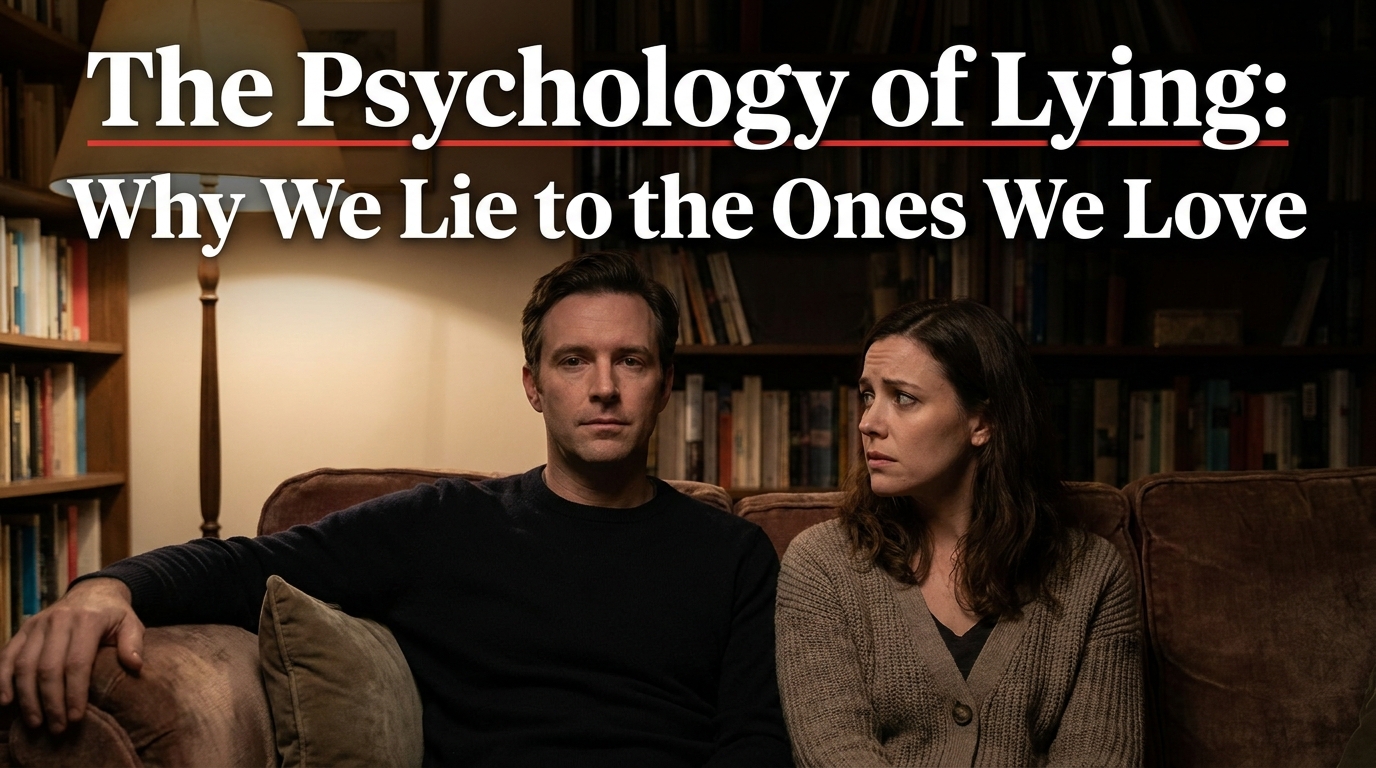
There is a quiet contradiction buried inside every close relationship — the people we love most are also the people we are most likely to deceive. Not strangers. Not colleagues. Not acquaintances. The ones we share our beds, our dreams, and our deepest fears with. If that makes you uncomfortable, it should. But it should also make you curious, because the psychology of lying is far more complex, far more human, and far more deeply wired into our brains than most of us are willing to admit.
A landmark study by psychologist Bella DePaulo at the University of Virginia found that people lie in approximately one out of every five social interactions. More strikingly, her research revealed that we lie more frequently to people we are emotionally close to than to strangers — not less. A separate 2021 study published in the Journal of Personality and Social Psychology confirmed that deception in romantic relationships is not rare behavior. It is, in many cases, a consistent and patterned response to emotional vulnerability.
This is not an article designed to make you distrust the people you love. It is an article designed to help you understand them — and yourself — at a level most conversations about honesty never reach.

The Psychology of Lying: What Science Says About Deception
The psychology of lying begins not with morality, but with the brain. When a human being chooses to deceive — consciously or otherwise — a surprisingly complex neurological sequence takes place. Brain imaging studies using fMRI technology have shown that lying activates multiple regions of the brain simultaneously, including the prefrontal cortex, the anterior cingulate cortex, and the limbic system.
The prefrontal cortex, responsible for decision-making and impulse control, works overtime during deception. It suppresses the truth and constructs the alternative narrative simultaneously — a cognitively demanding task that explains why sustained, complex lying is mentally exhausting. The anterior cingulate cortex monitors for conflict between competing thoughts — in this case, the truth and the lie — and signals discomfort. The limbic system regulates the emotional response: the guilt, the anxiety, the fear of being discovered.
What this means is profound. Lying is not a passive act. It is an active, energy-consuming psychological process. The brain essentially fights itself every time a lie is constructed — which explains why most people experience some form of discomfort when they deceive, even when the deception appears effortless on the surface.
There is also the matter of practice. Research by Tali Sharot and colleagues at University College London demonstrated through neural scanning that the amygdala — the brain’s emotional alarm system — shows reduced activation with each successive lie. In simple terms, the more you lie, the less your brain protests. Dishonesty, at a neurological level, is a muscle. And like any muscle, it strengthens with repeated use.
Why We Lie to the People We Love Most
This is the question that sits at the core of the psychology of lying in relationships. If we love someone, why do we deceive them? The answer is not one thing. It is a layered, psychologically dense web of reasons — some selfish, some protective, some so deeply unconscious that the person doing the lying would genuinely deny it is happening.
Fear of Emotional Consequences
The single most common driver of relationship deception is fear. Not fear of the other person — fear of what honesty will cost. We lie to avoid conflict, to sidestep disappointment, to prevent the painful unraveling of a conversation we have already played out in our heads and dreaded. When we anticipate that the truth will cause pain — to us, to them, or to the relationship itself — the brain begins to calculate an alternative route almost automatically.
This is particularly pronounced in relationships where emotional safety has never been fully established. If previous experiences of honesty have been met with overreaction, punishment, or withdrawal, the nervous system learns quickly that transparency is dangerous. Deception becomes a survival strategy wrapped in the language of love.
The Need for Autonomy
Psychologists describe a phenomenon called “reactance” — the psychological impulse to resist perceived threats to personal freedom. In relationships, particularly long-term partnerships, this manifests as lying about small things: where you were, what you spent, how you really felt about something. Not because the truth is catastrophic, but because the act of full disclosure can feel suffocating.
This is especially common in relationships with a strong power imbalance or with a partner who monitors, controls, or interrogates. In these cases, lying becomes an act of self-preservation — a way of maintaining an interior life that feels like your own when the relationship has absorbed everything else.
Altruistic Deception — Lying Out of Love
Not all lies in relationships are self-serving. Research has consistently shown that a significant percentage of deception between romantic partners falls into what psychologists call “altruistic” or “prosocial” lying — deception intended to protect the other person’s feelings rather than serve the liar’s interests.
You tell your partner their cooking is wonderful when it is not. You say you are fine when you are struggling, because you do not want to add to their stress. You withhold a truth about their appearance, their work, their decision — not because you are manipulating them, but because you genuinely cannot bear to be the source of their pain.
These lies feel different from betrayal-level deception. And in many ways, they are. But they carry their own set of consequences — particularly the way they slowly erode authentic intimacy, replacing it with a carefully managed version of reality that neither person fully inhabits.
“We lie to the people we love not always because we want to hide from them — but because we are terrified of what the truth might do to them, to us, or to the fragile thing we have built together.”

The Different Types of Lies We Tell in Relationships
Understanding the psychology of lying requires distinguishing between categories of deception, because not all lies carry the same weight, motivation, or consequence.
White Lies
These are the smallest unit of deception — low-stakes, socially lubricating, and often entirely automatic. “You look great.” “I’m not upset.” “I forgot to reply.” White lies are so embedded in daily interaction that most people do not register them as deception at all. They exist primarily to smooth social friction and protect emotional comfort — our own and others’.
The problem with white lies is not their individual size. It is their cumulative effect. A relationship built on a consistent foundation of small untruths trains both partners to accept a filtered version of reality — and when a larger truth finally emerges, there is no established infrastructure for receiving it honestly.
Lies of Omission
Perhaps the most psychologically sophisticated form of deception, lies of omission involve deliberately withholding information that the other person would consider relevant. Nothing false is stated outright. But the incomplete picture functions as effectively as any direct lie.
“How was your night?” “Fine, I stayed in.” — technically accurate, but with the evening’s most significant event deliberately erased. Lies of omission are particularly insidious because they provide the liar with plausible deniability. I never actually lied. And yet the effect on trust, when the omission is discovered, is often indistinguishable from direct deception.
Defensive Lies
These emerge when a person lies specifically to avoid accountability — to escape punishment, criticism, or confrontation. They are often impulsive, constructed in the moment under emotional pressure, and frequently layered on top of each other as the original deception requires ongoing maintenance.
Defensive lies are the most commonly associated with relationship betrayal. An affair. A financial secret. An addiction. A hidden friendship. The initial act may or may not have been intentional deception, but the ongoing concealment almost always is — and the psychological toll on both parties is enormous.
Delusional Self-Deception
This is perhaps the most uncomfortable category to examine — lying not just to your partner, but to yourself. Psychologists refer to this as self-deception, and it is more common than most people acknowledge.
When we minimize our role in a conflict, when we convince ourselves our partner is “too sensitive” to handle the truth, when we reframe our hurtful behavior as justified — we are not just lying to them. We are lying to ourselves. And self-deception is particularly resistant to change because the person has no conscious awareness that deception is occurring at all.
How Lying Shapes Relationship Dynamics Over Time
The long-term psychological impact of deception in relationships extends far beyond the moment of discovery. Lies — even those never uncovered — alter the architecture of a relationship in ways both partners often cannot fully articulate.
Trust, once established, operates as what researchers call a “cognitive shortcut.” When we trust someone, we stop consciously evaluating every statement they make. We extend a baseline assumption of honesty that frees up enormous amounts of mental and emotional energy.
Deception breaks that shortcut. Once a lie is discovered — or even strongly suspected — the brain switches from trust mode to surveillance mode. The partner who was deceived begins unconsciously analyzing statements, searching for inconsistencies, monitoring body language, reinterpreting past memories through the new lens of doubt. This is not paranoia. It is the brain doing exactly what evolution designed it to do: protecting you from future harm.
The problem is that surveillance mode is exhausting. It consumes emotional and cognitive resources that were previously invested in intimacy, connection, and genuine partnership. Over time, a relationship living under sustained mistrust becomes a relationship that functions primarily as a monitoring exercise — with genuine closeness becoming increasingly impossible.
For the person who lied, the psychological burden is equally significant. Maintaining a deception requires constant cognitive management. Every new interaction must be filtered through the existing lie. Memory becomes a liability. Spontaneity becomes dangerous. The psychological experience of sustained deception has been compared by researchers to carrying a hidden weight — one that invisibly shapes posture, tone, and presence in ways the other person may sense long before they can name.
“A lie does not end when the words leave your mouth. It lives inside the relationship, quietly reshaping everything around it, long before anyone finds out the truth.”

The Role of Attachment Style in Deception
Attachment theory does not just explain how we love — it explains how we lie. The way you were attached to your primary caregivers in childhood has a profound and often underestimated impact on your relationship with honesty as an adult.
Anxiously Attached Individuals lie primarily out of fear of abandonment. They withhold truths, manage their partner’s perception of them, and construct idealized versions of themselves and the relationship to prevent the other person from leaving. Their deception is driven not by indifference but by overwhelming attachment — the terror that the truth will cost them the relationship entirely.
Avoidantly Attached Individuals lie primarily to protect their autonomy. They may conceal feelings, minimize connection, or deny the significance of the relationship to maintain emotional distance and control. Their deception is often unconscious — a reflexive defense against the vulnerability that genuine honesty requires.
Securely Attached Individuals are significantly less likely to engage in sustained deception in relationships, because their internal model of relationships is built on the foundational belief that honesty is survivable — that the truth, even when painful, will not destroy the bond or their place within it.
Understanding your own attachment style — and your partner’s — does not excuse deception. But it does provide a psychologically informed map of where the lies are likely coming from and what they are actually trying to protect.

Can a Relationship Survive Deception — And Can Honesty Be Rebuilt?
This is the question most people arrive at eventually, after the shock of discovery settles and the real work begins. The honest answer is: it depends. Not on the size of the lie, though that matters. It depends primarily on three factors — the willingness of the person who lied to take full, undefended accountability; the willingness of the person who was lied to, to eventually move toward forgiveness without weaponizing it indefinitely; and the presence of a genuine shared commitment to building something new and more honest in the aftermath.
Research on relationship recovery after deception — including studies on post-infidelity repair — consistently shows that the most critical variable is not what happened, but how it is handled afterward. Partners who survive betrayal and build stronger relationships tend to share one specific quality: they used the crisis as a doorway rather than a dead end.
Rebuilding honesty is a daily practice, not a single conversation. It requires the person who deceived to develop a new relationship with transparency — not just in the absence of lies, but in the active, sometimes uncomfortable practice of radical truth-telling. It requires the person who was deceived to gradually extend trust again in small increments rather than demanding an impossible guarantee of future honesty.
Couples therapy is one of the most evidence-supported environments for this process. A skilled therapist can create a psychologically safe container for both partners to speak truths that feel too dangerous to say alone, and to begin the slow reconstruction of a shared reality built on something more durable than managed perception.
How to Build a Culture of Honesty in Your Relationship
You do not have to wait for a crisis to make honesty the foundation of your relationship. The conditions that make honesty feel safe or dangerous are built slowly, in thousands of small daily interactions. Here is how to begin constructing an environment where both of you can eventually tell the truth without fear.
Make it safe to be imperfect. Relationships where one partner responds to every mistake, every uncomfortable truth, every difficult admission with criticism, anger, or withdrawal, will always produce lying. Not because the other person is dishonest by nature, but because they have learned that honesty has a cost they cannot consistently afford.
Stop punishing honesty. When your partner tells you something you do not want to hear, resist the impulse to retaliate. Your response to their truth becomes the data their brain uses to decide whether to tell you the next one.
Create regular space for emotional transparency. Weekly check-ins where both partners speak about how they are genuinely feeling — about the relationship, about themselves, about what they need — normalize honest conversation before it becomes urgent.
Model the honesty you want. If you want a partner who tells you the truth, examine your own relationship with honesty first. The standards you hold others to are most powerful when you apply them to yourself with equal rigor.

Final Thoughts: The Truth About Lying in Love
The psychology of lying does not paint human beings as fundamentally dishonest creatures. It reveals us as fundamentally frightened ones — afraid of rejection, afraid of conflict, afraid of the enormity of being fully known by another person and still chosen.
Every lie told inside a relationship is, at its root, a communication about fear. Fear of losing the person. Fear of losing the self. Fear of what the truth will unmake. Understanding that does not make deception acceptable. But it does make it comprehensible — and compassion and comprehension are the only places where genuine change can begin.
If you have been lied to, your pain is valid and your need for honesty is not negotiable. If you have been the one doing the lying, your fear is understandable — and so is the work you now need to do.
The goal is not a relationship free from all imperfection. The goal is a relationship where the truth — even when it is hard, even when it costs something — is still chosen. Because that is what real love, at its most honest and most courageous, actually looks like.
💾 Save this article — understanding the psychology of your relationship starts here.
📤 Share it with someone who deserves to understand why people lie to the ones they love.
➕ Follow Truthsinside.com for psychology and relationship content that goes deeper than the surface.
📃 Related article: Signs He Likes You But Is Scared: 18 Behaviors Men Show When Afraid to Commit
Frequently Asked Questions
Q1: Is it normal to lie to someone you love?
Yes — statistically and psychologically, it is extremely common. Research shows that deception in close relationships is a near-universal human experience. This does not make it acceptable or harmless, but it does mean that experiencing or practicing some form of relational deception does not make a person uniquely dishonest or unworthy of love. What matters most is awareness, accountability, and the willingness to do better.
Q2: What is the difference between a harmless white lie and a damaging deception?
The primary distinctions are intent, impact, and pattern. A white lie told to spare someone unnecessary pain in a low-stakes situation is psychologically different from sustained deception about something significant. The clearest indicator of whether a lie is harmful is this: if the other person discovered it, would they feel their trust had been violated? If the answer is yes, it crosses into territory that deserves serious attention.
Q3: Why do people lie even when they know they will probably get caught?
This is one of the most psychologically fascinating aspects of deception. Research suggests several reasons — the immediate emotional relief of avoiding confrontation outweighs the anticipated consequence; the brain underestimates detection probability in emotionally charged moments; and for some individuals, particularly those with anxious attachment, the risk of future discovery feels less threatening than the certainty of present conflict.
Q4: Can someone who has lied repeatedly in relationships genuinely change?
Yes — but change of this depth requires more than intention. It requires psychological insight into the drivers of the deception, often developed through therapy; consistent behavioral practice over an extended period; and the capacity to tolerate the discomfort of honesty even when every instinct says to conceal. Change is possible. It is also rarely linear, and it requires patience from both the person changing and the person watching them try.
Q5: How do I know if my partner is being honest with me now after a past betrayal?
Trust after betrayal is rebuilt incrementally through consistent, observable behavior over time — not through declarations or promises. Watch for alignment between words and actions. Notice whether your partner’s honesty extends to small, low-stakes moments — not just the big ones. And pay attention to your own nervous system. Genuine trust, when it begins to return, has a particular quality of ease that is distinct from the forced calm of trying to believe someone you are not yet sure of.
🎵 Music
Maren Lull is a singer-songwriter who writes from the places most people don’t talk about out loud.
Not the dramatic grief. Not the obvious heartbreak. The quiet kind — the ordinary Tuesday emptiness, the habit of reaching for someone who isn’t there anymore, the particular exhaustion of being strong for so long that the strength itself wears thin.
Her music lives at the intersection of emotional honesty and soft beauty — breathy vocals over gentle piano, slow tempos, lyrics that feel less like songs and more like something you wrote in a private notebook at two in the morning and never showed anyone.
Maren Lull writes for the people who feel everything deeply and say very little about it. For the ones who listen to sad music not because they want to feel worse — but because being understood, even by a song, makes the feeling easier to carry.
📱 Follow Maren Lull:
→ Spotify
→ Apple Music
→ Youtube
→ Audiomack