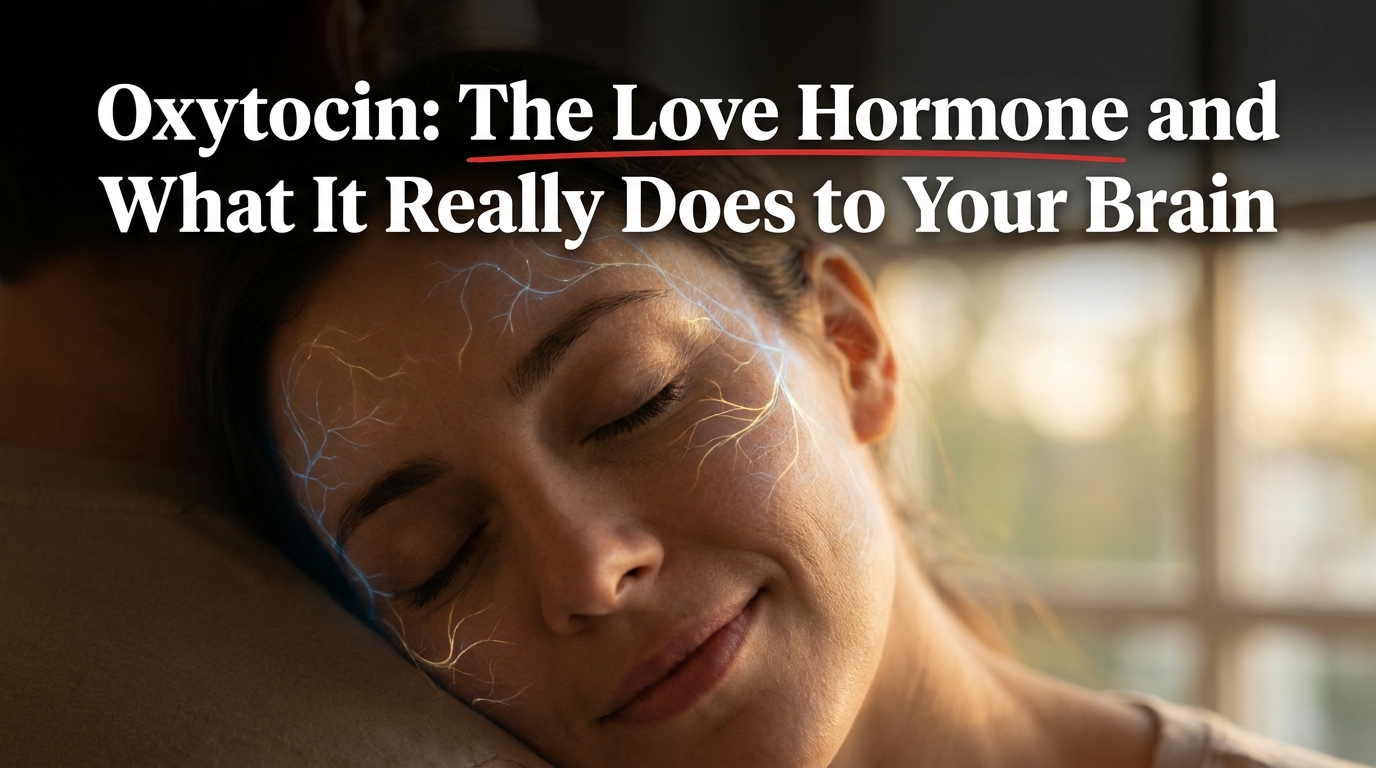
You have probably heard it called the “love hormone” — the chemical your brain releases when you hug someone you care about, when a mother holds her newborn for the first time, when two people reach across the ordinary distance of daily life and genuinely touch. And that description is not wrong, exactly. But it is radically incomplete. Oxytocin the love hormone is one of the most studied, most misunderstood, and most fascinating neurochemicals in the human brain — and what the science actually reveals about what it does goes far beyond the warm, soft narrative that popular culture has built around it.
A landmark study published in Neuron found that oxytocin does not simply generate love and bonding — it amplifies whatever emotional state is already present, including fear, aggression, and intergroup hostility. The love hormone, it turns out, has a considerably darker and more complex biography than its nickname suggests.
This matters enormously — not just as an intellectual curiosity, but as a practical framework for understanding your own emotional experiences, your relationships, and the neurological forces that shape how you attach, trust, bond, and sometimes hurt the people closest to you.
Understanding oxytocin properly means releasing the simplified, romanticized version and engaging with the actual science — which is considerably more interesting, considerably more nuanced, and considerably more relevant to the lived experience of human love and connection than the greeting-card version allows.
This article is that engagement. A thorough, honest, psychologically and neurologically grounded exploration of what oxytocin the love hormone actually is, what it actually does, where it comes from, and what understanding it means for your relationships and your emotional life.
What Is Oxytocin? The Basic Science
Oxytocin is a neuropeptide — a small protein-like molecule that functions simultaneously as a hormone and a neurotransmitter. It is produced primarily in the hypothalamus, a small but extraordinarily powerful region of the brain that regulates many of the body’s most fundamental functions, including body temperature, hunger, circadian rhythms, and emotional processing.
Once produced in the hypothalamus, oxytocin follows two primary pathways. In its hormonal function, it is released into the bloodstream through the pituitary gland — traveling throughout the body to influence organs, tissues, and physiological processes. In its neurotransmitter function, it is released directly into specific brain regions, where it influences neural communication, emotional processing, and behavioral responses.
This dual function is important to understand because it means oxytocin is not simply doing one thing in one place. It is simultaneously influencing your body’s physiology and your brain’s emotional and behavioral processing — often in ways that interact with and amplify each other.
The Historical Discovery
Oxytocin was first identified in 1906 by British pharmacologist Sir Henry Dale, who discovered that extracts from the human pituitary gland caused uterine contractions. The name itself comes from the Greek words “oxy” (swift) and “tokos” (birth) — reflecting its original identification in the context of labor and childbirth.
For much of the twentieth century, oxytocin was understood primarily as a reproductive hormone — one that facilitated uterine contractions during labor and stimulated milk production and release during breastfeeding. Its role in social bonding and emotional life was not seriously investigated until the 1990s and early 2000s, when a series of landmark studies — many involving the comparison of prairie voles (which are monogamous) and meadow voles (which are not) — began to reveal oxytocin’s extraordinary influence on social attachment and bonding behavior.
Where It Is Made and How It Is Released
The primary site of oxytocin production is a cluster of neurons in the hypothalamus called the paraventricular nucleus and the supraoptic nucleus. These neurons synthesize oxytocin and release it both locally within the brain and peripherally into the bloodstream via the posterior pituitary gland.
Oxytocin release is triggered by a remarkable variety of stimuli — many of them social and physical in nature. Research has identified the following as reliable oxytocin release triggers:
- Physical touch — particularly warm, sustained, non-threatening touch
- Eye contact — especially prolonged mutual gaze
- Social bonding interactions — cooperative behavior, shared laughter, empathic communication
- Sexual activity — particularly orgasm, which produces one of the largest acute oxytocin surges documented
- Breastfeeding — both in the nursing mother and, to a lesser extent, in the infant
- Childbirth — during labor and delivery
- Positive social interactions with familiar individuals
- Interaction with companion animals — stroking a dog or cat produces measurable oxytocin increases in both human and animal
What is notable about this list is how consistently it reflects physical and social closeness with trusted others. Oxytocin is, in a very real sense, the neurological reward system for connection — the brain’s way of reinforcing the behaviors that maintain social bonds.

What Oxytocin the Love Hormone Actually Does — Beyond the Simple Story
The Bonding Function: What Everyone Knows
The role most commonly associated with oxytocin — and the one that earned it the “love hormone” designation — is its function in facilitating social bonding and attachment. This function is real, well-documented, and genuinely extraordinary.
Oxytocin promotes bonding through several interconnected mechanisms:
It reduces the social brain’s threat response. The amygdala — the brain’s primary threat-detection center — is significantly modulated by oxytocin. In the presence of oxytocin, the amygdala becomes less reactive to social threat cues, reducing social anxiety and making approach behavior more likely than avoidance. This is why touch, eye contact, and warm social interaction feel calming — oxytocin is literally quieting the part of your brain that decides whether other people are safe.
It increases trust. A famous 2005 study published in Nature by Ernst Fehr and colleagues administered oxytocin or placebo to participants in a financial trust game and found that oxytocin significantly increased the amount of money participants were willing to entrust to strangers. This was one of the first direct demonstrations of oxytocin’s trust-promoting effects in humans — and it generated enormous excitement in both scientific and popular media.
It promotes empathy and social cognition. Research has shown that oxytocin enhances the ability to read emotional states from facial expressions and social cues — essentially sharpening the social brain’s capacity to understand what others are feeling. It also increases the tendency to attribute positive intentions to others in ambiguous social situations.
It reinforces bonding behaviors. By making social connection feel rewarding — through its interaction with the brain’s dopamine reward systems — oxytocin creates a positive feedback loop that encourages the repetition of bonding behaviors. Touch feels good partly because it releases oxytocin, which feels good, which makes you want more touch, which releases more oxytocin.
It plays a central role in pair bonding. The vole studies that first illuminated oxytocin’s bonding function demonstrated something remarkable: prairie voles, which mate for life and show strong pair bond behavior, have significantly more oxytocin receptors in key brain regions than meadow voles, which do not form pair bonds. Blocking oxytocin receptors in prairie voles disrupted their pair bonding behavior. Administering oxytocin to meadow voles promoted it. The neurological architecture of monogamy, in other words, is significantly shaped by oxytocin receptor distribution.
The Maternal Bonding Function: Where It All Begins
Oxytocin’s role in maternal bonding represents one of its most profound and consequential functions — and one that has deep implications for understanding attachment across the entire lifespan.
During childbirth, oxytocin surges dramatically — facilitating uterine contractions that enable delivery and, simultaneously, beginning the neurological process of mother-infant bonding. In the minutes and hours after birth, skin-to-skin contact between mother and infant produces continued oxytocin release in both parties, helping to establish the foundational attachment relationship from which all subsequent social and emotional development unfolds.
Research has demonstrated that the quality of this early oxytocin-mediated bonding experience has measurable long-term consequences. Studies examining the relationship between early maternal bonding quality and adult attachment patterns find significant correlations — suggesting that the oxytocin system is being calibrated during early life experiences in ways that shape the capacity for secure attachment throughout the lifespan.
This has important implications for understanding adult relationship patterns. People who experienced early disruptions to secure maternal bonding — through illness, separation, neglect, or trauma — may have oxytocin systems that were calibrated differently than those who experienced consistent, responsive early caregiving. This does not determine adult relationship outcomes, but it does shape the neurological baseline from which adult attachment operates.

The Dark Side of the Love Hormone: What Most People Do Not Know
Here is where the science becomes genuinely surprising — and where the simplified “love hormone” narrative begins to significantly mislead.
Oxytocin is not universally prosocial. It does not simply make people more loving, more trusting, and more connected to everyone around them. Its effects are considerably more specific, more context-dependent, and in some situations, more troubling than its popular reputation suggests.
The In-Group / Out-Group Effect
One of the most important and disturbing findings in oxytocin research is what researchers have termed the “in-group / out-group” effect — the discovery that oxytocin promotes bonding and prosocial behavior specifically toward people perceived as belonging to the same group, while simultaneously increasing hostility, suspicion, and competitive behavior toward perceived out-group members.
A landmark 2011 study by Carsten De Dreu and colleagues, published in Science, administered oxytocin to participants in intergroup competition scenarios and found that oxytocin increased both in-group favoritism and out-group derogation. Participants who received oxytocin were more willing to sacrifice out-group members for in-group benefit — a finding with sobering implications for the role of oxytocin in tribal behavior, nationalism, and intergroup conflict.
This finding reframes oxytocin not as a general love molecule but as a parochial bonding molecule — one that strengthens the bonds within groups while simultaneously sharpening the boundaries between them. Love and hostility, in this neurological framework, are not opposites. They are two faces of the same oxytocin-mediated process.
The Amplification Effect
Research published in the journal Neuron by Adam Farago and colleagues revealed something that fundamentally complicates the simple oxytocin-equals-love equation: oxytocin does not generate positive social emotions out of nothing. Instead, it amplifies existing emotional states — making positive social experiences more positive, but also making negative social experiences more negative.
In a safe, positive social context, oxytocin promotes trust, warmth, generosity, and connection. In a threatening, negative social context, it intensifies fear, distress, and defensive aggression. In a context of social rejection, it can deepen the pain of exclusion rather than buffering against it.
This means that oxytocin’s effects are not unconditionally beneficial. The same neurological system that deepens love can deepen jealousy. The same chemistry that bonds can intensify possessiveness. The same molecule that promotes trust in safe relationships can amplify the hypervigilance of people in threatening ones.
Oxytocin and Envy
Research has demonstrated that oxytocin can increase social comparison and envy — specifically the painful experience of comparing your own outcomes unfavorably to others’. A study by Shlomo Hareli and Arie Kruglanski found that oxytocin increased gloating — pleasure at a rival’s misfortune — as well as envy of a rival’s success. These are not the emotions most people associate with the love hormone.
Oxytocin and In-Group Dishonesty
In a particularly striking finding, research by Shaul Shalvi and Carsten De Dreu demonstrated that oxytocin increased dishonest behavior — but only when that dishonesty served to benefit one’s in-group. Participants who received oxytocin were more likely to lie and cheat when doing so benefited their group. The love hormone, in other words, can promote tribal dishonesty in service of group loyalty.
The Dark Side in Romantic Relationships
In the context of romantic relationships specifically, oxytocin’s amplification effect has particular relevance. Research by Simone Shamay-Tsoory and colleagues demonstrated that in romantic contexts, oxytocin increases jealousy in people with anxious attachment styles — amplifying the fear and possessiveness that anxious attachment already generates rather than soothing it.
This helps explain a pattern familiar to many people: why certain relationship dynamics that are already charged with insecurity and anxiety seem to become more intense and more painful rather than more connected, even in the presence of profound physical and emotional intimacy. The intimacy is releasing oxytocin. The oxytocin is amplifying the anxiety that is already present. And the result is an intensity that feels like passionate love but operates partly through pain.
“Oxytocin the love hormone does not simply make you love more. It makes you feel more — whatever you are already feeling. In a safe, loving relationship, it deepens the bond. In an anxious, insecure one, it can deepen the fear. The molecule is not choosing. It is amplifying.”

Oxytocin and Attachment Styles — The Critical Connection
One of the most practically significant bodies of oxytocin research concerns its relationship to attachment styles — the enduring patterns of relating to others in intimate relationships that are shaped by early bonding experiences and persist, with varying degrees of modification, throughout adult life.
Secure Attachment and Oxytocin
People with secure attachment styles — those who are comfortable with both intimacy and independence, who trust others without excessive anxiety about abandonment or engulfment — tend to show the most straightforwardly positive responses to oxytocin. For securely attached individuals, oxytocin’s trust-promoting, anxiety-reducing, and empathy-enhancing effects operate relatively cleanly. Physical closeness and positive social interaction release oxytocin. Oxytocin reduces threat response. Reduced threat response allows deeper connection. Deeper connection releases more oxytocin. A genuinely virtuous cycle.
Anxious Attachment and Oxytocin
For people with anxious attachment styles — characterized by intense fear of abandonment, hypervigilance to signs of rejection, and a strong drive toward closeness — the oxytocin story is considerably more complicated.
Research indicates that anxiously attached individuals may have dysregulated oxytocin systems — showing different patterns of oxytocin release and different receptor sensitivity than securely attached individuals. Crucially, as noted above, oxytocin in anxiously attached people can amplify anxiety rather than soothe it, intensify jealousy rather than reduce it, and increase the painful hypervigilance to social threat cues rather than quieting it.
This creates a painful paradox: the people who most desperately seek closeness — who are most driven toward the touch, eye contact, and intimacy that trigger oxytocin release — may be the people for whom oxytocin’s effects are most likely to be amplifying their distress alongside their connection.
Avoidant Attachment and Oxytocin
People with avoidant attachment styles — characterized by discomfort with closeness, a preference for emotional self-sufficiency, and a tendency to withdraw when intimacy intensifies — show yet another pattern. Research suggests that avoidantly attached individuals may show reduced sensitivity to oxytocin’s social approach-promoting effects, or may actively suppress the social approach tendencies that oxytocin promotes in order to maintain their preferred emotional distance.
For avoidantly attached people, the behaviors that most reliably release oxytocin — sustained physical closeness, emotionally vulnerable communication, and mutual gazing — are precisely the behaviors that feel most threatening to their regulatory strategy. The neurological system that is trying to promote connection is running directly against the psychological defensive system that is trying to prevent it.
Understanding these attachment-oxytocin dynamics does not resolve attachment difficulties — that requires deeper psychological work. But it provides a neurological framework for understanding why certain relationship patterns feel so driven, so painful, and so resistant to simple rational intervention.
Oxytocin in the Context of Trauma
The relationship between oxytocin and trauma is one of the most important and least commonly discussed dimensions of this research — and one with profound implications for understanding why trauma so profoundly disrupts the capacity for intimacy and trust.
Traumatic experiences — particularly interpersonal trauma, including childhood abuse, neglect, and exposure to domestic violence — significantly dysregulate the oxytocin system. Research has found that adults with histories of childhood maltreatment show altered patterns of oxytocin release and reduced oxytocin receptor sensitivity compared to individuals without such histories.
This dysregulation has specific consequences. The system that is supposed to make social closeness feel safe and rewarding has been calibrated, through early experience, to associate closeness with danger. The neurological signal that should say “this person is safe, move toward them” has been corrupted by a history of contexts in which closeness was followed by harm.
For trauma survivors, this means that the ordinary triggers of oxytocin release — touch, eye contact, emotional vulnerability, physical intimacy — may trigger defensive or dysregulated responses rather than the connection and safety they are supposed to promote. Not because the person is choosing this response. But because the oxytocin system itself has been shaped by a history that made the response adaptive.
Emerging research is examining the potential role of oxytocin in trauma treatment — with some studies investigating whether carefully administered oxytocin can help recalibrate the social trust systems of trauma survivors in the context of therapy. The findings are preliminary and complex — reflecting the fact that for trauma survivors, oxytocin’s amplification effect means that introducing it without a safe, therapeutic context can intensify distress rather than reduce it.
This underscores a critical point: oxytocin is not a love drug that can be administered or triggered to produce connection in any context. Its effects are always mediated by the individual’s neurological history, attachment calibration, and the safety of the current context.

How Oxytocin Actually Gets Released — Practical Implications for Your Relationships
Understanding what triggers oxytocin release has immediate, practical relevance for how you approach connection in your most important relationships. Here is what the research actually supports:
Touch is the most reliable trigger — and it is specific.
Not all touch releases oxytocin equally. Research indicates that warm, sustained, non-threatening touch — the kind associated with comfort and affection rather than sexual charge or social obligation — is the most reliable oxytocin trigger. Specifically:
Slow, gentle stroking at approximately five centimeters per second has been identified as activating a specific class of nerve fibers called C-tactile afferents that are particularly effective at triggering central oxytocin release. This is not random — it is the speed of a gentle caress, a comforting hand on the back, a slow stroke of someone’s hair. The nervous system has evolved a dedicated pathway for exactly this kind of touch.
Hugging — particularly prolonged hugging of twenty seconds or more — produces measurable oxytocin increases and has been associated with reduced blood pressure and cortisol levels in research by Kathleen Light and colleagues at the University of North Carolina.
Eye contact matters more than most people realize.
Mutual gazing — the sustained, warm eye contact between people who feel safe with each other — is a powerful oxytocin trigger. Research has documented this in both human-human and human-dog interactions. The familiar feeling of looking into the eyes of someone you love and feeling a flood of warmth is, in part, a real neurological event — oxytocin being released in response to a social signal of mutual recognition and safety.
Genuine laughter and shared positive experience.
Spontaneous, genuine laughter — particularly shared laughter between people who feel comfortable with each other — has been associated with oxytocin release. This provides a neurological basis for the widely observed relationship between a couple’s capacity for genuine shared humor and their overall relationship satisfaction.
Acts of generosity and cooperation.
Research indicates that cooperative, generous behavior — giving to others, working together toward a shared goal — triggers oxytocin release. This creates a positive feedback loop: oxytocin promotes generosity, and generous behavior releases more oxytocin. Understanding this loop has implications for how couples navigate the maintenance of their connection — specifically, the finding that doing things for each other and working together on shared goals is not just emotionally meaningful but neurologically reinforcing.
“Every time you choose to reach for the person you love — with your hands, your eyes, your laughter, your honest words — you are doing something measurable in the brain. You are releasing the chemistry that makes the bond real. Connection is not just emotional. It is biological.”
Oxytocin, Social Media, and the Modern Intimacy Problem
One of the most significant and underexplored implications of oxytocin research concerns the substitution of digital interaction for physical presence in the maintenance of social bonds.
The activities that most reliably trigger oxytocin release — physical touch, sustained eye contact, genuine face-to-face laughter, physical co-presence — are precisely the activities that digital communication cannot replicate. A text message, however warm its content. A social media like, however appreciated. A video call, however genuine its connection. None of these activates the C-tactile nerve fibers that warm touch activates. None produces the sustained mutual gaze of genuine face-to-face presence. None provides the nervous system co-regulation of physical proximity to a trusted other.
This has measurable consequences. Research on loneliness consistently finds that social media use — even intensive, regular social media use — does not reduce loneliness the way face-to-face social interaction does. The brain’s oxytocin system is not being adequately triggered by digital interaction, regardless of how connected the person may feel in a cognitive sense.
This is not an argument against digital communication — it is an irreplaceable tool for maintaining relationships across distance and time constraints. It is an argument for the irreplaceable value of physical presence, physical touch, and face-to-face connection as the primary fuel for the oxytocin system that underlies human social wellbeing.
In an era of increasing digital mediation of relationships, this represents a genuine public health consideration. The rising rates of loneliness — particularly among young adults who maintain extensive digital social networks — may reflect, in part, the insufficient activation of an oxytocin system that requires physical presence to function optimally.

Practical Takeaways: What Understanding Oxytocin Means for Your Life and Relationships
The science of oxytocin is not merely academically interesting. It has concrete, practical implications for how you approach the most important relationships in your life:
Protect and prioritize physical touch in your close relationships.
Given what the research demonstrates about touch as the most reliable oxytocin trigger, the gradual erosion of physical affection in long-term relationships — the decline in casual touch, in non-sexual physical closeness, in the simple act of reaching for your partner’s hand — is not just emotionally significant. It is neurologically significant. Couples who maintain regular, warm physical contact are continuously fueling the oxytocin system that underlies their bond.
Understand that the intensity of early love is a neurological state, not a permanent baseline.
The extraordinary oxytocin surges of early romantic love — which contribute significantly to the intensity and certainty of that experience — naturally moderate over time. This moderation is not the death of love. It is the transition from the neurological state of infatuation to the neurological state of attachment — a different, quieter, but equally real bond that is maintained by the ongoing, ordinary practices of physical closeness, genuine communication, and shared positive experience.
Recognize your own attachment-oxytocin patterns.
If you identify with anxious attachment, understanding that oxytocin’s effects may amplify your anxiety rather than simply soothing it is practically important. It means that the intensity of your feelings in close relationships is not pure evidence of their quality or your partner’s behavior — some of it is your own neurological amplification at work. This does not make the feelings less real, but it makes them more interpretable — and therefore more manageable.
Use the oxytocin system deliberately in conflict repair.
Research supports the practice of physical touch during or after conflict as a genuine tool for nervous system regulation and connection repair. This runs counter to the instinct — particularly for avoidantly attached individuals — to increase physical distance during emotional difficulty. A hand on the arm during a difficult conversation, a hug before the discussion begins, a physical gesture of connection after a repair attempt — these are not empty gestures. They are neurological signals.
Prioritize face-to-face time as a non-negotiable relationship investment.
Given what the research demonstrates about digital interaction’s inability to adequately activate the oxytocin system, treating face-to-face time with close others as a genuine, non-negotiable priority — not something that happens when everything else is done, but something scheduled and protected — is a legitimate and evidence-based approach to maintaining relationship health and personal wellbeing.
The Future of Oxytocin Research
The science of oxytocin is still actively developing, and several frontiers of current research promise to significantly deepen — and in some cases further complicate — our understanding.
Oxytocin in clinical treatment. Researchers are investigating oxytocin’s potential therapeutic applications in conditions including autism spectrum disorder, social anxiety disorder, schizophrenia, borderline personality disorder, and PTSD. Early results are mixed — reflecting the complexity of the amplification effect and the importance of context — but the research is active and promising.
Individual differences in oxytocin receptor genetics. Research has identified specific genetic variants in the oxytocin receptor gene that are associated with differences in social behavior, empathy, stress response, and relationship quality. This suggests that some of the individual variation in how people experience and respond to social connection may have a genuine genetic component mediated by the oxytocin receptor system.
Oxytocin across the lifespan. Emerging research is examining how oxytocin system function changes across the lifespan — particularly in aging, where some research suggests that the social motivation system becomes recalibrated in ways that prioritize emotional quality of relationships over social breadth.
The gut-brain oxytocin axis. Recent research has identified oxytocin production in the gut and is investigating the relationship between gut microbiome health, oxytocin signaling, and social behavior — a frontier with potentially significant implications for understanding the mind-body dimensions of social wellbeing.
Final Thoughts
Oxytocin the love hormone is real. Its role in bonding, trust, empathy, and human connection is real, documented, and genuinely extraordinary. The warmth you feel when someone you love holds you, the surge of tenderness when a child takes your hand, the particular calm of being in the presence of someone your nervous system recognizes as safe — these are, in part, oxytocin. And they are among the most important experiences available to human beings.
But oxytocin is also complex, context-dependent, and capable of amplifying darkness as readily as it amplifies light. The love hormone is not unconditionally kind. It is powerful — and like all powerful things, its effects depend enormously on the environment in which it operates.
Understanding this does not diminish the beauty of what oxytocin makes possible. It deepens it. Because a love that is understood — including its neurological architecture, its vulnerabilities, and its genuine complexity — is a love that can be consciously cultivated, deliberately protected, and honestly maintained.
Reach for the people you love. Not just emotionally — physically. With your hands, your eyes, your sustained presence. The chemistry will follow. And the chemistry, once you understand it, is one of the most remarkable things about being human.
Save this article — for the next time someone tells you that love is just a feeling.
Share it with someone who would find it fascinating to understand the biology beneath the emotion they have felt most deeply.
Follow Truthsinside.com for more psychology-rooted, science-grounded content on love, the brain, and the human experience of connection.
Related article: Signs He Likes You But Is Scared: 18 Behaviors Men Show When Afraid to Commit
Frequently Asked Questions
Q1: Can you increase oxytocin naturally without medication?
Yes — and research supports several reliable methods. Regular physical affection with trusted others is the most potent natural trigger. Beyond touch, activities including sustained eye contact with loved ones, acts of generosity and cooperation, genuine laughter in social settings, caring for animals, and engaging in meaningful face-to-face conversation all produce measurable oxytocin increases. Exercise — particularly group exercise — also triggers oxytocin release. The most important principle is that oxytocin is a social molecule: it is most reliably and most beneficially triggered by genuine connection with trusted others.
Q2: Is the “oxytocin nasal spray” available as a treatment, and does it work?
Synthetic oxytocin administered intranasally has been used extensively in research settings to investigate oxytocin’s behavioral effects — and it is this research that underlies much of what we know about the molecule’s social functions. However, the clinical applications of intranasal oxytocin are still under investigation. Results in conditions like autism spectrum disorder and social anxiety have been mixed — reflecting the complexity of oxytocin’s context-dependent amplification effects. Intranasal oxytocin is not currently approved as a clinical treatment for social or psychiatric conditions in most jurisdictions, though research continues actively.
Q3: Why does physical intimacy sometimes increase anxiety rather than connection?
This is one of the most important and least commonly understood dimensions of oxytocin’s function. For individuals with anxious attachment styles, trauma histories, or dysregulated oxytocin systems, the amplification effect of oxytocin means that physical intimacy can intensify existing anxiety, fear, or hypervigilance rather than soothing it. The oxytocin is doing what it is supposed to do — amplifying the dominant emotional state — but the dominant emotional state in these contexts is anxiety rather than safety. This is not a personal failure. It is a neurological pattern that can be understood, addressed through therapy, and gradually recalibrated through repeated experiences of safe, genuine connection.
Q4: Does oxytocin affect men and women differently?
Research does suggest some sex-based differences in oxytocin function, though the picture is complex and still developing. Estrogen appears to enhance oxytocin receptor sensitivity — meaning that in contexts where estrogen is higher, the same amount of oxytocin may produce stronger effects. Some research suggests that testosterone can partially counteract certain oxytocin effects. Studies have also found some differences in how oxytocin influences social behavior across sexes in specific experimental contexts. However, the fundamental social bonding and amplification functions of oxytocin appear to operate similarly across all humans, regardless of sex.
Q5: Can oxytocin make you bond with the wrong person?
This is one of the most practically significant questions about oxytocin — and the honest answer is: yes, it can contribute to bonding in contexts where the bonding is not in your best interest. Because oxytocin is released through physical intimacy, consistent physical contact can promote feelings of attachment and trust toward a person even when the relationship is not genuinely safe, healthy, or mutual.
This is one of the neurological mechanisms that may contribute to the difficulty of leaving intimate relationships that are harmful — the oxytocin-mediated bond is real, even when the relationship itself is damaging. Understanding this is not a reason to avoid intimacy — it is a reason to bring conscious awareness to the difference between neurochemical bonding and genuine relational safety.
🎵 Music
Maren Lull is a singer-songwriter who writes from the places most people don’t talk about out loud.
Not the dramatic grief. Not the obvious heartbreak. The quiet kind — the ordinary Tuesday emptiness, the habit of reaching for someone who isn’t there anymore, the particular exhaustion of being strong for so long that the strength itself wears thin.
Her music lives at the intersection of emotional honesty and soft beauty — breathy vocals over gentle piano, slow tempos, lyrics that feel less like songs and more like something you wrote in a private notebook at two in the morning and never showed anyone.
Maren Lull writes for the people who feel everything deeply and say very little about it. For the ones who listen to sad music not because they want to feel worse — but because being understood, even by a song, makes the feeling easier to carry.
📱 Follow Maren Lull:
→ Spotify
→ Apple Music
→ Youtube
→ Audiomack