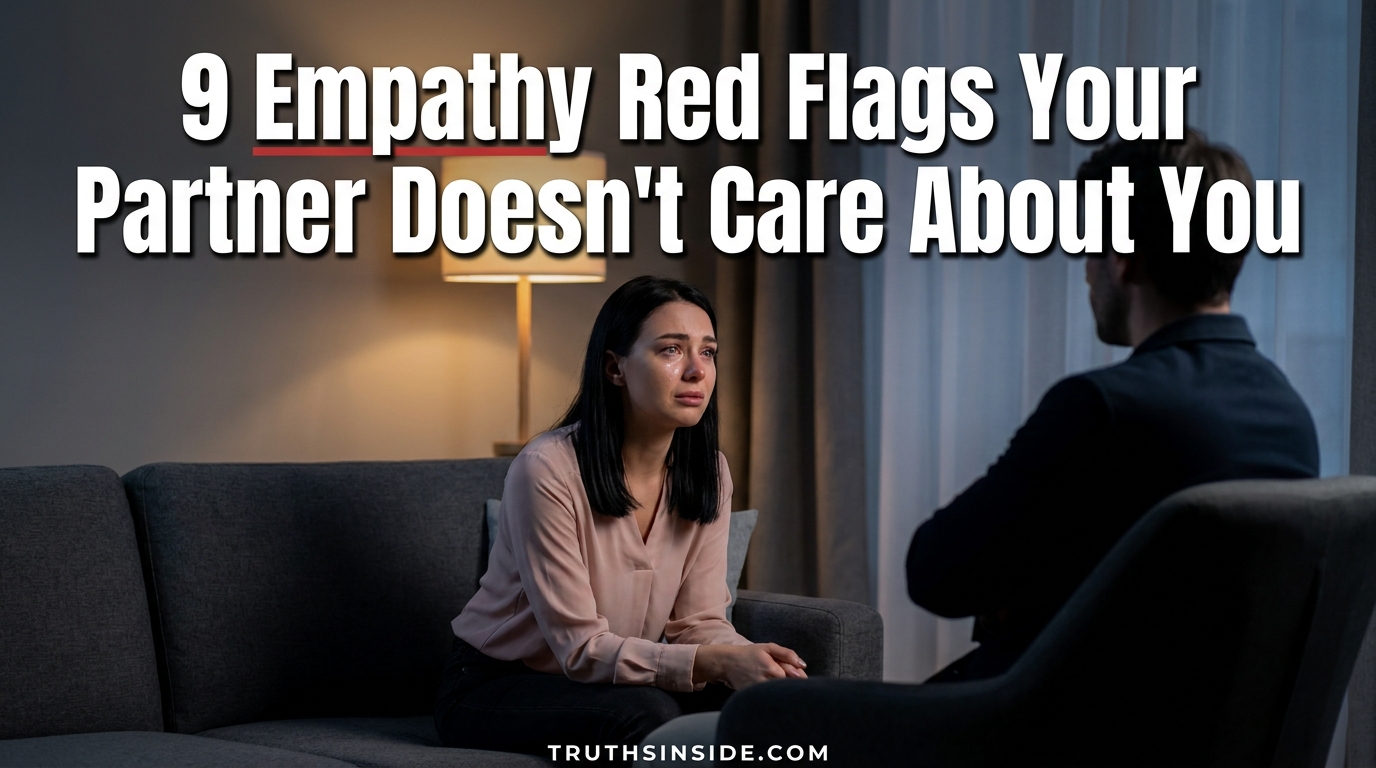
Empathy red flags are some of the most painful and damaging warning signs in any relationship — and they are also among the easiest to miss until real harm has already been done.
If you have ever tried to share something painful with your partner only to be met with silence, dismissal, or an immediate pivot to their own feelings, you already know what it feels like to reach for someone and find nothing there. According to a landmark study published in the journal Social Neuroscience, consistent lack of empathy in close relationships is one of the strongest predictors of long-term emotional damage to the receiving partner — including increased rates of anxiety, depression, and chronic self-doubt. That is not a small finding. It means that who you choose to love and how they respond to your emotional world has a measurable impact on your mental health.
What makes empathy red flags particularly insidious is that they rarely announce themselves loudly. There is no dramatic moment where your partner declares “I do not care about your feelings.” Instead, it happens quietly — through a thousand small moments of dismissal, through conversations that always somehow circle back to them, through the creeping realization that you have stopped sharing how you truly feel because experience has taught you it will not be received with care.
This article is for anyone who has ever questioned whether what they are experiencing is real. It is real. Your need to be emotionally seen by the person you love is not too much to ask — it is one of the most fundamental human needs in any intimate relationship. What follows are the most telling empathy red flags to recognize, understand, and take seriously before they cost you more than they already have.
What Is Empathy in a Relationship — and Why Does It Matter So Much?
Before identifying the red flags, it is important to understand what genuine empathy in a relationship actually looks like — because many people have been in empathy-deficient relationships for so long that they have lost the baseline of what healthy emotional responsiveness feels like.
Empathy in a relationship is not simply feeling sorry for your partner when they are upset. It is the active, consistent ability to step outside your own perspective and genuinely engage with your partner’s emotional experience — to feel with them, not just about them. Psychologist and relationship researcher Dr. Brené Brown defines empathy as choosing to be present with someone in their pain rather than trying to silver-line it, fix it, or make it about yourself.
In a healthy relationship, empathy looks like this: your partner notices when something is wrong even before you say anything. They ask questions that show they are genuinely trying to understand — not questions designed to defend themselves or redirect. They hold space for your feelings without immediately jumping to solutions. They validate your emotional experience even when they do not fully share it. And perhaps most importantly, they remember the things that matter to you — because your emotional world lives in their awareness, not just in yours.
When this is consistently absent, the relationship does not simply feel less warm. It begins to feel psychologically unsafe. And a relationship that is not emotionally safe is one that is slowly causing harm — regardless of what it looks like from the outside.

9 Empathy Red Flags That Signal Your Partner Simply Does Not Care How You Feel
Red Flag 1 — They Dismiss Your Feelings as an Overreaction
One of the clearest and most damaging empathy red flags is consistent dismissal. When you express that something hurt you — that a comment stung, that a situation made you anxious, that you felt left out or disrespected — and your partner’s automatic response is “you are being too sensitive,” “you are overreacting,” or “here we go again,” that is not a communication style difference. That is a refusal to validate your emotional reality.
Dismissal is particularly harmful because it does not just fail to address the original hurt — it adds a second layer of pain by communicating that your feelings themselves are the problem. Over time, repeated dismissal teaches you to stop trusting your own emotional perceptions. You begin to wonder whether you really are too sensitive, whether you are seeing things that are not there, whether your reactions are proportionate. This erosion of self-trust is one of the most lasting forms of emotional damage a relationship can cause.
A partner with genuine empathy does not have to agree that something was worth feeling upset about. But they do care that you feel upset — and that care is always visible in how they respond.
Red Flag 2 — Every Conversation Somehow Becomes About Them
Pay close attention to what happens when you try to share something emotionally significant with your partner. Do they listen with genuine attention — or does the conversation consistently and quickly pivot to their own experiences, their own struggles, their own opinion about what you should do?
This pattern is sometimes called conversational narcissism, a term coined by sociologist Charles Derber, and it is one of the most quietly exhausting empathy red flags in a relationship. It does not always come from malice. Sometimes it is habitual and unconscious. But regardless of the intention, the impact is the same: you never feel truly heard, because the emotional space of every conversation gets filled with the other person before you have finished sharing.
In a relationship with healthy empathy, both partners have room. There is a natural rhythm of giving and receiving emotional attention — and when one person is in pain or needs to be heard, the other can genuinely set their own narrative aside long enough to be fully present.
Red Flag 3 — They Never Apologize Meaningfully
A genuine apology requires empathy. To truly apologize, a person must be able to step outside their own defensiveness long enough to understand how their actions affected their partner — and to actually care about that impact. A partner who lacks empathy is frequently incapable of this.
What you get instead are non-apologies. “I am sorry you feel that way.” “I am sorry, but you have to understand that I was stressed.” “I already said sorry, what more do you want?” These statements are designed to close the conversation and relieve the discomfort of accountability — not to genuinely repair the emotional breach between two people.
If you find yourself repeatedly receiving apologies that feel hollow, conditional, or that come with an immediate return of blame, this is one of the most significant empathy red flags in this list. The inability to offer genuine repair is not a communication skill gap — it is a window into how much your partner is willing to prioritize your emotional wellbeing over their own comfort.
“A partner who cannot apologize meaningfully has chosen their own comfort over your healing — every single time.”
Red Flag 4 — Your Pain Makes Them Uncomfortable Rather Than Compassionate
Watch carefully how your partner responds when you are genuinely distressed — when you are crying, when you have received bad news, when you are going through something difficult. Does their presence feel comforting? Or does your emotional distress seem to make them visibly uncomfortable, irritated, or withdrawn?
A partner with low empathy often responds to a partner’s pain not with compassion but with discomfort — because other people’s emotions feel threatening or burdensome to them rather than something they naturally want to engage with. They may become cold when you need them most. They may minimize what you are going through to make the situation feel less emotionally demanding. They may physically leave the room, change the subject, or become subtly irritable — signaling that your emotional needs are an inconvenience.
This is one of the most heartbreaking empathy red flags because it tends to emerge most visibly at the moments when you are most vulnerable. The people who are supposed to feel safest to fall apart with become the people you feel least safe showing pain to.
Red Flag 5 — They Cannot Remember What Matters to You
Empathy is not just about responding in the moment — it is also about holding your partner’s emotional world in your ongoing awareness. A partner who genuinely cares about how you feel will remember the things that are important to you: the difficult conversation you had with your mother, the job situation that has been keeping you up at night, the anniversary of something painful.
When a partner consistently forgets the things that matter to you — not occasionally, as everyone does, but as a pattern — it communicates something important. Your emotional world does not live in their awareness because it has never been prioritized enough to get there. They are not tracking you emotionally because your emotional experience is not something they are genuinely invested in.
This pattern can be easy to rationalize away. People are busy. Memories are imperfect. But there is a meaningful difference between occasionally forgetting and consistently showing no retention of the things your partner has told you are significant. One is human. The other is a red flag.
Red Flag 6 — They Turn Your Vulnerability Against You
This is one of the darkest empathy red flags on this list, and if it is happening in your relationship, it needs to be taken very seriously. A partner with low or absent empathy will sometimes use the vulnerable things you have shared with them — your fears, your insecurities, your past wounds — as weapons during arguments or as tools to maintain control.
You trusted them with something tender, and instead of holding it with care, they file it away and retrieve it when it serves them. They bring up your insecurities to destabilize you during conflict. They mock the fears you once confided. They reference painful parts of your past to make a point or to win an argument.
This behavior is not just a lack of empathy. It is an active weaponization of intimacy — and it is one of the clearest signs that the emotional safety of the relationship has been fundamentally compromised.

Red Flag 7 — They Compete With Your Pain
You come home after a devastating day and begin to share what happened. Before you have finished, your partner has launched into their own difficult day — and suddenly the conversation is about them. Or perhaps when you express that you are struggling, they respond not with empathy but with their own list of struggles, as if emotional pain is a competition that only one person can win.
Pain comparison is a subtle but significant empathy red flag. It communicates that your partner cannot simply hold space for your experience — they must immediately contextualize it against their own, which invariably diminishes what you brought to the conversation. Healthy empathy does not compete. It does not compare. It simply shows up.
Red Flag 8 — They Are Empathetic to Everyone Except You
This particular red flag is deeply confusing and can make you question your own perception of reality. Your partner seems warm, caring, and emotionally available to friends, colleagues, even strangers — but when it comes to you, that empathy is consistently absent or conditional.
This pattern sometimes indicates that the relationship has moved into a dynamic of contempt — where your partner has unconsciously or consciously deprioritized your emotional needs specifically. It can also occur in relationships with a controlling partner who strategically extends warmth to those outside the relationship to maintain a positive image while reserving emotional withdrawal for the person closest to them.
Whatever the mechanism, if the person who should be most emotionally attuned to you is consistently the least empathetic person in your life, that asymmetry is a profound red flag that deserves honest examination.
Red Flag 9 — You Have Stopped Sharing How You Really Feel
Perhaps the most telling sign of all — not of your partner’s behavior, but of what their behavior has done to you. If you have gradually stopped sharing your real feelings, stopped bringing your genuine struggles, stopped reaching for your partner when you are hurting — ask yourself why.
Most people do not consciously decide to emotionally withdraw from their partner. It happens slowly, as a learned response to repeated experiences of not being received with care. When reaching out consistently results in dismissal, defensiveness, or indifference, the nervous system learns to stop reaching. You begin to process everything alone. You find other outlets — friends, journaling, simply keeping it inside.
This quiet withdrawal is the cumulative result of too many empathy red flags left unaddressed. And while it may feel like you are simply protecting yourself, it is also a signal that the emotional foundation of the relationship has already been significantly eroded.
“When you stop sharing how you feel with the person you love, it is not because you ran out of things to say. It is because experience taught you that saying them would only hurt more.”
Why Some Partners Lack Empathy — And What It Means for You
Understanding why a partner lacks empathy does not excuse the behavior — but it can provide important context for making decisions about your relationship with greater clarity.
Some people have low empathy due to their own unresolved trauma, attachment wounds, or personality patterns they have never been challenged to examine. Growing up in an emotionally invalidating environment — where feelings were dismissed, mocked, or punished — can leave a person without the internal tools to offer what they never received. This does not make them incapable of growth, but it does mean that growth requires significant self-awareness and consistent effort.
Others may have traits associated with narcissistic, antisocial, or borderline personality patterns in which empathy is structurally limited in ways that go beyond personal history. In these cases, change is possible but typically requires intensive professional support — and is unlikely to happen simply because you love them more, stay longer, or make yourself smaller.
The most important question is not “why are they this way” — it is “what is staying costing me, and is this person actively working to change?”
What to Do If You Recognize These Empathy Red Flags in Your Relationship
Recognizing empathy red flags is one thing. Knowing what to do with that recognition is another. Here are grounded, compassionate steps forward.
Name what you are experiencing without accusation. Choose a calm moment — not the middle of a conflict — to share specifically what you have noticed. Use language focused on your experience: “When I share something painful and the conversation moves to your experience quickly, I end up feeling unheard.” This opens a door rather than triggering a defensive shutdown.
Observe how they respond to your concern. A partner who is capable of empathy and growth will receive this kind of conversation with at least some openness — even if it is uncomfortable. A partner who responds with immediate dismissal, counterattack, or victim positioning is showing you exactly the pattern you were describing.
Set a clear internal boundary about what you need. You deserve a relationship in which your emotional world matters. That is not a demand — it is a baseline. Know what you need, and be honest with yourself about whether this relationship is providing it.
Seek support outside the relationship. Therapy — individual therapy in particular — is enormously valuable when you are navigating a relationship with significant empathy deficits. A good therapist can help you rebuild self-trust, process the emotional impact of what you have experienced, and make decisions from a place of clarity rather than confusion or fear.
Take the pattern seriously. Empathy red flags do not typically resolve on their own. They require active, sustained effort from the person exhibiting them. If you have communicated your needs clearly and the pattern continues unchanged, that information is important. It tells you something about the limits of what this relationship is able to offer — and what you will need to decide going forward.
You Deserve to Be Emotionally Seen
At the heart of every empathy red flag is the same wound: feeling invisible to the person who is supposed to know you best. That wound is real, it is valid, and it matters. You are not too sensitive. You are not asking for too much. You are asking for one of the most fundamental things a human being can offer another: the willingness to truly care how they feel.
You deserve that. Not a version of it. Not occasionally, when it is convenient. But consistently, as the baseline of the relationship you are in.
If this article has stirred something in you — a recognition, a relief that someone has named what you have been living — please take that seriously. Awareness is always the beginning of something better.
CTA
💾 Save this article — you may need to come back to it when the self-doubt creeps back in and you start questioning whether what you experienced was real.
📤 Share it with someone who needs to see their relationship clearly right now. It could be the most important thing they read this week.
👣 Follow Truthsinside.com for honest, research-backed relationship and psychology content that helps you recognize what you deserve — and find the courage to pursue it.
📃 Related article: Signs He Likes You But Is Scared: 18 Behaviors Men Show When Afraid to Commit
FAQ: Empathy Red Flags in Relationships
Q1: Can a person with low empathy actually change?
Yes — but only if they are genuinely aware of the pattern, motivated to change it, and actively working with professional support to do so. Empathy can be developed, particularly when low empathy stems from learned emotional suppression rather than a fixed personality disorder. However, change requires the person themselves to acknowledge the problem and commit to growth. It cannot be loved or waited into existence by their partner.
Q2: Is lack of empathy always a sign of narcissism?
Not necessarily. While low empathy is one of the hallmark traits of narcissistic personality disorder, it can also appear in people dealing with depression, severe anxiety, unresolved trauma, or simply deeply ingrained emotional avoidance patterns that have nothing to do with narcissism. A clinical diagnosis requires professional evaluation. What matters most relationally is not the label but the impact — and whether the person is willing to address it.
Q3: How do I know if I am being too sensitive or if my partner genuinely lacks empathy?
This is one of the most common questions people in these situations ask — often because their partner has told them repeatedly that they are the problem. A helpful distinction: sensitivity is about how intensely you experience emotions. Empathy is about how your partner responds to those emotions. Even if you are highly sensitive, you still deserve a partner who responds to your feelings with care rather than dismissal. The two things are not in conflict with each other.
Q4: What if my partner shows empathy sometimes but not consistently?
Inconsistency is itself a red flag — and in some ways a more confusing one than consistent absence, because the moments of empathy give you hope and make the absences harder to take seriously. Pay attention to the overall pattern rather than the best moments. Does your partner show up emotionally when it is convenient for them, but withdraw when real vulnerability is required? That inconsistency has a pattern — and that pattern tells you something important.
Q5: Should I leave a relationship because of empathy red flags?
That is a deeply personal decision that no article can make for you. What this article can tell you is that empathy is not optional in a healthy relationship — it is foundational. If empathy is consistently absent and your partner shows no awareness of or motivation to address the pattern, you are not in a relationship that can provide what you fundamentally need. Whether you stay, set boundaries, seek couples therapy, or leave is your decision to make — ideally with the support of a trusted therapist who knows your full situation.
🎵 Music
Maren Lull is a singer-songwriter who writes from the places most people don’t talk about out loud.
Not the dramatic grief. Not the obvious heartbreak. The quiet kind — the ordinary Tuesday emptiness, the habit of reaching for someone who isn’t there anymore, the particular exhaustion of being strong for so long that the strength itself wears thin.
Her music lives at the intersection of emotional honesty and soft beauty — breathy vocals over gentle piano, slow tempos, lyrics that feel less like songs and more like something you wrote in a private notebook at two in the morning and never showed anyone.
Maren Lull writes for the people who feel everything deeply and say very little about it. For the ones who listen to sad music not because they want to feel worse — but because being understood, even by a song, makes the feeling easier to carry.
📱 Follow Maren Lull:
→ Spotify
→ Apple Music
→ Youtube
→ Audiomack