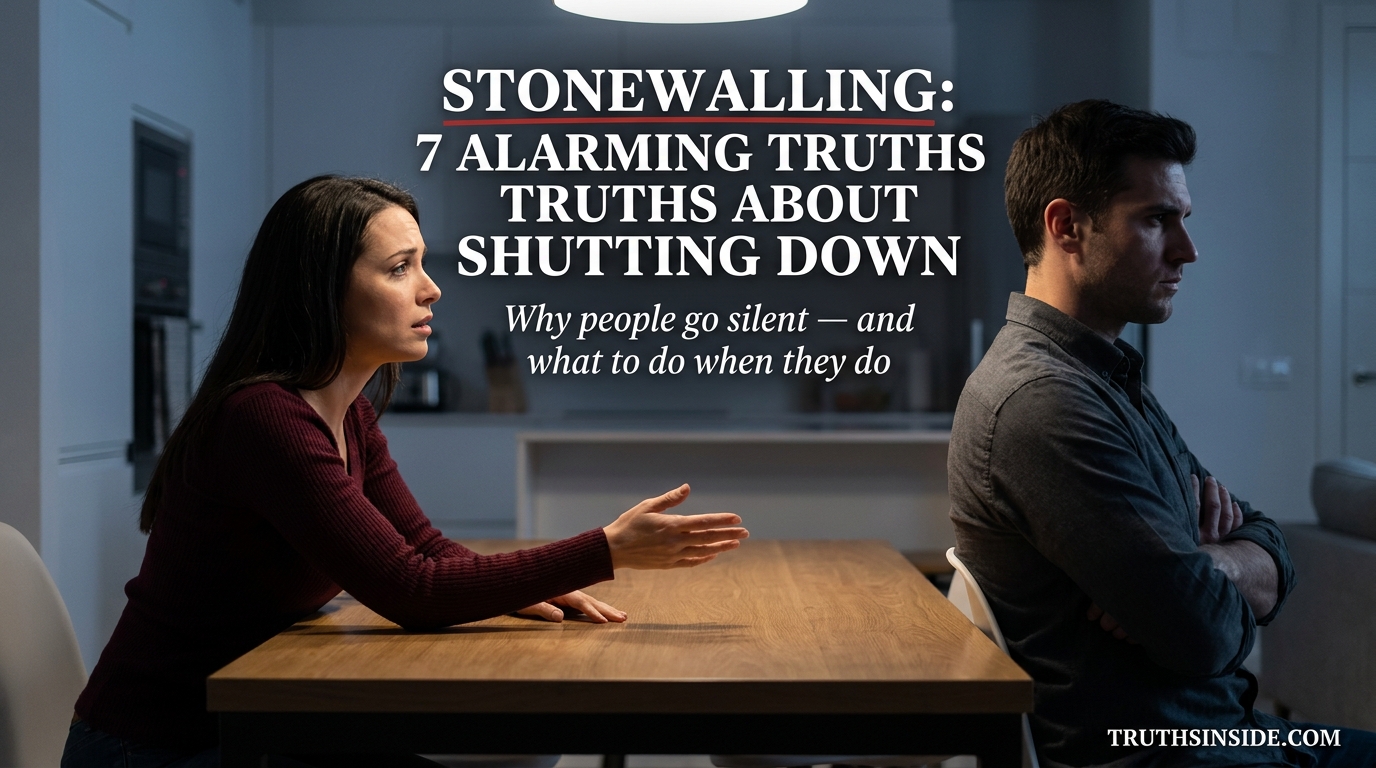
Stonewalling: Why People Shut Down and How to Respond
Stonewalling — the act of emotionally and communicatively shutting down during conflict or difficult conversation — is one of the most damaging patterns a relationship can develop, and one of the least understood. If you have ever been mid-sentence, trying to express something real and important, only to watch your partner go completely silent, turn away, or leave the room without a word — you have experienced stonewalling. And if you have ever been so overwhelmed during a conflict that you simply could not find words, could not make eye contact, could not stay in the conversation — you may have stonewalled without fully realizing what you were doing or why.
Research by Dr. John Gottman — whose four-decade study of couples at the University of Washington remains the most comprehensive relationship research ever conducted — identified stonewalling as one of the four communication patterns most predictive of relationship breakdown and divorce. He called it one of the “Four Horsemen” — alongside criticism, contempt, and defensiveness — and found it to be particularly destructive because of how completely it halts any possibility of resolution, repair, or connection.
Understanding stonewalling is not simply academic. It is practical, urgent, and — for many couples — potentially relationship-saving. Because what looks from the outside like indifference, cruelty, or deliberate punishment is almost never that simple. The psychology of why people shut down is layered, neurologically grounded, and deeply connected to attachment history, emotional regulation capacity, and the body’s involuntary stress response. That complexity doesn’t excuse the behavior. But it provides the understanding necessary to respond to it in ways that actually help — rather than ways that deepen the damage.
The seven truths that follow are grounded in relationship science, neurobiology, and clinical psychology. They are intended for both the person who shuts down and the person left on the other side of the silence — because both experiences deserve to be seen clearly.
Truth 1: Stonewalling Is Not the Same as Taking Space
This is the first and most important distinction to establish — because the confusion between the two causes significant damage on both sides. Healthy space-taking is a communicated, temporary withdrawal for the purpose of emotional regulation. It sounds like: “I’m getting overwhelmed and I need twenty minutes to calm down before we continue this conversation.” It has a timeline. It has communication. And it returns to the conversation.
Stonewalling is none of those things. It is a unilateral, uncommunicated shutdown — a wall that goes up without warning or explanation, leaving the other partner stranded with no information, no timeline, and no sense of when or whether the conversation will resume. It can last minutes, hours, days, or — in extreme cases — become the permanent default response to any emotional demand.
The person experiencing stonewalling almost universally interprets it as rejection, punishment, or evidence that their partner does not care enough to engage. That interpretation is painful, understandable, and often inaccurate — but it becomes accurate in its impact regardless of the intent behind the shutdown. The relationship suffers the same damage whether stonewalling is weaponized deliberately or triggered involuntarily. Intent matters for understanding. Impact matters for healing.

Truth 2: The Brain Is the Beginning of Every Shutdown
To understand why people stonewall, you have to begin in the body — specifically, in the nervous system’s threat response. Dr. Gottman’s physiological research identified what he called “diffuse physiological arousal” — a state in which the body’s stress response activates so intensely that productive conversation becomes neurologically impossible. Heart rate climbs above 100 beats per minute. Stress hormones flood the system. The brain’s prefrontal cortex — responsible for language, empathy, rational thought, and problem-solving — goes partially offline as the limbic system takes over.
In this state, the person is not choosing to be cruel or indifferent. Their nervous system has classified the emotional intensity of the conversation as a threat — equivalent, at the neurological level, to a physical danger — and has activated its protective response. Fight, flight, or freeze. For stonewalling individuals, the response is freeze and flight — a simultaneous internal lockdown and withdrawal from the perceived threat.
This neurobiological reality is critical for the partner on the receiving end to understand. When someone is in full physiological flooding, they genuinely cannot access the emotional intelligence, empathy, and communication skills necessary for productive conversation. Pushing harder — raising the emotional intensity, escalating the urgency — does not break through the wall. It raises the threat level and drives the shutdown deeper. Understanding this changes the entire strategy for responding effectively.
📃 Related article: Signs He Likes You But Is Scared: 18 Behaviors Men Show When Afraid to Commit
Truth 3: Stonewalling Has Deep Roots in Attachment History
While the immediate trigger of stonewalling is physiological flooding, the underlying vulnerability to it is almost always rooted in early attachment experience. People who stonewall consistently — who have developed shutdown as their default conflict response — almost universally learned, at a young age, that emotional intensity was dangerous, unpredictable, or punishing.
In homes where conflict meant explosion, humiliation, or loss of love, the child’s most adaptive response was to go quiet. To disappear emotionally. To become a smaller target. That shutdown — practiced thousands of times across childhood — becomes the nervous system’s automatic go-to when adult conflict triggers the same physiological alarm. The grown person shuts down not because they’ve calculated that it’s the best strategy, but because their nervous system recognizes the feeling and executes the response it has always executed.
People with avoidant attachment styles are particularly prone to stonewalling — their entire relational strategy is built around emotional self-sufficiency and the suppression of vulnerability. For them, being asked to remain emotionally present during intense conflict activates a threat response that is genuinely overwhelming — not manufactured, not strategic, but real and deeply conditioned. This context does not make stonewalling acceptable. It makes it understandable — and understandable problems are problems that can actually be worked with.
“Stonewalling rarely begins as cruelty. It begins as survival. The tragedy is that what once protected a child slowly destroys the adult’s most important relationships.”
Truth 4: Stonewalling Is Experienced as Emotional Abandonment
Regardless of the internal experience of the person shutting down, the external experience of the partner left behind is almost universally one of emotional abandonment. Being stonewalled is not a neutral experience. Research consistently shows that it activates the same neural pathways as physical pain — the brain processes social rejection and exclusion in the same regions it processes bodily hurt.
For the partner being stonewalled, the experience produces a cascade of painful responses. First, confusion — what just happened? Then self-blame — what did I do? Then escalation — an instinctive attempt to break through the wall by increasing emotional intensity. Then, if the wall holds, despair — a quietly devastating sense of being fundamentally unreachable to the person who matters most.
Repeated experiences of stonewalling erode a partner’s sense of safety, self-worth, and trust in the relationship’s capacity to survive difficulty. They begin to either stop bringing up important issues — knowing the likely response — or to approach every conversation with pre-emptive anxiety that generates the very emotional intensity most likely to trigger another shutdown. The relationship enters a damage cycle that compounds with every unresolved episode.
Truth 5: There Is a Critical Difference Between Stonewalling and Emotional Abuse
This distinction matters enormously and deserves honest, direct treatment. Stonewalling exists on a spectrum. On one end sits the involuntary, physiologically-driven shutdown of someone who is overwhelmed and has not yet developed better emotional regulation skills — a pattern that causes harm but is not deliberately weaponized. On the other end sits deliberate, calculated silence used as a tool of control and punishment — the conscious withdrawal of communication to destabilize, frighten, or dominate a partner.
The second form — stonewalling as a deliberate power tactic — is emotional abuse. It is the intentional use of silence to communicate “you don’t exist to me” or “I can disappear you whenever I choose.” This form is often accompanied by other controlling behaviors, is applied selectively (the person can communicate perfectly when they want something), and leaves the partner in a chronic state of anxious appeasement.
Distinguishing between these two forms requires honest observation over time. Does the person show remorse after shutting down? Do they acknowledge the impact? Are they willing to work on it? Or do they show no awareness, no accountability, and use silence consistently as leverage? The answer to those questions tells you which end of the spectrum you’re dealing with — and what your appropriate response is.

Truth 6: How to Respond When Someone Stonewalls You
Knowing what to do when you are being stonewalled is one of the most practically important relationship skills you can develop. The instinctive response — pursue, escalate, demand engagement — is also the least effective one. It raises threat levels, deepens the shutdown, and produces exactly the opposite of what you need.
Step one: Stop pursuing immediately. This is counterintuitive when you are hurt and need resolution. But continuing to push against a flooded nervous system does not produce connection — it produces deeper entrenchment. Lower the emotional temperature. Give the shutdown space without abandoning the issue entirely.
Step two: Name it calmly and clearly, once. “I can see you’ve shut down. I’m going to give us both some time. But I want us to come back to this conversation when we’re both able to.” This communicates three things: I see what’s happening. I’m not going to pursue it in this moment. And this is not over. That combination — acknowledgment without escalation, boundary without abandonment — is the most effective communication possible in this moment.
Step three: Use the break productively. Regulate your own emotional state. The goal is not to suppress your feelings but to bring your own nervous system down from flooding so that when the conversation resumes, you can participate from a regulated, clear place.
Step four: Return to the conversation. Once both people have regulated — ideally after at least twenty minutes, which is approximately how long it takes the body’s physiological flooding to subside — revisit the issue. Calmly. Without punishing each other for what happened during the shutdown. The goal is resolution, not a verdict.
📃 Related article: Anxious Attachment: Signs, Causes, and How to Heal
Truth 7: How to Stop Stonewalling if You Are the One Who Shuts Down
If you recognize yourself as the person who shuts down — who goes silent, leaves the room, or becomes a wall during conflict — this truth is for you. And the first thing it requires is honesty: stonewalling, however involuntary its origins, causes real harm to the people who love you. That harm is your responsibility to address, regardless of how overwhelming conflict feels from your side.
The most important first step is developing awareness of your own flooding before it becomes complete shutdown. Learn your early warning signs — the physical sensations that signal escalating overwhelm before the wall goes fully up. Racing heart. Tight chest. A narrowing of focus. The urge to leave. These signals are your window — the moment before shutdown when you can still choose a different response.
When you notice them, communicate immediately. “I can feel myself shutting down. I need to take a break — twenty minutes, and then I want to come back to this with you.” This one sentence — communicated at the right moment — can completely transform the dynamic. It tells your partner what is happening. It sets a timeline. And it makes a commitment to return. That commitment is the difference between healthy space-taking and stonewalling.
“The moment you can name your shutdown before it happens is the moment you take your power back — and stop letting your nervous system run your relationship.”
Longer term, developing emotional regulation capacity is the work. This looks like therapy — particularly approaches like EMDR, somatic therapy, or Internal Family Systems that work directly with the nervous system’s threat responses rather than simply addressing behavior at the cognitive level. It looks like mindfulness practices that increase your window of tolerance for emotional intensity. It looks like gradually, deliberately building the capacity to remain present in difficult conversations — not perfectly, not immediately, but consistently over time.
Partners who stonewall and genuinely want to change report that the combination of individual therapy, couples therapy, and daily mindfulness practice produces the most significant and lasting results. Change is real. It is available. But it requires acknowledging the pattern honestly and pursuing its resolution with the same seriousness you would give any other significant problem in your life.
When Stonewalling Becomes a Relationship Crisis
For some couples, stonewalling has been the default conflict response for so long that the relationship has developed significant secondary damage — unresolved issues stacked on top of each other, eroded trust, chronic anxiety in one or both partners, and a growing sense of hopelessness about whether real communication is even possible between them.
If this is your situation, individual good intentions and better communication strategies may not be sufficient. Couples therapy — particularly the Gottman Method, which directly addresses the Four Horsemen including stonewalling — or Emotionally Focused Therapy, which works with the attachment dynamics underlying shutdown, provides the structured, professionally supported environment that deeply entrenched patterns often require.
Seeking that help is not a concession that the relationship has failed. It is the most direct acknowledgment that what you have together is worth the investment of real, professional support. The couples who make it through chronic stonewalling patterns to genuine repair consistently name professional intervention as the turning point. Not because a therapist fixed it for them — but because the therapist gave them the tools and the safety to fix it themselves.
A Final Word on Silence and Its Costs
Stonewalling is not peace. It is not strength. It is not control. It is pain — the pain of someone overwhelmed beyond their current capacity to cope, expressed in a way that transfers that pain directly to the person they love. Understanding it that way — as transferred pain rather than deliberate punishment — makes it possible to respond with strategy rather than matching hurt.
But understanding has limits. Stonewalling that continues without acknowledgment, without accountability, and without genuine effort to change is stonewalling that will eventually cost the relationship everything. The silence that feels like self-protection is, over time, a slow erosion of everything that made the relationship worth protecting in the first place.
If you recognize this pattern — from either side — take it seriously. Name it. Get support. Do the work. Because the conversation you keep shutting down or being shut out of almost always contains something that both of you genuinely need to say — and to hear. And that conversation, however hard, is worth having.
💾 Save this. Share it with someone navigating this pattern. Follow Truthsinside.com for psychology-backed relationship insight that tells the whole truth.
FAQ
Q1: Is stonewalling always intentional?
No — and this distinction is crucial. Most stonewalling is involuntary, driven by physiological flooding where the nervous system shuts down higher cognitive functions during perceived emotional threat. The person is not consciously choosing to punish their partner. However, stonewalling can also be deliberately weaponized as a control tactic. Observing whether the person shows remorse, acknowledges impact, and works toward change helps distinguish between these two very different forms.
Q2: How long does it take for physiological flooding to subside?
Research by Dr. Gottman found that once the body enters a state of diffuse physiological arousal — heart rate above 100 BPM, stress hormones activated — it takes a minimum of twenty minutes of genuine calm for the physiological state to return to baseline. During this window, productive conversation is neurologically difficult. Breaks taken during this period should involve genuine calming activity — not rehearsing arguments or ruminating on grievances.
Q3: Can stonewalling cause long-term psychological harm to the partner experiencing it?
Yes — significantly. Chronic stonewalling activates the same neural pathways as physical pain and social rejection. Partners who are regularly stonewalled report symptoms consistent with anxiety, depression, reduced self-worth, and hypervigilance in the relationship. Over time, the unpredictability of when the wall will appear creates a chronic low-grade stress response that affects both psychological and physical health.
Q4: What if my partner denies they are stonewalling?
This is common — many stonewalling individuals genuinely don’t recognize their behavior as problematic, particularly if shutdown was normalized in their family of origin. Rather than arguing about the label, describe the specific behavior and its specific impact: “When you go silent and leave the room during a difficult conversation, I feel completely alone and unable to resolve anything.” Behavior and impact are harder to deny than diagnostic labels. A couples therapist can also provide the neutral, evidence-based framing that personal conversations often can’t.
Q5: Is stonewalling grounds for ending a relationship?
Stonewalling alone is not necessarily grounds for ending a relationship — but chronic, unaddressed stonewalling combined with unwillingness to acknowledge or work on the pattern is a serious relational health issue. The deciding factors are whether both partners recognize the problem, whether the stonewalling individual is genuinely committed to developing better emotional regulation, and whether the damage already done to the relationship’s trust and safety can be repaired with appropriate support. If stonewalling is accompanied by other controlling behaviors and shows no signs of change despite clear communication, that combination deserves very serious consideration.
🎵 Music
Maren Lull is a singer-songwriter who writes from the places most people don’t talk about out loud.
Not the dramatic grief. Not the obvious heartbreak. The quiet kind — the ordinary Tuesday emptiness, the habit of reaching for someone who isn’t there anymore, the particular exhaustion of being strong for so long that the strength itself wears thin.
Her music lives at the intersection of emotional honesty and soft beauty — breathy vocals over gentle piano, slow tempos, lyrics that feel less like songs and more like something you wrote in a private notebook at two in the morning and never showed anyone.
Maren Lull writes for the people who feel everything deeply and say very little about it. For the ones who listen to sad music not because they want to feel worse — but because being understood, even by a song, makes the feeling easier to carry.
📱 Follow Maren Lull:
→ Spotify
→ Apple Music
→ Youtube
→ Audiomack