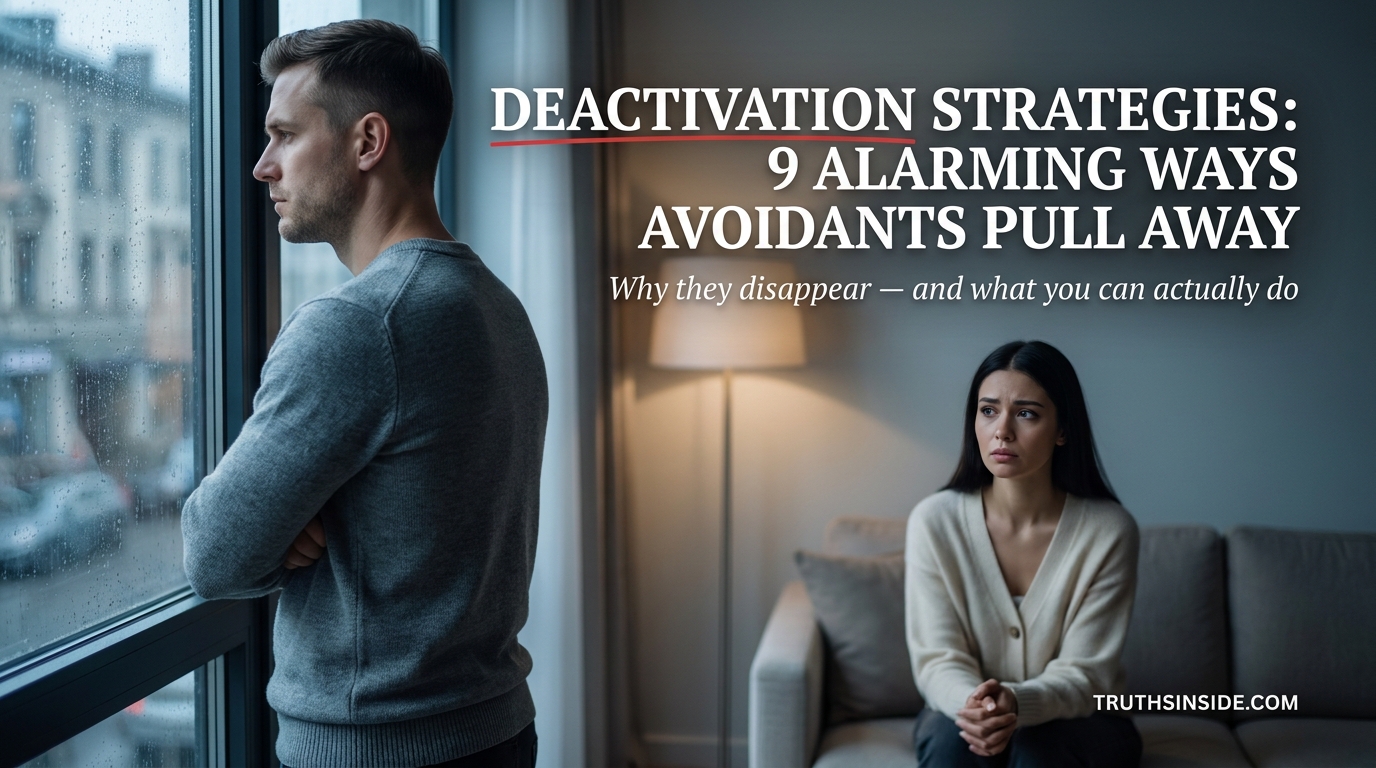
Deactivation Strategies: How Avoidants Pull Away (And What You Can Do)
Deactivation strategies are the specific behavioral and psychological mechanisms that people with avoidant attachment styles use — often unconsciously — to suppress their attachment needs and increase emotional distance when closeness begins to feel threatening. If you have loved someone who seemed to pull away exactly when things were getting good, who went cold after moments of genuine connection, who found sudden fault in you after a particularly intimate experience, or who simply disappeared emotionally without explanation — you have witnessed deactivation strategies in action.
Research by Dr. Amir Levine and Rachel Heller, whose landmark work on attachment theory in adult relationships brought these concepts into mainstream understanding, identifies avoidant attachment as affecting approximately 25% of the adult population — meaning a significant portion of people in relationships are navigating a partner whose nervous system has learned to treat intimacy as a threat rather than a comfort. Understanding deactivation strategies — what they are, why they happen, how they manifest, and what genuinely helps — is the most important foundation available for anyone in relationship with an avoidant partner.
Deactivation is not the same as not caring. This distinction matters enormously and is the source of enormous confusion for the partners of avoidant individuals. Avoidants typically do experience genuine attachment feelings — warmth, desire for connection, love in the truest sense of the word. The problem is not the absence of feeling but the nervous system’s response to it. When attachment feelings rise to a certain intensity, the avoidant’s internal alarm system — calibrated in early childhood to associate emotional dependence with danger — activates a deactivating response. The pullback is a self-regulatory move, not a relational verdict.
Understanding this does not mean accepting unlimited emotional withdrawal as acceptable relationship behavior. It means understanding the mechanism clearly enough to respond in ways that are both self-protective and genuinely effective — rather than in ways that intensify the cycle. Nine specific deactivation strategies follow, along with what you can actually do when you encounter each one.
Strategy 1: Deactivation Strategies Begin With Emotional Distancing After Closeness
Deactivation strategies most commonly activate immediately following moments of genuine intimacy or closeness — which is one of the most confusing and painful features of avoidant attachment for their partners. A beautiful evening together, a moment of real vulnerability shared, a period of sustained warmth and connection — these are precisely the moments most likely to trigger the avoidant’s deactivating response.
This happens because closeness itself is the trigger. The avoidant’s nervous system has learned — through early relational experience — that emotional dependence is dangerous. When closeness increases to a certain threshold, the internal alarm activates: too close, too dependent, too vulnerable. The deactivating response — emotional withdrawal, increased distance, sudden preoccupation with other things — is the nervous system’s attempt to restore the felt sense of safety by increasing the felt sense of independence.
For the partner on the receiving end, the timing of this withdrawal is particularly destabilizing. It arrives precisely when the relationship felt best — creating the cruel paradox of being punished, apparently, for genuine connection. Understanding that the withdrawal is triggered by the closeness itself — not by anything wrong with the connection or with you — is the foundational reframe that makes everything else navigable.
What you can do: Resist the impulse to pursue when the withdrawal begins. Pursuit raises the closeness level further — intensifying the threat response and deepening the deactivation. Give the space without abandoning the relationship. Regulate your own anxiety during the withdrawal period through your own support systems rather than through the avoidant. The withdrawal typically cycles back to connection when the avoidant’s nervous system restores its equilibrium.

Strategy 2: They Suddenly Find Fault — With You, With Everything
One of the most psychologically revealing deactivation strategies is the sudden emergence of criticism and fault-finding that appears with suspicious timing — usually following a period of genuine closeness or at the moment commitment is being implicitly or explicitly increased. The avoidant partner begins noticing things about you that previously seemed unimportant or even endearing. Your laugh. A habit. The way you phrase something. A difference in values or lifestyle that never registered as significant before.
This deactivating strategy works by creating psychological distance through the manufacturing of dissatisfaction. If the avoidant can convince themselves — and sometimes you — that the relationship has fundamental problems, the intimacy that triggered the alarm can be defensibly reduced. The faults being found are often real in the most literal sense — they are genuine observations. But their sudden salience, their emotional amplification, and their convenient timing are the signals that they are serving a deactivating function rather than expressing genuine relational concern.
Dr. Levine’s research describes this as “activating the mental list of your partner’s faults” — a specific cognitive deactivating strategy where the avoidant redirects attention toward the partner’s negatives to suppress the attachment feelings that are activating the threat response. It is genuinely not a conscious decision in most cases. It is the mind doing what it has always done to manage the discomfort of closeness.
What you can do: Do not defend yourself exhaustively against criticisms that feel sudden and disproportionate. Acknowledge what is valid, set aside what is not, and gently name the pattern if the relationship is secure enough: “I notice you seem more critical when we’ve been particularly close. I’m wondering if that’s connected.” This naming, delivered calmly and without accusation, can bring the unconscious strategy into conscious examination.
📃 Related article: 15 Signs She Is Testing You: Why Women Test Men and What to Do
Strategy 3: They Idealize Past Partners or Alternative Lives
A specific and particularly painful deactivation strategy involves the avoidant’s sudden or sustained focus on past romantic partners, on people they find attractive outside the relationship, or on alternative lives they could be living if they were not in this relationship. References to an ex’s qualities. Mentions of how free and uncomplicated life felt before the relationship. An unusual interest in other people.
This strategy functions by creating psychological competitors to the current relationship — alternative attachment objects or lifestyles that represent, in the avoidant’s deactivating mind, the freedom from dependency that increasing intimacy is threatening. It is a cognitive strategy for reducing commitment by keeping alternatives mentally active.
For the partner experiencing this, it is one of the most destabilizing deactivation strategies — because it feels like direct comparative rejection. Understanding that it is functioning as an internal self-regulatory mechanism — not as a genuine expression of comparative preference — is important context. That understanding does not make it acceptable as an ongoing pattern, but it prevents the partner from over-personalizing what is, at its root, a nervous system regulation strategy rather than a genuine relational verdict.
What you can do: Express how this pattern affects you, specifically and without catastrophizing: “When you talk about your ex or mention how much simpler life was before, I feel insecure in our relationship. I’d like to understand what’s prompting that.” Their response to this honest expression is itself informative — genuine care produces engagement, while deeper deactivation produces deflection.
“Deactivation strategies are not the avoidant’s verdict on you or the relationship. They are the nervous system’s attempt to survive something it was taught to fear — closeness itself. Understanding that changes everything about how you respond.”
Strategy 4: They Withdraw Communication — Suddenly and Without Explanation
Sudden, unexplained withdrawal of communication is one of the most immediately painful deactivation strategies — and one of the most common. Texts go unanswered for hours or days without explanation. Phone calls are not returned. The warmth and responsiveness of previous contact simply disappears, replaced by silence or clipped, minimal responses that communicate presence without connection.
This withdrawal serves the deactivating function of physically enacting the emotional distance the avoidant’s nervous system is seeking. If the intimacy has become too high, reducing contact reduces the intimacy — at least from the avoidant’s experiential side. From the partner’s side, the unexplained withdrawal typically produces the opposite of its intended function — it increases emotional activation and pursuit, which increases the avoidant’s felt sense of threat, which deepens the withdrawal.
The cycle is well-documented in attachment research as the anxious-avoidant spiral — each person’s response to the other’s behavior intensifies the very thing they are trying to escape. The anxious partner pursues because the withdrawal feels threatening. The avoidant withdraws because the pursuit feels threatening. Both people are responding to genuine threat. And both responses make each other’s experience worse.
What you can do: Send one clear, non-emotionally-escalated message communicating your experience and your availability: “I’ve noticed you’ve been less responsive lately. I’m here when you’re ready to connect.” Then — critically — stop. Do not follow up repeatedly. Do not escalate. One clear communication, followed by genuine withdrawal of pursuit, gives the avoidant’s nervous system the space to regulate and return without the pressure of escalating contact maintaining the threat response.
Strategy 5: They Become Hyper-Focused on Work, Hobbies, or Distractions
Avoidant individuals frequently use external preoccupation — an intensified focus on work, hobbies, friends, exercise, or virtually any activity that is not the relationship — as a deactivation strategy. The preoccupation is genuine in the sense that they really are absorbed in these activities. But the timing and intensity of the absorption, correlated with moments of relational closeness or commitment pressure, reveals its deactivating function.
Work is perhaps the most socially acceptable and therefore most effectively disguising deactivation vehicle. An avoidant who suddenly becomes consumed by a work project immediately following a significant relational moment is using the work’s legitimacy to provide cover for what is functionally a deactivating withdrawal. The external world offers infinite legitimate reasons to be unavailable — and the avoidant’s nervous system is expert at finding them when intimacy rises to threatening levels.
This strategy is particularly difficult to name without sounding unreasonable — because the activities themselves are legitimate. “You’re always working” sounds like a complaint about ambition rather than an observation about deactivating timing. Understanding the pattern’s function — not judging the activities but recognizing their correlation with intimacy moments — is the key to engaging with it productively.
What you can do: Rather than competing with the preoccupation or complaining about it, invite connection in low-pressure ways that don’t require the avoidant to abandon their regulatory activity: “I know you’re in a busy work period. Would you want to have dinner together tonight — no pressure, just to connect for a bit?” Low-pressure invitations are more likely to be accepted than demands that compete directly with the deactivating function.

Strategy 6: They Question the Relationship’s Validity
A particularly destabilizing deactivation strategy involves the avoidant suddenly or persistently questioning whether the relationship is right — not necessarily through explicit statements of wanting to leave, but through a pattern of expressed doubt, raised concerns about compatibility, or philosophical questioning of whether the relationship is genuinely what they want.
“I’m not sure this is working.” “Maybe we’re too different.” “I just don’t know if I see this going long-term.” These statements — delivered in the aftermath of genuine closeness or during periods of increased commitment — serve a precise deactivating function. They introduce uncertainty that reduces the felt commitment level, which reduces the felt intimacy, which reduces the threat level produced by that intimacy. The avoidant’s nervous system uses doubt as a distance-creator.
The cruel irony of this strategy is that it typically arrives precisely when the relationship is actually going well — when genuine connection has increased to the point of triggering the alarm. The partner experiences it as a sudden relational crisis that bears no relationship to what just happened between them. Because it doesn’t, really. It bears a relationship to what is happening inside the avoidant’s nervous system in response to what just happened between them.
What you can do: Do not immediately accept the doubt as a genuine relational verdict without examining its context. Ask calmly: “Has something specific happened that’s prompting these concerns?” If the doubt has appeared suddenly following a period of genuine closeness and cannot be attached to specific, observable relational problems, name that pattern gently. And establish your own internal clarity: genuine, sustained relational concern is different from anxiety-driven deactivation — and you deserve to know which you are responding to.
📃 Related article: Psychology of Ghosting: 7 Shocking Truths About Ghosters
Strategy 7: They Minimize the Relationship to Others
A quieter but equally revealing deactivation strategy involves how the avoidant represents the relationship to people in their external life — friends, family, colleagues. Avoidants in deactivation mode frequently minimize the relationship’s significance, seriousness, or depth when speaking about it to others. They may refer to their partner vaguely or minimally, avoid introducing the partner to important people in their life, or describe the relationship in terms that significantly understate its actual emotional depth.
This external minimization serves the internal deactivating function of reducing felt commitment — if the relationship is “not that serious” in the social narrative, the avoidant’s nervous system experiences less of the commitment-related threat that triggers deactivation. It is, in essence, a social-level deactivating strategy that mirrors the internal cognitive strategies of fault-finding and idealized alternatives.
For the partner who becomes aware of this minimization — through mutual friends, social situations, or direct observation — it is one of the more acutely painful deactivation experiences. The relationship that feels significant and real internally is being presented externally as something smaller and less defined than it actually is. That gap between private experience and public representation is a direct product of the deactivating function the minimization serves.
What you can do: Name the specific experience clearly and without accusation: “I noticed you introduced me as ‘a friend’ to your colleague. That felt confusing given where we are. Can we talk about how you see us?” This directness creates an opportunity for honest dialogue that the avoidant’s deactivating impulse would prefer to avoid — but the conversation itself, handled calmly, can produce genuine clarity about both the relationship’s status and the avoidant’s internal experience of it.
Strategy 8: They Become Emotionally Flat or Unavailable
Emotional flatness — the withdrawal of the warmth, humor, affection, and emotional responsiveness that characterizes the avoidant at their best — is one of the most pervasive and most sustained deactivation strategies. When deactivation is active, the avoidant seems present in form but absent in substance. Conversations feel surface-level. Affection becomes mechanical or disappears. The emotional aliveness that attracted their partner in the first place goes quiet.
This flatness is not performed indifference — it is the experiential result of active emotional suppression. Avoidants in deactivation mode are genuinely suppressing their attachment system — turning down the emotional volume on connection to reduce the closeness that triggered the alarm. Research using physiological measurement has found that avoidants in dismissing states show elevated physiological arousal even while appearing calm and unaffected — meaning the suppression costs them something, even when it appears effortless.
The partner experiences this emotional flatness as withdrawal of love — and at a behavioral level, that experience is accurate. What is not accurate is the interpretation that the withdrawal reflects the permanent or fundamental truth of the avoidant’s feelings. The flatness is a regulation strategy, not an emotional verdict. But it produces real distance that has real relational costs regardless of its internal function.
What you can do: Engage with low-stakes, enjoyable shared activities that don’t demand emotional vulnerability. Avoidants are most accessible when closeness is approached through shared experience rather than emotional conversation. A walk, a film, a shared meal — these create connection without the vulnerability demand that activates the threat response. Warmth can re-emerge in these contexts more naturally than in direct emotional engagement during a deactivation period.
“The emotional flatness of an avoidant in deactivation isn’t absence of love. It’s love with its volume turned down by a nervous system doing what it has always done to stay safe. The tragedy is that both people feel alone in it.”
Strategy 9: They Create Conflict to Manufacture Distance
The final and perhaps most sophisticated deactivation strategy is the deliberate — though usually unconscious — creation of conflict as a distance-manufacturing tool. When the avoidant’s nervous system needs more space than withdrawal alone is producing, conflict provides a socially legitimate reason to increase distance. If there is a fight, pulling away makes sense to both parties. The conflict provides the justification the deactivation needs.
This conflict-creation can be remarkably subtle — a tone that invites escalation, a criticism delivered with an edge just sharp enough to produce a defensive response, a topic raised at a moment designed to generate tension. It can also be more overt — a sudden, disproportionate reaction to a minor event that produces a significant enough argument to justify days of distance in the aftermath.
The tell is disproportionality and timing. Conflict that functions as a deactivation strategy tends to appear at predictable moments — following closeness, preceding anticipated commitment increases, or during periods when the avoidant’s felt independence is otherwise low. When the argument ends and distance is achieved, something in the avoidant settles — their nervous system has gotten what it needed, even though the cost was relational damage neither person wanted.
What you can do: When conflict appears to arrive without proportionate cause — particularly following a positive relational period — name the pattern without accusation: “I’ve noticed we tend to have conflict right after things feel really good between us. I’m wondering if that’s a pattern worth looking at together.” This meta-communication — talking about the pattern rather than engaging within it — is one of the most powerful tools available for interrupting the cycle.

What These Strategies Mean for the Relationship
Understanding deactivation strategies provides two genuinely useful things — an accurate map of what is happening, and a framework for responding in ways that are both self-protective and relational-health-promoting. But understanding has limits that are important to name honestly.
Deactivation strategies, understood compassionately, are survivable. They become problematic — and potentially relationship-ending — when they are consistent, severe, and entirely unexamined by the avoidant partner. An avoidant who has no awareness of their deactivating patterns and no motivation to develop it will continue producing these strategies without accountability, leaving their partner in a permanent state of relational uncertainty that serves no one.
The question of whether an avoidant relationship is sustainable is ultimately answered by two factors: whether the avoidant has — or is willing to develop — sufficient self-awareness about their patterns to take genuine responsibility for their impact, and whether their partner has — or is willing to build — sufficient self-security to not require the avoidant’s constant emotional presence as the foundation of their own stability. Both factors are developable. Neither develops without genuine, sustained intentional work — usually with professional support.
📃 Related article: Anxious Attachment: Signs, Causes, and How to Heal
How to Take Care of Yourself in an Avoidant Relationship
Living with deactivation strategies is genuinely demanding — and your own psychological health requires deliberate, proactive protection. This begins with maintaining a full, self-sustaining life that does not depend on the avoidant’s level of engagement on any given day as its primary emotional resource. Friends, creative pursuits, professional investment, physical health — these are not substitutes for the relationship. They are the foundation of the self-security that makes the relationship survivable on its harder days.
Individual therapy is particularly valuable for partners of avoidant individuals — providing both the perspective necessary to observe the dynamic clearly and the support necessary to make genuinely free decisions about whether and how to continue within it. Understanding your own attachment patterns — whether you carry anxious attachment tendencies that make the avoidant dynamic particularly activating — is equally important work. Many people find that developing their own secure attachment baseline, through therapeutic work, fundamentally changes how they experience and respond to an avoidant partner’s deactivation cycles.
A Final Word on What Is and Is Not Your Responsibility
Deactivation strategies are the avoidant’s patterns — rooted in their history, located in their nervous system, and their responsibility to understand and work on. They are not caused by your love being too much, your needs being too demanding, or your presence being too intense. They predate you entirely.
Your responsibility in the dynamic is your own response — choosing not to escalate pursuit when withdrawal activates, maintaining your own life and identity independently of the avoidant’s engagement level, communicating your needs clearly and calmly rather than through the protest behaviors the anxious-avoidant cycle tends to produce, and making honest, genuinely free decisions about whether this relationship — with this particular person at this particular level of willingness to grow — is genuinely sustainable for you.
That last question deserves your most honest answer. Avoidant attachment is workable. It is not a permanent sentence for either the avoidant or their partner. But it requires two people willing to examine their patterns with honesty and do the real work of changing them. Where that willingness exists, genuinely secure, deeply satisfying relationships become possible. Where it is absent on either side, that absence is itself the most important information available.
💾 Save this article. Share it with someone navigating this dynamic. Follow Truthsinside.com for attachment psychology and relationship clarity that meets you exactly where you are.
FAQ
Q1: Are deactivation strategies always conscious and deliberate?
No — the vast majority of deactivation strategies operate below conscious awareness. The avoidant is not thinking “I will now withdraw to create distance.” Their nervous system activates a regulatory response automatically, and their behavior follows that response before conscious reflection can intervene. This is why avoidants are often genuinely confused when their deactivating behavior is named — they didn’t experience it as a choice. Increasing conscious awareness of these automatic patterns — usually through individual therapy — is what creates the possibility of choosing differently.
Q2: What is the difference between deactivation and simply needing space?
Healthy space-taking is communicated directly, has a clear timeframe, and returns to full engagement afterward. Deactivation is triggered by closeness, is rarely communicated, has no clear timeline, and leaves the partner in uncertainty. The key distinguishing feature is transparency. A partner who says “I need some time to recharge — I’ll reach out Thursday” is taking space. A partner who goes cold after intimacy without explanation, for an indefinite period, is deactivating. Both may feel similar from the inside. They produce entirely different relational experiences for the partner.
Q3: Can an avoidant learn to stop using deactivation strategies?
Yes — with genuine self-awareness and sustained therapeutic work. The most effective approach is individual therapy focused on attachment patterns, combined with couples therapy when both partners are committed. Approaches including Emotionally Focused Therapy, schema therapy, and somatic-based therapies that work directly with nervous system regulation have shown meaningful results. Change is real but requires the avoidant to take genuine ownership of their patterns — something that cannot be prompted or pressured by the partner, but must emerge from internal motivation.
Q4: Is it my fault when my avoidant partner deactivates?
No — deactivation is triggered by the avoidant’s internal threat response to closeness, not by anything wrong with you or your love. However, certain responses to deactivation — primarily escalating pursuit — can intensify the cycle and lengthen its duration. This is not your fault either, as pursuit is the attachment system’s natural response to perceived withdrawal. But understanding that your pursuit response intensifies their withdrawal gives you genuinely useful information about what to do differently — for both your own wellbeing and the relationship’s health.
Q5: How do I know if the relationship with an avoidant is worth continuing?
This question deserves honest, specific assessment rather than a general answer. Relationships with avoidant partners can be deeply rewarding and genuinely sustainable when the avoidant has meaningful self-awareness about their patterns, genuine motivation to work on them, and consistent — if imperfect — effort toward greater emotional availability over time. The relationship becomes genuinely unsustainable when deactivation is severe, the avoidant shows no acknowledgment of its impact, and the partner’s psychological wellbeing is consistently suffering without genuine reciprocal investment in change. Honest assessment of which situation describes yours is the most important work available.
🎵 Music
Maren Lull is a singer-songwriter who writes from the places most people don’t talk about out loud.
Not the dramatic grief. Not the obvious heartbreak. The quiet kind — the ordinary Tuesday emptiness, the habit of reaching for someone who isn’t there anymore, the particular exhaustion of being strong for so long that the strength itself wears thin.
Her music lives at the intersection of emotional honesty and soft beauty — breathy vocals over gentle piano, slow tempos, lyrics that feel less like songs and more like something you wrote in a private notebook at two in the morning and never showed anyone.
Maren Lull writes for the people who feel everything deeply and say very little about it. For the ones who listen to sad music not because they want to feel worse — but because being understood, even by a song, makes the feeling easier to carry.
📱 Follow Maren Lull:
→ Spotify
→ Apple Music
→ Youtube
→ Audiomack