
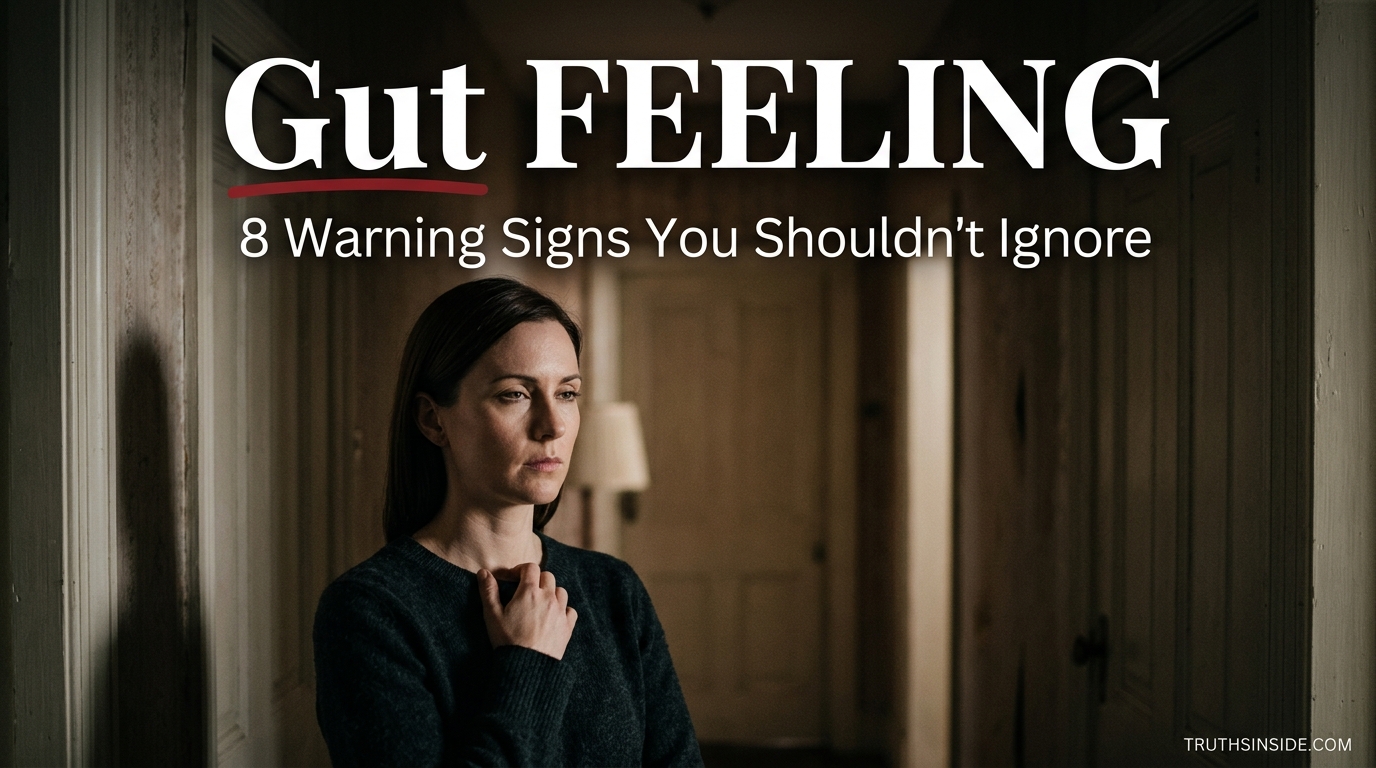
Signs Your Gut Is Telling You Something Is Wrong
A gut feeling isn’t superstition — it’s data. Neuroscientists have identified the gut as home to over 500 million neurons connected directly to the brain through the vagus nerve, a network so influential that researchers now call it the body’s “second brain.” When something feels wrong before you can explain why, that gut feeling is often your nervous system processing information faster than your conscious mind can articulate it.
If you’ve ever brushed off that tight, uneasy sensation in your stomach around a certain person or situation, only to realize weeks later that your instinct was right, you already know how powerful a gut feeling can be. The challenge isn’t whether the gut feeling is real — it’s learning to recognize it before logic talks you out of it.
This article breaks down eight specific signs your gut feeling is trying to warn you that something is wrong, so you can start trusting that signal instead of dismissing it.
1. You Feel Tension Before You Can Explain Why
One of the clearest signs of a gut feeling at work is physical tension — a tightening in the stomach, a knot in the chest, shallow breathing — that shows up around a specific person or situation before your conscious mind has identified a reason.
This is the vagus nerve responding to subtle cues your brain has already processed: microexpressions, tone shifts, inconsistencies too small to consciously register. A gut feeling often arrives in the body before it arrives in words.
2. You Keep Rehearsing Conversations in Your Head
When a gut feeling is trying to flag something wrong, it’s common to find yourself mentally replaying conversations, searching for what you might have missed or misread. This isn’t overthinking for no reason — it’s your brain trying to reconcile a mismatch between what you were told and what you sensed.
If you notice yourself doing this repeatedly around the same relationship or situation, that persistent mental loop is often a strong signal your gut feeling has already identified something worth examining more closely.
📃 Related article: Online Dating Red Flags: 9 Dangerous Catfishing Signs
3. You Feel Relieved When That Person Isn’t Around
A quiet but telling sign of a gut feeling is a subtle sense of relief or lightness whenever a specific person leaves the room, ends a call, or isn’t present. This physical and emotional easing is your nervous system signaling that something about their presence feels unsafe or draining, even if you can’t name exactly what.
People often overlook this sign because it feels small compared to dramatic red flags. But a gut feeling frequently communicates through this kind of subtle contrast rather than obvious alarm.

4. You Explain Things Away More Than You Investigate Them
When a gut feeling shows up, a common response is to immediately rationalize it rather than explore it — “I’m probably just tired,” “I’m overreacting,” “they didn’t mean it that way.” This pattern of instant self-dismissal is itself a sign worth paying attention to.
A genuine gut feeling doesn’t need extensive rationalizing to make sense; it’s the discomfort with sitting in uncertainty that often drives people to explain it away before they’ve actually investigated what triggered it in the first place.
5. Your Sleep or Appetite Shifts Without a Clear Reason
The gut-brain connection means emotional stress often shows up physically before it shows up mentally. Trouble sleeping, appetite changes, or a persistent low-grade stomach unease around a specific situation can be your gut feeling manifesting through the body rather than conscious thought.
These physical symptoms are frequently dismissed as unrelated stress, when in reality they often correlate directly with an unresolved gut feeling about a relationship, decision, or person that hasn’t been consciously addressed yet.
“Your gut feeling doesn’t need permission from your logic to be right. Sometimes the body knows first.”
6. You Feel the Need to Double-Check What You’re Told
When something doesn’t add up, a gut feeling often shows up as an unusual urge to verify — checking a story against timestamps, quietly cross-referencing details, or feeling unsatisfied with an explanation that should logically be enough.
This isn’t paranoia; it’s a gut feeling prompting you to close a gap between what you’re being told and what you’re sensing. People who later discover deception often recall this exact instinct showing up long before they had concrete proof.
📃 Related article: Worst Day: 1 Sign That Revealed Everything
7. You Feel Smaller or More Anxious Around Certain People
A strong gut feeling often manifests as a shift in how you carry yourself around a specific person — shrinking, over-explaining, feeling anxious in a way that’s inconsistent with how you feel in your other relationships. This shift is a signal, not a personality flaw.
If your gut feeling consistently makes you feel smaller around someone specific while everyone else in your life makes you feel more like yourself, that contrast is worth taking seriously rather than attributing to your own insecurity.

8. You Already Know the Answer — You’re Just Avoiding It
The final and most important sign is simple: a gut feeling often isn’t asking you to figure something out. It’s asking you to stop avoiding what you’ve already figured out. Many people describe hindsight moments where they admit, “deep down, I knew.”
Sitting with that honesty — even before you’re ready to act on it — is often the real turning point. A gut feeling rarely lies; the delay usually comes from not wanting the answer it’s already given you.

Why Learning to Trust Your Gut Feeling Matters
Ignoring a gut feeling repeatedly doesn’t make it disappear — it usually makes the eventual realization more painful, since the gap between instinct and acknowledgment keeps widening. Learning to notice these physical and behavioral signs early gives you the chance to act on information your body already has.
Trusting a gut feeling doesn’t mean abandoning logic entirely. It means treating your instinct as valid data worth investigating, rather than an inconvenience to override in favor of what feels more comfortable to believe.
FAQ
Q: Is a gut feeling actually reliable, or just anxiety?
It can be either, which is why context matters. A gut feeling tied to a specific person or situation, especially one that’s consistent over time, is different from generalized anxiety unrelated to any trigger.
Q: Why do I ignore my gut feeling so often?
Most people are taught to prioritize logic and evidence over instinct, which makes a gut feeling easy to dismiss even when it’s accurate.
Q: Can a gut feeling be wrong?
Yes, occasionally — but a persistent, specific gut feeling that keeps returning around the same person or situation is far more likely to reflect something real worth examining.
Q: How do I start trusting my gut feeling more?
Start by simply naming it out loud or in writing without immediately rationalizing it away. Tracking patterns over time also helps distinguish genuine instinct from passing anxiety.
Final Thoughts
A gut feeling is rarely random. It’s your nervous system synthesizing information faster than your conscious mind can organize into words. Learning to recognize these eight signs is the first step toward trusting that signal instead of overriding it.
If this article helped you make sense of a feeling you’ve been carrying, save it for the next time doubt creeps in, share it with someone who tends to ignore their instincts, and follow Truthsinside.com for more signs-and-signals content.
🎵 Music
Maren Lull is a singer-songwriter who writes from the places most people don’t talk about out loud.
Not the dramatic grief. Not the obvious heartbreak. The quiet kind — the ordinary Tuesday emptiness, the habit of reaching for someone who isn’t there anymore, the particular exhaustion of being strong for so long that the strength itself wears thin.
Her music lives at the intersection of emotional honesty and soft beauty — breathy vocals over gentle piano, slow tempos, lyrics that feel less like songs and more like something you wrote in a private notebook at two in the morning and never showed anyone.
Maren Lull writes for the people who feel everything deeply and say very little about it. For the ones who listen to sad music not because they want to feel worse — but because being understood, even by a song, makes the feeling easier to carry.
📱 Follow Maren Lull:
→ Spotify
→ Apple Music
→ Youtube
→ Audiomack