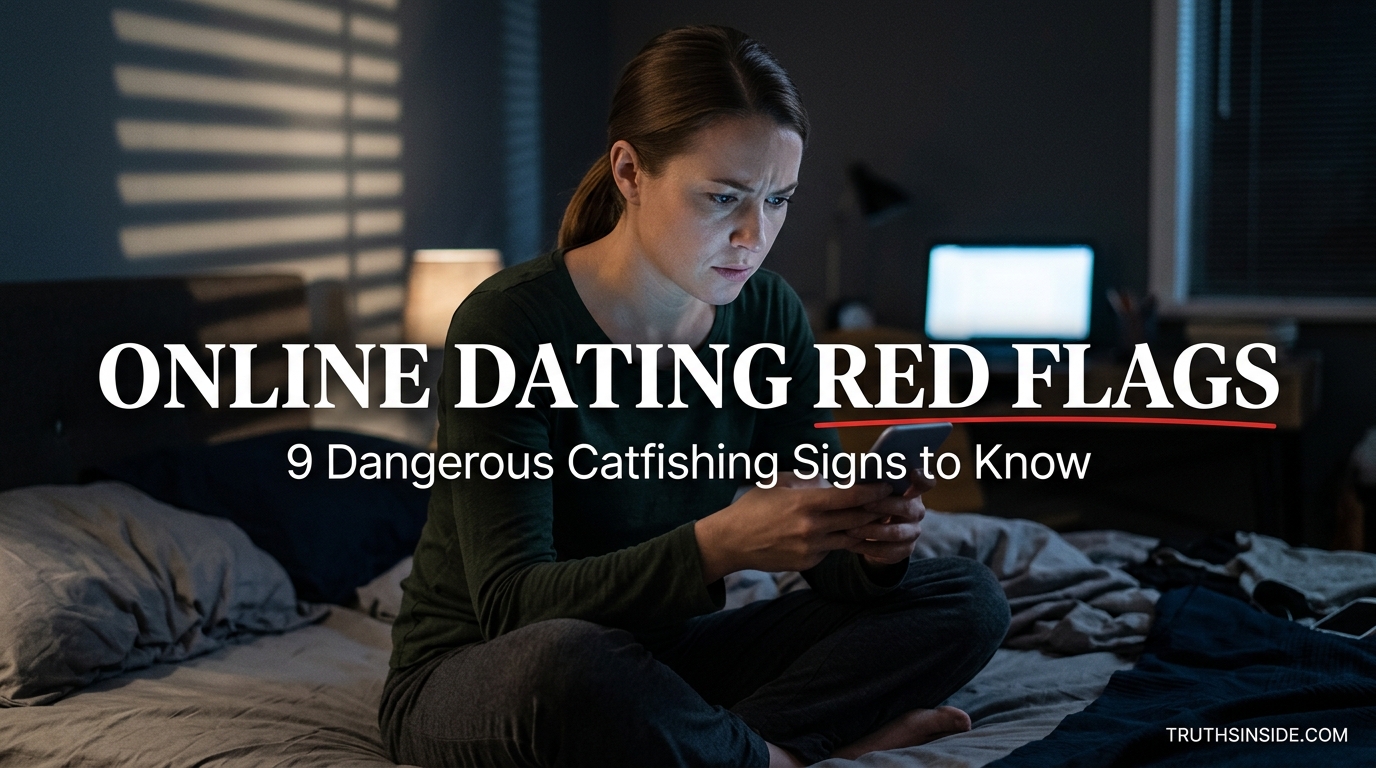
Online Relationship Red Flags: Catfishing and Digital Deception
Online dating red flags rarely announce themselves clearly. They show up disguised as charm, urgency, or a connection that feels almost too perfect for how new it is. According to the FTC, romance scam victims in the United States reported losses exceeding $1.3 billion in a recent year alone, with the median individual loss running into the thousands of dollars — proof that digital deception isn’t rare or easy to spot in the moment.
If you’ve ever felt that flicker of doubt scrolling through a match’s profile — a photo that seems slightly off, a story that doesn’t quite add up — that instinct is worth listening to. Online dating red flags are often visible early, but they’re easy to explain away when someone is saying exactly what you want to hear.
This article breaks down nine of the most common online dating red flags tied to catfishing and digital deception, so you can recognize the pattern before it costs you emotionally, financially, or both.
1. They Refuse to Video Call
One of the most reliable online dating red flags is a consistent refusal to video chat. Excuses pile up — a broken camera, bad internet, “I’m shy on video” — but the pattern rarely breaks even after weeks of talking. Legitimate matches are generally willing to hop on a quick call once trust starts building.
This particular online dating red flag exists because catfishers are often using stolen or stock photos. A live video call would immediately expose the deception, so avoidance becomes their default strategy, wrapped in a reasonable-sounding excuse each time.
📃 Related article: Red Flag I Mistook for Effort: 1 Costly Truth
2. Their Photos Look Too Polished
Professional-quality photos, magazine-style lighting, or images that look suspiciously like modeling headshots are a classic online dating red flag. Real dating profiles usually include a messy mix of casual selfies, group photos, and candid shots — not a curated portfolio.
Reverse image searching a profile photo takes less than a minute and can immediately confirm whether it’s been lifted from a modeling site, a stranger’s social media, or a stock photo library — a step worth taking whenever something about a profile feels a little too flawless.
3. The Relationship Moves Unusually Fast
Accelerated intimacy is one of the most emotionally effective online dating red flags because it feels flattering rather than alarming. “I’ve never felt this connected to anyone” within days of matching is a manipulation tactic known as love bombing, designed to build trust and dependency before a person has time to verify anything.
Genuine connections typically deepen gradually, with inconsistencies smoothed out through real-world interaction over time. A relationship that skips straight to declarations of love within a week deserves scrutiny, not celebration.

4. They Avoid Meeting in Person
A persistent pattern of canceled plans or vague timelines about meeting up is a significant online dating red flag. There’s always a reason — work travel, a family emergency, a deployment overseas — but an actual meeting date never quite materializes.
This online dating red flag is particularly common in romance scams involving fabricated military personas, since claiming overseas deployment provides a built-in excuse for avoiding both video calls and in-person meetings indefinitely.
5. Their Story Has Small Inconsistencies
Catfishers are managing a fabricated identity, and fabricated identities are hard to maintain perfectly over time. Small contradictions — a hometown that changes, a job title that shifts, timeline details that don’t line up with earlier conversations — are subtle but telling online dating red flags.
Most people don’t consciously track every detail a new match shares, which is exactly why this red flag slips past so easily. Keeping loose mental notes of what someone has said in early conversations can help surface inconsistencies before emotional investment deepens.
“The most dangerous online dating red flags rarely look like danger. They look like exactly what you were hoping to find.”
6. They Ask for Money, Gift Cards, or Financial Help
This is the most damaging online dating red flag on the list, and it almost always follows a predictable script: weeks of relationship-building followed by a sudden emergency — medical bills, a stuck shipment, travel costs to finally meet in person. The request is often framed as small or temporary at first.
No legitimate romantic partner who hasn’t met you in person needs gift cards, wire transfers, or cryptocurrency. This online dating red flag should end the interaction immediately, regardless of how convincing or emotionally urgent the story sounds.
📃 Related article: Just Protective: 8 Alarming Signs It Was Actually Control
7. Their Profile Is Suspiciously New or Sparse
A profile created recently, with few photos, minimal friends or followers, and almost no activity history, is a quieter but important online dating red flag. Genuine long-term social media presence is difficult to fabricate convincingly and quickly.
Checking how long an account has existed, whether it has organic engagement from real-looking accounts, and whether older posts exist can reveal a profile built hastily for the purpose of deception rather than genuine connection.
8. They Isolate You From Outside Opinions
A more psychologically manipulative online dating red flag is subtly discouraging you from discussing the relationship with friends or family, or reacting defensively when loved ones express concern. This isolation tactic reduces the chance that outside perspective will catch the deception.
Genuine partners generally welcome the people in your life getting to know them eventually. A consistent pattern of “they wouldn’t understand us” or “people are just jealous of what we have” is a serious online dating red flag worth taking seriously.
9. Something Simply Feels Off — And You Keep Explaining It Away
The final and often most important online dating red flag isn’t a specific behavior — it’s a persistent gut feeling that gets rationalized instead of addressed. Explaining away small doubts one at a time, without stepping back to see the full pattern, is exactly how digital deception succeeds for months at a time.
Trusting that instinct enough to pause, verify, and ask direct questions is one of the strongest protective habits against online dating red flags of every kind.

Why Online Dating Red Flags Are Easy to Miss
Digital deception works because it’s engineered to bypass the instincts people normally rely on in person — body language, tone, physical presence. Online dating red flags have to be evaluated through a much narrower lens: text, photos, and inconsistent stories, which makes deliberate manipulation far easier to disguise.
Recognizing these patterns isn’t about becoming paranoid toward every new match. It’s about knowing which specific online dating red flags matter most, so genuine connections aren’t confused with carefully constructed ones.
FAQ
Q: What’s the biggest online dating red flag to watch for?
A consistent refusal to video call combined with any request for money is the strongest combined signal of catfishing or a romance scam.
Q: Can catfishing happen even with photo verification features?
Yes. Some scammers use stolen photos of real people who consent to nothing, and verification badges can sometimes be manipulated or bypassed depending on the platform.
Q: How fast do romance scams typically escalate?
Financial requests often appear anywhere from two weeks to a few months into the relationship, once enough emotional trust has been established.
Q: Should I confront someone I suspect is catfishing me?
It’s generally safer to stop engaging and report the profile to the platform rather than confronting them directly, especially before verifying their identity independently.
Final Thoughts
Online dating red flags aren’t always dramatic or obvious. Most of the time, they’re quiet inconsistencies that get explained away because the connection feels good. Learning to recognize the pattern — not just individual moments — is the strongest protection against digital deception.
If this helped you spot something you’d been overlooking, save this article for reference, share it with a friend currently navigating the dating apps, and follow Truthsinside.com for more safety-focused relationship content.
🎵 Music
Maren Lull is a singer-songwriter who writes from the places most people don’t talk about out loud.
Not the dramatic grief. Not the obvious heartbreak. The quiet kind — the ordinary Tuesday emptiness, the habit of reaching for someone who isn’t there anymore, the particular exhaustion of being strong for so long that the strength itself wears thin.
Her music lives at the intersection of emotional honesty and soft beauty — breathy vocals over gentle piano, slow tempos, lyrics that feel less like songs and more like something you wrote in a private notebook at two in the morning and never showed anyone.
Maren Lull writes for the people who feel everything deeply and say very little about it. For the ones who listen to sad music not because they want to feel worse — but because being understood, even by a song, makes the feeling easier to carry.
📱 Follow Maren Lull:
→ Spotify
→ Apple Music
→ Youtube
→ Audiomack