
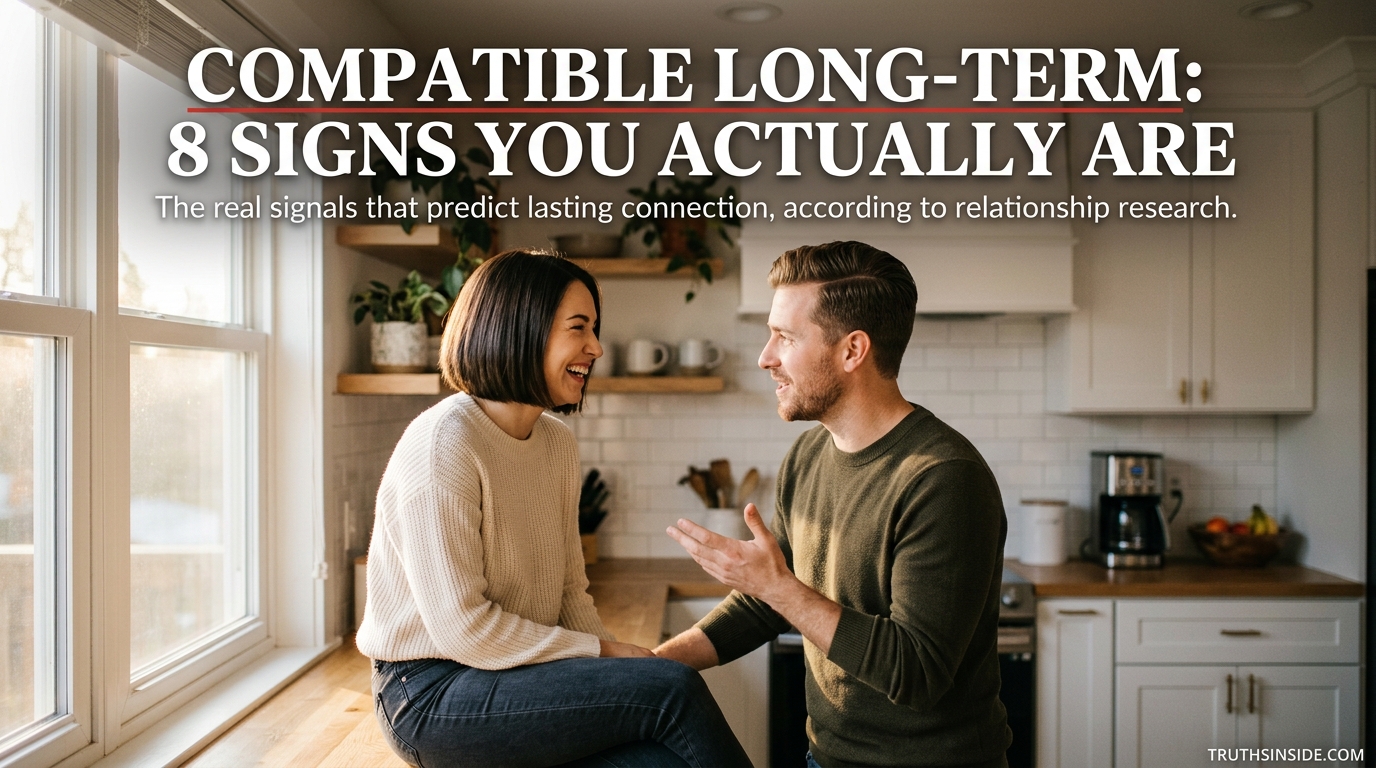
Signs You Are Compatible With Someone Long-Term
Early attraction feels electric, but it rarely tells you whether you’re actually compatible long-term. Relationship researchers have found that chemistry and compatibility are measured by entirely different systems, one driven by novelty and dopamine, the other by shared values, communication style, and how two people handle real life together. If you’ve ever wondered whether the spark you feel with someone actually translates into lasting compatibility, the answer lies less in how someone makes you feel on a good day and more in specific, observable patterns that show up over time.
Many people confuse intense chemistry with being compatible long-term, only to discover years later that excitement alone wasn’t enough to sustain the relationship. Being compatible long-term isn’t about liking all the same things or never disagreeing. It’s about whether two people can build a life together that works for both of them, through stress, change, and the inevitable ordinary stretches that make up most of a real relationship. These signs tend to be quieter than chemistry, but they matter significantly more.
This article breaks down eight signs that reliably indicate whether you and a partner are compatible long-term, based on research from relationship psychology and patterns observed in couples who’ve stayed together for decades. None of these signs require a perfect relationship. They simply require enough alignment in the areas that actually predict staying power.
Sign 1: You Handle Conflict Without Losing Respect
One of the clearest signs you’re compatible long-term is how conflict actually unfolds between you. Couples who are genuinely compatible long-term can disagree, sometimes intensely, without resorting to contempt, insults, or character attacks. Dr. John Gottman’s research identified contempt as one of the strongest predictors of relationship failure, meaning its absence, even during real disagreements, is a meaningful sign of long-term potential.
This doesn’t mean compatible couples never fight loudly or feel frustrated. It means the disagreement stays focused on the actual issue rather than escalating into attacks on each other’s character. If you notice that even your worst arguments with a partner still leave room for respect, and that you both tend to circle back and repair afterward, that pattern is one of the more reliable signs of being compatible long-term, far more telling than how well you get along on easy days.
📃 Related article: Red Flags: 6 Warning Signs Under Stress
Sign 2: Your Core Values Actually Align
Shared interests can make a relationship fun, but shared values are what make two people compatible long-term. This includes bigger questions: how you each think about money, family, ambition, honesty, and how you want to spend your time and energy over the years. Couples who are compatible long-term don’t need to agree on everything, but they need enough overlap in the values that shape daily decisions and future plans.
A couple can share a love of hiking, cooking, or travel and still be fundamentally mismatched if one person values financial security intensely and the other is indifferent to it, or if one prioritizes family closeness and the other values independence above almost everything else. These deeper value alignments are harder to spot early on, since they rarely come up in the excitement of new dating, but they become the actual foundation of whether two people are compatible long-term once daily life settles in.

Sign 3: You Communicate Needs Without Guessing
A significant sign of being compatible long-term is the ability to state your needs directly and have your partner do the same, without either of you relying on hints, silent treatment, or assuming the other should “just know.” Couples who are compatible long-term develop a communication rhythm where needs are voiced clearly, and where hearing a need doesn’t trigger defensiveness but genuine consideration.
This kind of direct communication tends to strengthen over time in genuinely compatible relationships, rather than becoming more guarded. If you find that expressing a need, more affection, more space, more help around the house, tends to be met with curiosity rather than resistance, that responsiveness is one of the clearest predictors that you and your partner are compatible long-term, since it shows both people are actively adjusting to make the relationship work for each other.
“We’re not the same person at all. But we’ve never once had to guess what the other one needed. That’s what made me believe we were built for the long run.”
Sign 4: You Support Each Other’s Growth
Being compatible long-term also means both people can grow, change careers, develop new interests, evolve emotionally, without the relationship feeling threatened by that growth. Psychologists refer to this as mutual “self-expansion,” the idea that a partner should help you become a fuller version of yourself rather than requiring you to stay static to keep the relationship stable. Couples who are compatible long-term tend to actively encourage each other’s ambitions, even when those ambitions require adjustment or sacrifice.
Relationships that struggle with long-term compatibility often show the opposite pattern: one partner feeling threatened or resentful when the other grows, changes interests, or pursues something new. If you consistently feel supported rather than held back when you evolve, and you offer that same support in return, it’s a strong indicator that you and your partner are compatible long-term, built to grow alongside each other rather than in competition.

Sign 5: You Handle Stress as a Team, Not Opponents
How a couple handles external stress, financial pressure, family conflict, health scares, reveals a great deal about long-term compatibility. Couples who are compatible long-term tend to instinctively frame stress as “us versus the problem” rather than “me versus you.” This team-oriented mindset, sometimes called dyadic coping in psychological research, consistently predicts stronger relationship satisfaction and resilience over time.
Couples lacking this compatibility often turn on each other during stressful periods, assigning blame or withdrawing support exactly when it’s needed most. If you’ve noticed that hard seasons tend to bring you and your partner closer rather than driving a wedge between you, that pattern is one of the more powerful, if less obvious, signs of being compatible long-term, since it reflects how the relationship performs under real pressure rather than ideal conditions.
📃 Related article: Hypervigilance: 7 Warning Signs You Can’t Trust
Sign 6: Your Intimacy Styles Are Compatible, Not Identical
Physical and emotional intimacy don’t need to look identical for two people to be compatible long-term, but they do need to be workable for both partners. This includes differences in love languages, desire levels, and how affection is expressed and received. Couples who are compatible long-term tend to communicate openly about these differences and actively find middle ground, rather than expecting one partner to simply adapt entirely to the other’s preferences.
Mismatched intimacy styles aren’t automatically a sign of incompatibility if both people are willing to understand and meet each other partway. The real sign of trouble is when one partner’s needs are consistently dismissed or ignored rather than discussed. Genuine long-term compatibility in this area looks less like perfect matching and more like continuous, respectful negotiation that leaves both people feeling considered and satisfied over time.

Sign 7: You Can Imagine Ordinary Life Together
Excitement is easy to imagine with almost anyone during the early stages of dating. Being compatible long-term requires something less glamorous: being able to picture ordinary Tuesday evenings, grocery runs, sick days, and quiet weekends with this person and still feeling content rather than bored or drained. Couples who are compatible long-term genuinely enjoy each other’s company in mundane, unremarkable moments, not just during vacations or special occasions.
This sign often gets overlooked because it isn’t as thrilling to notice as chemistry or attraction. But relationship researchers consistently find that satisfaction with ordinary, everyday shared life predicts long-term relationship success far more reliably than satisfaction with exciting, novel experiences. If the idea of an uneventful evening together still sounds genuinely appealing rather than something to endure, that’s a meaningful, often underrated sign that you’re compatible long-term.
Sign 8: You Trust Each Other’s Word
Trust functions as the foundation beneath every other sign of being compatible long-term. This means believing what your partner tells you, trusting their intentions even during disagreements, and feeling confident they’ll follow through on commitments. Couples compatible long-term describe a baseline sense of security, not naive trust that ignores real concerns, but a general confidence built from consistent, reliable behavior over time.
Without this foundational trust, every other area of potential compatibility becomes harder to build on, since doubt tends to color communication, conflict, and intimacy alike. If you find that your default assumption about your partner’s actions and words is good faith rather than suspicion, and that this trust has been earned through consistency rather than blind hope, it’s one of the strongest indicators that you and your partner are compatible long-term.
Frequently Asked Questions
Can two very different people still be compatible long-term?
Yes. Compatibility depends more on shared core values, communication style, and mutual respect than on shared hobbies or personality similarities. Differences in interests rarely predict long-term outcomes on their own.
Is chemistry a reliable sign of long-term compatibility?
Not on its own. Chemistry predicts initial attraction, while long-term compatibility depends on separate factors like conflict style, values alignment, and how a couple handles stress together.
How early can you tell if you’re compatible long-term?
Some signs, like communication style and conflict handling, become visible relatively early. Others, like shared values around money or family, often take more time and real-life situations to reveal fully.
Can compatibility develop over time, or is it fixed from the start?
Compatibility can strengthen through effort, communication, and shared experience, but fundamental mismatches in core values or communication willingness tend to remain difficult to fully resolve.
What’s the most overlooked sign of long-term compatibility?
Enjoying ordinary, everyday moments together. Many people focus on excitement and chemistry while underestimating how much satisfaction with mundane shared life actually predicts lasting relationship success.
Final Thoughts
Being compatible long-term isn’t about finding someone who matches you perfectly. It’s about finding someone whose patterns, values, and responses to real life genuinely fit with yours over time. If this article helped you recognize these signs in your own relationship, save it for later, share it with someone navigating this question, and follow Truthsinside.com for more research-backed relationship insight.
🎵 Music
Maren Lull is a singer-songwriter who writes from the places most people don’t talk about out loud.
Not the dramatic grief. Not the obvious heartbreak. The quiet kind — the ordinary Tuesday emptiness, the habit of reaching for someone who isn’t there anymore, the particular exhaustion of being strong for so long that the strength itself wears thin.
Her music lives at the intersection of emotional honesty and soft beauty — breathy vocals over gentle piano, slow tempos, lyrics that feel less like songs and more like something you wrote in a private notebook at two in the morning and never showed anyone.
Maren Lull writes for the people who feel everything deeply and say very little about it. For the ones who listen to sad music not because they want to feel worse — but because being understood, even by a song, makes the feeling easier to carry.
📱 Follow Maren Lull:
→ Spotify
→ Apple Music
→ Youtube
→ Audiomack