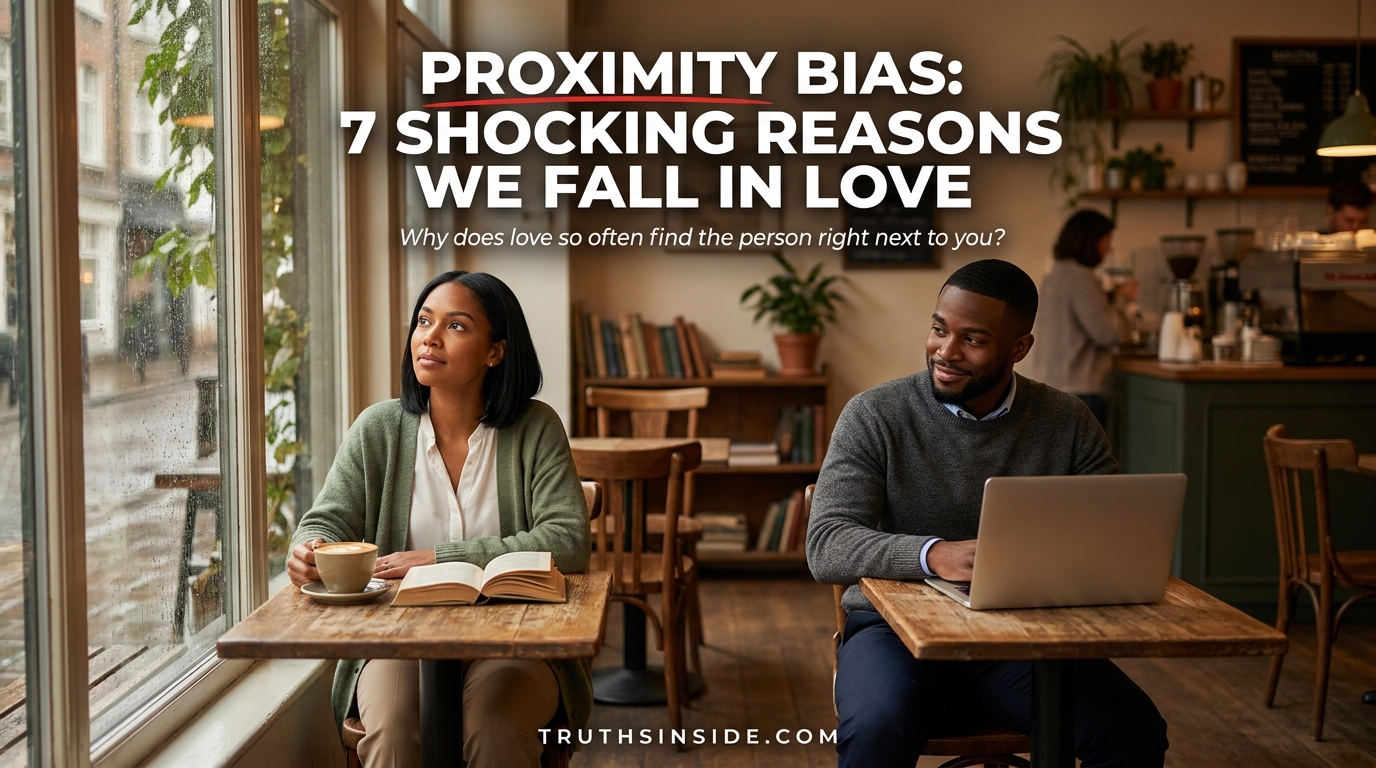
Proximity Bias in Love: Why We Fall for the People Around Us
Proximity bias in love is the quiet reason so many of us end up with the coworker down the hall, the neighbor across the street, or the friend we see every single week. You may have wondered whether it was fate or chemistry. Often, it was simply distance. In the famous Westgate studies at MIT, psychologist Leon Festinger and his colleagues found that students were most likely to befriend the people living right next door, and friendship grew less likely with every few steps away.
If you have ever felt a little embarrassed that your love story began with a shared elevator, a nearby desk, or a short walk between apartments, you are not alone. It can feel less romantic to learn that closeness gave you a head start. Yet understanding proximity bias does not shrink your love. It simply explains the stage on which that love first appeared, and it can help you choose more consciously from here.
In this guide, you will learn what proximity bias in love really means, what classic psychology experiments reveal about it, and seven reasons it shapes who we fall for. You will also see when it helps, when it quietly limits you, and how to tell real compatibility from simple convenience. Read with curiosity, because the goal is not to doubt your relationship but to understand your heart a little better.
“Closeness does not create love by itself, but it opens the door that love walks through.”
What Is Proximity Bias in Love?
Proximity bias in love is the tendency to feel drawn to people who are physically or routinely close to us. Psychologists often call the underlying pattern the propinquity effect. We meet more often, notice more details, and feel more comfortable with the people who share our spaces, so those people become more likely friends and partners than equally wonderful strangers across town.
The word bias matters here. It does not mean attraction is fake. It means the odds are tilted. Two people who are equally compatible on paper do not get an equal chance to fall in love if one lives down the hall and the other lives two hours away. Proximity bias quietly decides who enters your life first, and first impressions repeated over time are powerful.
The Propinquity Effect in Plain English
Think of your daily routine as a net. Everyone who passes through your commute, workplace, gym, building, or friend group is caught in it. Proximity bias means the people in the net get far more chances to become important to you, while people outside it, no matter how perfect, never get the exposure. Seen this way, love is partly a story about who happened to be there, often, and for long enough.
📃 Related article: Avoid Being Alone: 7 Shocking Relationship Signs
The Science Behind Proximity Bias
The Westgate Studies: Friendship by Floor Plan
The most famous evidence comes from housing studies at MIT in the 1940s. Leon Festinger, Stanley Schachter, and Kurt Back studied student residents who had been assigned apartments more or less at random. People were far more likely to become close friends with those who lived next door than with those a few doors away, and physical distance mattered more than shared interests.
Even small design details changed who became friends. Residents whose apartments sat near stairways or mailboxes, where people crossed paths constantly, ended up with more friends. The researchers concluded that frequent, unplanned contact was the engine. That is the heart of proximity bias: not magic, but repeated, low-effort encounters adding up over weeks and months.
Mere Exposure: Why Familiar Faces Feel Better
Psychologist Robert Zajonc described the mere exposure effect in 1968: the more often we encounter something, the more we tend to like it, even without conscious thought. In a classroom study by Richard Moreland and Scott Beach, women who attended more class sessions were rated as more attractive and likable by students who never spoke with them. Later research by Harry Reis and colleagues found that familiarity also increased attraction in live interactions.
This is why proximity bias feels so natural. Your brain interprets familiarity as safety, and safety as warmth. You do not decide to like the person at the next desk. Your mind quietly updates its opinion each time they appear, and eventually the feeling arrives looking like a spontaneous spark.
Alphabet Seating and City Blocks
Two more studies show how strong the pattern is. Sociologist Mady Segal studied police trainees who were seated alphabetically and found they were most likely to become friends with people whose last names were close to theirs, simply because they sat nearby. Decades earlier, sociologist James Bossard examined thousands of marriage licenses in Philadelphia and reported that a large share of couples had lived only a few blocks apart before they married.
Taken together, these findings paint a consistent picture. Proximity bias works through exposure and convenience, not destiny. That does not make love less meaningful. It simply shows how much of attraction is built by circumstance before personality even gets a vote.

7 Reasons Proximity Bias Shapes Who We Love
Each of these reasons can work alone, but they usually stack. The more of them present in a situation, the stronger proximity bias becomes. As you read, notice which ones match your own love story, past or present.
Reason 1: Familiarity Feels Safe
Your nervous system prefers what it knows. A familiar face signals that you have met this person many times and nothing bad happened. Over weeks, that predictability relaxes your guard, and relaxed people are more open, more playful, and more honest. Proximity bias in love begins here, with a body that quietly decides this person is safe.
Safety is not the same as passion, but it is the soil passion often grows in. Many people describe their relationship as starting with comfort rather than fireworks. That is not a lack of chemistry. It is calm, repeated contact turning into trust that deepens into attraction.
Reason 2: Repeated Exposure Builds Liking
Every small encounter is a tiny deposit. A smile in the hallway, a shared joke at the coffee machine, a quick wave from the balcony. None of them feels significant alone. Together they build a growing sense that you know this person and they know you, which is why many people cannot remember the exact moment they started to care.
Compare this with a single perfect date. A strong first meeting can create excitement, but repeated exposure creates familiarity, and familiarity often outlasts excitement. When two people see each other daily, this pattern turns ordinary moments into quiet evidence of compatibility.
Reason 3: Convenience Lowers the Cost of Connection
Connection takes effort. Long commutes, busy schedules, and awkward planning can kill budding romances before they start. When someone lives or works nearby, the cost of seeing them drops almost to zero. A coffee takes ten minutes. A walk happens naturally. Easy plans happen more often than complicated ones.
This explains why nearness is so powerful in a busy adult life. People rarely have spare energy for elaborate dating. The person who fits into the gaps of your day gains an advantage no profile or photo can match. Convenience may not sound romantic, but it is often the engine behind relationships that actually get started.
Reason 4: Shared Routines Create Shared Stories
Neighbors share the same noisy plumbing. Coworkers share the same impossible deadline. Classmates share the same demanding professor. These common experiences give people instant material for conversation, humor, and bonding, and they create a sense of being on the same team that can fast-forward emotional closeness.
Over time, those routines become rituals: the Friday lunch, the elevator chat, the morning nod at the bus stop. Rituals signal reliability, and reliability signals care. In this way, shared routine ties two people into one small, private world that outsiders do not fully see.

Reason 5: Low-Pressure Contact Lets Feelings Grow Slowly
When you meet someone through proximity, there is often no label, no pressure, and no performance. You are simply two people who keep running into each other. That freedom lets you show your real self, including the tired, funny, ordinary parts. By the time attraction appears, you have already seen each other on average days, which is a surprisingly solid foundation.
Compare that with high-stakes dating, where everyone tries to impress. Nearness gives relationships a gentler on-ramp, and because nothing was forced, the feelings often seem more trustworthy. The risk is that slow growth can hide mismatches a direct conversation about values would have revealed sooner.
Reason 6: A Small Pool Creates a Big Illusion
Your daily circle is small compared with the number of people you could meet. When most of your social contact happens at work, in one building, or in one friend group, the people inside it become your entire dating pool. Proximity bias then magnifies their appeal, because you are comparing them only with each other.
This can lead to a subtle trap. You may decide someone is the best option when they are really the best option within a limited circle. That is not necessarily a problem, since many happy couples began exactly this way. But recognizing the limits of your pool helps you ask the right question: is this person right for me, or just the nearest candidate?
Reason 7: Shared Context Feels Like Compatibility
People who live, work, or study in the same place often share income level, schedule, values, humor, and goals. That overlap is real, and it genuinely supports a relationship. But closeness can exaggerate it. When you share a context, it is easy to assume you share a worldview, even if you have never discussed the deeper questions.
Shared context can feel like soul-level compatibility because everything around you reinforces the sense of similarity. The challenge appears when the context changes, such as a new job, a move, or a lifestyle shift. Couples who only shared a setting sometimes discover, once the setting disappears, how much they did not know about each other.
“Proximity can start a story, but only honesty can decide how it ends.”
When Proximity Bias Helps and When It Hurts
The Benefits of Falling for Someone Nearby
There is nothing wrong with a love story that began close to home. Nearby partners are easier to see regularly, simpler to coordinate with, and often share your community and values. They may also already know your friends, which provides natural social support. This pattern helps explain why so many long, happy marriages began with a neighbor, a classmate, or a coworker.
The Risks of Mistaking Convenience for Compatibility
The risk appears when closeness replaces compatibility. If you stay together mostly because it is easy, you may overlook mismatched values, different life goals, or unmet needs. Convenience can also hide boredom, since habit feels similar to comfort. And nearness does not guarantee harmony. Researchers have noted that closeness also increases the chance of conflict, because people nearby see more of each other’s flaws.
A useful test is what happens when the convenience vanishes. If you would still choose this person with a long commute and a calendar full of obstacles, proximity bias probably opened the door while real connection kept it open. If the spark disappears with the convenience, it may have been the context, not the person, that you were attached to.
Proximity Bias in the Digital Age
Technology has changed what nearness means. Psychologists sometimes talk about functional distance, the idea that what matters is how often your paths cross, not just how many feet separate you. Daily messages, group chats, and shared online spaces can create a kind of virtual closeness, giving proximity bias a new home.
Dating apps widen your pool, yet many people still end up choosing the person who replies most often and most quickly, which is proximity bias in digital form. Frequent contact creates familiarity fast, even with someone you have never met in person. The lesson stays the same: whoever is consistently present in your attention gains an advantage.
📃 Related article: Emotional Enmeshment: 7 Hidden Signs of Harm
How to Tell Real Connection From Proximity Bias
Ask yourself these questions honestly. They help separate genuine compatibility from the pull of convenience.
- Would I still be drawn to this person if they lived across the city?
- Do we share core values, or only a shared environment?
- Have we talked about the big questions, such as family, money, and the future?
- Do I admire who they are, or do I mostly enjoy that they are available?
- How do we treat each other when the routine changes?
- Am I curious about their inner world, beyond the daily logistics?
If most of your answers feel warm and confident, proximity bias likely brought you together while real compatibility keeps you together. If they feel uncertain, it is not a verdict. It is simply a reason to have deeper conversations.
How to Use Proximity Bias in Your Favor
Once you understand proximity bias, you can use it deliberately. If you want to meet someone, put yourself in repeated, low-pressure situations: a weekly class, a volunteer group, a regular coffee shop, a running club. Consistency beats intensity. Showing up in the same place at the same time gives mere exposure time to work, and it gives other people a chance to see the real you.
Widen Your Circle on Purpose
Because proximity bias favors whoever is nearby, widening your circle widens your options. Join communities that reflect your interests and values, not just your convenience. Say yes to invitations that pull you outside your usual routes. The more varied your daily life, the more varied the people who become familiar to you.
Turn Familiarity Into Real Intimacy
If proximity bias has already put someone in your life, do not rely on it alone. Move from small talk to real talk. Ask about their fears, dreams, and boundaries, and spend time together outside the usual setting. Closeness creates the opportunity, but vulnerability creates the bond. Couples who combine easy access with honest conversation tend to build the strongest relationships.

Frequently Asked Questions
What is proximity bias in relationships?
Proximity bias in relationships is the tendency to develop feelings for people who are physically or routinely close to us, such as neighbors, coworkers, and classmates. It works through repeated exposure, familiarity, and convenience, and it makes nearby people more likely to become partners than equally compatible people who live farther away.
Is proximity bias the same as the mere exposure effect?
They are closely related but not identical. The mere exposure effect describes how repeated contact increases liking. Proximity bias is the broader pattern of who we meet and bond with because of nearness, and mere exposure is one of its main mechanisms. In workplace settings, the term can also describe managers favoring employees they see in the office, which is a different topic.
Does proximity bias mean my relationship is not real love?
No. Understanding how a relationship began does not make the feelings less genuine. Many strong couples started through proximity. What matters is whether the connection deepens through honesty, shared values, and care once convenience is no longer the main factor.
Can long-distance couples overcome proximity bias?
Yes, though it takes intention. Long-distance couples lose casual contact, so they must replace it with regular calls, shared routines, and planned visits. Consistent contact recreates functional closeness, and strong communication keeps familiarity and trust growing even when miles separate you.
How can I avoid settling for someone just because they are nearby?
Check for compatibility beyond convenience: shared values, mutual respect, and genuine curiosity. Widen your social circle, talk about long-term goals early, and notice whether you would still choose the person if effort were required. Awareness of this pattern helps you choose with intention instead of by default.
Final Thoughts
Proximity bias is a reminder that romance is shaped by circumstance as much as by chemistry. The person beside you at the right time, again and again, had a head start. That is not a flaw in your story. It is part of how human attraction works. Knowing this gives you freedom: you can appreciate the luck that brought you together, test whether the connection runs deeper than convenience, and choose your relationships with open eyes.
Enjoyed this deep dive? Save this article for later, share it with someone who loves understanding the psychology of attraction, and follow Truthsinside.com for more science-backed insights into love and relationships every week.
🎵 Music
Maren Lull is a singer-songwriter who writes from the places most people don’t talk about out loud.
Not the dramatic grief. Not the obvious heartbreak. The quiet kind — the ordinary Tuesday emptiness, the habit of reaching for someone who isn’t there anymore, the particular exhaustion of being strong for so long that the strength itself wears thin.
Her music lives at the intersection of emotional honesty and soft beauty — breathy vocals over gentle piano, slow tempos, lyrics that feel less like songs and more like something you wrote in a private notebook at two in the morning and never showed anyone.
Maren Lull writes for the people who feel everything deeply and say very little about it. For the ones who listen to sad music not because they want to feel worse — but because being understood, even by a song, makes the feeling easier to carry.
📱 Follow Maren Lull:
→ Spotify
→ Apple Music
→ Youtube
→ Audiomack