
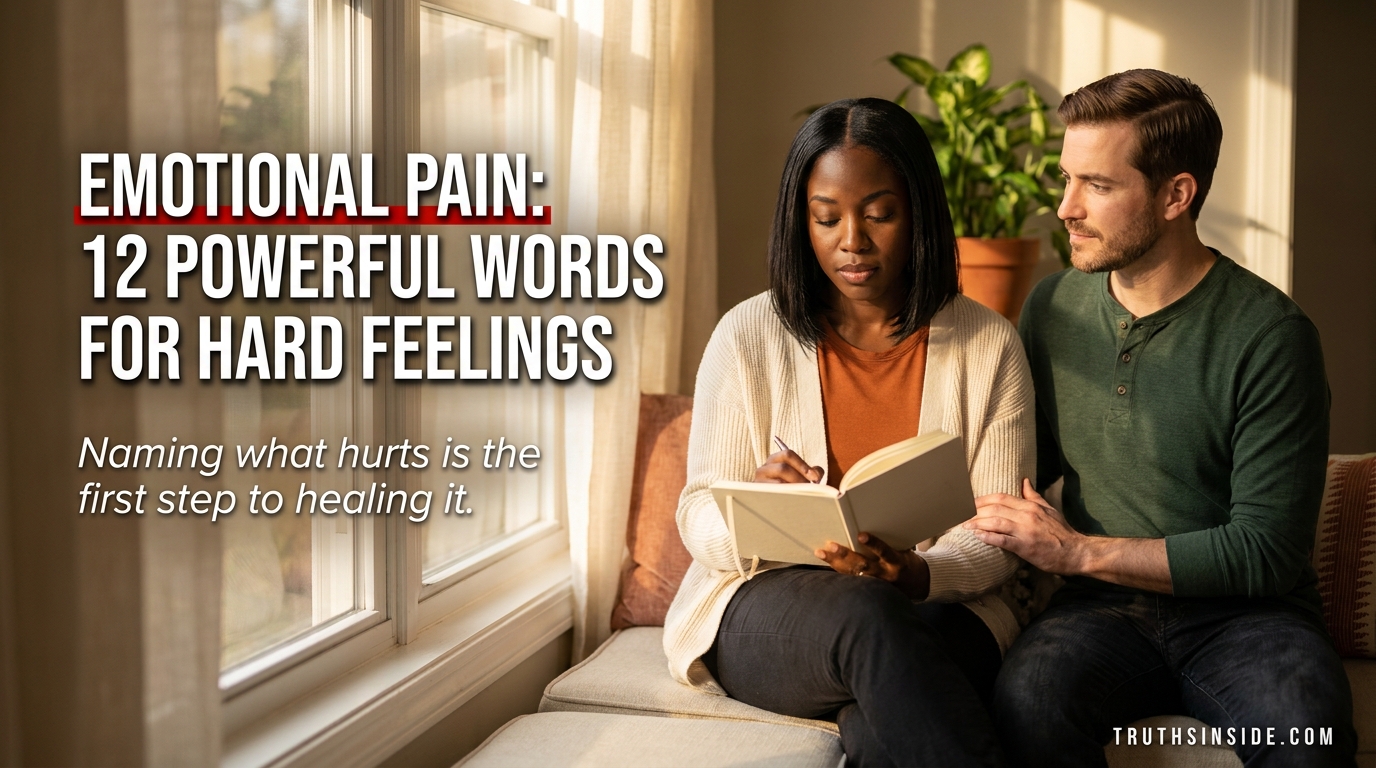
The Language of Emotional Pain: Words for Feelings We All Have
Emotional pain is hard to describe because it rarely arrives with a clear name. It shows up as a tight chest, a heavy afternoon, or a restless night, and when someone asks what is wrong, all you can say is, “I don’t know. I just feel bad.” That struggle for words is not a personal failing. It is one of the most common human experiences.
Science suggests that finding the words matters. In a UCLA brain-imaging study led by Matthew Lieberman, 30 adults who put feelings into words while viewing emotional faces showed less activity in the amygdala, the brain’s threat alarm, and more activity in a prefrontal region linked to emotional regulation. Naming emotional pain does not erase it, but it can gently turn down the alarm.
This guide offers a vocabulary for the feelings we all share. You will learn why emotional pain is so hard to put into words, how naming it helps, and 12 powerful words that may fit what you are carrying, each with a gentle way to respond.

Why Emotional Pain Is So Hard to Put Into Words
Many of us were never taught an emotional vocabulary. As children, we learned words for colors, animals, and numbers, but feelings were often brushed aside with phrases like “you’re fine” or “stop crying.” Without practice, adults end up with a tiny toolkit: good, bad, stressed, tired. When real emotional pain arrives, those words feel far too small.
Emotional pain is also layered. A single afternoon can hold grief, anger, guilt, and fear all at once, tangled together like headphone cords. It is hard to name something that has several faces. Add cultural messages like “be strong” or “don’t make a fuss,” and many people learn to swallow what they feel rather than describe it.
There is a physical side too. Brain-imaging research on social rejection has found activity in regions that also respond to physical pain, which may help explain why heartbreak and loneliness can truly hurt. When emotional pain lives in the body this way, it can be felt long before it can be explained. Language gives that feeling a shape, so it stops being a fog.
📃 Related article: Rebound Relationship: 9 Hidden Warning Signs
How Naming Emotional Pain Helps You Heal
The UCLA study is part of a larger body of research on what psychologists call affect labeling. When you put a feeling into words, the thinking part of your brain gets involved, and the emotional alarm tends to quiet. Researchers compared this effect to a brake on emotional reactions. It does not remove the hurt, but it can make the hurt more manageable.
Psychologist Lisa Feldman Barrett uses the term emotional granularity for the skill of telling similar feelings apart, such as disappointment, resentment, and grief. Research on granularity suggests that people who describe their feelings in fine detail tend to handle emotional pain with more flexibility. Instead of thinking, “I feel awful,” they can say, “I feel rejected, and underneath that, I feel lonely.”
Naming also changes your relationships. When you can tell a partner, friend, or therapist exactly what hurts, they can respond with the right kind of care. Vague pain invites guesses and misunderstandings. Precise words invite compassion. That is why building a vocabulary for emotional pain is not an intellectual exercise. It is an act of self-respect and of connection.
“Naming emotional pain does not make it smaller. It makes it something you can hold.”
12 Powerful Words for Emotional Pain
These words are not a diagnosis, and you do not need to fit one perfectly. Read them slowly and notice which ones make your chest soften or your eyes sting. That reaction is information. Each word below includes what it feels like and one gentle way to respond.
1. Heartbreak
Heartbreak is the ache that follows the loss of love, whether through a breakup, a divorce, or a person who simply drifted away. It can feel like a literal weight in the chest. This form of emotional pain often comes in waves, calm for hours and then suddenly overwhelming. Respond with patience: sleep, eat, lean on friends, and let the waves pass without judging how long they last.
2. Grief
Grief is the deep sorrow of losing someone or something that mattered, including a person, a job, a home, or a version of your future. It is love with nowhere to go. Grief does not follow a tidy schedule, and it can return on birthdays or ordinary Tuesdays. Respond by allowing it to exist, talking about the person or loss, and creating small rituals of remembrance.
3. Loneliness
Loneliness is not the same as being alone. It is the painful gap between the connection you have and the connection you want, and you can feel it in a crowded room or a long marriage. This ache whispers that no one truly sees you. Respond with small steps toward contact: a message, a walk with a neighbor, or an honest word to someone safe.
4. Shame
Shame says, “I am bad,” while guilt says, “I did something bad.” It is one of the heaviest forms of emotional pain because it attacks your sense of worth and makes you want to hide. Shame grows in secrecy and softens in understanding. Respond by sharing it with someone trustworthy and treating yourself the way you would treat a friend who made the same mistake.
5. Guilt
Guilt is the uncomfortable sense that you have acted against your own values. At its best, it is a compass pointing toward repair. At its worst, it becomes endless self-punishment. This feeling asks a useful question: what needs to be made right? Respond with a sincere apology, a concrete change, and forgiveness toward yourself once you have done what you can.
6. Resentment
Resentment is anger that has gone underground. It builds when needs go unspoken, efforts go unnoticed, or boundaries are crossed again and again. It can feel bitter and tiring, and it quietly damages closeness. Behind resentment there is often hurt that was never voiced. Respond by identifying the unmet need beneath it and sharing it calmly, using “I feel” statements rather than blame.
7. Rejection
Rejection is the sting of being turned away, left out, or deemed not enough. Because humans are wired for belonging, this emotional pain can feel sharp and personal, even when the cause has little to do with you. Respond by separating the event from your worth. One person’s “no” is a fact about fit, not a verdict about your value.
8. Betrayal
Betrayal is the shock of being hurt by someone you trusted. It shakes your sense of safety, because the person who harmed you was the one you counted on. Betrayal-based emotional pain often includes anger, confusion, and doubt about your own judgment. Respond by honoring your reaction, setting boundaries, and rebuilding trust in yourself first, at whatever pace feels safe.
9. Regret
Regret is the painful wish that you had chosen differently. It replays old decisions like a movie you cannot edit. A little regret can teach wisdom, but too much keeps you living in the past. This ache softens when you remember that you acted with the knowledge and resources you had then. Respond by naming the lesson and gently moving your attention toward what you can still do.
10. Dread
Dread is the heavy anticipation of something painful that has not happened yet. It lives in the stomach and the shoulders, and it can make an ordinary evening feel unbearable. This emotional pain is rooted in the future, so grounding helps. Respond by slowing your breath, naming what you can see and hear right now, and writing down one small action you can take.
11. Numbness
Numbness is the absence of feeling when feeling becomes too much. It can seem like relief, but it often leaves people feeling flat, disconnected, or strangely far from those they love. Numbness is the mind’s way of protecting you from emotional pain that has been overwhelming. Respond gently: move your body, spend time in nature, and let small feelings return without forcing them.
12. Longing
Longing is the tender ache for someone, something, or somewhere that is out of reach. It is a mix of love and absence, and it can arrive with a song, a scent, or a photograph. This feeling is not a problem to fix. It is a sign of how deeply you have cared. Respond by honoring it through writing, art, or simply saying the name aloud.
Beautiful Words From Other Languages for Painful Feelings
Sometimes English runs out of room, and other languages offer words that fit tender feelings with surprising accuracy. The Portuguese word saudade describes a loving longing for someone or something absent. The Welsh word hiraeth names a deep homesickness for a place or time that may no longer exist. The German word Sehnsucht describes an intense yearning for something you cannot quite reach, and Weltschmerz describes sorrow over the world’s imperfections.
You do not need to speak these languages to borrow their wisdom. Their existence reminds us that these feelings are shared across cultures and centuries. Whatever you are carrying, someone, somewhere, has felt it, named it, and written songs about it. That knowledge alone can make a heavy feeling less lonely.

How to Find the Right Word for Your Emotional Pain
If none of the words above fits exactly, that is fine. You can build your own vocabulary with a simple routine. Try these steps once a day for a week, even when you feel fairly okay, so the skill is ready when you need it.
- Pause and scan your body. Notice tightness, heaviness, heat, or hollowness. The body often speaks before the mind.
- Start with a simple word. Sad, angry, scared, or tired are all valid starting points.
- Go one level deeper. Ask, “What kind of sad?” Lonely, disappointed, ashamed, or grieving?
- Look for the story. Ask what happened and what it means to you.
- Name the need. Rest, comfort, apology, space, or reassurance.
- Say it out loud or write it down. One honest sentence is enough.
Journaling can speed this up. Try finishing sentences like “Right now I feel…”, “It reminds me of…”, and “What I wish someone knew is…”. There are no wrong answers, and no one else has to read them. Five minutes of honest writing often reveals the word you were searching for.
Keep in mind that words can change. You might name your emotional pain as anger in the morning and discover it is hurt by evening. That is not confusion. It is understanding unfolding in layers.
📃 Related article: Emotionally Present: 7 Powerful Ways to Love Deeper
How to Talk About Emotional Pain With Someone You Love
Once you have a word, sharing it can feel scary. Start small and choose a calm moment. You might say, “I’ve been feeling something heavy, and I think it’s loneliness. I’m not asking you to fix it, I just want you to know.” Naming your emotional pain this way makes it easier for the other person to respond with care instead of confusion.
If you are the listener, try to receive the word without correcting it. Replace “At least…” with “That sounds really painful.” Ask, “Do you want comfort or ideas right now?” Many people need company in their emotional pain before they need solutions. A steady presence tells them that their feelings are safe with you.
Couples and families can also build a shared vocabulary. A weekly check-in, where each person names one feeling and one need, builds trust over time. When everyone practices the language of emotional pain together, hard conversations stop feeling like emergencies and start feeling like opportunities for closeness.
“A feeling with a name is a feeling you no longer have to carry alone.”
When Emotional Pain Needs More Support
Words are powerful, but they are not always enough. If your emotional pain lasts for weeks, interferes with sleep, work, or relationships, or leaves you feeling hopeless, it is time to reach out to a licensed therapist or your doctor. Asking for help is a form of strength, not weakness, and professionals can offer tools that friends and journals cannot.
If you ever feel unsafe or think about harming yourself, please contact emergency services or, in the United States, call or text 988 to reach the Suicide and Crisis Lifeline. You deserve immediate support, and you do not have to carry that moment alone.

Frequently Asked Questions About Emotional Pain
What is emotional pain?
Emotional pain is the distress we feel in response to loss, rejection, shame, fear, or hurt. It is not imaginary, and it can affect sleep, appetite, concentration, and even physical sensations like chest tightness. Like physical pain, emotional pain is a signal that something needs attention, care, or change.
Why can’t I explain my emotional pain?
Many people never learned the words, and emotions often arrive blended together. Stress, exhaustion, and numbness can also make feelings harder to reach. Try body scanning, journaling, or choosing from a list of feeling words. With practice, naming emotional pain becomes more natural.
Does talking about emotional pain really help?
For many people, yes. Research on affect labeling suggests that putting feelings into words can calm emotional reactions in the brain. Sharing with someone supportive also reduces isolation. Talking does not erase the hurt, but it can make it lighter, clearer, and easier to carry.
How long does emotional pain last?
There is no single answer. Some emotional pain eases within days, while grief or betrayal may take months or longer. Healing is rarely a straight line. If your pain feels stuck or grows heavier over time, a mental health professional can help you move forward.
Final Thoughts: Give Your Pain a Name, and Give Yourself Grace
Emotional pain is not a sign that something is wrong with you. It is a sign that you have loved, lost, hoped, or hurt, which is to say, that you are human. The words in this guide are not a cure, but they are a doorway. Each time you name a feeling, you move from being swallowed by it to standing beside it.
Be patient as your vocabulary grows, and remember that no one learns this language overnight. Every attempt counts, even the clumsy ones, even the ones that only reach a journal page at midnight. Some days the right word will come easily, and other days it will not. Either way, keep speaking, writing, and listening with kindness. The language of emotional pain is a language of healing, and every honest word brings you a little closer to peace.
Save this article so you can find the right word on a hard day. Share it with someone who is struggling to explain how they feel. Follow Truthsinside.com for more honest guides to love, emotions, and the psychology of connection.
🎵 Music
Maren Lull is a singer-songwriter who writes from the places most people don’t talk about out loud.
Not the dramatic grief. Not the obvious heartbreak. The quiet kind — the ordinary Tuesday emptiness, the habit of reaching for someone who isn’t there anymore, the particular exhaustion of being strong for so long that the strength itself wears thin.
Her music lives at the intersection of emotional honesty and soft beauty — breathy vocals over gentle piano, slow tempos, lyrics that feel less like songs and more like something you wrote in a private notebook at two in the morning and never showed anyone.
Maren Lull writes for the people who feel everything deeply and say very little about it. For the ones who listen to sad music not because they want to feel worse — but because being understood, even by a song, makes the feeling easier to carry.
📱 Follow Maren Lull:
→ Spotify
→ Apple Music
→ Youtube
→ Audiomack