Moving Too Fast Red Flags: When Speed Is a Warning Sign
Moving too fast red flags are easy to miss because they feel so good in the beginning. Someone says “I’ve never felt this way,” plans your future by week two, and texts you all day. It feels like fate. But relationship researchers have long noted that healthy trust usually builds gradually, through repeated experiences of someone being consistent, honest, and respectful of your pace.
If you have ever felt flattered and uneasy at the same time, you are not imagining it. That mix of excitement and unease is often how moving too fast red flags first announce themselves. Your heart is enjoying the attention while a quieter part of you is asking, “How can they know me this well already?”
In this guide, you will learn why speed matters, seven specific moving too fast red flags, how they differ from genuine chemistry, and what to do if you recognize them. Fast does not always mean dangerous. But when intensity outruns knowledge, it deserves a closer look.
“Real love can survive a slow week. Pressure usually can’t.”
Why Moving Too Fast Red Flags Matter
Trust is not a feeling you can order. It is a track record. Psychologists who study relationships describe closeness as something that deepens through gradual, mutual self-disclosure, where each person shares a little and sees how the other responds. When someone skips that process, they ask for the rewards of trust without having earned it.
That is why moving too fast red flags matter. Speed is not the problem on its own. The problem is that speed can hide the things you most need to learn: how a person handles disagreement, disappointment, and the word “no.” A relationship built in a whirlwind may never get the chance to show you those parts.
Chemistry Versus Intensity
Real chemistry feels exciting and also leaves you feeling calm, respected, and like yourself. Intensity feels exciting but leaves you anxious, pressured, or overwhelmed. Many people confuse the two. A helpful test: does this person’s enthusiasm leave room for your own pace, or does it quietly demand that you match theirs?
When Fast Is Fine
Some couples do move quickly and do well, especially when both people are emotionally mature, honest, and equally comfortable with the pace. What separates a happy fast couple from one showing moving too fast red flags is mutuality. If both of you are choosing the speed freely, that is a very different story from one person setting the pace and the other keeping up.
📃 Related article: Red Flags After a Breakup: 7 Painful Warning Signs
What Is Love Bombing and How Does It Connect?
Love bombing is a term used by many therapists to describe overwhelming affection, flattery, and attention used early to build a quick, intense bond. It can be sincere, coming from someone who is simply anxious or enthusiastic. But it can also be a pattern in controlling relationships, where early intensity is followed by pressure, criticism, or withdrawal.
Moving too fast red flags often overlap with love bombing, but not always. You do not need to decide what is in your partner’s heart. You only need to notice the effects: do their words and actions leave you with more freedom, or less?
“Ask not how much they give you, but how much room they leave you.”

7 Moving Too Fast Red Flags to Watch For
No single sign proves anything. Look for clusters, and pay attention to how you feel when you try to slow things down. That reaction is often the most useful information you will get.
Red Flag 1: Declaring Love Within Days or Weeks
“I love you” after three dates is one of the most common moving too fast red flags. Feelings can be real, but love, as most people mean it, rests on knowing someone. Early declarations can also be a way to create obligation, because it becomes awkward not to say it back. Notice whether you feel pressure to respond in kind.
Red Flag 2: Planning a Future Before You Know Each Other
Talking about marriage, moving in, or children in the first month can feel romantic. It can also be a way to make the relationship feel inevitable. Healthy planning grows out of shared experience. When someone is already assigning you a role in a story you have barely begun, it can leave you feeling more like a character than a partner.
Red Flag 3: Constant Contact and Expected Instant Replies
Frequent texting is not a flaw by itself. The red flag appears when silence is treated as a problem. If a few hours without a reply brings guilt, anger, or “Where were you?”, you are looking at one of the quieter moving too fast red flags: a pace that does not allow you your own life.
Red Flag 4: Pushing for Exclusivity and Commitment Quickly
Wanting to be exclusive is normal. Demanding it before you are ready, or treating hesitation as betrayal, is different. A partner who respects you will let you arrive at commitment honestly. One who rushes it may be more interested in securing the relationship than in knowing you.
Red Flag 5: Isolating You From Friends and Family
“Why do you need to see them when you have me?” can sound flattering at first. Over time, it can cut you off from the people who would notice if something was wrong. Among the moving too fast red flags, this one deserves particular attention, because isolation is a recognized feature of controlling relationships.

Red Flag 6: Intense Reactions When You Ask to Slow Down
This is the clearest test. Say, kindly, “I’m enjoying this, but I’d like to go a bit slower.” A secure partner might feel disappointed but will respect it. Moving too fast red flags become much more serious when slowing down is met with anger, guilt-tripping, sulking, or sudden coldness. The reaction tells you whether your pace matters.
Red Flag 7: Sharing Too Much, Too Soon
Someone who tells you their deepest wounds on the second date can seem refreshingly open. Sometimes it is. Sometimes it creates a sense of intimacy that is not yet earned, making you feel like a confidant before you are a friend. Vulnerability that goes both ways and unfolds gradually builds trust. Vulnerability dumped all at once can create pressure.
Why Some People Move Too Fast
It helps to remember that moving too fast red flags do not always come from bad intentions. Some people move quickly because they are anxious about being alone, because past relationships ended suddenly, or because they genuinely fall fast. Attachment researchers note that people with anxious attachment styles may seek closeness and reassurance quickly.
That context matters, but it does not erase your needs. You can feel compassion for why someone is going fast and still decide the pace does not work for you. Understanding a pattern is different from accepting it. The question is not “Are they a bad person?” but “Can we find a pace that is comfortable for both of us?”
The Role of Control
In some cases, speed is not about anxiety. It is about control. When a relationship moves quickly, you have less time to gather information, consult friends, or notice inconsistencies. By the time doubts surface, you may already feel deeply invested. That is why moving too fast red flags are taken seriously in discussions of unhealthy relationships.
How Moving Too Fast Red Flags Feel in Your Body
Your body often notices before your mind does. People describe a tight chest, a knot in the stomach, a feeling of being swept along, or a sense of relief when the other person is busy. They also describe confusion: “Everything looks perfect, so why do I feel uneasy?”
Take that feeling seriously. It does not prove anything, but it is data. Many people later say they sensed something early and talked themselves out of it because the relationship looked so good on paper. Giving yourself permission to say “I need more time” is not being dramatic. It is protecting your judgment.
Questions to Ask Yourself
Try these honest questions:
- Do I feel free to say no, or slow down?
- Do I feel more like myself, or less like myself?
- Have I seen how this person handles stress and disappointment?
- Do my friends and family know about this relationship?
- If I took a week off, would this person respect it?
If several answers worry you, you may be seeing moving too fast red flags and not just excitement.

What to Do If You Notice Moving Too Fast Red Flags
You do not have to end things at the first sign. You do have the right to set the pace. These steps can help you respond calmly and safely, whatever your partner’s intentions turn out to be.
Step 1: Name the Pace Out Loud
Say it simply and kindly: “I really like you, and I’d like to take this more slowly.” Clear, calm language gives you information. You are not accusing anyone. You are stating a need and watching how it is received. Respect is the sign of a partner worth keeping.
Step 2: Keep Your Own Life
Keep seeing friends, keep your routines, and keep your own plans. A healthy relationship can sit beside the rest of your life. If maintaining your independence leads to conflict, that is meaningful information about the relationship, and about the moving too fast red flags you noticed.
Step 3: Watch Consistency, Not Words
Early charm is easy. Consistency is harder. Over several weeks and months, notice whether actions match promises, whether disagreements are handled with respect, and whether your “no” is honored. Time is the most useful tool you have, and it costs nothing.
Step 4: Talk to People You Trust
Share what is happening with a friend, family member, or counselor. Outside perspective can help you notice patterns you are too close to see. If someone discourages you from talking to others, treat that as one of the more serious moving too fast red flags.
Step 5: Decide What You Need
You are allowed to want a slower pace, a clearer conversation, or no relationship at all. A good relationship will welcome your honesty. If your needs are repeatedly dismissed, that is not a compatibility quirk. It is an answer.
“A healthy partner asks ‘What pace feels good to you?’ and then listens.”
When It Might Be More Serious
Most moving too fast red flags describe ordinary relationship mismatches, but some patterns overlap with coercive control: monitoring your phone, controlling your money, isolating you, threatening you, or making you afraid to disagree. If any of this sounds familiar, take it seriously.
In the United States, the National Domestic Violence Hotline offers free, confidential-as-possible, round-the-clock support at 1-800-799-7233, and you can text START to 88788. If you are in immediate danger, call 911. Trusted friends, family, and counselors can also help you plan safely.
A Healthier Pace: What It Looks Like
A healthy pace tends to feel steady rather than urgent. You learn about each other over time. You meet friends gradually. Disagreements are handled with curiosity. You are free to say “not yet.” Where moving too fast red flags involve pressure, a healthy pace involves choice.
It is also okay if the relationship is exciting and warm. Slow does not mean cold. It means the closeness is being earned together, with both of you awake to what is happening. That is the kind of closeness that tends to last.
A Real-Life Example of Moving Too Fast Red Flags
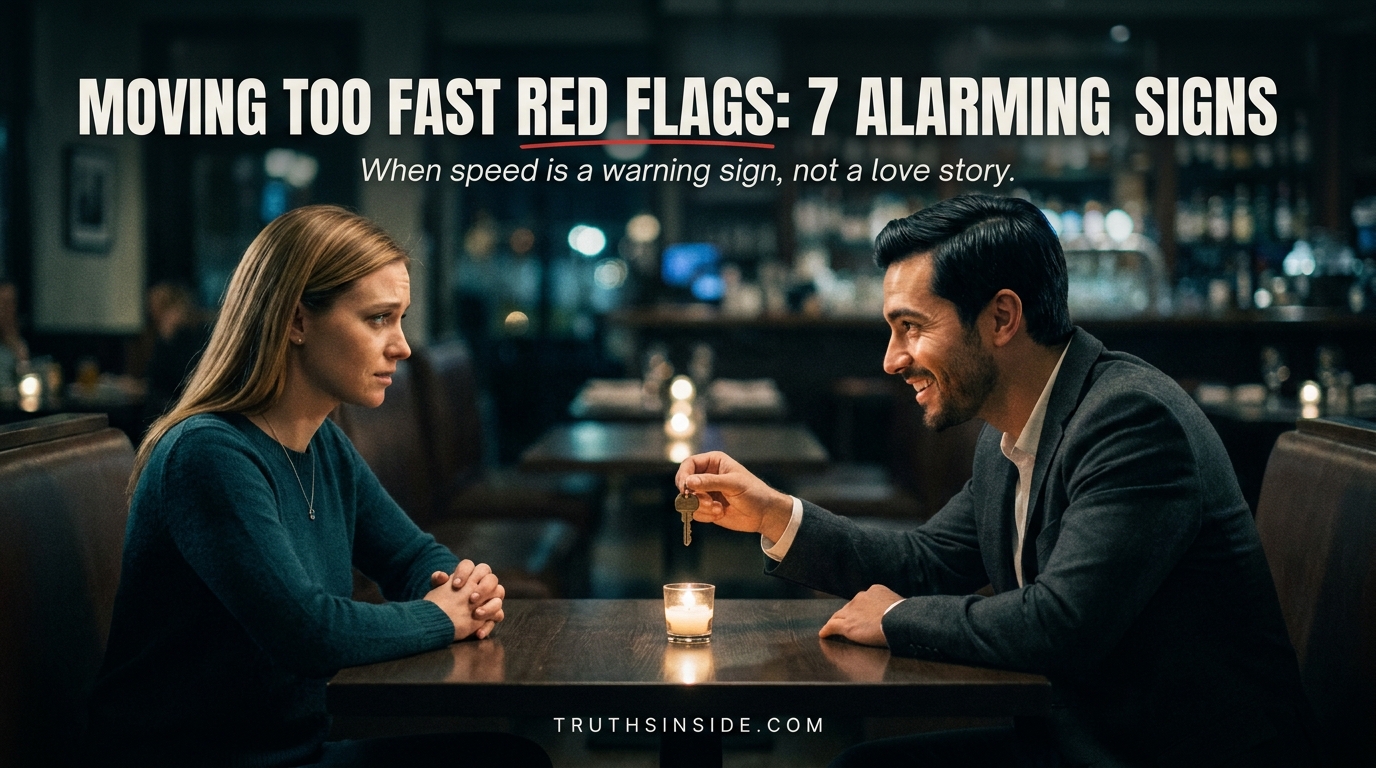
Imagine Tessa, who meets Gabriel through friends. In week one, he calls her his soulmate. In week two, he suggests she give up her Thursday dinners with her sister because “we should be spending every night together.” In week three, he hands her a key to his apartment and asks her to move in by the end of the month.
Taken one at a time, each moment looks romantic. Together, they form a pattern of moving too fast red flags: early declarations, a shrinking social life, and a future decided before she has had a say. When Tessa says, “Can we slow down?”, Gabriel goes quiet and cold for two days. The silence teaches her something important: her pace is being treated as a problem to fix instead of a boundary to respect.
What Tessa Could Say Instead of Staying Silent
Tessa does not need a perfect speech. Something as simple as “I care about you, and I need us to take this slowly” is enough. Whatever happens next is the real answer. If Gabriel adjusts, the relationship can grow at a healthier speed. If he pushes harder, the moving too fast red flags were not about excitement at all.
Moving Too Fast Red Flags Versus Healthy Excitement
It can be hard to tell the difference when you are swept up in a new connection, so here is a simple comparison. Healthy excitement says, “I can’t wait to see you, and I’m fine if you’re busy.” Pressure says, “Why are you busy? Don’t you want to see me?” Healthy excitement shares feelings and lets you share yours. Pressure expects your feelings to match.
Another difference is how each one feels after the moment passes. Healthy excitement leaves you relaxed and curious. Moving too fast red flags leave you tired, second-guessing, or quietly relieved when the person is not around. Pay attention to the afterglow, not only the moment.
📃 Related article: Identity Fusion in Relationships: 7 Warning Signs
Frequently Asked Questions
What are the moving too fast red flags in a relationship?
Common moving too fast red flags include early declarations of love, planning a future within weeks, constant contact and pressure to reply, pushing for exclusivity, isolating you from others, strong reactions when you ask to slow down, and sharing very intense personal stories too soon.
Is moving fast in a relationship always bad?
No. Some couples move quickly and do well when both people are comfortable and choosing the pace freely. Moving too fast red flags appear when one person sets the speed and the other feels pressured, anxious, or unable to say no.
How fast is too fast in a relationship?
There is no universal timeline. A useful test is whether you feel free to slow down without punishment, and whether the closeness matches what you actually know about each other. If intensity outruns knowledge, it may be too fast.
Is moving too fast the same as love bombing?
They can overlap, but they are not identical. Love bombing involves overwhelming early affection, often followed by control or withdrawal. Moving too fast red flags may also come from anxiety or enthusiasm. The key is how the person responds when you set a boundary.
What should I do if my partner moves too fast for me?
Name the pace kindly and clearly, keep your friendships and routines, and watch how they respond. If they respect your pace, you can continue at a comfortable speed. If they push back, take that seriously and consider talking to someone you trust.
Final Thoughts
Moving too fast red flags are not a reason to distrust all passion. They are a reminder that love, to be safe, needs room: room to learn, to disagree, to say “not yet,” and still be loved. Trust your pace, notice how you feel when you slow down, and let time show you who someone really is. The right person will not mind waiting for you to feel ready.
Found this helpful? Save this article for the next time a relationship feels too fast, share it with someone who needs the reminder, and follow Truthsinside.com for more honest relationship insights every week.
🎵 Music
Maren Lull is a singer-songwriter who writes from the places most people don’t talk about out loud.
Not the dramatic grief. Not the obvious heartbreak. The quiet kind — the ordinary Tuesday emptiness, the habit of reaching for someone who isn’t there anymore, the particular exhaustion of being strong for so long that the strength itself wears thin.
Her music lives at the intersection of emotional honesty and soft beauty — breathy vocals over gentle piano, slow tempos, lyrics that feel less like songs and more like something you wrote in a private notebook at two in the morning and never showed anyone.
Maren Lull writes for the people who feel everything deeply and say very little about it. For the ones who listen to sad music not because they want to feel worse — but because being understood, even by a song, makes the feeling easier to carry.
📱 Follow Maren Lull:
→ Spotify
→ Apple Music
→ Youtube
→ Audiomack