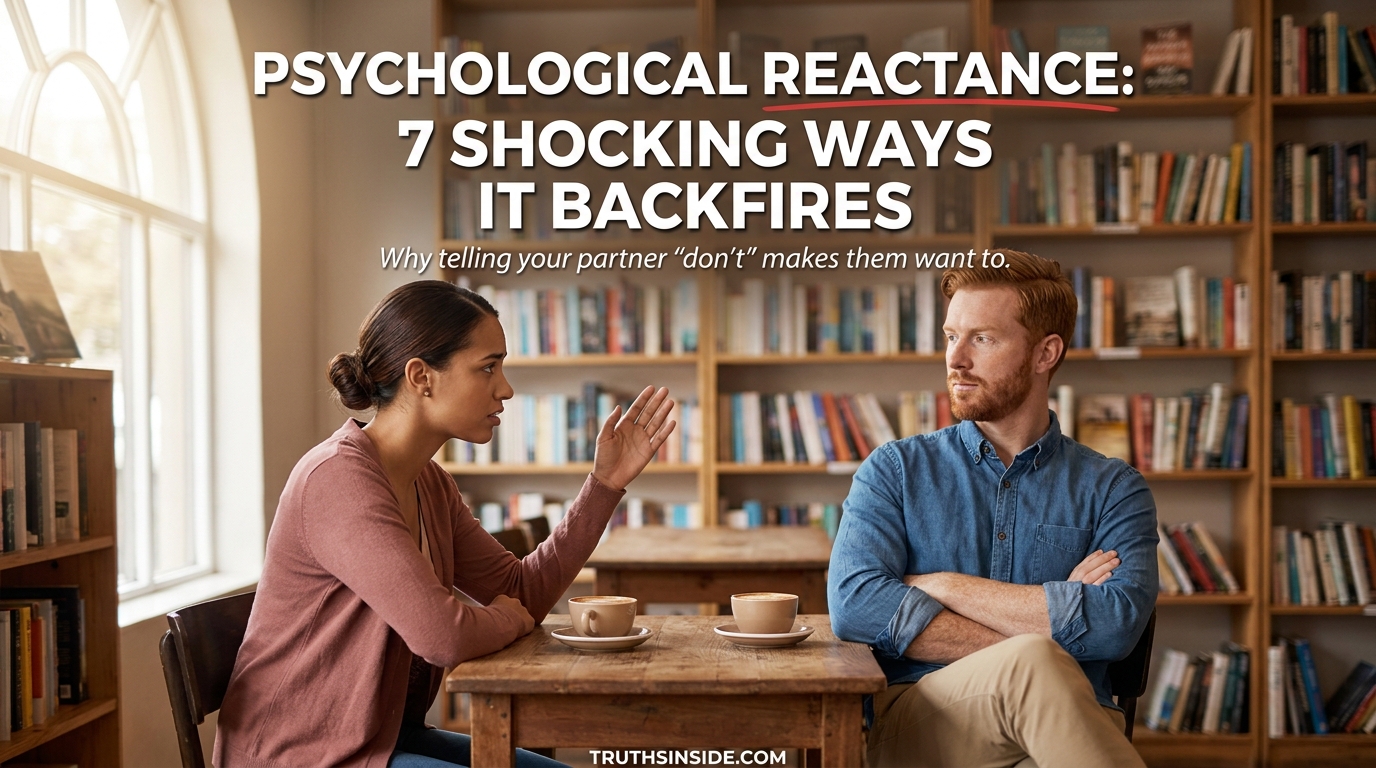
Psychological Reactance: Why Telling Your Partner Not to Do Something Backfires
Psychological reactance is the reason your partner suddenly wants to stay up late, skip the gym, or text an old friend the moment you say, “Please don’t.” It is not stubbornness for its own sake. In 1966, psychologist Jack Brehm proposed that when people feel their freedom of choice is threatened, they experience an uncomfortable motivational pull to reclaim it, often by doing exactly what they were told not to do.
If you have ever been baffled by how a reasonable request turned into a standoff, you are not alone. Psychological reactance catches most of us off guard, because we tell our partners not to do things out of care, worry, or hurt: don’t drive tired, don’t spend that, don’t talk to me like that. We expect the logic to land. Instead, the conversation escalates, and both of you walk away feeling misunderstood.
In this guide, you will learn what psychological reactance is, why it flares up in close relationships, and seven common triggers, from commands and ultimatums to nagging and guilt. You will also learn how to spot it in yourself, and how to use research-backed alternatives that protect your partner’s sense of freedom while still getting your needs heard.
“People rarely resist the request. They resist the feeling of being controlled.”
What Is Psychological Reactance?
Psychological reactance is a motivational state that arises when a person feels that a freedom, a choice they believed was theirs, is being restricted or taken away. Brehm described it as an unpleasant arousal that drives people to restore the threatened freedom. The more important the freedom and the stronger the pressure, the stronger the reaction.
Later researchers, including James Price Dillard and Lijiang Shen, found that psychological reactance combines anger with negative thoughts about the message and its source. That helps explain what it feels like from the inside: a flash of irritation, a quick mental rebuttal, and an urge to do the opposite, sometimes before you have even weighed the actual request.
How Reactance Shows Up
Brehm described several ways people restore freedom. They may do the forbidden thing directly. They may do something similar. They may suddenly find the forbidden option more attractive. Or they may attack the source of the pressure, deciding that the person pushing them is controlling, unfair, or wrong. In couples, all four can happen in a single conversation.
Forbidden Fruit: A Familiar Example
Psychological reactance is not limited to couples. In a well-known study, Brad Bushman and Angela Stack found that warning labels on violent television programs increased some viewers’ interest in watching them. The warnings meant to discourage had the opposite effect. The same pattern appears in teenage rebellion, strict diets, and the way a “wet paint” sign makes a wall irresistible to touch.
Why Psychological Reactance Is Stronger in Close Relationships
Several features of intimate life make psychological reactance especially likely. Partners care about each other’s choices, so requests are often emotionally loaded. They share money, time, and space, so freedoms are constantly being negotiated. And because the relationship matters, a perceived attempt at control can feel like a threat to identity, not just to a plan.
Autonomy Is a Core Need
Self-determination theory, developed by Edward Deci and Richard Ryan, describes autonomy, the sense of acting from your own choice, as a basic psychological need. When a partner’s request feels like pressure, it can frustrate that need, and psychological reactance is often the result. Research on romantic relationships suggests that partners who feel their autonomy is supported tend to report greater satisfaction.
The Romeo and Juliet Effect
In 1972, psychologist Richard Driscoll and colleagues reported that couples who faced more parental interference tended to report stronger love and trust, an idea nicknamed the Romeo and Juliet effect. Later research has been mixed, and some studies find that social disapproval predicts declines in relationship quality. Still, the original finding shows how opposition can sometimes intensify attachment to the very thing being opposed.
📃 Related article: Identity Fusion in Relationships: 7 Warning Signs
Some People Bristle Faster Than Others
People differ in how easily they resist pressure. Researchers have developed tools such as the Hong Psychological Reactance Scale to measure trait reactance, the general tendency to push back against influence. Someone with high trait reactance may react strongly even to gentle requests, and someone raised under strict control may be especially sensitive. Neither is a character flaw. It is a pattern worth understanding.

7 Triggers That Set Off Psychological Reactance in Your Partner
None of these triggers makes you a bad partner. Most are well-meant habits. Read them as a chance to notice what lands as pressure, rather than as a list of faults.
Trigger 1: Commands and Controlling Language
Controlling words are the fastest route to psychological reactance. Words like must, should, have to, and never are the classic spark. Studies on health messages, including work by Claude Miller and colleagues, found that forceful, controlling language produces more reactance than language that leaves room for choice. “You need to stop doing that” sounds like an order. “I’d love it if we could find a different way” sounds like an invitation.
Trigger 2: Ultimatums
“If you go out tonight, we’re done.” Ultimatums remove choices and attach a penalty, which makes them a powerful threat to freedom. Even if your partner complies, they may do so with resentment, and compliance under threat rarely changes their real desire. Ultimatums have a place around true dealbreakers, but as a routine tactic they tend to create standoffs.
Trigger 3: Nagging and Repetition
Repeating a request again and again increases perceived pressure. Each reminder carries the message “I don’t trust you to decide.” The demand/withdraw pattern described by Andrew Christensen and Christopher Heavey shows how one partner’s pursuing can lead the other to retreat, which makes the first partner push harder. This loop is a textbook case of psychological reactance in a long relationship.
Trigger 4: Guilt and Emotional Pressure
Guilt-tripping is one of the quietest forms of psychological reactance fuel. “If you really loved me, you would stay home.” Guilt turns a choice into a loyalty test. It can work briefly, but it breeds resentment and teaches your partner that independent choices are costly. Psychological reactance often appears here as defensiveness, withdrawal, or a sudden insistence on doing the opposite just to prove a point.
Trigger 5: Being Corrected in Front of Others
Pressure feels sharper when other people are watching. Correcting your partner in front of friends or family threatens both freedom and status, which can intensify psychological reactance. A quiet, private conversation removes the audience and lets your partner respond to the request instead of defending their image.

Trigger 6: Predicting the Worst
“You’re going to flake again, aren’t you?” Predicting bad behavior can feel like an accusation, and it removes your partner’s chance to show good intentions. When a person feels pre-judged, resisting the prediction can feel like defending their identity, even if that means doing the very thing you feared.
Trigger 7: Restricting Something They Value
The more your partner values a freedom, whether it is time with friends, a hobby, or control over their own money, the stronger the reaction when it is threatened. Telling someone to give up a long-standing part of their life feels very different from asking them to adjust one evening’s plans. Importance amplifies psychological reactance.
“The harder you push on a door someone is holding shut, the harder they hold.”
How to Recognize Psychological Reactance in Your Relationship
Psychological reactance is easier to manage once you can spot it. Signs that your partner may be experiencing psychological reactance include sudden irritability after a reasonable request, doing the opposite of what you asked, arguing against ideas they previously agreed with, or accusing you of being controlling. You may hear, “I was going to do it, but now I won’t.” That sentence is nearly a definition.
Signs that you may be triggering it include frequent reminders, absolute language, rising frustration when your partner does not comply, and a growing sense that you are the only one who cares. Notice also whether the pattern is mutual. Many couples take turns being the one who pushes and the one who resists.
When You Are the One Reacting
Reactance runs in both directions. If you notice a hot surge of resistance when your partner makes a request, pause before you respond. Ask yourself, “Would I want this if no one had asked?” Sometimes the answer reveals a real preference. Sometimes it reveals a reflex. Naming the feeling, “I notice I’m bristling,” can loosen its grip and make room for a calmer response.
7 Research-Backed Ways to Avoid Psychological Reactance
These approaches share one idea: protect your partner’s sense of choice while still being honest about your needs. You do not need all seven in one conversation. Start with the one that feels easiest.
1. Make a Request, Not a Command
Replace “You need to” with “Would you be willing to?” Questions and invitations preserve choice. They also invite your partner to help solve the problem instead of defending against it.
2. Add “But You Are Free to Say No”
French researchers Nicolas Guéguen and Alexandre Pascual found that adding a phrase like “but you are free to accept or refuse” to a request significantly increased compliance in several studies, and a later meta-analysis supported the effect. The phrase works because it removes the threat to freedom. In a relationship, it must be sincere. If you say it but punish a no, it stops working.
3. Share the Why and Your Feelings
Explaining yourself is one of the best defenses against psychological reactance. Rather than issuing a rule, share your concern and the need behind it: “I get anxious when you drive late at night because I care about you getting home safely.” Reasons feel respectful because they treat your partner as capable of deciding. Feelings are also hard to argue with, because they describe your experience instead of dictating theirs.
4. Ask Questions Before Giving Advice
Psychologists William Miller and Stephen Rollnick, who developed motivational interviewing, describe the “righting reflex,” the urge to fix people and steer them toward the right choice. They found that pushing tends to evoke arguments against change, while open questions draw out a person’s own reasons for it. Try “What do you think would help?” before offering your solution.
5. Offer Choices and Collaborate
Giving options preserves freedom. Instead of “Stop spending on that,” try “How could we plan our spending so we both feel comfortable?” Collaboration signals that the decision belongs to both of you. People are more motivated to follow a plan they helped shape.
6. Choose the Right Time and Place
Psychological reactance rises when people feel cornered, tired, or watched. Choose a private, calm moment, and ask whether it is a good time. If tension rises, pause and return later. A calm setting lowers the sense of threat and makes your partner more likely to hear the actual request.
7. Say It Once, Then Trust Them
Sometimes the most effective move is to say your piece once and let go. Autonomy-supportive partners trust each other to decide, and accept that outcomes may not match their preferences. Trust reduces the pressure that fuels reactance. If a choice truly affects you, say so clearly, and then focus on what you control: your own response.
From Backfiring to Working: Real-Life Rewrites
- Backfires: “Don’t go out tonight.” Works: “I’d love to have you home tonight, but it’s your call. What sounds good to you?”
- Backfires: “You have to stop spending so much.” Works: “I feel stressed about our budget. Could we look at it together this weekend?”
- Backfires: “Stop being on your phone.” Works: “I miss you when we’re both scrolling. Could we try phone-free dinners?”
- Backfires: “You always forget.” Works: “I’d really appreciate a reminder system. What would help you remember?”
- Backfires: “You can’t drive that late.” Works: “I worry about you driving that late. Would you text me when you arrive?”
When Saying “Don’t” Is Appropriate
None of this means you can never set limits. You are allowed to state boundaries about your own behavior, such as “I won’t stay in conversations that involve name-calling,” and to say clearly when something is a dealbreaker, such as infidelity, abuse, or behavior that puts you at risk. The aim is to separate controlling someone else’s choices from protecting your own wellbeing.
It also matters to tell ordinary reactance from real control. If you are the one being told what to wear, who to see, or where to go, and you fear the consequences of saying no, that is not ordinary psychological reactance. It may be coercive control. In the United States, the National Domestic Violence Hotline offers free, round-the-clock support at 1-800-799-7233, and you can text START to 88788. If you are in immediate danger, call 911.

A Quick Self-Check Before Your Next “Don’t”
Answer these honestly before you raise a concern.
- Is this a request, or am I giving an order?
- Have I already said this several times?
- Can I explain the feeling behind it?
- Am I willing to accept a no?
- Is this a private, calm moment?
- What will I do if the answer is still no?
If most answers are encouraging, you are ready to ask in a way that invites cooperation. If several are no, take a day to rephrase. A little preparation often prevents a lot of psychological reactance.
📃 Related article: Respect in a Relationship: 9 Powerful Signs
Frequently Asked Questions
What is psychological reactance in a relationship?
Psychological reactance in a relationship is the resistance one partner feels when they believe their freedom of choice is being restricted. It often shows up as irritation, defensiveness, or doing the opposite of what was requested, even when the request was reasonable.
Why does telling my partner not to do something make them do it more?
Because the pressure threatens their sense of autonomy. According to reactance theory, people try to restore threatened freedoms, sometimes by doing the forbidden behavior. The stronger and more controlling the request sounds, the stronger the urge to resist it.
Is psychological reactance the same as stubbornness?
Not exactly. Stubbornness is a general trait, while psychological reactance is a response to perceived pressure on freedom. A person who is usually flexible can show reactance when they feel controlled, and the same person may cooperate happily when given a real choice.
How do I ask my partner to change without triggering reactance?
Use a request instead of a command, share your feelings and reasons, ask questions first, offer choices, and make clear the decision is theirs. Choose a private, calm moment, and avoid repeating the request again and again.
Can reverse psychology work on a partner?
It can sometimes work because of psychological reactance, but it is a risky habit. It treats your partner as someone to steer rather than trust, and it can damage honesty. Clear, respectful requests tend to build more lasting cooperation.
Final Thoughts
Understanding psychological reactance changes how you hear every “don’t.” Psychological reactance is a reminder that people protect their freedom, even from the ones they love. When your partner pushes back on a “don’t,” they may not be rejecting you or the request. They may simply be defending their right to choose. Ask rather than command, explain rather than pressure, and trust rather than chase. You may be surprised how often a free choice leads exactly where you hoped.
Found this helpful? Save this article for the next time you feel a “don’t” coming on, share it with someone who is tired of the same argument, and follow Truthsinside.com for more science-backed psychology insights every week.
🎵 Music
Maren Lull is a singer-songwriter who writes from the places most people don’t talk about out loud.
Not the dramatic grief. Not the obvious heartbreak. The quiet kind — the ordinary Tuesday emptiness, the habit of reaching for someone who isn’t there anymore, the particular exhaustion of being strong for so long that the strength itself wears thin.
Her music lives at the intersection of emotional honesty and soft beauty — breathy vocals over gentle piano, slow tempos, lyrics that feel less like songs and more like something you wrote in a private notebook at two in the morning and never showed anyone.
Maren Lull writes for the people who feel everything deeply and say very little about it. For the ones who listen to sad music not because they want to feel worse — but because being understood, even by a song, makes the feeling easier to carry.
📱 Follow Maren Lull:
→ Spotify
→ Apple Music
→ Youtube
→ Audiomack