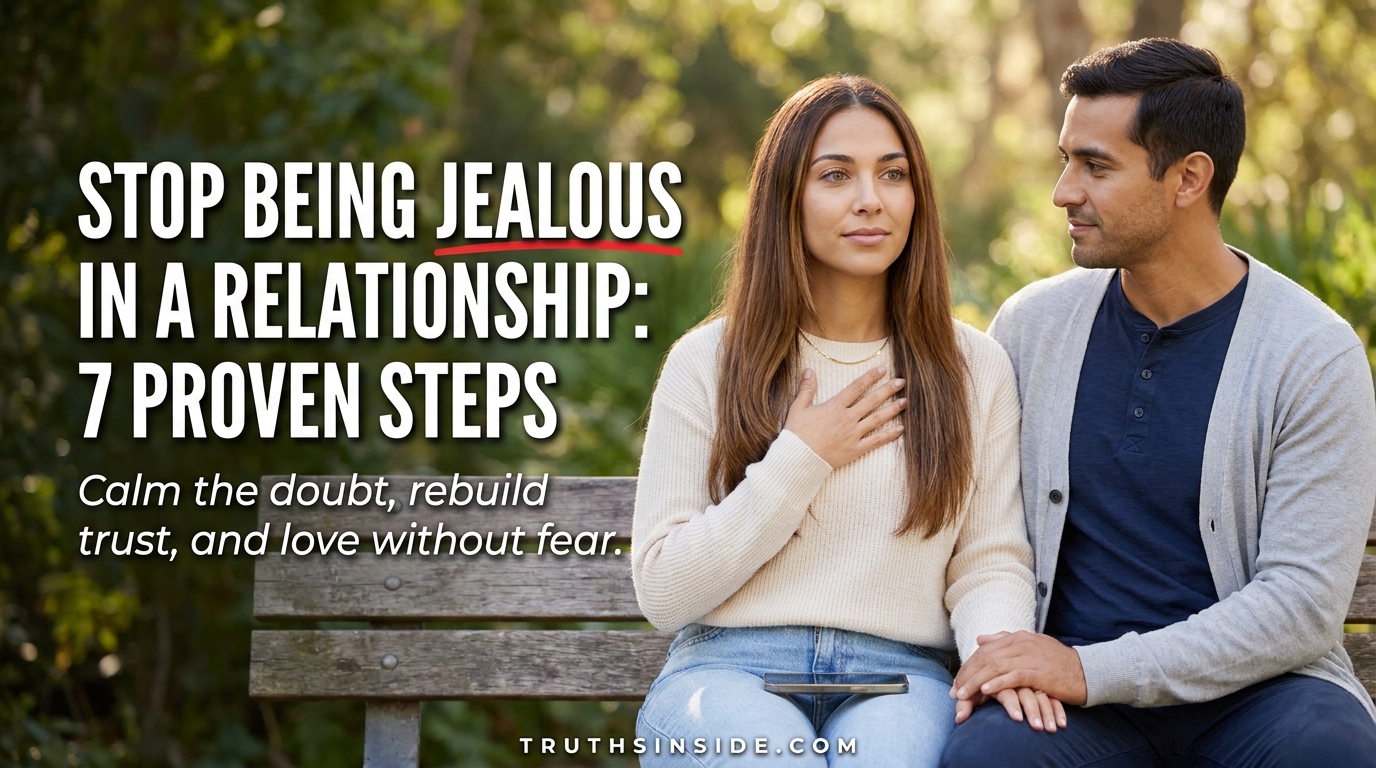
How to Stop Being Jealous in a Relationship
Your partner’s phone buzzes, they smile at the screen, and your chest tightens before your mind can catch up. If you have ever tried to stop being jealous in a relationship and failed, you are not weak or dramatic. You are human, and you love deeply.
Research by communication scholar Laura Guerrero links anxious attachment to stronger jealousy, while secure partners handle the same triggers with far less distress. Jealousy is about how your nervous system reads safety, not only what your partner does, and a nervous system can be retrained.
In this guide, you will learn how to stop being jealous without suppressing your feelings or pretending you are fine. You will get seven proven steps, word-for-word scripts, a 14-day plan, and honest guidance on when to ask for extra help. Let’s start with what jealousy really is.
Is a Little Jealousy Normal?
Yes. A passing pang of jealousy is a normal human response, and it can even be a signal that you value your partner and the bond you share. Evolutionary psychologists argue that jealousy helped our ancestors protect important relationships. The problem begins when the feeling becomes constant, intense, or controlling.
Occasional jealousy says, “I care about us.” Chronic jealousy says, “I cannot feel safe unless I control everything.” Your goal is not to feel nothing. Your goal is to feel the pang, understand it, and respond wisely. That is the healthiest way to stop being jealous without becoming emotionally numb.
Why It Is So Hard to Stop Being Jealous
Jealousy is a signal, not a character flaw. It is your threat-detection system firing an alarm that says, “Something I value might be taken away.” The trouble is that the alarm often goes off when there is no real danger: a late reply, a friendly coworker, an old photo on a social feed. Because the feeling is real, it is hard to stop being jealous by simply telling yourself to calm down. You need to understand the alarm before you can quiet it.
Jealousy, Envy, and Insecurity Are Not the Same Thing
Envy is wanting something someone else has. Jealousy involves three people, real or imagined: you, your partner, and a perceived rival. Insecurity is the belief underneath both, the quiet voice that says you are not enough.
Most people who want to stop being jealous discover that jealousy is only the visible symptom, while insecurity is the root. Treating the symptom alone, by checking a phone or demanding passwords, brings relief that lasts about ten minutes. Treating the root changes the whole pattern.
What Happens in Your Body When Jealousy Hits
When jealousy spikes, your body reacts as if you are under attack. Your heart rate climbs, your stomach knots, and your thinking narrows. Relationship researcher John Gottman calls this state flooding, and he has found that when a heart rate climbs past roughly 100 beats per minute, it becomes very hard to listen, empathize, or think clearly.
That is why arguments in this state go badly. If you want to stop being jealous during the heat of the moment, the first target is your body, not your argument.

The Hidden Roots Behind Jealousy
Nobody wakes up jealous for no reason. Almost every pattern has a root, and finding yours is a major step toward the day you finally stop being jealous in your relationship. Here are the three most common sources.
Your Attachment Style
Attachment theory, first developed by John Bowlby and expanded by Mary Ainsworth, explains how early bonds shape adult love. If caregivers were inconsistent, you may have learned that love can vanish without warning. As an adult, you scan for signs of abandonment and read neutral events as threats.
People with an anxious style often struggle most to stop being jealous, but the pattern is not a life sentence. Attachment styles can shift through secure relationships, self-awareness, and therapy, a process researchers call earned security.
Past Betrayal and Old Wounds
If a previous partner cheated, lied, or left suddenly, your mind learned a painful lesson: trust gets punished. Your current partner pays for a crime they did not commit. The goal is not to forget what happened. The goal is to separate then from now, so you can stop being jealous of threats that belong to a different story.
Ask yourself, “Is my partner giving me evidence, or is my history giving me a script?”
Comparison, Social Media, and Low Self-Worth
Scrolling through curated photos of your partner’s followers, exes, or coworkers is like comparing your behind-the-scenes footage to everyone else’s highlight reel. The more you compare, the smaller you feel, and the smaller you feel, the more threatening everyone else appears.
Low self-worth turns every attractive stranger into a potential replacement. Rebuilding your sense of value is one of the most powerful ways to stop being jealous for good, and we will return to it in the steps below.
📃 Related article: Positive Psychology in Love: 7 Proven Keys to Thrive
7 Proven Steps to Stop Being Jealous in a Relationship
These seven steps work together. You do not need to master them in a day. Practice them in order for two weeks, and notice how your reactions soften.
Step 1: Name the Feeling Before It Names You
The moment you label an emotion, the thinking part of your brain gets a little more control. Psychologists call this affect labeling, and brain-imaging research from UCLA found that putting feelings into words reduces activity in the amygdala, the brain’s alarm center.
Try saying quietly, “I am feeling jealous, and underneath it I feel afraid.” Naming the fear matters, because jealousy is almost always fear wearing anger’s clothing. When you can see the fear, you can begin to stop being jealous of the story it tells.
Write down three details each time: what triggered it, what you felt in your body, and what story your mind told. Within a week, you will see patterns you never noticed.
Step 2: Slow Your Body Down First
You cannot reason with a flooded body. Before you speak, text, or scroll, give your nervous system two minutes to settle. Breathe in through your nose for four counts, then breathe out slowly for six to eight counts. The longer exhale signals safety to your body.
Place a hand on your chest, relax your jaw, and drop your shoulders. If you are in a heated moment, tell your partner, “I need twenty minutes to calm down, and then I want to talk.” Taking a break is not avoidance when you promise to return. It is how you keep jealousy from running the conversation.
Step 3: Challenge the Story in Your Head
Cognitive behavioral therapy teaches that it is rarely the event itself that hurts. It is the meaning we attach to it. Your partner laughs at a coworker’s joke, and your mind says, “They find that person more fun than me.” That is a thought, not a fact.
Ask three questions: What is the evidence for this thought? What is the evidence against it? What would I tell a friend who had this thought? Then write a balanced replacement, such as, “My partner enjoys friendships, and they chose to come home to me.” This habit helps you stop being jealous at the source: the story.
Step 4: Ask for Reassurance the Right Way
Everyone needs reassurance sometimes. The problem is demanding it constantly or in the form of an accusation. Compare these two sentences: “Who were you texting?” and “I had a moment of insecurity today. Could you tell me one thing you love about us?” The first creates defense. The second invites closeness.
Use this simple formula: I feel (emotion) when (situation), and what would help me is (specific request). Keep requests small, kind, and doable. Partners are far more willing to help when you share your vulnerability instead of your suspicion. That shift alone helps you stop being jealous in a way your partner can actually support.
Step 5: Rebuild Your Own Life and Self-Worth
Jealousy grows in empty space. When your entire emotional world revolves around one person, every minute apart feels like a threat. Invest in friendships, hobbies, movement, and goals that belong only to you.
Make a list of ten things you are proud of that have nothing to do with being someone’s partner. Read it when jealousy rises. Self-compassion researcher Kristin Neff has shown that treating yourself with kindness, rather than harsh criticism, builds emotional resilience. You will stop being jealous more easily when your sense of worth no longer depends on one person’s attention.
Step 6: Cut Your Triggers and Drop the Detective Habits
Checking a phone, reading old messages, or stalking an ex’s profile feels like control, but it is an addiction to temporary relief. Every check teaches your brain that the only way to feel safe is to investigate, which strengthens the cycle.
Create friction: log out of the apps, mute accounts that spark comparison, and delete the habit of “just looking.” If you slip, do not shame yourself. Simply note it and return to your plan. Each time you resist an urge and the anxiety rises, peaks, and falls without you acting, you teach your brain you can stop being jealous without proof.
Step 7: Build Trust Through Small, Repeated Moments
Trust is not one grand gesture. Gottman found that stable couples consistently turn toward each other’s small bids for connection, such as a comment, a look, or a joke. Brené Brown describes trust the same way, as a marble jar filled one marble at a time.
Notice and record the marbles: the call that came when promised, the honest answer to a hard question, the time your partner chose you. Share appreciation daily. These small deposits give you evidence, and evidence helps you stop being jealous without needing blind faith.
Jealousy asks, “Can I trust them?” Healing asks, “Can I trust myself to be okay either way?”
What This Looks Like in Real Life
Maya used to react to every late reply with a flood of questions. One evening, her partner Daniel mentioned he was grabbing drinks with a colleague named Priya. Her chest tightened, and the old script started: “Who else is going? Why didn’t you tell me earlier?”
This time, she paused. She breathed out slowly, named the feeling, and challenged the story. Then she said, “I noticed a wave of insecurity when you mentioned Priya. I trust you, and I would love a quick text when you are heading home.”
Daniel’s answer surprised her. He thanked her for telling him instead of interrogating him, and he sent a goodnight message without being asked. Nothing about the situation changed. What changed was how Maya handled the feeling.
Over the next month, her triggers softened, because honest words were met with warmth, not defensiveness. That is how you stop being jealous in a relationship, one calm conversation at a time.

5 Scripts to Use When Jealousy Shows Up
Words matter most in the first thirty seconds of a tense moment. Keep a few ready, so you do not have to invent them while your heart is racing.
- “I am feeling a wave of insecurity. I do not need you to fix it, just a hug.”
- “I know this is my fear talking, but could we check in about the weekend plans?”
- “Can I tell you what I felt when that happened, without blaming you?”
- “I am going to take twenty minutes to settle down, and then I want to talk.”
- “Thank you for being open with me. It really helps me feel close to you.”
Every script describes a feeling, makes a small request, and never accuses. Over time, this helps you stop being jealous because your partner experiences you as a teammate, not a detective.
What Not to Do When You Want to Stop Being Jealous
Some habits feel protective but quietly poison the relationship. Avoid these five common traps:
- Interrogating. Rapid-fire questions turn your partner into a suspect and teach them that honesty leads to punishment.
- Testing. Creating traps or hypotheticals to see if your partner “passes” damages trust on both sides.
- Controlling. Demanding passwords, limiting friendships, or dictating who they can talk to may calm you for a moment, but it breeds resentment.
- Punishing with silence. Withdrawing affection to make a point leaves both of you lonely.
- Comparing yourself to a rival. Studying someone else’s profile only feeds the belief that you are not enough.
If you notice any of these in yourself, treat it as information rather than a verdict. Each behavior is an attempt to feel safe. The fix is not shame but replacement: swap the interrogation for a kind request, swap the test for an honest talk, and swap control for self-soothing. That is the practical path to stop being jealous without damaging the bond you are trying to protect.
How Your Partner Can Help You Stop Being Jealous
Your partner is not responsible for fixing your feelings, but they can be a steady teammate. Healthy support looks like honest answers, predictable communication, and patience during rough days. It does not look like giving up friends, deleting contacts, or reporting every move.
Those accommodations feel kind at first, yet they keep the anxiety alive by confirming that the threat is real. Talk openly about the difference between reassurance that heals and rules that restrict.
Agree on small rituals instead: a goodnight message, a weekly check-in, a clear heads-up when plans change. These habits build safety while you stop being jealous at your own pace.
When to Seek Professional Support
Self-help works for many people, but some patterns need more. Consider working with a licensed therapist if jealousy disrupts your sleep or work, if you have intrusive thoughts you cannot dismiss, if you have repeatedly checked or followed your partner, or if past trauma keeps replaying.
Cognitive behavioral therapy, attachment-focused therapy, and couples therapy all have strong track records for relationship anxiety. Asking for help is not an admission that you are too much. It is a decision to stop being jealous with proper tools instead of willpower alone.
One important note: if you are the person being monitored, controlled, or blamed for your partner’s jealousy, that is a different situation. Controlling behavior is not love, and you deserve support. Reach out to a trusted friend, a counselor, or a local domestic violence hotline if you feel unsafe.

Your 14-Day Plan to Stop Being Jealous
Change feels easier when it is broken into small pieces. Follow this simple plan, and adjust it to fit your life.
- Days 1 to 3, Notice. Keep a jealousy log. Write the trigger, the body sensation, and the story. Do not try to fix anything yet.
- Days 4 to 7, Soothe. Practice the breathing technique twice daily and once during any trigger.
- Days 8 to 11, Reframe and speak. Challenge one thought each day and make one kind, specific request for reassurance.
- Days 12 to 14, Rebuild. Schedule one solo activity, one friend meet-up, and one moment of appreciation with your partner.
At the end, review your log and compare the intensity of your jealousy from day one to now. Most people find the peaks lower and the recoveries faster. Progress is not perfection. It is shorter storms.
Repeat the cycle for another two weeks, and you will find you can stop being jealous more often than you expected.
📃 Related article: Taking the Relationship for Granted: 7 Shocking Signs
Final Thoughts: You Can Stop Being Jealous and Still Love Deeply
Learning to stop being jealous in a relationship is not about becoming emotionless or pretending you never feel a pang. It is about responding to the pang with awareness instead of accusation, with breath instead of panic, and with honesty instead of control.
Your feelings make sense, and your patterns can change. Every time you pause, name the fear, and choose a calm sentence over a sharp one, you build a new neural path toward security.
Be patient with yourself. Some days will feel like progress, and some like a setback. Both are part of the process.
You are not too much. You are learning to feel safe, and safety can be built.
Frequently Asked Questions
Why do I get jealous even when my partner has done nothing wrong?
Jealousy often comes from your own history, attachment style, or self-worth rather than your partner’s behavior. Your brain predicts danger based on past pain, so it can fire an alarm without a real threat. Understanding this is the first step to stop being jealous of things that have not happened.
Can jealousy ever be healthy?
Mild, occasional jealousy can show that you value your relationship, and it can prompt a useful conversation. It becomes unhealthy when it leads to controlling behavior, constant checking, or accusations. The aim is to manage it, not to erase it.
How long does it take to stop being jealous?
It varies. Many people notice lower intensity within two to four weeks of consistent practice, while deeper patterns tied to attachment or past betrayal may take months and benefit from therapy. Steady, small practice beats occasional big efforts.
Should I tell my partner I am jealous?
Yes, if you share it without blame. Say what you feel and what would help, rather than accusing them of causing it. Honest, calm sharing builds intimacy, and it gives your partner a chance to support you as you work to stop being jealous.
Save, Share, Follow
Save this guide so you can return to the 14-day plan whenever jealousy flares. Share it with someone who needs to hear that they are not alone. Follow Truthsinside.com for more relationship advice that helps you love with confidence and calm.
🎵 Music
Maren Lull is a singer-songwriter who writes from the places most people don’t talk about out loud.
Not the dramatic grief. Not the obvious heartbreak. The quiet kind — the ordinary Tuesday emptiness, the habit of reaching for someone who isn’t there anymore, the particular exhaustion of being strong for so long that the strength itself wears thin.
Her music lives at the intersection of emotional honesty and soft beauty — breathy vocals over gentle piano, slow tempos, lyrics that feel less like songs and more like something you wrote in a private notebook at two in the morning and never showed anyone.
Maren Lull writes for the people who feel everything deeply and say very little about it. For the ones who listen to sad music not because they want to feel worse — but because being understood, even by a song, makes the feeling easier to carry.
📱 Follow Maren Lull:
→ Spotify
→ Apple Music
→ Youtube
→ Audiomack