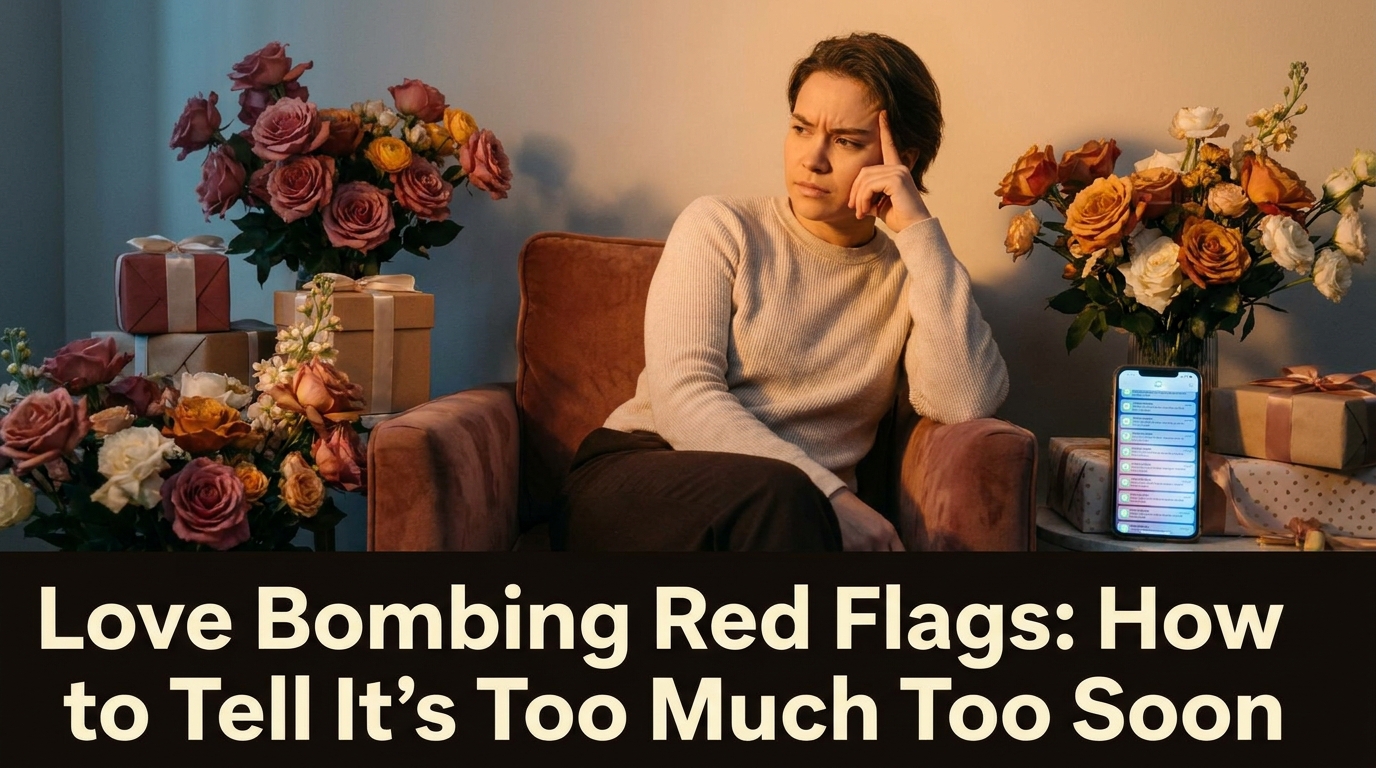
It felt like a fairytale.
The messages that arrived before you were even fully awake. The declarations that came faster than any relationship had a right to produce. The feeling of being chosen, seen, and pursued with an intensity that made everything that came before look pale and insufficient.
Nobody told you to be suspicious of it. Everything in you wanted to believe it was real.
And in one sense, it was real. The feeling was genuine. The neurochemical experience was as authentic as any you have had. The warmth, the attention, the extraordinary sense of being truly known — these registered as real because, neurologically, they were.
What was not real — or not yet, or not in the way it appeared — was the relationship that seemed to be producing all of it.
Love bombing is one of the most misunderstood early relationship dynamics precisely because it does not feel wrong. It feels like finally getting it right. Learning to recognize love bombing red flags is not about becoming suspicious of all intensity. It is about developing the discernment to tell the difference between genuine early connection and the specific, identifiable pattern of manufactured intimacy.
Research from the Journal of Social and Personal Relationships found that love bombing behaviors are significantly associated with narcissistic personality traits, with insecure attachment patterns, and with relationships that follow the specific cycle of idealization, devaluation, and discard.
This article names what that pattern actually looks like.
What Makes Love Bombing Different From Genuine Intensity
This is the question that matters most — and the one most love bombing discussions fail to answer with sufficient specificity.
Not all early intensity is love bombing. Genuine chemistry, genuine compatibility, and genuine mutual attraction can all produce early relationship experiences that are intense, warm, and deeply meaningful. The experience of falling in love is genuinely overwhelming — neurologically, emotionally, experientially. Early love is supposed to feel significant.
The difference between love bombing and genuine intensity is not in the feeling. It is in the source, the function, and the pattern.
Genuine early intensity:
Grows as both people actually discover each other. The intensity deepens because real things are being revealed — actual vulnerabilities, actual histories, actual complexities. The warmth is responding to who you genuinely are as you gradually become known.
Allows space for the pace to be set by both people. Genuine mutual attraction respects each person’s rhythm. If you indicate a need to slow down, the other person adjusts — not because they are strategic, but because they are genuinely interested in you and your comfort matters to them.
Contains genuine disagreement and difference. The person pursuing you does not agree with everything you say, does not mirror every preference back to you, does not present a version of themselves that aligns perfectly with every value you express. They are a real person discovering another real person — and real people do not coincide perfectly.
Feels warm and sustaining. The intensity of genuine early connection produces a feeling of warmth and possibility that is energizing rather than destabilizing.
Love bombing:
Arrives fully formed from the beginning. The intensity is complete before genuine knowing has had time to occur. It is not responding to who you actually are — it is projecting an idealized image onto you.
Does not slow when you indicate a need for pace. The love bomber escalates regardless of your rhythm because the purpose of the intensity is not to respond to you — it is to create attachment in you. Your pace is not relevant to that purpose.
Contains uncanny alignment. The love bomber appears to share all your values, all your interests, all your preferences — with a precision that, in retrospect, is more suspicious than comforting.
Feels overwhelming rather than sustaining. The intensity of love bombing produces a specific quality of feeling — more than you know what to do with, slightly destabilizing, not quite within the container that genuine early connection provides.
“The difference between love bombing and genuine intensity is not the volume of the feeling. It is whether the feeling is responding to who you actually are — or to who they need you to be.” — Relationship Psychology Research
15 Love Bombing Red Flags to Recognize
1. The Pace Is Set Entirely by Them — And It Is Very Fast
Relationships develop at the pace of genuine mutual knowing — which takes time, which cannot be artificially accelerated, which follows the natural rhythm of two people discovering each other.
Love bombing bypasses this pace entirely. The intensity arrives before genuine knowing has occurred. The declarations come before there is a relationship deep enough to support them. The future plans are discussed with a seriousness that the relationship’s actual age cannot warrant.
And crucially — the pace is set by the love bomber. It does not reflect mutual momentum. It reflects a unilateral urgency that serves the love bomber’s need to create attachment rapidly.
Watch for: declarations of love, future plans, or deep personal commitment arriving in a timeframe that the relationship cannot genuinely support. Watch for: your own sense of the relationship moving faster than you have had time to choose.
2. The Attention Is Constant — And the Absence of It Produces Anxiety
In love bombing, the attention is so consistent, so pervasive, so omnipresent that it gradually becomes the baseline — and the baseline, once established, makes any deviation feel like withdrawal.
The constant good morning messages, the continuous checking in throughout the day, the evenings of unbroken contact — these create a neurological expectation. And when the expectation is not met — when the message does not come at the usual time, when the attention briefly lapses — the resulting anxiety is real and significant.
This is the mechanism by which love bombing creates dependency before genuine attachment has had time to develop. The attachment system is conditioned to the presence of the stimulus — and responds to its absence with the anxiety of genuine withdrawal.
Watch for: a level of contact that establishes itself as the baseline early and rapidly, producing anxiety in its absence rather than ordinary longing.

3. They Know Everything About What You Want — Immediately
The love bomber presents an extraordinary alignment with your values, your interests, your aesthetic preferences, your life philosophy — in a timeframe that makes genuine discovery of these things implausible.
They love the same obscure things you love. They hold the same specific values you hold. They have the same vision for their life that you have for yours. They reflect back your own desires and preferences with a precision that feels miraculous.
This mirroring is one of the most seductive features of love bombing — and one of the most reliable red flags. Because genuine people are not perfect mirrors. They have their own specificity — their own corners of difference, their own preferences that diverge from yours, their own complexity that does not resolve perfectly into your expectations.
The person who is perfectly aligned is not revealing who they are. They are performing who you need them to be.
Watch for: agreement that is too complete, alignment that is too precise, a person who seems to have no values or preferences of their own that diverge from yours.
4. They Push Back When You Need Space
Genuine mutual connection respects your pace. A partner who genuinely cares about you accepts the word no — to a request, a pace, a plan — without sulking, escalating, or applying pressure.
Love bombing does not respect pace because pace is not the point. The point is attachment creation — and attachment creation requires the continuous maintenance of contact and intensity. When you introduce space, you interrupt that process.
The response can take many forms: mild sulking, subtle hurt that communicates your withdrawal is damaging the relationship, escalation of intensity to compensate for the space you have created, or explicit guilt — “I thought you felt the same way I do.”
Watch for: any response to your need for space that is not simple acceptance. Healthy partners do not need to pressure you into more contact than you want.
5. Future Plans Are Discussed With Serious Intensity Very Early
“When we move in together…” “I’ve been thinking about where we should go for our one-year…” “I want you to meet my family next month…” — conversations held in the first weeks of a relationship with a seriousness that the relationship cannot yet support.
This is future faking in its love bombing form — and its function is to create a sense of shared investment and shared future before genuine mutual commitment has had the time to develop.
The proposed future is real enough to feel like genuine investment. The relationship is not yet old enough to have earned it. And the gap between those two things — the relationship implied by the future plans and the relationship that actually exists — is the space in which attachment is manufactured before it has been genuinely built.
Watch for: future plans introduced with intensity and seriousness in a timeframe that the relationship’s actual depth cannot support.

6. The Compliments Are Excessive and Arrive Before They Can Be Earned
Love bombing typically includes a volume of compliments, flattery, and declarations of your exceptional qualities that exceed what genuine early knowledge could have produced.
“I’ve never met anyone like you.” “You’re the most extraordinary person I’ve encountered.” “I knew from the moment I saw you that you were different.”
These statements may feel wonderful. They are not descriptions of you — they cannot be, because you have not been known long enough to be described with this specificity. They are projections of an idealized image onto you.
And the idealized image is not you. When the love bombing phase ends and the idealization gives way to the actual person, the gap between the person who was idealized and the actual person you are — with your ordinary complexity, your imperfections, your specific way of being human — becomes the source of the devaluation that follows.
Watch for: praise and declarations that exceed what genuine knowledge of you could support.
7. They Make You Feel Uniquely Seen — But You Are Not Sure How
The feeling of being uniquely seen is one of the most powerful experiences available in early relationship — and love bombing produces it with extraordinary efficiency.
The love bomber makes you feel known — with a specificity, a precision, an attunement that feels more profound than anything you have experienced before. They say the exact right thing. They notice the things you hoped would be noticed. They understand in ways that feel almost uncanny.
But underneath the feeling, when you examine it carefully, you are not sure how they know what they seem to know. The attunement is real. The basis for it is not. They are reading and reflecting rather than genuinely discovering.
Watch for: the feeling of being profoundly known before you have genuinely been shared — the experience of being seen by someone who has not had the time to genuinely see you.
8. They Establish Exclusivity Before the Relationship Warrants It
“Are you talking to anyone else?” “I want us to be exclusive.” “I’m not interested in anyone else and I hope you feel the same.” — introduced very early, with an urgency that the relationship’s actual stage does not require.
The push for early exclusivity serves the love bombing function of rapid attachment creation — by establishing commitment before genuine evaluation has occurred, it increases the investment in the relationship and makes future disengagement more costly.
Watch for: pressure for exclusivity in a timeframe that the relationship’s depth does not warrant, or that you feel pressured into rather than genuinely choosing.

9. Gifts and Grand Gestures Arrive Before Genuine Connection Has Been Established
Gestures of care in a relationship communicate thoughtfulness, attention, and genuine regard. In love bombing, they communicate something different — they are deployed as tools of attachment creation, before genuine connection has had time to develop, in volumes that exceed what the relationship warrants.
The elaborate gift after three dates. The grand gesture after two weeks. The surprise that is more suited to a six-month anniversary than a first month of knowing each other.
These gestures create a sense of indebtedness — of something owed in return — and of a relationship that is further along than it actually is. Both effects serve the love bombing function.
Watch for: gestures that exceed what the relationship’s actual depth would warrant, and that arrive with an expectation — explicit or implicit — of reciprocal investment.
10. They Become Subtly Critical the Moment You Pull Back
One of the most revealing love bombing red flags is what happens when you create distance — however briefly, however reasonably. The warmth that was unconditional suddenly carries a condition: your consistent, enthusiastic proximity.
The subtle criticism might take many forms. “I thought you were different.” “I felt really hurt when you didn’t respond.” “You’re not as [positive quality] as I thought.” The idealization briefly drops, revealing what is underneath it — and what is underneath it is not acceptance of your full, complex self. It is a performance of acceptance conditional on your behaving in accordance with the love bomber’s needs.
Watch for: the first hint of criticism that arrives precisely when you have introduced distance, suggesting that the warmth was always contingent on your continuous availability and investment.
11. Your Friends and Family Have Noticed the Pace and Are Concerned
The people who know you — who have no stake in this relationship, who know what your ordinary relationship experiences look like — often notice the abnormality of love bombing before you do. Because they are outside the neurochemical environment it creates.
Their concern, when it arrives consistently and from multiple sources, is worth genuine attention. Not as a veto. As information from people who can see the pattern from outside the experience of it.
Watch for: consistent concern about the pace from multiple people who know you well and who have previously been supportive of your relationships.

12. The Relationship Moves From Extraordinary to Ordinary Very Quickly — And the Ordinary Feels Like Loss
Love bombing sets an emotional baseline that is impossible to sustain. The constant messages, the extraordinary attention, the overwhelming warmth — these are not the normal operating temperature of a healthy relationship. They are a performance that serves a function in the early period.
When the performance naturally relaxes — when the love bomber settles into the level of investment that a long-term relationship actually requires — the person who was love bombed experiences the adjustment as loss. As withdrawal. As evidence that something has changed, that they have done something wrong, that the extraordinary love of the beginning is slipping away.
This is the specific mechanism by which love bombing creates ongoing dependency — the person who experienced the extraordinary baseline is now perpetually working to recapture it, perpetually experiencing the ordinary as a disappointing diminishment of what was.
Watch for: a significant drop in the love bomber’s intensity relatively early in the relationship — and your own response of feeling that something has been lost that you need to recover.
13. Their Attention Feels More Like Need Than Genuine Interest
There is a quality to love bombing attention that, examined carefully, feels different from genuine interest. Genuine interest is curious — it wants to know you, discovers you gradually, responds to what it actually finds.
Love bombing attention has a quality of urgency beneath it — a need to be met, a validation to be received, a specific response to be elicited. The attention arrives in service of the love bomber’s need rather than in genuine response to you.
Watch for: the quality of being overwhelmed by someone’s attention while simultaneously sensing that the attention is not quite about you — that it serves something in them that does not require you specifically.
14. They Involve You in Their Life at a Pace That Creates Obligation
Meeting the family after two weeks. Being introduced to their entire social world within a month. Being positioned as a primary support person before genuine mutual support has been established.
These rapid involvements serve the function of increasing your investment and therefore the cost of disengaging. They create a relational infrastructure — social connections, shared events, family relationships — that makes the relationship feel more established than it is and leaving feel more disruptive than it would otherwise be.
Watch for: involvement in their life that moves faster than the relationship’s genuine depth and that feels like it is creating social obligations before genuine mutual commitment has been established.
15. Something Feels Slightly Off Beneath the Overwhelmingly Good Feeling
This is the most important and the most difficult to name. It is not a specific behavior. It is a quality — a barely perceptible something that registers beneath the extraordinary positive feeling.
A sense that the attention is slightly too calibrated. That the alignment is slightly too precise. That something about the pace is moving at a speed that is not fully within your control. That beneath the warmth there is an urgency that has not been explained.
This quality is your nervous system processing information that has not yet resolved into conscious assessment. It deserves genuine attention — not catastrophizing, not immediate action, but the honest acknowledgment that it is there and the willingness to let it inform how you proceed.
Watch for: the feeling that something is slightly off beneath the overwhelmingly good — and your own impulse to explain it away before you have fully examined what it might be.
What to Do If You Recognize These Red Flags
Slow down — unilaterally if necessary. You do not have to announce that you suspect love bombing. Simply slow your pace. Maintain your existing life and relationships. Be less continuously available. Observe the response.
Notice what happens when you slow down. Does the other person adjust naturally and warmly — demonstrating that your pace matters to them? Or do they escalate, sulk, or communicate hurt in ways that suggest your continuous availability is required rather than welcome? The response to your slowing is some of the most reliable information available.
Talk to people outside the relationship. Bring the experience to people who know you. Not to seek permission or a verdict — but to hear a perspective not clouded by the neurochemical environment that love bombing creates.
Give yourself time before increasing investment. Each significant increase in relationship investment — exclusivity, major time commitments, meeting important people in each other’s lives — should be a choice made with adequate time and information. If you feel urgency around these decisions that seems to come from outside you, examine where that urgency is coming from.
Trust the pace of genuine knowing. Genuine connection deepens as both people gradually reveal themselves. If intensity arrived before genuine knowing could have occurred, that mismatch is worth honoring with the patience to find out who this person actually is before increasing your investment.
Love bombing feels like the beginning of everything you have been waiting for. The discernment to recognize it is not the death of hope. It is the protection of your capacity to receive genuine love — when it arrives at the pace that makes it real.
CALL TO ACTION
💾 Save this — read it again before your next first month with someone new. 📤 Share it with someone in the early stages of something that might be moving too fast. 👣 Follow Truthsinside.com for honest, psychology-backed content on red flags, love, and the discernment that protects genuine connection.
Frequently Asked Questions
Q1: How early is too early for declarations of love? There is no universal timeline — and any answer that provides one oversimplifies something genuinely variable. What matters is not the specific timing but the relationship between the declaration and the actual depth of knowing it claims to reflect. “I love you” in week two, before genuine knowledge of each other has been established, is likely not describing love in the way the word conventionally means — it is more accurately describing an intense attraction or an emotional state that is real but not yet earned by genuine mutual knowing. The pace of declaration should follow the pace of genuine discovery. When it precedes it significantly, that gap is worth examining.
Q2: Can love bombing be unintentional? Yes — and this is important to understand. Love bombing is most consistently associated with narcissistic personality traits and calculated manipulation. But it also occurs in people with anxious attachment who genuinely feel the intensity they are expressing and do not recognize the impact of their pace on the other person. It can occur in people who fall in love intensely and quickly without understanding how their expression of that intensity lands. The behavior and its impact are the same regardless of intent. Understanding that it may be unintentional does not reduce the red flag its presence represents — it simply affects how you understand the person exhibiting it.
Q3: What if the intensity feels completely mutual and genuine on both sides? Mutual intensity in early relationships is real and can be the foundation of something genuine. The most useful questions to ask are not about the intensity but about what happens when circumstances naturally moderate it.
Does the connection deepen as both people are genuinely known — including their less-perfect aspects — or does it depend on the maintenance of the extraordinary initial experience? Does the intensity coexist with genuine curiosity and genuine discovery, or does it substitute for them? Genuine mutual intensity grows into something more nuanced as both people are genuinely revealed. Love bombing tends to peak in the early period and then shift — because it cannot be sustained once genuine knowing begins.
Q4: I was love bombed and now the relationship has shifted. What should I do? The shift itself — the move from extraordinary idealization to something noticeably cooler or more critical — is significant information. It confirms that the extraordinary early experience was not the sustainable baseline of this person’s care.
The most useful steps are: naming honestly to yourself that the shift has occurred and what it represents, examining what the relationship looks like now without the lens of the initial intensity, talking to people who know you about what they observed in the early period and what they are observing now, and working with a therapist if the shift has activated significant distress or confusion. You are not required to work to recover the early intensity. That intensity was not the relationship — it was its introduction.
Q5: How do I stay open to genuine early connection without being vulnerable to love bombing? By maintaining yourself — your life, your relationships, your pace — while remaining genuinely open. Love bombing works, in part, by creating an environment in which the person receiving it gradually reorganizes their life and attention around the love bomber. Maintaining the full context of your own life — your existing friendships, your interests, your independent rhythms — while enjoying a new connection does two important things simultaneously.
It protects you by ensuring you have external perspectives and independent resources. And it provides a natural, automatic test: a person with genuine interest in you will accept and respect the continuity of your full life. A love bomber will, with increasing pressure and subtlety, work against it.
🎵 Music
Maren Lull is a singer-songwriter who writes from the places most people don’t talk about out loud.
Not the dramatic grief. Not the obvious heartbreak. The quiet kind — the ordinary Tuesday emptiness, the habit of reaching for someone who isn’t there anymore, the particular exhaustion of being strong for so long that the strength itself wears thin.
Her music lives at the intersection of emotional honesty and soft beauty — breathy vocals over gentle piano, slow tempos, lyrics that feel less like songs and more like something you wrote in a private notebook at two in the morning and never showed anyone.
Maren Lull writes for the people who feel everything deeply and say very little about it. For the ones who listen to sad music not because they want to feel worse — but because being understood, even by a song, makes the feeling easier to carry.
📱 Follow Maren Lull:
→ Spotify
→ Apple Music
→ Youtube
→ Audiomack