
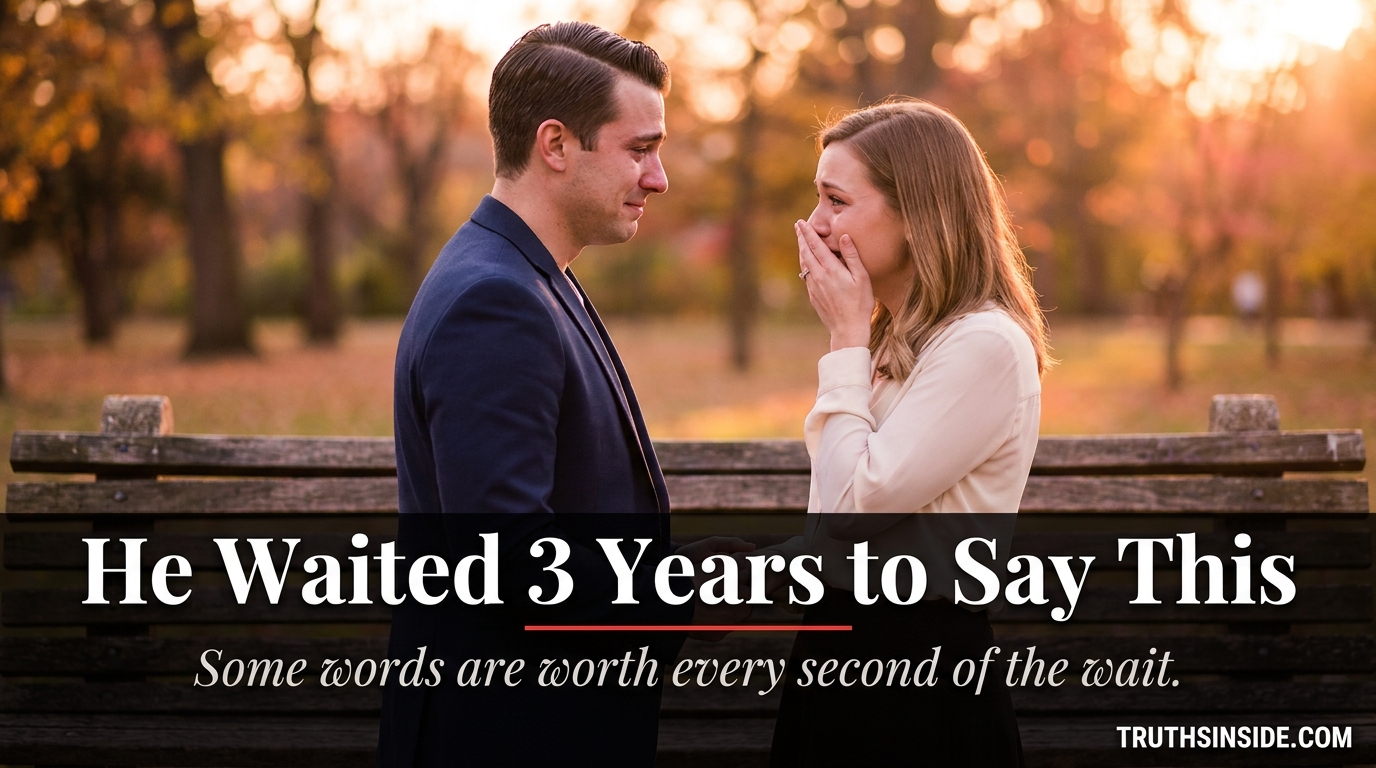
He Waited 3 Years to Say This — And It Changed Everything
There is something quietly devastating about loving someone in silence. He waited 3 years to say this — three full years of swallowed words, sleepless nights, and a feeling so enormous it had no room left to live inside his chest. If you have ever loved someone without the courage to tell them, you already know exactly what kind of pain that is. Research from the University of Toronto found that fear of rejection is one of the top three reasons people suppress romantic feelings — sometimes for years. This is not just a love story.
This is a story about what happens to a heart when it carries too much for too long — and what it looks like when it finally lets go.
His name was Daniel. He was thirty-one years old, quiet in the way that people mistake for coldness. He worked as a landscape architect in a mid-sized city in Ohio, designing green spaces that other people got to enjoy while he spent most evenings alone. He wasn’t unhappy, exactly. He had friends, a routine, a dog named Scout who slept at the foot of his bed every night. But there was a hollow place in him that he couldn’t fill with any of it — and he knew exactly why.
Her name was Maya.
How It All Began
They met at a mutual friend’s birthday dinner three years before any of this reached its conclusion. Maya arrived late, sliding into the seat directly across from Daniel, apologizing breathlessly to the table. She had just come from teaching her evening yoga class, and her dark hair was clean and neatly pulled back into a smooth, polished low bun. She smelled like lavender. She laughed too loud at her own jokes before the punchline landed, and then laughed harder at herself for doing it.
Daniel was a careful man. He noticed everything. He noticed the way she tore her bread roll into four exact pieces before eating any of it. He noticed that she asked the waiter his name and used it every time after that. He noticed that when someone at the table said something sad, her face changed before she could stop it — like her emotions lived just beneath the surface of her skin, always a half-second faster than she was.
He drove home that night thinking about her. He thought about her the next morning too.
The Friendship That Held Everything
Within two months, Daniel and Maya had become part of the same friend group. Weekend hikes. Group dinners. The occasional movie night crammed onto someone’s too-small sofa. He was always there when she was there. He told himself it was coincidence. It was not coincidence. He was thirty-one years old and actively rearranging his schedule around a woman he had never once told how he felt.
Maya, for her part, liked Daniel enormously. She trusted him in a way that felt immediate and solid, the way you trust a house that was built properly. When her apartment had a leak at midnight, she called him. When she got bad news about a family member’s health, he was the one who sat with her on her kitchen floor while she cried. He brought soup she didn’t ask for. He fixed things she hadn’t noticed were broken.
“You’re the best friend I’ve ever had,” she told him once, and he smiled and said thank you and went home and stared at his ceiling for an hour.
“He had memorized the exact way her face changed right before she laughed. He had never told a single soul.”
Why He Didn’t Say It
People who learn this story always ask the same question — why didn’t he just say something? He waited 3 years to say this when he could have said it in month one. The answer, like most real answers, is complicated.
Daniel had been in one serious relationship before Maya. It ended badly — not dramatically, not with shouting, but with a quiet unraveling that left him feeling like he had misjudged everything. He had been so sure about that relationship. He had said “I love you” early, easily, and then watched it fall apart anyway. The experience taught him a brutal lesson about the gap between feeling something deeply and that feeling being returned.
So he waited. He watched. He convinced himself that being near Maya as a friend was better than losing her entirely by being honest. Psychologists call this self-protective silence — a coping mechanism where the fear of loss outweighs the desire for connection. It is extraordinarily common. It is also, in the long run, extraordinarily costly.
📃 Related article: Emotional Aftershock of Cheating: 9 Raw Truths Revealed
The Year Everything Shifted
In the second year, Maya started dating someone. His name was Brett. He was easy to be around, charming in a surface-level way, the kind of man who always had a plan for the weekend. Daniel shook Brett’s hand the first time they met and said it was great to meet him, and he meant absolutely none of it.
He watched Maya be happy with Brett and told himself that was enough — that her happiness was what mattered. Some days he believed it. Most days he did not. He worked longer hours. He took on extra projects. He got very good at landscape architecture and very bad at sleeping.
Brett lasted seven months. The breakup was not dramatic either. Maya told Daniel about it over coffee one Saturday morning, calm and clear-eyed, saying she realized Brett was wonderful but that something fundamental was missing. “I kept feeling like I was performing the relationship,” she said, “instead of actually living it.”
Daniel looked into his coffee cup so she wouldn’t see his face.

The Third Year
Something changed in Daniel during Maya’s third year in his life — or more accurately, something stopped working. The emotional architecture he had built to contain his feelings began to crack. He started noticing things he had trained himself to stop noticing. The way she remembered things he mentioned once in passing. The way she celebrated his wins harder than he did. The fact that she had kept every birthday card he had ever given her in a box in her closet — she mentioned it casually and had no idea what it did to him.
He began writing. Not to send — just to release. Pages in a journal that lived in his nightstand drawer, full of the words he couldn’t say out loud. He wrote about the dinner where they met. He wrote about the night she cried on her kitchen floor and how he would have sat there forever if she needed him to. He wrote about the specific color of her laugh, which is an impossible thing to describe but which made complete sense when he read it back.
He waited 3 years to say this — and for most of those years, the journal was the only place it existed.
The Night He Almost Said It
Eight months into year three, Daniel came close. They were at a rooftop gathering for a friend’s engagement party. Fairy lights. Warm September air. Maya had her hair down that night — smooth and clean, falling neatly over her shoulders. She was wearing a deep green dress and talking to no one Daniel recognized, laughing at something. She looked across the rooftop, found him in the crowd without seeming to look for him, and smiled the specific smile that she only ever gave to him.
He walked over. They stood side by side against the railing, looking out at the city lights. The conversation drifted into a quiet, easy silence — the kind you can only have with someone you trust completely. And then Maya said, softly, almost to the city itself: “I always feel the most like myself when you’re around. Is that a weird thing to say?”
Daniel opened his mouth. He felt the words right there — fully formed, three years in the making.
He said: “It’s not weird at all.”
He went home and sat in his car in the parking garage for twenty-three minutes before he could drive.
“Three years of carefully chosen silence, and the words finally had nowhere left to go.”

The Day He Finally Said It
He waited 3 years to say this and the moment came not on a rooftop or in a grand romantic setting. It came on a Tuesday.
Maya had texted him that morning — nothing unusual, just asking if he wanted to walk Scout with her after work. They did this sometimes. It was a normal thing. He said yes. He always said yes.
They walked the usual trail through Riverside Park as the late October light turned everything copper and gold. Scout trotted ahead of them, endlessly optimistic about what might be around the next bend. The air was cold enough to see their breath. Maya was telling a story about a difficult student in her yoga class — someone who kept sighing loudly during the quiet meditation section — and she was doing impressions of the sighs, each one more theatrical than the last.
Daniel stopped walking.
Maya walked two more steps before she noticed, then turned around. “What?” she said, still half-smiling from her own story.
He looked at her — really looked at her — and every carefully constructed reason he had ever built for staying silent collapsed at once.
“I have been in love with you,” he said, “for three years. And I’m sorry it took me this long to say it out loud, but I couldn’t go another day — not one more day — without you knowing that.”
The smile on her face didn’t disappear. It transformed — into something slower and deeper, something that looked, to Daniel’s terrified eyes, like recognition. Like a door that had been locked from the inside suddenly swinging open.
“Daniel,” she said. Her voice was not steady.
“You don’t have to say anything back,” he added immediately, because he was still Daniel. “I just needed you to know.”
She stepped toward him and took his face in both her hands.
“I have been waiting,” she said quietly, “for you to say that for a very long time.”
What Science Says About Waiting
Psychologists who study romantic timing have found that fear-based romantic suppression — the pattern Daniel lived in for three years — is often rooted not in indifference but in profound emotional investment. A 2021 study published in the Journal of Social and Personal Relationships found that individuals who delay romantic confessions often do so precisely because the relationship means too much to risk. The longer the feelings exist unexpressed, the more they become intertwined with the person’s sense of safety and identity.
In other words — Daniel didn’t wait because he didn’t care. He waited because he cared more than he knew how to hold.
This is the paradox at the center of so many real love stories. The people who feel the most are sometimes the last ones to speak. The bravest thing they ever do is finally decide that the truth matters more than the protection silence offers them.

What Changed After That Tuesday
They did not rush. That, perhaps, was the most fitting thing of all — that two people who had spent three years arriving slowly would take the same care stepping into something new together. They had their first real date that Friday. They talked for six hours at a restaurant that eventually had to close around them, and then walked home through streets that felt entirely different than they had before.
Maya told him later that she had written about him too. Not in a journal — in voice memos she recorded late at night, rambling thoughts she never organized into anything. She played him one once, a recording from fourteen months earlier, her voice sleepy and unguarded: “I keep thinking about Daniel. I keep thinking about how I don’t want to imagine a version of my life where he isn’t in it. I don’t know what that means. I think I might know what that means.”
He waited 3 years to say this. She had been finding her own way to the same conclusion, in her own time, in her own voice.
📃 Related article: Nostalgia and Love: 7 Reasons We Romanticize the Past
What This Story Is Really About
He waited 3 years to say this, and that fact alone makes some people frustrated and others deeply moved — and both reactions are completely understandable. Patience in love is not always wisdom. Sometimes silence is self-sabotage dressed up as carefulness. Sometimes the fear of losing someone keeps us from ever really having them.
But Daniel’s story is also about something else — about the specific kind of person who loves carefully, who would rather hold something precious quietly than risk dropping it by reaching too fast. There is no perfect timeline for love. There is no correct number of months or years before honesty becomes necessary. What matters, ultimately, is that the words get said. That the person across from you — the one who makes you feel most like yourself, who you have memorized in a hundred quiet ways — gets to know what they mean to you.
Because the worst story isn’t the one where you say it and it doesn’t work out. The worst story is the one where you never say it at all, and spend years wondering what would have happened if you had.
Daniel chose not to let that be his story. On a Tuesday in October, with cold air and a happy dog and copper leaves underfoot, he decided that the truth was worth more than the safety of silence.
And she had been waiting.
She had always been waiting.
FAQ
Q1: Is this story based on real events?
This story is inspired by real emotional experiences and patterns that many people live through. The names and specific details have been shaped into narrative form, but the emotional truth at its center — fear of confession, long-held love, and the courage it takes to finally speak — reflects experiences that are genuinely and universally human.
Q2: Why do people wait so long to confess their feelings?
According to relationship psychology, people suppress romantic feelings primarily out of fear — fear of rejection, fear of ruining an existing friendship, and fear of being wrong about what they feel. The longer someone waits, the higher the emotional stakes become, which can make speaking up feel even harder over time.
Q3: Is it too late to tell someone how you feel after years of silence?
Not necessarily. While there is no guarantee of outcome, honesty almost always creates more possibility than continued silence. Many couples report that one person carried feelings quietly for a long time before finally speaking — and that the confession, whenever it came, was the beginning of something real.
Q4: What if the other person doesn’t feel the same way?
That is always a real risk, and it is the risk Daniel spent three years trying to avoid. Therapists generally agree that while rejection is painful, it is survivable — and that the clarity it brings is often healthier than indefinitely sustaining a friendship under the emotional weight of unspoken love.
Q5: What does this story teach us about love?
It teaches us that love is not only about boldness or perfect timing. It is about the quiet, consistent ways we show up for someone — and that the bravest moment does not always arrive on a dramatic stage. Sometimes it arrives on a Tuesday, in a park, with cold breath and a dog running ahead, and three years of waiting finally finding its voice.
Save This. Share This. Follow For More.
If this story moved you — save it so you can come back to it when you need a reminder that real love is worth the courage it costs. Share it with someone who needs to hear that it is never too late to say the thing that matters most. Follow Truthsinside.com for more stories about love, emotions, and the quietly extraordinary things that happen inside ordinary hearts.
🎵 Music
Maren Lull is a singer-songwriter who writes from the places most people don’t talk about out loud.
Not the dramatic grief. Not the obvious heartbreak. The quiet kind — the ordinary Tuesday emptiness, the habit of reaching for someone who isn’t there anymore, the particular exhaustion of being strong for so long that the strength itself wears thin.
Her music lives at the intersection of emotional honesty and soft beauty — breathy vocals over gentle piano, slow tempos, lyrics that feel less like songs and more like something you wrote in a private notebook at two in the morning and never showed anyone.
Maren Lull writes for the people who feel everything deeply and say very little about it. For the ones who listen to sad music not because they want to feel worse — but because being understood, even by a song, makes the feeling easier to carry.
📱 Follow Maren Lull:
→ Spotify
→ Apple Music
→ Youtube
→ Audiomack