5 Months In, I Finally Understood What His ‘Jokes’ Really Meant
The red flags in jokes are rarely obvious the first time you hear them. They arrive wrapped in laughter, softened by a smirk, and dismissed before you can even process how they made you feel. Research from the American Psychological Association confirms that emotional manipulation in relationships is most effective when it is disguised — and humor is one of the most common disguises. I know this now. But five months into a relationship that felt exciting and electric, I had no idea I was already in the middle of something that was slowly chipping away at my confidence.
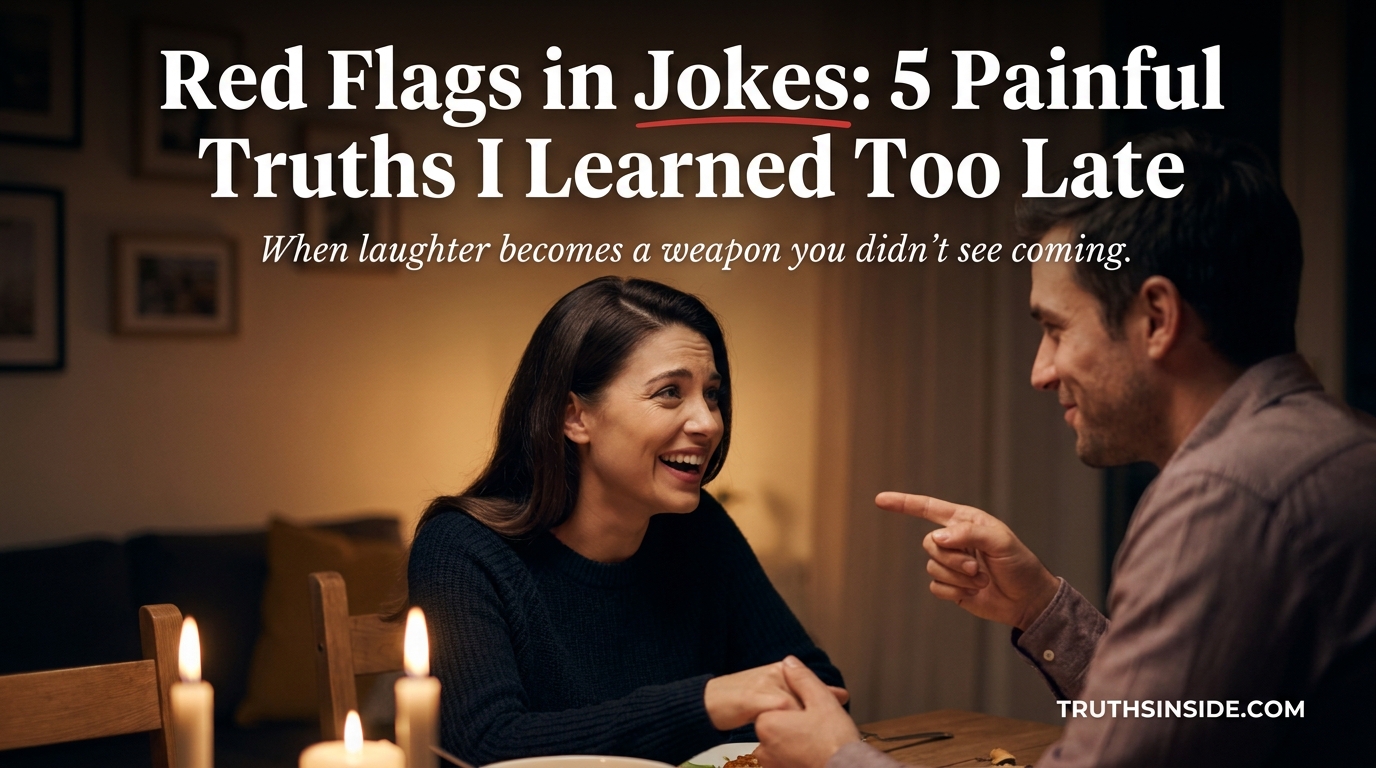
I remember sitting across from him at dinner during our second month together, laughing at something he said about my cooking. “I mean, I’ve had better, but I love the effort,” he said, grinning. I laughed too. I told myself it was banter. I told myself confident people can take a joke. What I didn’t tell myself — because I wasn’t ready — was that it didn’t feel like a joke. It felt like a small, sharp thing.
By month five, those small sharp things had accumulated into something I could no longer ignore. The pattern had a name. The red flags in jokes I had been dismissing finally became impossible to unsee.

What Are Red Flags in Jokes — And Why Are They So Hard to See?
Most people enter relationships with optimism. We want to believe the best about the people we choose. That hope is beautiful, but it can also blind us. Red flags in jokes are particularly difficult to identify early on because humor creates a social shield. When someone says something cruel inside a joke, they have built-in protection — “I was just kidding.” Calling it out makes you look oversensitive. Staying silent makes you complicit in your own diminishment.
Psychologists call this “deniable aggression” — the delivery of hostile or demeaning messages through a format that gives the sender plausible deniability. It is one of the most effective tools of emotional control in close relationships, precisely because the person on the receiving end is trained to doubt their own perception. You start to believe that the problem is your thin skin rather than their sharp tongue.
Red flags in jokes are not always loud. They do not always make you cry immediately. Often, they make you laugh — and then feel vaguely wrong about yourself an hour later, without being able to explain exactly why.
Red Flag #1 — The Joke That Only Works at Your Expense
There is a specific kind of humor that depends on one person being the butt of every joke. In a healthy relationship, humor is shared — both people laugh, both people are occasionally playful targets, and both people feel safe. But when one partner consistently becomes the punchline, that is one of the clearest red flags in jokes you can observe.
He joked about my career choices. He joked about my weight in ways he framed as “teasing.” He joked about how I handled emotions — calling me “dramatic” and then laughing so I would laugh too. Over time, each joke quietly reinforced a message: I was less than. I was the flawed one. I was lucky he put up with me.
This type of humor functions as a slow erosion of self-worth. You do not notice it happening because it is gradual. But one day you realize you have stopped speaking up at dinner, stopped sharing your opinions freely, stopped trusting your own instincts — because somewhere along the way, you internalized the punchline. You became the joke.
📃 Related article: Red Flags You’re Being Used for Money: 9 Brutal Signs
Red Flag #2 — Laughing at Your Boundaries
One of the most telling red flags in jokes is when your boundaries become the subject of mockery. Boundaries in a relationship are not restrictions — they are communication. They tell your partner what you need in order to feel safe and respected. A healthy partner hears a boundary and adjusts. A manipulative partner hears a boundary and turns it into material.
I told him early on that I was sensitive about a specific topic from my past. He listened. He nodded. And then, three weeks later, he made a passing joke about it in front of friends. When I went quiet, he said, “Oh come on, don’t be like that.” The laughter from the group made it worse. I felt exposed, embarrassed, and somehow responsible for ruining the mood.
That moment was one of the clearest red flags in jokes I experienced, and I still almost missed it. When someone mocks your boundaries, they are not making a mistake — they are sending a message. The message is: your limits do not matter to me. Pay attention the first time. You rarely get a cleaner warning than that.
“The cruelest things are often said with a smile. That is not charm — that is cover.”
Red Flag #3 — The Apology That Isn’t
Every time I brought up a joke that hurt me, the same pattern played out. He would look slightly amused, tilt his head, and say something like, “I’m sorry you felt that way” or “I’m sorry my humor doesn’t land for you.” At first, those felt like apologies. They were not.
A real apology takes ownership. It says: “I said something hurtful and I’m sorry I said it.” What I was receiving was a non-apology — one that centered my reaction rather than his behavior. This is a major red flag in jokes and one of the most misunderstood signs in relationships. The non-apology keeps the power entirely in one person’s hands. You are positioned as the problem. He is positioned as the well-meaning guy whose jokes you just can’t appreciate.
This pattern is documented in research on narcissistic communication styles. Fake apologies are used to temporarily relieve the tension caused by harmful behavior without requiring genuine change. If the jokes continue after the “apology,” it was never an apology. It was a reset button — pressed entirely for his comfort, not yours.

Red Flag #4 — Humor Used to Control Public Perception
He was funnier in public. That was something I noticed around month three. In private, the jokes were directed at me. In public, he performed warmth and wit for everyone around us — but I was still the punchline, just dressed up more politely for the audience. Friends would laugh and tell me he was hilarious. I would smile and think: you have no idea.
This is one of the most isolating red flags in jokes because it creates a reality gap. The version of him that others saw was charming and playful. The version I lived with used humor as a tool for control and humiliation. When you try to explain this to people who only see the public version, you often sound unbelievable. He knew that. The public performance was not separate from the behavior — it was part of it.
Manipulative people are often deeply aware of social optics. The humor they display publicly builds goodwill and credibility. That credibility then protects them from accountability. If you ever tell a mutual friend, “his jokes hurt me,” the response is often “really? He seems so funny and sweet.” The joke is now your problem to prove.
Red Flag #5 — When You Stop Laughing and He Gets Angry
This was the moment everything became undeniable for me. By month five, I had stopped laughing at the jokes about me. I would go quiet, or give a thin smile, or change the subject. I stopped performing the reaction he wanted. And that is when his real feelings became visible.
He did not handle it quietly. He became irritated. He accused me of being no fun. He said I had “changed” and that I used to be more relaxed and easygoing. He framed my self-awareness as a character flaw. This reaction — the anger that emerges when you no longer play along — is one of the most important red flags in jokes you will ever observe in a relationship.
Humor used as control requires your participation. When you withdraw your laughter, you withdraw the permission. That withdrawal reveals what the humor was always about — not joy, not connection, but compliance. A person who genuinely loves you does not get angry when you stop laughing at jokes that hurt you. They get curious. They ask what’s wrong. They try to understand. Anger in that moment is the confession he never meant to make.
“When stopping the laughter makes him furious, you were never the audience. You were the target.”
What I Learned in Five Months That I Wish I Had Known on Day One
Looking back, the red flags in jokes were present from very early on. The reason I missed them was not stupidity or weakness — it was hope. I hoped I was misreading things. I hoped the jokes would soften. I hoped the good parts of him were more real than the uncomfortable parts. That hope is human and understandable. But it cost me five months of quietly shrinking.
What I know now is this: humor in a healthy relationship feels expansive. It makes both people feel seen, warm, and safe. It does not leave one person replaying the punchline alone at midnight wondering what it really meant. Healthy humor does not require your self-esteem as a sacrifice.
The red flags in jokes your partner makes are not entertainment — they are data. They tell you how your partner sees you when they think the laughter will cover it. They tell you what they think they can get away with. They tell you, if you listen carefully, exactly who you are dealing with beneath the performance. I listened. Eventually. And what I heard changed everything.

How to Trust Yourself When You’re Not Sure What You’re Seeing
One of the hardest parts of identifying red flags in jokes is that your own mind works against you. You want to be fair. You want to be easygoing. You have been told your whole life that being able to laugh at yourself is a virtue. All of those things are true — but they can also be weaponized against you by someone who knows how to exploit your self-doubt.
Here is a simple practice: after a joke lands in a way that feels wrong, give yourself permission to notice that feeling without immediately explaining it away. You do not need to confront anyone in the moment. You do not need to be certain. Just notice. Write it down if it helps. Track whether the feeling is isolated or recurring. A one-time misstep in humor is human. A pattern is a portrait.
Trust the feeling that something is off before you have the language to explain it. Your nervous system often understands a red flag in jokes long before your conscious mind has organized the evidence. That gut sense is not oversensitivity — it is intelligence. Learn to treat it that way.
📃 Related article: Dismissive Partner: 8 Alarming Red Flags Never to Ignore
How to Respond When You Identify This Pattern
If you are currently in a relationship where you are recognizing these red flags in jokes, the first thing I want to say is: you are not overreacting. The second thing is: you have options. Leaving is one of them, but it is not the only starting point. Clarity is the starting point.
Have one direct, calm conversation. Name the specific behavior — not “your jokes are mean” but “when you joked about X in front of your friends, it made me feel embarrassed and disrespected.” Watch what happens next. Does he listen? Does he take accountability? Does his behavior change and stay changed? Or does he minimize, deflect, and wait for you to drop it?
The response to that conversation will tell you more than five months of jokes ever could. People who love you and want to keep you will rise to that moment. People who were using humor as control will reveal themselves in how they handle being seen. Either way, you get the truth. And the truth — even when it is painful — is always better than the comfortable confusion of laughing at jokes that were never meant to make you feel good.
Final Thoughts
Five months is not a long time. But it is long enough to learn something important about yourself and about the people you allow close to you. The red flags in jokes that I finally saw clearly at month five were present at month one — I simply did not have the awareness or the permission to trust what I was feeling. Now I do. And if you are reading this, I hope you give yourself that same permission.
You deserve humor that lifts you. You deserve a partner whose laughter brings you in rather than holds you up for examination. You deserve to enjoy a joke without mentally reviewing it afterward for hidden damage. That is not a high standard — it is the minimum. Do not let anyone convince you that recognizing the difference makes you too sensitive.
It makes you awake. And being awake is the beginning of everything.
💾 Save this article so you can come back to it.
📤 Share it with someone who needs to hear this today.
✅ Follow Truthsinside.com for more real stories about love, relationships, and the signs we almost missed.
FAQ
Q1: What are the most common red flags in jokes in a relationship?
The most common red flags in jokes include jokes that consistently target your insecurities, humor that mocks your stated boundaries, punchlines that require your humiliation to land, and repeated “apologies” that blame your sensitivity rather than addressing the behavior. If you feel consistently worse about yourself after laughing with your partner, that pattern is worth examining closely.
Q2: Is it possible that my partner really doesn’t know their jokes are hurtful?
It is possible, especially early in a relationship when communication styles are still being established. The real indicator is not the first joke — it is the response when you express that something hurt you. A partner who is genuinely unaware will be concerned, apologetic, and will make visible effort to change. A partner using humor as control will minimize your reaction and repeat the behavior.
Q3: How do I bring up red flags in jokes without starting a fight?
Use specific language focused on your experience rather than character accusations. Instead of “you always make mean jokes,” try “when you said X, I felt Y, and I need us to talk about it.” Stay calm and be direct. The goal is not to win an argument — it is to communicate clearly and observe the response. That response is the real information.
Q4: Can red flags in jokes be a sign of emotional abuse?
Yes. When humor is used consistently to demean, control, isolate, or gaslight a partner, it can absolutely fall within the definition of emotional abuse. The fact that the delivery is comedic does not reduce the psychological impact. If the pattern is persistent and your self-esteem, confidence, or sense of reality is being affected, speaking with a licensed therapist or counselor is strongly recommended.
Q5: What does healthy humor look like in a relationship compared to red flags in jokes?
Healthy relationship humor feels inclusive, warm, and mutual. Both partners can laugh together, and neither person consistently feels reduced or exposed by the laughter. Healthy humor does not rely on one partner’s insecurities or past wounds. It brings people closer rather than creating a subtle hierarchy. If laughter in your relationship leaves you feeling connected and safe, that is the standard — hold onto it.
🎵 Music
Maren Lull is a singer-songwriter who writes from the places most people don’t talk about out loud.
Not the dramatic grief. Not the obvious heartbreak. The quiet kind — the ordinary Tuesday emptiness, the habit of reaching for someone who isn’t there anymore, the particular exhaustion of being strong for so long that the strength itself wears thin.
Her music lives at the intersection of emotional honesty and soft beauty — breathy vocals over gentle piano, slow tempos, lyrics that feel less like songs and more like something you wrote in a private notebook at two in the morning and never showed anyone.
Maren Lull writes for the people who feel everything deeply and say very little about it. For the ones who listen to sad music not because they want to feel worse — but because being understood, even by a song, makes the feeling easier to carry.
📱 Follow Maren Lull:
→ Spotify
→ Apple Music
→ Youtube
→ Audiomack