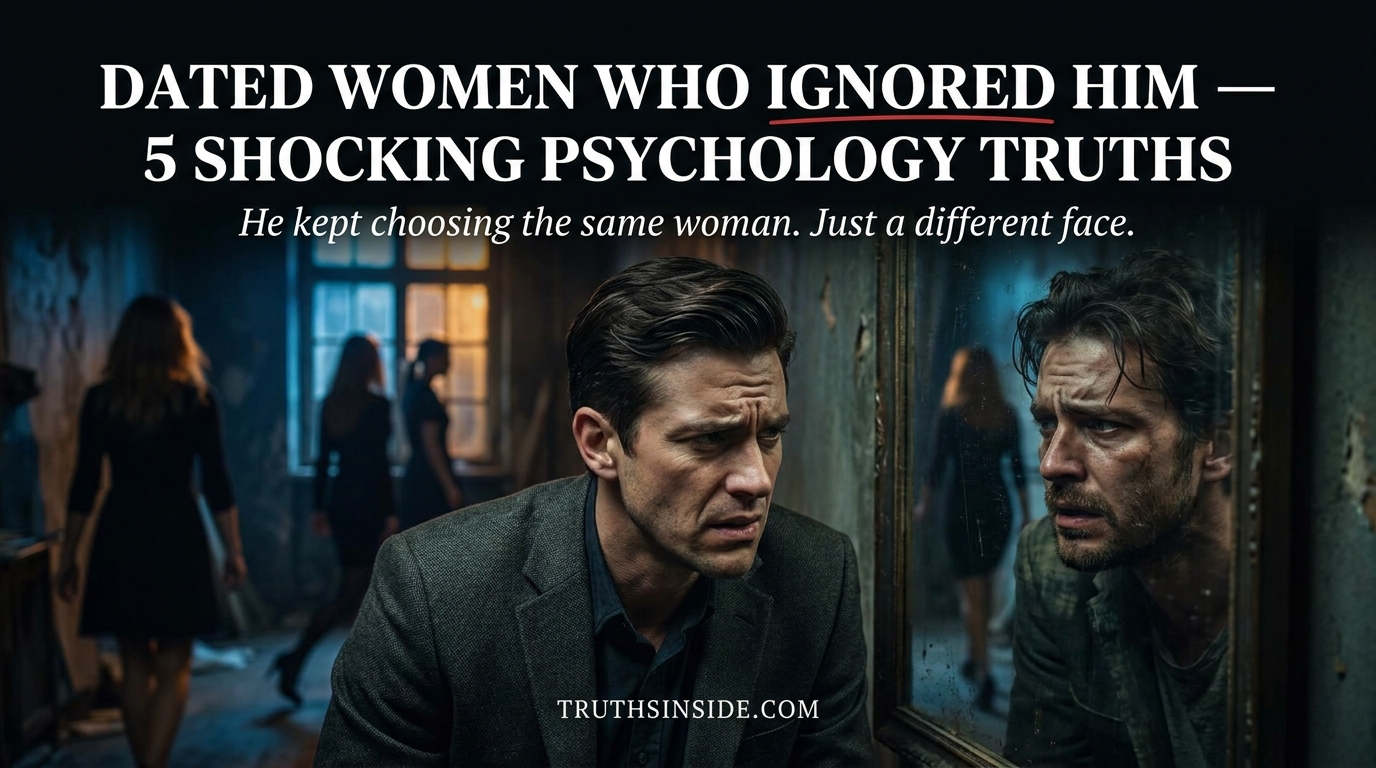
He Always Dated Women Who Ignored Him. Then He Found Out Why.
He always dated women who ignored him — and for years, he called it a type. Marcus was thirty-four years old, professionally successful, genuinely kind, and completely baffled by his own love life. Every relationship followed the same invisible script. He would meet a woman who was emotionally distant, hard to reach, slow to respond, and somehow completely magnetic to him. The more unavailable she was, the more obsessively he pursued her. The more she pulled back, the harder he tried. And every single time, he ended up confused, exhausted, and alone — wondering what was wrong with him.
He wasn’t alone in this pattern. Research published in the journal Personal Relationships found that individuals with anxious attachment styles are significantly more likely to experience intense romantic attraction toward avoidant partners — creating what psychologists call the “anxious-avoidant trap.” It is one of the most common and most painful relationship cycles in modern psychology. And for most people caught inside it, they have no idea it’s happening — or why.
This is the story of how Marcus finally found out. And what he discovered changed not just his relationships — but his entire understanding of himself.

The Pattern He Couldn’t See
It took Marcus’s best friend, Daniel, pointing it out bluntly one evening over drinks for Marcus to even consider that a pattern existed at all. Daniel lined them up — five relationships over ten years — and described each woman in one sentence. Cold. Emotionally unavailable. Needed constant chasing. Never fully committed. Always kept him at arm’s length. Marcus laughed at first. Then he went quiet.
“You always pick the ones who make you work for it,” Daniel said. “And the second a woman actually likes you back — genuinely, easily — you lose interest within three months. Every time.”
Marcus wanted to argue. He opened his mouth and closed it again. Because Daniel was right. There had been women — good women, warm women, emotionally available and genuinely interested — who had loved Marcus clearly and consistently. And Marcus had felt almost nothing for them. A kind of muted affection, but nothing close to the electric, consuming pull he felt toward the ones who kept him guessing. He had always quietly assumed he just wasn’t that attracted to those women. Now, sitting with Daniel’s words, he wasn’t so sure anymore.
The Therapy Session That Cracked Everything Open
Marcus started therapy six months later — not specifically for his relationship patterns, but for anxiety and chronic stress at work. His therapist, a soft-spoken woman named Dr. Reyes, had a way of asking questions that seemed simple on the surface and devastating underneath. About eight weeks into their sessions, she asked him to describe his earliest memory of trying to get someone’s attention and not receiving it.
He expected to draw a blank. Instead, he surprised himself completely. He was six years old. His mother was sitting at the kitchen table — physically present, eyes open — but somewhere else entirely. He had drawn a picture at school that day and wanted to show her. He stood beside her chair for what felt like a very long time, picture in hand, waiting. She didn’t look up. She wasn’t cruel. She was simply — gone. Somewhere inside herself that he couldn’t reach.
Dr. Reyes let the silence sit for a moment. Then she asked, “And how did that feel?” Marcus said, “Like if I could just find the right thing to do — the right words, the right moment — she would finally see me.” Dr. Reyes nodded slowly. “Tell me,” she said quietly, “does that sentence remind you of anyone in your adult life?”
The room felt like it tilted sideways.
“He wasn’t falling in love with unavailable women. He was falling back into the oldest, most familiar feeling he knew — the desperate hope that this time, he would finally be enough.”
The Psychology of Why We Choose Who We Choose
What Marcus was experiencing has a name in psychology — it’s called repetition compulsion, a concept originally introduced by Sigmund Freud and extensively studied in modern attachment theory. Simply put, the human psyche has a powerful, largely unconscious drive to recreate familiar emotional environments — even painful ones — in an attempt to finally resolve them. The brain doesn’t seek what makes us happy. It seeks what feels known.
When a child grows up in an environment where love is inconsistent — where affection has to be earned, where a parent is emotionally unpredictable or unavailable — the nervous system actually encodes that experience as the baseline for what love feels like. Not just what love is. What love feels like. The uncertainty. The longing. The chase. The relief when you finally get a small moment of connection. Those feelings become neurologically associated with love itself.
So when Marcus met a warm, emotionally available, consistently loving woman — his nervous system registered it as foreign. Pleasant, maybe. Safe, yes. But not exciting. Not love. Not the thing his nervous system had been wired to recognize as love. And when he met a distant, unpredictable, emotionally guarded woman — every cell in his body lit up. Not because she was right for him. Because she felt like home.
📃 Related article: Psychology of Ghosting: 7 Shocking Truths About Ghosters
Anxious Attachment — The Science Behind the Chase
Dr. Reyes introduced Marcus to attachment theory — specifically to the work of psychologists John Bowlby and Mary Ainsworth, whose research on early childhood bonding transformed modern relationship psychology. The central idea is straightforward but profound: the way our primary caregivers responded to our emotional needs in early childhood creates an internal working model — essentially a template — for how we expect relationships to function for the rest of our lives.
Marcus showed every hallmark of anxious attachment. He craved deep intimacy but feared abandonment simultaneously. He became hypervigilant to emotional cues — overanalyzing texts, reading too deeply into a shift in someone’s tone, catastrophizing silence. He felt most alive and most connected when he was in pursuit — when there was still something to win, still emotional territory to capture. The moment a relationship felt secure and stable, the intensity dropped away and he began — subconsciously — to question whether it was real love at all.
Anxious attachment, Dr. Reyes explained, is most commonly developed in response to inconsistent caregiving — not abusive, not absent, but unpredictable. A parent who is sometimes warm and sometimes emotionally unavailable creates a child who is constantly scanning, constantly performing, constantly hoping to hit the right note that unlocks the love they know is somewhere in there. That child grows up. The parent becomes a romantic partner. The dynamic continues — invisibly, painfully, and with devastating consistency.

The Avoidant Partner — The Other Half of the Equation
Understanding his own pattern was only half of the revelation. Marcus also had to understand why he was so magnetically drawn to avoidant partners specifically — and why avoidant partners, in turn, were often drawn to him.
Avoidant attachment, Dr. Reyes explained, typically develops in response to a different kind of early experience — one where emotional expression was consistently minimized, dismissed, or unwelcome. Children who learned that expressing needs led to rejection or discomfort learn to suppress those needs entirely. They grow up valuing independence fiercely, feeling suffocated by emotional closeness, and instinctively pulling back when a relationship begins to deepen. They are not cold by nature. They are protected by conditioning.
The anxious-avoidant pairing is so common precisely because each style unconsciously activates the other’s deepest fears and deepest longings. The anxious partner’s pursuit confirms the avoidant partner’s fear of being consumed. The avoidant partner’s distance confirms the anxious partner’s fear of being abandoned. Both are locked in a dance that feels intensely alive — because it mirrors something deeply, painfully familiar — but rarely leads anywhere emotionally sustainable. They trigger each other perfectly. That’s exactly why it feels like chemistry.
The 5 Psychology Truths Marcus Finally Understood
Truth 1: He always dated women who ignored him because familiar pain feels like love.
The nervous system doesn’t distinguish between familiarity and health. It distinguishes between known and unknown. If your earliest experience of love involved emotional unavailability, your brain literally registers unavailability as a signal of love. Not because you want pain — but because your body recognizes the feeling. Healing starts the moment you understand that intense attraction to unavailability is data about your history, not evidence of compatibility.
Truth 2: The chase isn’t about her — it’s about unfinished business.
Every time Marcus chased an emotionally unavailable woman, he wasn’t really pursuing her. He was pursuing resolution. The six-year-old version of him, standing beside his mother’s chair with a drawing, was still trying to be seen. The adult relationships were unconscious attempts to finally win the love that was withheld early on. Recognizing this didn’t mean blaming his mother — it meant understanding the origin of the wound so he could stop reopening it in every new relationship.
Truth 3: Emotional safety feels boring when you’ve been wired for chaos.
This is the uncomfortable truth most people resist hearing. If your nervous system was calibrated in an environment of emotional unpredictability, genuine warmth and consistency will initially feel dull — not because it is dull, but because it doesn’t trigger your threat-detection system the way chaos does. The heart-racing, can’t-stop-thinking-about-her feeling? For anxiously attached people, that’s often anxiety masquerading as passion. Real love, sustainable love, is quieter — and learning to recognize it requires deliberately rewiring your response to emotional safety.
Truth 4: You cannot pursue your way into secure love.
Every strategy Marcus used — being more attentive, more charming, more emotionally generous — was designed to make unavailable women stay. None of it worked. Because avoidant partners don’t become securely attached through being pursued more intensely. If anything, increased pursuit accelerates their withdrawal. The only relationship dynamic that creates genuine security is one where both people begin with enough emotional availability to actually build something — not one where one person perpetually earns while the other perpetually withholds.
Truth 5: Healing the pattern means tolerating discomfort in a new direction.
The most important thing Dr. Reyes told Marcus was this: recovery from anxious attachment doesn’t feel good at first. Choosing emotionally available partners will feel strange, underwhelming, even uncomfortable — because your nervous system hasn’t yet learned to recognize safety as love. Healing means sitting with that discomfort. Resisting the pull toward familiar chaos. Building new neural pathways through repeated, intentional experience of secure, reciprocal connection. It is not romantic. It is not dramatic. It is slow, deliberate, transformative work.
“The person you keep chasing isn’t your soulmate. They’re a mirror — showing you the wound you haven’t healed yet.”
What Changed for Marcus
The changes didn’t happen overnight. Attachment patterns built over decades don’t dissolve in a season of therapy. But something fundamental had shifted in Marcus — the way a light turns on in a room you’ve been navigating in the dark for years. He could now see the furniture. He could see where the walls were. He stopped walking into the same corners and calling it fate.
He began noticing the pull — that specific electric feeling toward emotionally unavailable women — and instead of following it, he started getting curious about it. He would ask himself: is this attraction, or is this familiarity? Is this love, or is this the chase? The question alone created enough space between impulse and action for him to make different choices. Not always. Not perfectly. But more often than before.
He also began, slowly and deliberately, to stay open to warmth. To resist the urge to downgrade emotionally available connections as unexciting. To understand that the absence of anxiety in a relationship was not the absence of love — it was the presence of safety. And safety, he was learning for the first time, was allowed to feel like enough.

A Word to Anyone Who Recognizes Themselves
If you read Marcus’s story and felt a quiet recognition settle in your chest — that’s worth paying attention to. Patterns this deeply rooted are rarely visible from the inside. We call them a type. We call them chemistry. We call them fate. We rarely call them what they actually are — old emotional programming, running on autopilot, recreating familiar dynamics in search of a resolution that can only come from within.
You are not broken for having these patterns. You are human. You were shaped by experiences that were not your fault, in years when you had no framework for understanding what was happening to you. But you are also an adult now — with the capacity for reflection, for choice, and for the kind of deliberate growth that actually changes the trajectory of your love life.
The question is not whether you have a pattern. Everyone does. The question is whether you are willing to look at it directly — without flinching, without self-blame, but with the kind of honest curiosity that becomes the beginning of something genuinely different.
Marcus found out why. And that why became the first door out of a ten-year loop. Yours can too.
FAQ
Q1: What is anxious attachment and how does it develop?
Anxious attachment develops when early caregiving is inconsistent — sometimes warm, sometimes emotionally unavailable. The child learns to be hypervigilant to signs of love and approval, creating an adult who craves closeness but fears abandonment and is intensely attracted to emotional unpredictability.
Q2: Why do I lose interest in partners who are genuinely kind and available?
This is a hallmark of anxious attachment meeting a securely attached partner. Your nervous system hasn’t yet encoded safety as love — it reads the absence of anxiety as the absence of passion. This response can change with awareness and deliberate exposure to healthy relationship dynamics over time.
Q3: Can attachment styles change in adulthood?
Yes — absolutely. Research shows that attachment styles are not fixed. Through therapy, self-awareness, and consistent experience of emotionally safe relationships, people can develop what psychologists call “earned secure attachment” — a genuinely secure style built through intentional adult experience rather than early childhood.
Q4: What is the anxious-avoidant trap?
It is a relationship cycle where an anxiously attached person and an avoidantly attached person pair together — each unconsciously activating the other’s core fears. The anxious partner pursues; the avoidant partner withdraws. Both feel intensely alive in the dynamic, but the relationship rarely achieves genuine emotional intimacy or stability without significant individual work from both partners.
Q5: How do I start breaking a pattern of dating unavailable people?
Start with awareness — noticing the pull and questioning it. Work with a therapist trained in attachment theory. Practice staying present in relationships that feel safe but unfamiliar. Distinguish between anxiety and attraction. And understand that the discomfort of choosing differently is temporary — but the reward of a genuinely reciprocal relationship is lasting.
Final Thoughts
Marcus didn’t find a magic solution. He found something better — understanding. And understanding, when you’re willing to act on it, is the most powerful relationship tool there is. He still feels the pull sometimes. The old familiar gravity toward unavailability. But now he knows what it is. And knowing what it is means he is no longer its prisoner.
You chose to read this to the end. That’s not nothing. That’s the same instinct Marcus had — the part of you that knows something needs to shift and is quietly, persistently looking for the door.
This is the door. You just have to be willing to walk through it.
💾 Save this — you’ll want to come back to it. Share it with someone who keeps falling for the wrong person. Follow Truthsinside.com for psychology and relationship stories that go deeper than the surface.
🎵 Music
Maren Lull is a singer-songwriter who writes from the places most people don’t talk about out loud.
Not the dramatic grief. Not the obvious heartbreak. The quiet kind — the ordinary Tuesday emptiness, the habit of reaching for someone who isn’t there anymore, the particular exhaustion of being strong for so long that the strength itself wears thin.
Her music lives at the intersection of emotional honesty and soft beauty — breathy vocals over gentle piano, slow tempos, lyrics that feel less like songs and more like something you wrote in a private notebook at two in the morning and never showed anyone.
Maren Lull writes for the people who feel everything deeply and say very little about it. For the ones who listen to sad music not because they want to feel worse — but because being understood, even by a song, makes the feeling easier to carry.
📱 Follow Maren Lull:
→ Spotify
→ Apple Music
→ Youtube
→ Audiomack