You have never felt anything like it.
The chemistry is electric. The connection, when it is good, is unlike anything you have experienced before. And the pain — when it goes wrong, when they pull away, when you feel the distance opening between you — is unlike anything you have experienced either.
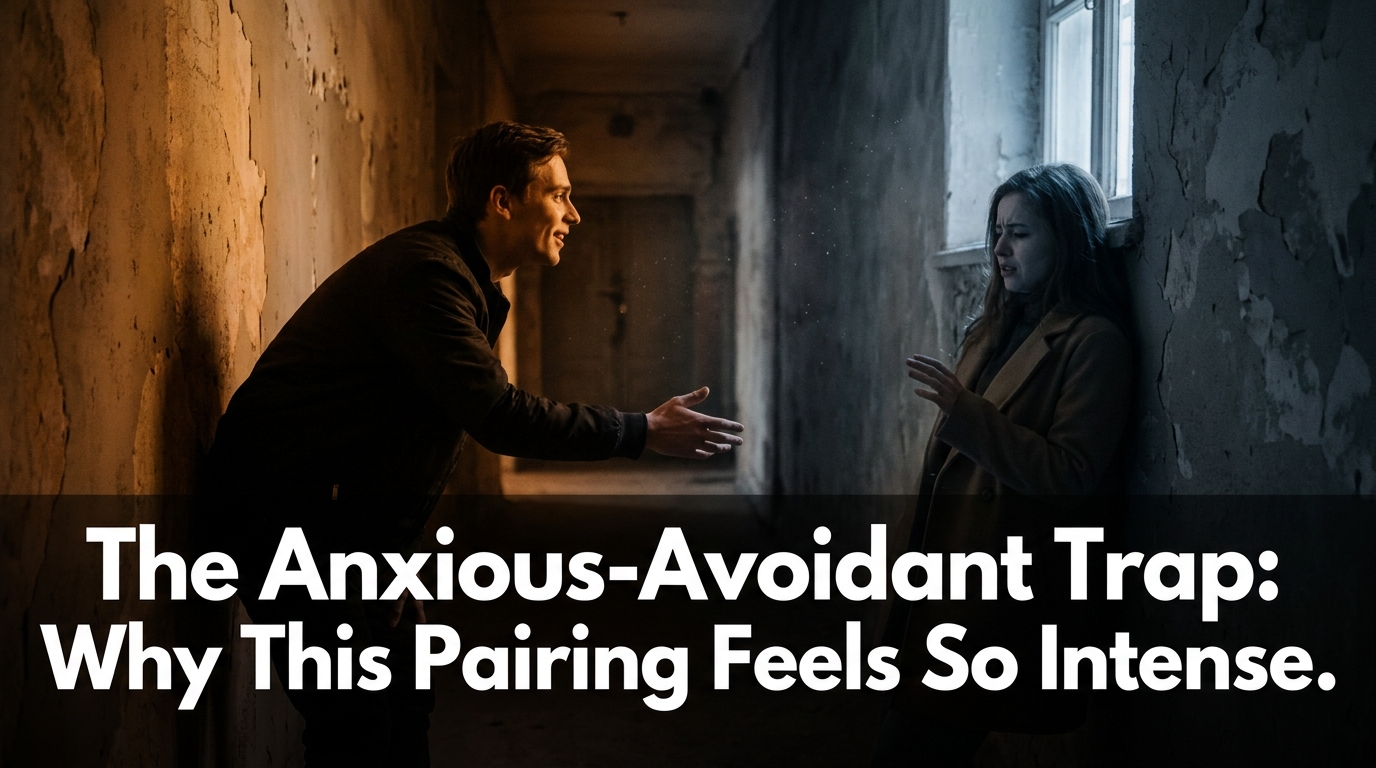
You pursue. They retreat. You reach. They withdraw. The more you try to close the gap, the wider it seems to become. And yet — somehow — you cannot stop trying.
This is the anxious-avoidant relationship. And it is one of the most studied, most common, and most painful relationship dynamics in attachment psychology.
Research by psychologists Jeffry Simpson and W. Andrew Collins found that anxious-avoidant pairings are significantly overrepresented in clinical settings — meaning they produce a disproportionate amount of relational distress compared to other attachment combinations.
The intensity is real. The chemistry is real. And so is the trap.
Understanding why it happens — and what it costs — is the first step toward something better.

What Is the Anxious-Avoidant Dynamic?
The anxious-avoidant dynamic is the relational pattern that emerges when an anxiously attached person and an avoidantly attached person enter a romantic relationship together.
On paper, this pairing seems unlikely. The anxiously attached person craves closeness, fears abandonment, and seeks constant reassurance. The avoidantly attached person values independence, fears engulfment, and withdraws from emotional intensity. Their needs are, on the surface, fundamentally incompatible.
And yet this pairing is extraordinarily common. Some researchers suggest it is the single most frequent attachment pairing in adult romantic relationships.
The reason is counterintuitive — and deeply important to understand.
Both the anxious and avoidant partner are drawn to each other precisely because the dynamic activates their deepest attachment wounds in the most familiar way. The anxious partner is drawn to someone who withholds — because chasing unavailable love is what love has always felt like. The avoidant partner is drawn to someone who pursues — because being wanted without having to initiate vulnerability is what comfortable intimacy has always looked like.
Neither is consciously choosing this. Both nervous systems are simply doing what they were trained to do — seeking the familiar, even when the familiar is painful.
“The anxious-avoidant pairing feels like home to both people — not because it is healthy, but because it is recognizable. And recognizable, to a nervous system shaped by early experience, feels like safety even when it isn’t.” — Attachment Psychology Research
Why the Attraction Is So Intense
This is the question most people ask first — and for good reason. The chemistry in anxious-avoidant relationships is frequently described as unlike anything either person has felt before. More intense. More alive. More real.
There are specific psychological reasons for this — and understanding them is important, because intensity and chemistry are not the same as compatibility.
The Intermittent Reinforcement Effect
Intermittent reinforcement is the psychological principle that unpredictable rewards produce stronger behavioral responses than consistent ones. It is the principle behind gambling addiction. And it is the principle that makes anxious-avoidant relationships feel so compulsively consuming.
When warmth and connection are consistently available — as they are in secure relationships — the nervous system settles. Connection feels good, but it does not feel urgent. There is no chase.
When warmth is unpredictable — available sometimes, withdrawn others, always slightly uncertain — the nervous system activates the pursuit system with considerably more intensity. The dopamine hit of connection after distance is far more powerful than the steady pleasure of consistent closeness.
This is why the moments of connection in an anxious-avoidant relationship feel so extraordinary. They are not just good — they are a relief. A resolution of tension that had been building. And relief, neurologically, registers as profound pleasure.
The problem is that the cycle requires the withdrawal to produce the relief. Consistency would end the intensity — but consistency is precisely what this pairing cannot sustain.

The Complementary Wound
There is a deeper psychological reason for the magnetic pull between anxious and avoidant partners — one that goes beyond intermittent reinforcement into the territory of attachment wounds.
The anxious partner’s deepest wound is: I am not enough. People I love will eventually leave. Love must be earned and constantly maintained.
The avoidant partner’s deepest wound is: Needing people is dangerous. Closeness leads to pain or suffocation. I am safest alone.
These wounds are complementary in a specific and painful way. The anxious partner’s pursuit temporarily soothes the avoidant’s fear of being unwanted — they are clearly desired, which feels safe. The avoidant partner’s intermittent availability temporarily confirms the anxious partner’s belief that love requires constant effort — which feels, paradoxically, like home.
Both partners are unconsciously recreating the emotional landscape of their earliest attachment experiences. The anxious partner chases the unavailable parent. The avoidant partner maintains the distance that kept them safe.
The relationship feels profound because it is touching something profound — the deepest, oldest wounds in each person’s emotional history.
The Fantasy of Healing Each Other
There is frequently, in anxious-avoidant pairings, a powerful unconscious narrative: if I can just get them to stay — if I can just get them to open up — then it means I am lovable. Then the wound heals.
The anxious partner believes that finally securing the avoidant’s full presence will prove, once and for all, that they are enough. The avoidant partner believes that finally finding someone patient enough to accept their distance without making them feel guilty about it will prove that closeness is possible without loss of self.
Neither gets what they are unconsciously seeking. Because the dynamic itself prevents it.
The Cycle — Step by Step
The anxious-avoidant cycle follows a remarkably consistent pattern across relationships and people. Understanding each stage makes it possible to recognize the cycle in real time — which is the first step toward interrupting it.
Stage 1 — Initial Attraction and Idealization
The relationship begins with intensity. The avoidant partner, early in the relationship when stakes feel low, is often genuinely warm, present, and engaged. The anxious partner experiences this as the connection they have always been looking for.
The avoidant partner is attracted to the anxious partner’s warmth, expressiveness, and clear desire — which provides the validation the avoidant system craves without requiring the avoidant to initiate vulnerability.
Both partners are experiencing the idealization phase of early love — amplified significantly by the specific chemistry of their complementary attachment systems.
Stage 2 — Deepening and the First Withdrawal
As the relationship deepens and real intimacy becomes possible, the avoidant partner’s nervous system begins to register threat. The closeness that felt comfortable at a distance now feels like engulfment. The withdrawal begins — often subtle at first. Slightly less responsive. Slightly more distant. A little harder to reach.
The anxious partner feels the shift immediately — often before it is consciously visible. The hypervigilant nervous system, trained to detect the slightest signs of potential abandonment, picks up the change and activates the pursuit response.
Stage 3 — Pursuit and Deeper Withdrawal
The anxious partner pursues. More texts. More reassurance-seeking. More emotional intensity. More effort to close the gap that has appeared.
The avoidant partner, already at the edge of their tolerance for closeness, experiences the pursuit as confirmation of their fear — that intimacy leads to suffocation, that closeness means losing themselves. The withdrawal deepens.
The more the anxious partner pursues, the more the avoidant withdraws. The more the avoidant withdraws, the more the anxious partner’s fear of abandonment is activated and the more urgently they pursue.
Both partners are now doing exactly what their nervous systems were trained to do. Neither is choosing this. Neither can easily stop.

Stage 4 — Crisis and Reconnection
Eventually, the withdrawal reaches a point of crisis — either the avoidant pulls back far enough to trigger genuine alarm in themselves, or the anxious partner’s distress becomes impossible to ignore. Something shifts. The avoidant, safe again in the distance they have created, feels the pull back toward the person they care about. The anxious partner, exhausted and desperate, receives the return with overwhelming relief.
The reconnection is intense — often described as the best moments in the relationship. The chemistry that drew them together reasserts itself. Both partners feel deeply connected. Both feel, temporarily, that they have found their way through.
This is the honeymoon phase of the cycle. And it is temporary.
Stage 5 — Repeat
As the reconnection deepens again into real intimacy, the cycle begins again. The avoidant’s nervous system re-registers threat. The withdrawal begins. The anxious partner feels the shift. The pursuit restarts.
Without awareness and intervention, this cycle can repeat indefinitely — each rotation leaving both partners more exhausted, more hurt, and more deeply convinced of the stories their attachment wounds are telling them. The anxious partner becomes increasingly certain: I am not enough. The avoidant becomes increasingly certain: closeness is suffocating.
The relationship that began with extraordinary chemistry gradually becomes a source of extraordinary pain — not because either person is bad or wrong, but because two nervous systems, each doing exactly what they were trained to do, have created a dynamic that neither can escape alone.
The Cost of the Anxious-Avoidant Trap
It is worth naming clearly what this dynamic costs both people — because the intensity of the chemistry frequently obscures the very real damage being done.
For the anxious partner: Chronic activation of the threat response. Persistent self-doubt and erosion of self-worth. The deepening conviction that love requires constant effort and is never truly secure. Physical symptoms of chronic anxiety — disrupted sleep, appetite changes, hypervigilance. And the gradual loss of self that comes from organizing one’s entire inner world around another person’s emotional temperature.
For the avoidant partner: Chronic guilt about their own withdrawal — often without fully understanding why they withdraw. Increasing isolation as their comfort zone for intimacy narrows. The loss of relationships that matter because the proximity they require eventually becomes intolerable. And the deepening loneliness of someone who wants connection and has built every defense against achieving it.
For the relationship itself: A dynamic that prevents both partners from being fully seen — the anxious partner from seeing the avoidant clearly because they are too focused on the pursuit, and the avoidant from seeing the anxious partner clearly because they are too focused on the escape. Two people in relationship with their own attachment wounds rather than with each other.

Can the Anxious-Avoidant Relationship Work?
This is the question both partners are usually most desperate to answer. And the honest answer is: sometimes — but only under very specific conditions, and only with significant intentional work from both people.
The anxious-avoidant dynamic, left unexamined and unaddressed, tends to intensify rather than resolve over time. The patterns deepen. The wounds compound. The exits narrow.
But examined, named, and worked with deliberately — particularly with the support of a couples therapist who understands attachment — the dynamic can become the vehicle for profound mutual healing. Because the wounds that drive the cycle are real, and healing them — within the safety of a relationship committed to doing so — is genuinely possible.
The critical requirements are:
Both partners must understand the pattern. Not just intellectually — but emotionally. The anxious partner must understand that the avoidant’s withdrawal is not a verdict on their worth. The avoidant must understand that the anxious partner’s pursuit is not an attack on their freedom.
Both partners must be willing to interrupt their own default response. The anxious partner must practice not pursuing when the avoidant withdraws — which feels terrifying. The avoidant must practice not withdrawing when closeness activates their threat response — which feels suffocating. Both must tolerate the discomfort of doing something different long enough for the nervous system to update its threat assessment.
Individual therapy is essential for both. The work of changing an attachment pattern is deep work — work that goes to the root of the earliest relational experiences. It almost always requires professional support alongside the relational work.
Couples therapy provides the container. An attachment-informed couples therapist can help both partners see the cycle from outside it, interrupt it in session, and develop new responses that create safety rather than activating the familiar dynamic.
How to Begin Breaking the Cycle
Whether or not the relationship continues, breaking the anxious-avoidant cycle requires the same fundamental shifts — in both partners, independently.
For the anxious partner: Practice self-soothing rather than pursuit when withdrawal is felt. Build a life and identity that does not depend entirely on the relationship for its sense of safety. Work with a therapist to address the core belief that love must be earned and that abandonment is inevitable. Practice tolerating uncertainty without seeking immediate reassurance.
For the avoidant partner: Practice staying present when closeness activates the withdrawal impulse — not indefinitely, but slightly longer than feels comfortable. Work with a therapist to identify the original wound beneath the self-sufficiency. Practice naming what is happening internally rather than simply enacting it behaviorally. Notice the loneliness beneath the independence and allow yourself to want connection — out loud, to the person you are with.
For both partners: Learn to name the cycle when it is happening — together, without blame. “I notice we’ve gone into our pattern. I’m feeling the pull to pursue and you’re probably feeling the pull to withdraw. Can we slow down and try something different?” This kind of shared language — naming the dynamic rather than enacting it — is itself a profound interruption of the cycle.

A Note on Knowing When to Stay and When to Leave
Not every anxious-avoidant relationship can or should be saved. Some have caused enough damage — enough erosion of self-worth, enough compounded trauma — that the most healing choice is to leave and do the attachment work outside the dynamic that activated it.
The clearest indicator is not the presence of the cycle — which can be worked with — but the presence of genuine willingness in both partners to examine it. A partner who refuses to acknowledge the pattern, who uses the anxious partner’s pursuit as evidence of their irrationality, or who expects the anxious partner to do all the changing while they do none — is not a partner the cycle can be healed within.
You deserve a relationship in which your attachment wounds are met with curiosity and care — not exploited or dismissed. That is not a high bar. It is the minimum.
The anxious-avoidant relationship is not a love story about two incompatible people. It is a story about two wounded people finding each other — and the profound possibility of what happens when both of them finally decide to heal.
CALL TO ACTION
💾 Save this — it may be the clearest picture you have ever seen of what has been happening. 📤 Share it with someone stuck in a cycle they cannot name but cannot seem to leave. 👣 Follow Truthsinside.com for honest, deeply researched content on attachment, relationships, and the psychology of love.
Frequently Asked Questions
Q1: Why do anxious and avoidant people keep attracting each other? Because both are unconsciously drawn to what feels familiar — not what feels healthy, but what feels like home. The anxious partner is drawn to unavailability because chasing love that is not freely given is what love has always looked like for them. The avoidant partner is drawn to someone who pursues because being wanted without having to initiate vulnerability satisfies a deep need while avoiding the closeness that threatens them. Both nervous systems are operating from deeply wired early templates. Without awareness, those templates simply repeat — in relationship after relationship.
Q2: Can an anxious person become more secure in a relationship with an avoidant partner? In theory, yes — but in practice, the anxious-avoidant dynamic tends to activate and reinforce insecure patterns rather than heal them. The avoidant’s intermittent availability is precisely the relational environment that maintains anxious attachment rather than healing it. A consistently secure, available partner provides the corrective emotional experience that gradually builds earned security. An avoidant partner, by definition, cannot consistently provide that experience. Some healing can happen in an anxious-avoidant relationship when both partners are genuinely working on their patterns — but it is significantly harder than healing in a more secure relational context.
Q3: What does it feel like to break the anxious-avoidant cycle? Disorienting at first — for both partners. For the anxious partner, not pursuing when withdrawal is felt produces an acute spike of anxiety before the system begins to settle. For the avoidant partner, staying present when closeness activates withdrawal produces genuine discomfort before the nervous system updates its threat assessment. The early stages of interrupting the cycle rarely feel better before they feel worse. But with time, therapeutic support, and consistent practice, both partners report a gradually increasing sense of steadiness — a relationship that feels less electric but far more sustaining.
Q4: Is the intensity of the anxious-avoidant relationship a sign of deep love? The intensity is real — but it is primarily a sign of activated attachment wounds rather than the depth of love itself. The neurological experience of relief after distance, the compulsive pursuit, the extraordinary chemistry of reconnection — these are the signatures of intermittent reinforcement and complementary attachment wounds, not indicators of the love being more genuine or profound than love in more secure relationships. Secure love, by contrast, tends to feel less dramatically intense and more quietly sustaining — which many people initially mistake for less passionate, but which is actually far more nourishing.
Q5: Can anxious and avoidant people both develop secure attachment and then be happy together? Yes — and this is, for many couples in this dynamic, the most hopeful possibility. If both partners do genuine attachment work — individually and together — they can each move toward earned security over time. And as both partners become more secure, the dynamic between them shifts. The anxious partner pursues less. The avoidant withdraws less. The cycle that once felt inescapable gradually loses its grip. Couples who navigate this successfully often report that their relationship — precisely because of the work required to heal it — becomes one of the most meaningful and deeply understood relationships of their lives.
🎵 Music
Maren Lull is a singer-songwriter who writes from the places most people don’t talk about out loud.
Not the dramatic grief. Not the obvious heartbreak. The quiet kind — the ordinary Tuesday emptiness, the habit of reaching for someone who isn’t there anymore, the particular exhaustion of being strong for so long that the strength itself wears thin.
Her music lives at the intersection of emotional honesty and soft beauty — breathy vocals over gentle piano, slow tempos, lyrics that feel less like songs and more like something you wrote in a private notebook at two in the morning and never showed anyone.
Maren Lull writes for the people who feel everything deeply and say very little about it. For the ones who listen to sad music not because they want to feel worse — but because being understood, even by a song, makes the feeling easier to carry.
📱 Follow Maren Lull:
→ Spotify
→ Apple Music
→ Youtube
→ Audiomack