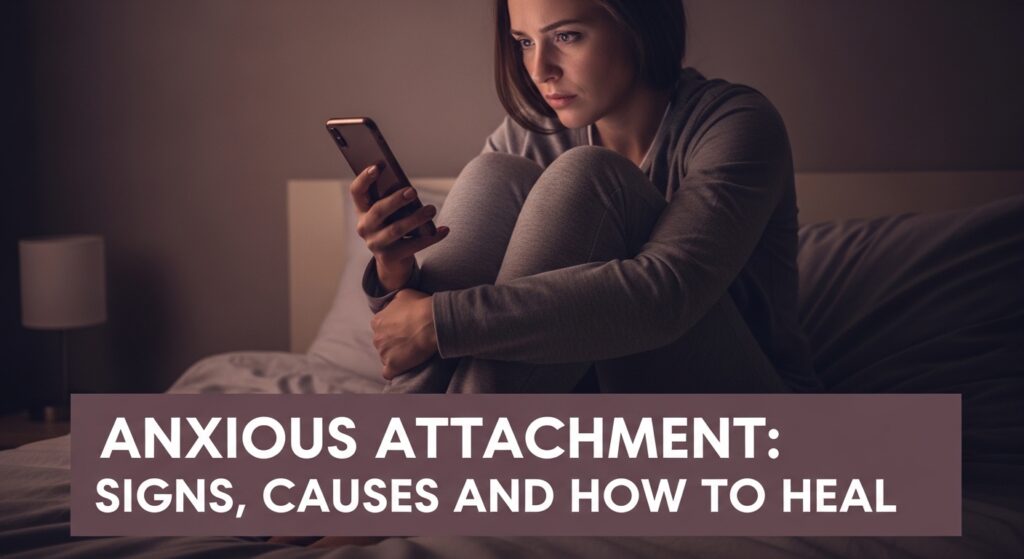

Most people know what it feels like when love is anxious.
The constant checking. The fear that sits just beneath the surface of every good moment. The exhausting hypervigilance of always waiting for something to go wrong.
And most people know what it feels like when love is distant — when the person you are with is physically present but somehow unreachable. When closeness feels like a wall rather than a door.
But secure attachment — the experience of love that feels genuinely safe, consistent, and sustaining — is something far fewer people have a clear picture of. Research from the University of California estimates that only 50 to 60 percent of adults have a predominantly secure attachment style. For the remaining 40 to 50 percent, secure love is not something they grew up experiencing.
The most important thing to understand is this: secure attachment is not only something you are born into. It is something you can build — deliberately, with the right knowledge, the right support, and the genuine belief that you deserve it.

What Is Secure Attachment?
Secure attachment is the relational pattern that develops when a child’s primary caregiver is consistently responsive, emotionally available, and reliably present. The child learns — at a deep, pre-verbal level — that the world is fundamentally safe, that other people can be trusted, and that they themselves are worthy of love and care.
John Bowlby, who first developed attachment theory in the 1950s and 1960s, described the securely attached child as one who uses their caregiver as a safe base from which to explore the world — confident that comfort is available if needed, and therefore free to engage with life fully without constant vigilance.
Mary Ainsworth’s landmark Strange Situation experiments in the 1970s showed that securely attached children, when briefly separated from their caregiver, showed distress — because the attachment bond is real and the loss of it matters. But upon reunion, they were comforted quickly and returned to exploratory play. The system worked as it was designed to: the attachment need arose, was met, and resolved.
In adulthood, this early template becomes the foundation for how a person navigates all close relationships. The securely attached adult carries an internal working model that says: I am lovable. Others are generally trustworthy. Relationships are a source of comfort rather than threat.
“Secure attachment is not the absence of need. It is the confident expectation that needs, when expressed, will be met.” — John Bowlby, Attachment Theory
What Secure Attachment Actually Looks Like
This is where theory meets real life — and where the picture becomes genuinely useful.
Secure attachment does not look like a perfect relationship. It does not mean never fighting, never feeling hurt, never needing reassurance. It means something more specific and more achievable than perfection.
In Yourself
You have a stable sense of your own worth. Your value as a person does not fluctuate dramatically based on how your partner is behaving, how the relationship is going, or whether someone just validated or criticized you. You have an internal baseline of self-worth that is relatively consistent and not primarily dependent on external input.
You can be alone without it feeling threatening. Time alone feels restorative or at least comfortable — not like abandonment, not like evidence that something is wrong. You have a relationship with yourself that is reasonably kind and reasonably stable.
You can identify and express your emotions. Not perfectly, not always eloquently — but with reasonable access to your own inner experience and a basic ability to put that experience into words. You know, most of the time, what you are feeling and why.
You can ask for what you need directly. Not through hints, not through emotional escalation, not by waiting for your partner to figure it out — but through clear, calm, honest communication. And when you ask, you are not destroyed if the response is not immediately perfect.
You can tolerate discomfort without catastrophizing. When something difficult happens in the relationship — a conflict, a miscommunication, a moment of distance — you can hold the discomfort without concluding that the relationship is over or that you are fundamentally unlovable. You trust that repair is possible.

In Relationships
You are comfortable with both intimacy and independence. You can be genuinely close to your partner — emotionally available, vulnerable, fully present — without losing your sense of self in the process. And you can be separate — pursuing your own interests, spending time apart — without interpreting the distance as threat or rejection.
Conflict is workable, not catastrophic. When disagreements arise, you move toward resolution rather than away from it. You can hear criticism without crumbling. You can offer criticism without attacking. You disagree about things without concluding that the relationship is fundamentally broken.
You trust your partner consistently. Not naively — trust is based on your partner’s actual behavior over time. But you do not require constant reassurance or monitoring. You extend reasonable good faith and update that assessment based on evidence rather than anxiety.
You repair quickly after conflict. When something goes wrong — when you hurt each other, when a conversation goes badly — you move back toward each other relatively quickly. The repair is not perfect or effortless. But the drive toward reconnection is stronger than the pull toward withdrawal or retaliation.
You can be genuinely happy for your partner. Their success is not threatening. Their friendships are not competition. Their growth is something you celebrate rather than something that destabilizes you.
You feel fundamentally safe in the relationship. Not safe in a passive, unchallenged way. Safe in the sense that you trust the foundation — you know that whatever difficulty arises, you are fundamentally secure with each other and in the knowledge that you are both choosing this.

How Secure Attachment Develops in Childhood
Understanding how secure attachment forms in childhood is important — not to assign blame for what was missing, but to understand the roots of the pattern and therefore the most effective pathways to changing it.
Consistent, Responsive Caregiving
Secure attachment forms when a caregiver reliably responds to a child’s emotional and physical needs — not perfectly, but consistently enough that the child develops a confident expectation of care.
The key word is consistent. Research by developmental psychologist Ed Tronick showed that even good caregivers attune accurately to their child only about 30 percent of the time. What matters is not perfection but the pattern of rupture and repair — the caregiver misattunes, notices, and corrects. This cycle of imperfect attunement followed by repair is itself what teaches the child that relationships are workable — that disconnection is temporary and recoverable.
Emotional Validation
Securely attached children grow up in environments where their emotions are acknowledged rather than dismissed. “I can see you’re really upset right now. That makes sense. I’m here.” This validation teaches the child two essential things: my emotions are real and legitimate, and other people are safe enough to bring them to.
The child who grows up with emotional validation develops an inner relationship with their own emotional world that is relatively kind, curious, and stable — the foundation of emotional intelligence in adulthood.
Safe Exploration
Secure attachment also requires a caregiver who can tolerate the child’s exploration and independence without becoming anxious or withdrawing. The child who is encouraged to venture out — knowing the caregiver is there as a safe base to return to — develops the confidence that comes from supported independence.
This experience — of being allowed to be separate and returning to find the caregiver still there, still warm, still available — is what teaches the nervous system that independence and connection are not mutually exclusive. Both are possible. Both are safe.

How to Develop Secure Attachment as an Adult
This is the part that matters most — and the part that is most frequently left out of conversations about attachment theory. Because while attachment patterns form in childhood, they are not fixed there. Earned security — the development of secure attachment in adulthood despite an insecure beginning — is well-documented in the research and entirely achievable.
1. Understand Your Own Attachment Pattern
You cannot change what you cannot see. The first step is honest, curious self-examination — identifying your own attachment style and understanding how it shows up in your relationships.
Do you tend to pursue when things feel distant? Do you withdraw when things get close? Do you oscillate between the two? Do you feel fundamentally secure, or is there a persistent background anxiety or distance that shapes how you relate?
Understanding your pattern — with curiosity rather than judgment — is where all attachment work begins.
2. Work With a Therapist
Of all the pathways to earned security, therapy is the most consistently effective — particularly attachment-focused approaches. A skilled therapist provides something profoundly healing: a consistent, warm, boundaried relationship in which your attachment needs are taken seriously, your emotional experience is validated, and ruptures are repaired. This relationship itself becomes a corrective emotional experience — teaching the nervous system, through direct lived experience, that safe connection is possible.
Emotionally Focused Therapy, Internal Family Systems, and trauma-informed approaches are all particularly effective for attachment healing.
3. Choose Relationships That Support Security
Healing does not happen in a vacuum. One of the most powerful pathways to earned security is a consistent relationship with a securely attached partner — someone whose emotional availability, reliability, and non-reactivity provide the lived experience of safe connection over time.
This does not mean waiting until you are fully healed before entering a relationship. It means being intentional about the relationships you invest in — choosing partners whose behavior, over time, demonstrates that they are capable of the consistency, warmth, and reliability that secure attachment requires.
A relationship that consistently reactivates your insecure patterns without ever providing the experience of safety is unlikely to heal those patterns. A relationship that provides genuine safety — even imperfectly — can be profoundly restorative.
4. Build Your Internal Security Deliberately
Security is not just something that comes from outside. It is something built from within — through practices that strengthen your relationship with yourself.
Self-compassion. Treating yourself with the same warmth and understanding you would offer a good friend — particularly in moments of failure, vulnerability, or emotional difficulty. Research by Kristin Neff consistently shows that self-compassion is one of the strongest predictors of psychological wellbeing and relational security.
Mindfulness. The practice of observing your own inner experience — thoughts, emotions, physical sensations — with curiosity rather than reactivity. This builds the internal observer that is foundational to emotional regulation.
Journaling. Regular, honest reflection on your emotional experience builds the narrative coherence — the capacity to make sense of your own story — that earned security requires.
Meeting your own needs. Learning to identify what you need and taking responsibility for meeting as many of those needs as you can through your own resources — rather than requiring a partner to be the sole source — builds the internal stability that security requires.
5. Practice the Behaviors of Secure Attachment
Attachment patterns change through experience — and you can deliberately create new experiences by practicing the behaviors of secure attachment even before they feel natural.
Express needs directly. Even when it feels vulnerable. Even when you are afraid of the response. Each time you ask for something clearly and it goes reasonably well, your nervous system updates its threat assessment — slightly, incrementally, over time.
Stay present during conflict. Instead of pursuing or withdrawing when things get difficult, practice remaining engaged — even when it is uncomfortable. The experience of staying and surviving — of conflict not being catastrophic — is itself therapeutic.
Repair quickly. When something goes wrong, move back toward connection sooner than feels comfortable. The experience of repair — of reconnection after disconnection — is one of the most healing things a relationship can offer.
Tolerate uncertainty without catastrophizing. When a partner is quiet, or slightly distant, or less warm than usual — practice sitting with the uncertainty without immediately seeking reassurance or withdrawing. Each time you tolerate uncertainty and the feared outcome doesn’t materialize, the window of tolerance expands slightly.
6. Grieve What You Didn’t Receive
Underneath insecure attachment is almost always an ungrieved loss — the consistent caregiving, the emotional attunement, the unconditional acceptance that every person needs and that was not reliably available.
Allowing yourself to grieve that loss — not to blame, not to remain stuck in it, but to acknowledge it honestly and feel it fully — is a necessary part of the healing process. You cannot build a new foundation on top of unprocessed grief. The grief needs somewhere to go before something genuinely new can be built in its place.

What Earned Security Actually Feels Like
People who develop earned security — who build secure attachment in adulthood after an insecure beginning — describe a specific internal shift that is worth naming.
It is not the absence of anxiety. It is the increasing capacity to notice anxiety without being governed by it.
It is not the absence of need. It is the growing ability to express need without shame.
It is not a relationship without conflict. It is a growing trust that conflict is survivable — and that repair is always possible.
It feels, most of all, like finally being able to exhale in a relationship. Like putting down something heavy you had been carrying so long you had forgotten it wasn’t yours to carry.
It feels like coming home — not to another person, but to yourself.
Secure attachment is not a destination. It is a practice — built slowly, through the accumulation of moments in which you chose to stay, to ask, to trust, and to believe that you were worth the effort of showing up for.
CALL TO ACTION
💾 Save this — and share it with someone still searching for what safe love feels like. 📤 Tag a friend who is doing the work of healing their relationship with themselves. 👣 Follow Truthsinside.com for honest, deeply researched content on attachment, psychology, and what healthy love actually looks like.
Frequently Asked Questions
Q1: Can you develop secure attachment if you never had it as a child? Yes — and this is one of the most important findings in contemporary attachment research. Researchers call this earned security — the development of a secure attachment style in adulthood despite an insecure early attachment history. Earned security is associated with the same relational outcomes as naturally occurring secure attachment. The primary pathways include long-term therapy, consistent relationships with securely attached people, and deliberate self-awareness practices. The process takes time and genuine effort. It is entirely real and entirely achievable.
Q2: What is the difference between secure attachment and just being independent? This is a common and important distinction. Independence — particularly the kind that avoids emotional intimacy and dependency entirely — can look like security from the outside while being driven by avoidant attachment on the inside. True secure attachment is not the absence of need — it is comfort with both need and independence simultaneously. Securely attached people can depend on others and be depended upon without feeling threatened by either. They can be alone without it feeling like abandonment and close without it feeling like suffocation. The key differentiator is comfort with both states, rather than a strong preference for one over the other.
Q3: Is it possible to have secure attachment with one person but not another? Yes — though it is more nuanced than it might appear. Attachment style is generally a relatively consistent internal orientation rather than something that varies completely between relationships. However, specific relationship dynamics can activate different aspects of a person’s attachment system. A person with predominantly secure attachment may become more anxious in a relationship with a particularly avoidant partner — not because their attachment style has changed, but because the relational dynamic is activating their attachment system differently. Conversely, a person with insecure attachment may function more securely in a relationship with a consistently safe, securely attached partner.
Q4: How long does it take to develop secure attachment? There is no fixed timeline — and any answer that provides one should be treated with skepticism. The development of earned security is a gradual, non-linear process that unfolds across months and years rather than weeks. The speed depends on many factors — the depth of the original insecurity, the quality and consistency of therapeutic support, the attachment security of key relationships in the person’s life, and the individual’s capacity for self-reflection and willingness to engage with the process honestly. What consistent research does show is that meaningful progress is possible for anyone who engages with the process genuinely and with adequate support.
Q5: Can two insecurely attached people create a secure relationship together? Yes — though it requires significantly more intentional effort than a relationship involving at least one securely attached partner. Two people with insecure attachment styles who have genuine self-awareness, strong motivation for growth, and consistent therapeutic support — ideally couples therapy with an attachment-informed therapist — can build a relationship that becomes progressively more secure over time. The relationship itself becomes a vehicle for mutual healing. The critical ingredients are honest self-awareness in both partners, genuine willingness to examine and change their own patterns, and enough safety in the relationship to make vulnerability possible.
🎵 Music
Maren Lull is a singer-songwriter who writes from the places most people don’t talk about out loud.
Not the dramatic grief. Not the obvious heartbreak. The quiet kind — the ordinary Tuesday emptiness, the habit of reaching for someone who isn’t there anymore, the particular exhaustion of being strong for so long that the strength itself wears thin.
Her music lives at the intersection of emotional honesty and soft beauty — breathy vocals over gentle piano, slow tempos, lyrics that feel less like songs and more like something you wrote in a private notebook at two in the morning and never showed anyone.
Maren Lull writes for the people who feel everything deeply and say very little about it. For the ones who listen to sad music not because they want to feel worse — but because being understood, even by a song, makes the feeling easier to carry.
📱 Follow Maren Lull:
→ Spotify
→ Apple Music
→ Youtube
→ Audiomack