You know what you need.
You just don’t know how to say it without feeling like too much.
So you hint. You wait. You drop small signals and hope they’re noticed. And when they’re not — when your partner misses the cue entirely — the frustration quietly builds into resentment, and the resentment builds into distance, and the distance eventually becomes the thing you were most afraid of in the first place.
This is one of the most common and most quietly damaging cycles in relationships. And it almost always starts with the same belief — that having needs makes you needy. That wanting something from the person you love is a burden. That asking directly is somehow less elegant, less lovable, less safe than hoping they figure it out.
Research from the University of California found that couples who express needs directly and clearly report significantly higher relationship satisfaction than those who rely on indirect communication — regardless of how those needs were initially received.
Needing things is not the problem. The way we have learned to express — or suppress — those needs is.

Why Expressing Needs Feels So Dangerous
Before exploring how to express needs well, it is worth understanding why it feels so threatening in the first place.
For most people, the fear of expressing needs is not irrational. It is learned. In childhood, many people received clear messages — spoken or unspoken — about the acceptable limits of needing things from others.
Perhaps expressing needs was met with withdrawal. Or irritation. Or the explicit message that needing too much was a character flaw — that self-sufficiency was virtue and dependency was weakness. Perhaps you learned, through accumulated experience, that the safest strategy was to want less, need less, ask for less — and to manage whatever remained entirely on your own.
These early lessons are deeply wired. And they follow us into adult relationships where they no longer serve us — where the person across from us is not the distracted parent or the overwhelmed caregiver, but a partner who, in most cases, genuinely wants to know what we need.
Attachment style also plays a significant role.
Anxiously attached people often express needs in ways that are indirect, amplified, or emotionally escalated — because their nervous system has learned that quiet, direct requests go unmet, and that only elevated distress reliably produces a response. This strategy, however understandable its origin, tends to produce exactly the opposite of what they need — a partner who feels overwhelmed rather than responsive.
Avoidantly attached people often suppress needs entirely — presenting a self-sufficient exterior while their actual needs go entirely unmet and unspoken. This strategy protects against the vulnerability of asking and being refused. It also guarantees that the need is never met.
Securely attached people — who tend to express needs most effectively — learned early that their needs were legitimate and that asking for them directly was safe. They are not more enlightened. They simply had different early experiences.
Understanding where your difficulty with expressing needs comes from is the first step toward doing it differently.
“The inability to express needs clearly is rarely about not knowing what you need. It’s about not believing you have the right to have them.” — Relationship Psychology

The Difference Between Needy and Having Needs
This distinction is the foundation of everything that follows — and it is one that most people have never clearly heard.
Having needs is human. Every person on the planet has emotional, physical, and relational needs. Needing connection, reassurance, quality time, physical affection, honest communication, respect, and space are not character flaws. They are the basic architecture of being a person in a relationship.
Needy is a behavioral pattern — not a fixed identity. It describes a specific way of relating to needs: indirectly, anxiously, with escalating intensity when needs are not met, and with significant dependency on external validation as a substitute for internal security.
The goal is not to need less. The goal is to express what you need in a way that is clear, calm, respectful of both people, and not contingent on your entire sense of self.
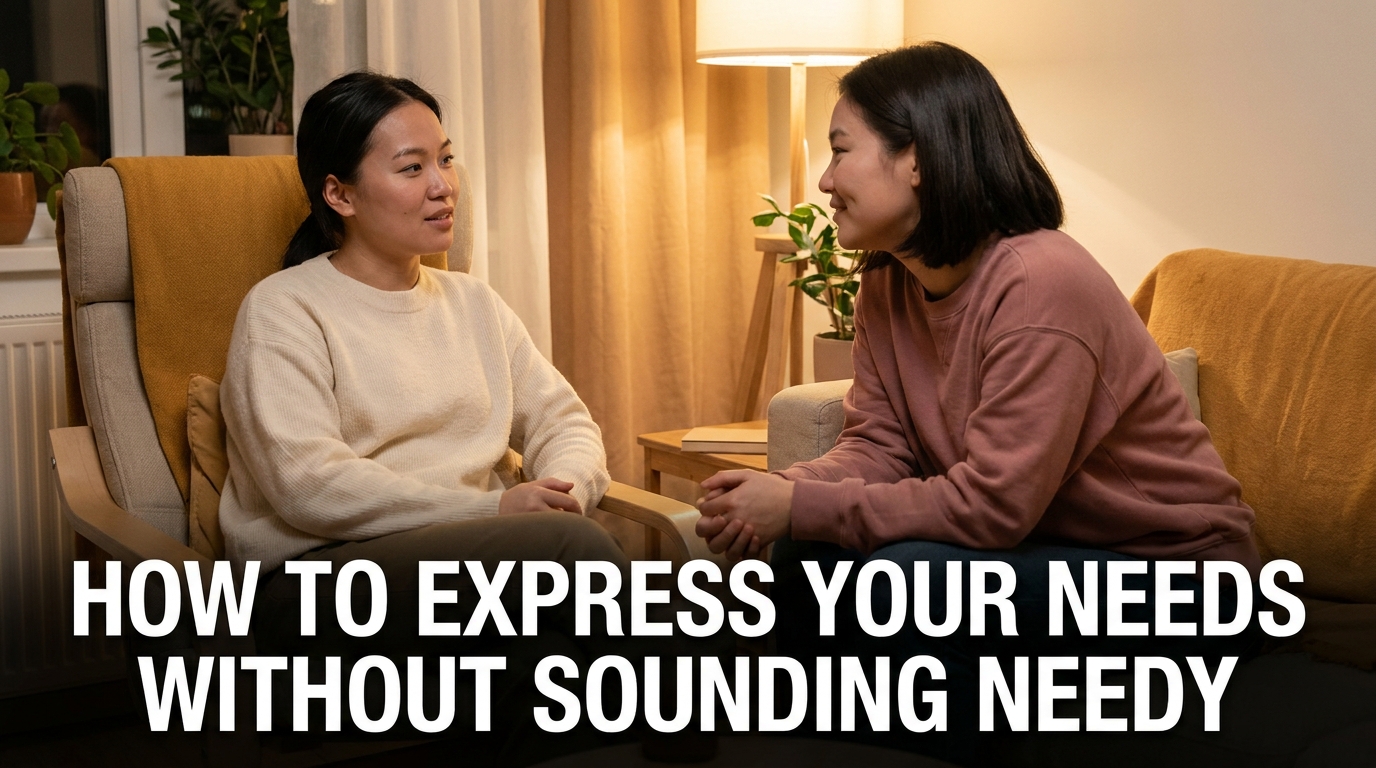
A person who says “I’ve been feeling disconnected from you lately — can we plan some quality time this week?” is expressing a need directly and clearly. A person who sulks until their partner notices, then denies anything is wrong, then escalates when the sulking is not effective is expressing the same need indirectly and anxiously.
The need is identical. The delivery is completely different. And the delivery determines almost everything about how it is received.
Why Indirect Communication Always Costs More Than It Saves
The instinct behind indirect communication is understandable — it feels less vulnerable, less exposing, less risk of the outright “no” that direct asking invites.
But indirect communication carries hidden costs that almost always outweigh what it saves.
It rarely works. Partners are not mind readers. The signals that feel unmistakably clear from the inside are frequently invisible from the outside. What feels like an obvious hint often lands as nothing at all.
It breeds resentment. When indirect communication fails — when the signal is missed, the hint goes unnoticed, the expectation goes unmet — the resulting disappointment carries a particular bitterness. “They should have known” becomes the unspoken accusation. And resentment built on expectations that were never clearly communicated is one of the most corrosive forces in a relationship.
It teaches your partner the wrong things. If your partner does occasionally pick up on indirect signals, they are being rewarded for guessing correctly — which reinforces a dynamic where both people are operating largely in subtext, and where connection depends on one person’s ability to decode the other’s silence. This is an exhausting and unreliable system.
It communicates something about your worth. Indirect communication often carries an implicit message: I do not believe my needs are legitimate enough to state clearly. Over time, this message is absorbed by both you and your partner — and it shapes how seriously those needs are taken.

How to Express Your Needs Clearly and Confidently: 10 Practical Strategies
1. Get Clear on What You Actually Need — Before You Speak
The most common reason people communicate needs indirectly is that they haven’t fully clarified the need to themselves. They know something is wrong. They know they want something to be different. But they haven’t done the internal work of identifying exactly what.
Before you bring something to your partner, take a moment to ask yourself: what do I actually need here? Not what do I want them to stop doing. Not what am I frustrated about. What specific thing, if it happened, would make me feel better?
The more specific you can be — “I need 20 minutes of phone-free time together in the evening” rather than “I need you to be more present” — the easier it is for your partner to actually meet the need, and the less room there is for misinterpretation.
2. Use ‘I’ Statements to Own Your Experience
This is foundational. The difference between “I feel disconnected from you lately and I miss us” and “You’re never present anymore” is not just tone — it is the entire emotional architecture of the conversation.
“I” statements place you in your own experience without placing blame. They invite your partner into your emotional world rather than putting them on the defensive outside it. And they communicate something important: I am not attacking you. I am sharing something real with you.
Practice the structure: “I feel [emotion] when [situation]. What I need is [specific request].”
It sounds simple. Used consistently, it is genuinely transformative.
3. Separate the Need From the Grievance
One of the most common mistakes in expressing needs is bundling the need with a complaint about every time the need was not met previously.
“I need more quality time with you — and by the way, you never make time for me, last month you cancelled twice, and I feel like I’m always last on your list” may be entirely accurate. But it is almost impossible to receive as a simple request. It becomes an indictment — and the defensive response it produces makes meeting the need far less likely.
State the need first. Separately, if necessary, address the pattern. But keep the request clean — one thing, clearly stated, without the weight of accumulated history attached to it.

4. Ask at the Right Time
Timing is not everything — but it is close. A legitimate, clearly stated need raised at the wrong moment will almost always land worse than if it had been raised at the right one.
The wrong moments: when your partner is stressed, distracted, or mid-task. When either of you is already emotionally activated. Immediately after a conflict. Late at night when both of you are exhausted. In the middle of a social situation where privacy is impossible.
The right moments: when you are both calm and present. When you have adequate time for a real conversation. When neither person is flooded or distracted. When you can give the conversation the space it deserves.
“Is now a good time to talk about something that’s been on my mind?” is one of the most underused sentences in relationship communication. It respects your partner’s state and sets the conversation up for success before it begins.
5. Make the Request Specific and Actionable
Vague needs produce vague responses. “I need you to be more affectionate” gives your partner nothing concrete to work with — and leaves both of you frustrated when their interpretation of affectionate doesn’t match yours.
Specific needs are actionable. “I would love it if you reached for my hand more often when we’re out together” gives your partner something they can actually do. The specificity is not clinical — it is kind. It saves them from guessing and you from being repeatedly disappointed.
The more clearly you can describe what meeting the need looks like, the more likely it is to be met in the way that actually helps.
6. Express the Need Before It Becomes Urgent
One of the most common reasons needs get expressed poorly is that they are expressed too late — after they have been suppressed for so long that they arrive not as a calm request but as an emotional flood.
When a need is expressed calmly and early, it is relatively easy to receive. When the same need arrives after weeks of unexpressed frustration, it carries the emotional weight of all that accumulated suppression — and the resulting intensity makes it look like neediness even when it is not.
Practice expressing needs when they are small. Before the frustration builds. Before the resentment sets in. Before the quiet signals have been ignored so many times that the only remaining option is to be loud about it.
7. Detach the Request From the Outcome
This is one of the most psychologically sophisticated — and most important — principles of expressing needs well.
You are responsible for clearly communicating what you need. You are not responsible for, and cannot control, how your partner receives or responds to that communication.
Expressing a need with your entire sense of security riding on the response — needing them to respond in exactly the right way, immediately, with full understanding and warmth — is what turns a legitimate request into neediness. The anxiety attached to the outcome is what makes the expression of need feel desperate rather than grounded.
Practice stating what you need clearly — and then releasing the grip on how it must be received. Your partner’s response is information. It is not a verdict on your worth.
8. Acknowledge That Your Partner Has Needs Too
Expressing your needs in a relationship is not a one-way act. The most effective need-expression happens in a context of genuine mutuality — where both partners feel equally safe and equally heard.
After expressing something you need, it is worth asking: “Is there anything you need from me right now that you haven’t felt able to say?” This question — asked genuinely, not as a tactic — shifts the conversation from request to collaboration. It communicates: your needs matter as much as mine. We are working on this together.
That collaborative spirit is what separates healthy need-expression from a pattern that, however unintentionally, consistently centers one partner’s needs at the expense of the other’s.
9. Appreciate When Needs Are Met
This seems obvious. It is more important than it appears.
When your partner meets a need you expressed — when they follow through, when they adjust, when they make an effort that shows they were listening — acknowledge it. Genuinely and specifically. “I really felt loved when you did that. It meant a lot to me.”
This is not just politeness. It is behavioral reinforcement — and it works. When a partner feels that their effort is noticed and appreciated, they are significantly more motivated to continue making that effort. Gratitude for met needs is one of the most practical investments in getting your needs met consistently.
10. Work on Your Own Internal Security
This is the deepest and most important item on this list.
The reason expressing needs feels like neediness is almost always because the need is attached to an underlying fear — of rejection, of being too much, of abandonment, of not being enough. That fear is the thing that makes a simple request feel like a matter of survival.
Building internal security — through therapy, through self-awareness practices, through the gradual experience of having needs met safely — changes the emotional charge attached to asking. When your sense of self is not on the line every time you express a need, expressing that need stops feeling like walking a tightrope.
This is long-term work. It is also the work that changes everything — not just how you express needs in this relationship, but how you relate to your own needs in every relationship, for the rest of your life.

A Note on Partners Who Dismiss Your Needs
Everything in this article assumes a partner who is capable of receiving a clearly expressed need with reasonable good faith.
If you have practiced all of these strategies — expressed needs clearly, calmly, specifically, and at the right time — and your needs are consistently dismissed, minimized, or turned against you, that is important information.
Healthy relationships are not ones where your needs are always immediately and perfectly met. They are ones where your needs are consistently taken seriously, even when the response is “I hear you, and I need some time to think about how to meet that.”
A partner who repeatedly dismisses clearly expressed needs — who uses your requests against you, who makes you feel ashamed for having them, who responds to legitimate asks with contempt or withdrawal — is not a partner whose response reflects something true about your needs. It reflects something important about their capacity to be in a genuinely mutual relationship.
Your needs are not the problem. In a relationship where they are consistently treated as though they are, that is the thing worth examining.
Asking for what you need is not neediness. It is one of the most mature and loving things you can do in a relationship — for yourself, and for the person trying to love you.
CALL TO ACTION
💾 Save this — and read it again before the next conversation you’ve been putting off. 📤 Share it with someone who always puts their own needs last. 👣 Follow Truthsinside.com for honest, psychology-backed relationship advice every week.
Frequently Asked Questions
Q1: What is the difference between expressing needs and being needy? Expressing needs is a healthy, direct communication practice — clearly stating what you require to feel loved, safe, and connected in a relationship. Being needy is a behavioral pattern characterized by excessive dependency on external validation, indirect or escalated communication of needs, and a fragile sense of self that is destabilized when needs are not immediately met. The difference is not in the need itself — everyone has the same basic relational needs — but in how that need is communicated and what is at stake emotionally when it is or isn’t met. Directness, calm, and internal security are what separate need-expression from neediness.
Q2: What if my partner says I am too needy when I express legitimate needs? This requires careful discernment. Sometimes the feedback is accurate — if needs are being expressed through escalation, indirect communication, or with significant emotional intensity, the delivery may genuinely be overwhelming even when the underlying need is legitimate. In those cases, the strategies in this article are directly relevant. However, sometimes “you’re too needy” is itself a form of dismissal — a way of making the person asking feel ashamed for having legitimate relational needs. If you have expressed needs clearly and calmly and are consistently told you are too much, that is worth examining with a therapist who can offer perspective from outside the relationship dynamic.
Q3: How do I express needs to a partner who gets defensive? Defensive responses are almost always triggered by perceived criticism or threat. The most effective approach is to maximize the safety of the request before it is made — by using “I” statements rather than “you” accusations, by leading with genuine appreciation before raising the need, by explicitly framing the conversation as collaborative rather than critical. “I want to talk about something because I care about us, not because I’m unhappy with you” reframes the conversation before it begins. Not every defensive response can be pre-empted — but removing the elements that predictably trigger defensiveness dramatically increases the likelihood of being genuinely heard.
Q4: Is it okay to have a lot of needs in a relationship? Yes — with an important nuance. Having a rich inner emotional life and a genuine need for connection, affirmation, quality time, and intimacy is not a flaw. What matters is that needs are expressed in ways that are fair, mutual, and respectful of your partner’s own needs and capacity. A relationship in which one partner has consistently more expressed needs than the other, with no reciprocal curiosity about the other’s needs, can become unbalanced over time. The goal is mutuality — both partners feeling seen, both partners feeling free to ask, both partners genuinely invested in the other’s wellbeing as much as their own.
Q5: What if I genuinely don’t know what I need? This is more common than most people realize — and it is often a symptom of having spent years suppressing or minimizing needs to the point where they are no longer easily accessible. Practices that rebuild connection with your own inner experience — journaling, therapy, mindfulness, even simply pausing to ask “what do I need right now?” several times a day — can gradually restore that access. Working with a therapist is particularly valuable here, both for reconnecting with suppressed needs and for building the sense of internal security that makes expressing them feel safe.
🎵 Music
Maren Lull is a singer-songwriter who writes from the places most people don’t talk about out loud.
Not the dramatic grief. Not the obvious heartbreak. The quiet kind — the ordinary Tuesday emptiness, the habit of reaching for someone who isn’t there anymore, the particular exhaustion of being strong for so long that the strength itself wears thin.
Her music lives at the intersection of emotional honesty and soft beauty — breathy vocals over gentle piano, slow tempos, lyrics that feel less like songs and more like something you wrote in a private notebook at two in the morning and never showed anyone.
Maren Lull writes for the people who feel everything deeply and say very little about it. For the ones who listen to sad music not because they want to feel worse — but because being understood, even by a song, makes the feeling easier to carry.
📱 Follow Maren Lull:
→ Spotify
→ Apple Music
→ Youtube
→ Audiomack