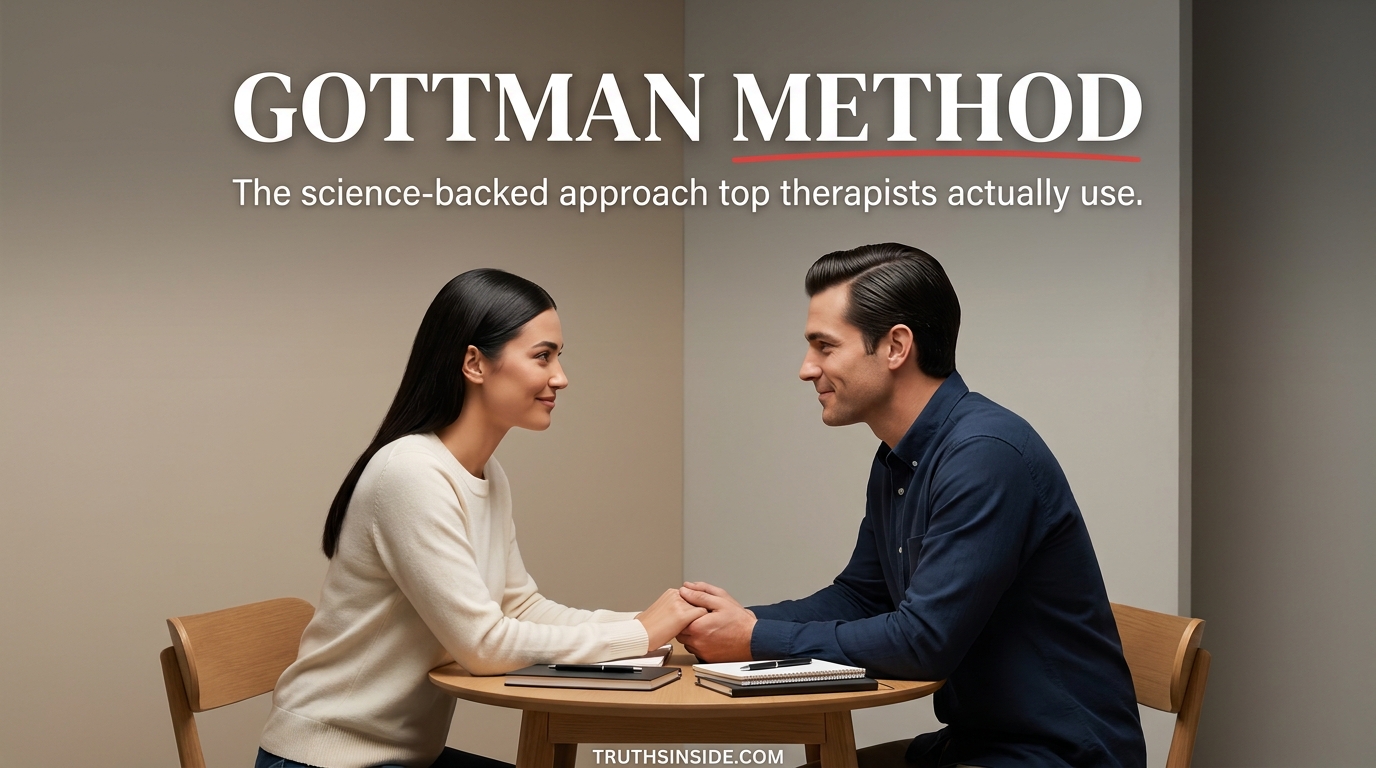
Gottman Method: The Research-Backed Approach to Relationship Success
Most couples fight about the same five things for decades — money, chores, sex, in-laws, and time — yet some marriages grow stronger with every disagreement while others quietly fall apart. For over four decades, psychologist Dr. John Gottman studied exactly why. After observing thousands of couples in his “Love Lab” at the University of Washington, he could predict divorce with over 90% accuracy just by watching a couple argue for a few minutes. Out of that research came the Gottman Method, one of the most empirically validated approaches to relationship therapy in existence today.
Unlike many relationship frameworks built on theory or intuition, this approach is built almost entirely on observed data — heart rates, facial expressions, tone of voice, and conflict patterns recorded across real couples over real years. It doesn’t promise a fairy-tale version of love. Instead, it offers something more useful: a map of what actually keeps relationships stable, and what quietly destroys them.
This article breaks down what the framework is, the psychological research behind it, and the core principles couples and therapists use to apply it — including the warning signs it identifies and the skills it teaches to reverse them.
What Is the Gottman Method?
The Gottman Method is a structured, research-based approach to couples therapy developed by Dr. John Gottman and Dr. Julie Schwartz Gottman. It focuses on strengthening friendship, managing conflict constructively, and creating shared meaning between partners — three pillars the Gottmans identified as essential to long-term relationship health.
What separates this framework from many other therapeutic approaches is its foundation in longitudinal research rather than clinical theory alone. Gottman didn’t start with a hypothesis about what makes relationships work; he started by observing thousands of real couples, tracking their interactions in painstaking detail, and following many of them for years to see who stayed together and who didn’t.
The result is a system less concerned with grand romantic gestures and more focused on small, repeatable behaviors — the kind that accumulate into either connection or resentment over time. This is part of why it has become one of the most widely trained approaches among licensed couples therapists worldwide.
📃 Related article: Partner Is Thinking About Marriage? 7 Shocking Signs
The Research Behind This Approach
The credibility of the Gottman Method comes from an unusually rigorous research process. Gottman’s team didn’t just interview couples — they wired them with physiological sensors, recorded their conversations, and coded every facial microexpression using the Facial Action Coding System. This allowed researchers to detect contempt, defensiveness, and disengagement even when couples themselves weren’t consciously aware they were displaying it.
From this data, Gottman identified four communication patterns so damaging to relationships that he called them “The Four Horsemen”: criticism, contempt, defensiveness, and stonewalling. Of these, contempt — expressed through sarcasm, eye-rolling, or mockery — emerged as the single strongest predictor of divorce. This model was built specifically to counteract these patterns with measurable, teachable alternatives.
“You can predict divorce not by how much couples fight, but by how they fight — and whether contempt has entered the relationship.” — adapted from Dr. John Gottman’s research
This wasn’t a one-time study. Gottman’s longitudinal work spanned decades and included multiple long-term follow-ups, giving this framework a rare distinction in relationship science: outcomes that could actually be tracked over time rather than measured only in a single therapy session.
The Sound Relationship House: Core Structure of the Framework
Central to this approach is a metaphorical framework called the “Sound Relationship House,” a structure built level by level. At its foundation are “love maps” — the detailed knowledge partners have of each other’s inner worlds, worries, dreams, and daily stresses. Without this foundation, the Gottmans argue, everything built above it is unstable.
The next levels include sharing fondness and admiration, turning toward bids for connection, and maintaining a positive perspective during conflict. Higher still sit conflict management, making life dreams come true together, and creating shared meaning. Two supportive walls — trust and commitment — hold the entire structure together.
This layered structure is what makes the method practical rather than abstract. Therapists trained in it assess exactly which level of the house is weakest for a specific couple, then target interventions there rather than applying generic advice. It’s a diagnostic tool as much as a treatment model.

The Four Horsemen This Framework Warns Against
A central diagnostic tool within this system is recognizing the Four Horsemen before they become entrenched. Criticism attacks a partner’s character rather than addressing a specific behavior. Contempt communicates disgust or superiority. Defensiveness deflects responsibility, and stonewalling withdraws entirely from the interaction.
This approach doesn’t just identify these patterns — it pairs each one with a specific antidote. Criticism is countered with a “gentle startup,” raising concerns without blame. Contempt is countered by building a culture of appreciation. Defensiveness is countered by taking partial responsibility, and stonewalling is countered by practicing physiological self-soothing during heated moments.
Couples trained in these antidotes often report a noticeable shift — not because conflict disappears, but because it stops accumulating lasting damage. According to Gottman’s research, it’s not the presence of conflict that predicts relationship failure, but the absence of repair attempts during and after it.
Repair Attempts: A Key Concept in This Method
One of the most practical contributions of the Gottman Method is the concept of “repair attempts” — any statement or action, however small or clumsy, that prevents negativity from escalating during conflict. This could be a joke, a gentle touch, or simply saying “can we pause for a second?”
Gottman’s research found that the success of a relationship often hinges not on avoiding conflict, but on how effectively a couple makes and receives these repair attempts. Emotionally stable couples weren’t couples who never argued — they were couples who consistently caught the moment before an argument spiraled out of control.
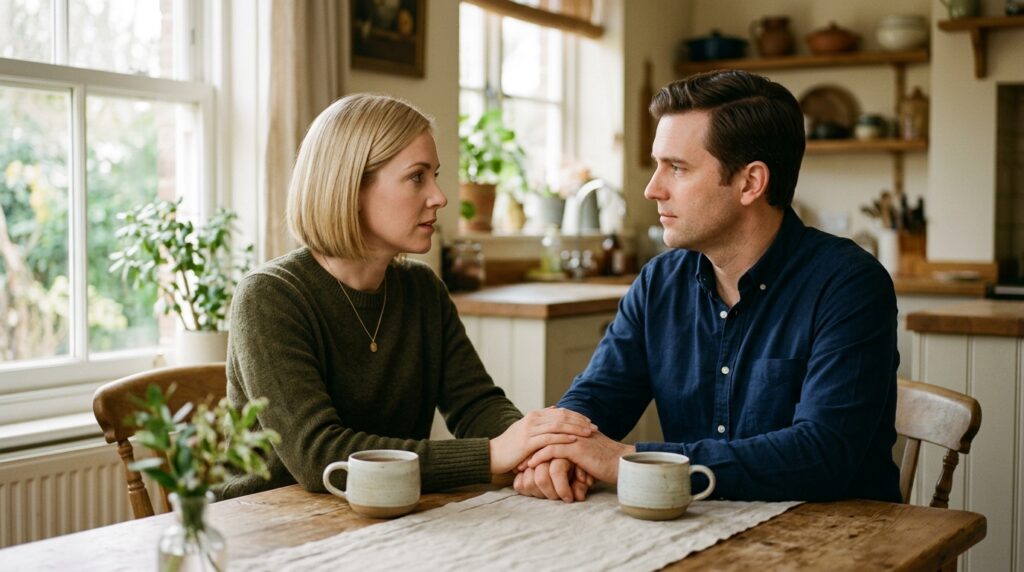
This is one of the most reassuring aspects of this framework for couples entering therapy: the goal was never a conflict-free relationship. It’s a relationship equipped with the tools to recover quickly and consistently.
Building Love Maps: The Foundation of the Approach
At the base of the Sound Relationship House sits the concept of “love maps” — an ongoing, evolving understanding of a partner’s inner psychological world. This includes knowing their current stresses, hopes, fears, and even smaller details like their favorite way to unwind after a hard day.
This method treats love maps as something that requires continual updating, not a one-time accomplishment from early dating. Couples are encouraged to ask open-ended questions regularly, treating their partner’s inner world as something still worth discovering even after years together.
Research consistently shows that partners who maintain updated, detailed love maps report significantly higher relationship satisfaction. This single component is often the first thing therapists rebuild when a couple has drifted into disconnected, purely logistical communication.
“The strongest relationships are between partners who still ask each other real questions, even after twenty years.” — a principle central to this framework’s love maps concept
Turning Toward: The Everyday Practice
Perhaps the most quietly powerful concept within this system is “turning toward” — the practice of responding to a partner’s small bids for attention, humor, or connection rather than ignoring or dismissing them. Gottman’s research found that couples who stayed together turned toward these bids roughly 86% of the time, compared to just 33% among couples who eventually divorced.

This finding is part of what makes the approach so approachable in daily life. Turning toward doesn’t require therapy sessions or scheduled exercises — it requires noticing the dozens of small bids for connection that happen throughout an ordinary day and choosing to respond rather than deflect.
Applying This Approach Outside of Therapy
While the Gottman Method was designed for clinical use, many of its core principles translate directly into everyday relationship habits. Couples don’t need a therapist present to practice a gentle startup, build a habit of appreciation, or work on updating their love maps regularly.
Workshops based on this framework, along with self-guided resources developed by the Gottman Institute, have made these tools increasingly accessible outside formal therapy settings. This accessibility is part of why it has remained one of the most referenced relationship frameworks in both clinical and popular psychology for decades.
Still, for couples navigating deeper, recurring conflict patterns, working with a therapist specifically trained in this method often yields more measurable results than self-application alone, since a trained clinician can accurately diagnose which level of the Sound Relationship House needs the most attention.
📃 Related article: Love Maps: 5 Ways They Predict Lasting Love
Why This Framework Continues to Influence Modern Psychology
Few relationship frameworks have maintained relevance across as many decades as the Gottman Method. Its staying power comes largely from its evidence base — most competing relationship theories rely far more heavily on clinical anecdote than longitudinal data. It remains one of the few frameworks that can point to predictive accuracy tested against real long-term outcomes.
As newer research emerges in fields like attachment theory and emotionally focused therapy, many clinicians now integrate this approach alongside these newer models rather than treating it as a standalone system. This integration reflects growing consensus that healthy relationships require both emotional attunement and practical communication skill — precisely the combination this framework was built to teach.
Frequently Asked Questions
What is the main goal of the Gottman Method?
The primary goal of the Gottman Method is to help couples build stronger friendship, manage conflict constructively, and create shared meaning, based on decades of observed research rather than theoretical assumption.
Is this approach only for couples in crisis?
No. While many couples seek it during difficult periods, it is also widely used preventatively, helping stable couples strengthen their relationship before serious conflict patterns develop.
How long does therapy based on this method typically take?
Duration varies by couple, but many therapists structure treatment in phases over several months, focusing first on assessment, then on targeted skill-building based on the couple’s specific weak points.
Can the Gottman Method be self-taught without a therapist?
Many core principles, such as gentle startups and turning toward bids for connection, can be practiced independently. However, couples with entrenched conflict patterns often benefit most from guidance by a therapist formally trained in it.
What makes this framework different from other couples therapy approaches?
Its foundation in long-term observational research sets the Gottman Method apart, allowing it to identify specific, measurable predictors of relationship success or failure rather than relying primarily on clinical theory.
If this gave you a clearer picture of what actually predicts relationship success, don’t let it end here. Save this article to revisit these core principles when conflict arises. Share it with a partner who’d benefit from understanding these patterns. And Follow Truthsinside.com for more research-backed insight into the psychology of lasting relationships.
🎵 Music
Maren Lull is a singer-songwriter who writes from the places most people don’t talk about out loud.
Not the dramatic grief. Not the obvious heartbreak. The quiet kind — the ordinary Tuesday emptiness, the habit of reaching for someone who isn’t there anymore, the particular exhaustion of being strong for so long that the strength itself wears thin.
Her music lives at the intersection of emotional honesty and soft beauty — breathy vocals over gentle piano, slow tempos, lyrics that feel less like songs and more like something you wrote in a private notebook at two in the morning and never showed anyone.
Maren Lull writes for the people who feel everything deeply and say very little about it. For the ones who listen to sad music not because they want to feel worse — but because being understood, even by a song, makes the feeling easier to carry.
📱 Follow Maren Lull:
→ Spotify
→ Apple Music
→ Youtube
→ Audiomack