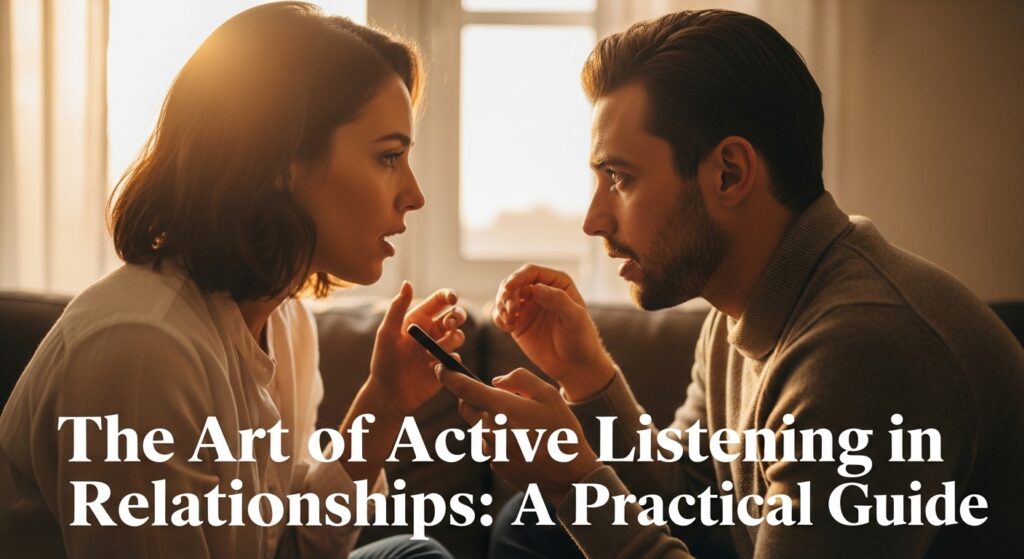

Taking Your Spouse For Granted: 7 Signs to Stop Now
Somewhere between the dishes, the deadlines, and the bedtime routines, most couples stop truly seeing each other. Psychologists call it “habituation” — the same neurological process that makes a ticking clock fade into silence after a few minutes. Dr. John Gottman’s decades of research at the Gottman Institute found that couples heading toward divorce weren’t necessarily fighting more; they were simply noticing each other less. Taking your spouse for granted isn’t usually a dramatic betrayal — it’s a slow, quiet erosion, and that’s exactly what makes it so dangerous.
If you’ve ever caught yourself forgetting to say thank you for the thousandth load of laundry, or scrolling your phone through a story your partner is excitedly telling you, you already know the feeling this article is about. It’s not that love disappeared. It’s that attention did. And attention, according to attachment researchers, is one of the strongest signals of safety and worth a partner can receive.
This article walks through what taking your spouse for granted actually looks like, why the brain does it so easily, and seven concrete signs that it may be happening in your own marriage right now — along with what the research says actually works to reverse it.
What Does Taking Your Spouse for Granted Really Mean?
Taking your spouse for granted means treating their presence, effort, and love as a permanent fixture rather than something that requires ongoing care. It’s the emotional equivalent of assuming the sun will rise without ever looking up to appreciate it. In relationship psychology, this pattern is closely tied to what’s known as “hedonic adaptation” — our tendency to get used to good things until they stop registering as good at all.
Early in a relationship, a partner’s kindness feels remarkable. Three years in, that same kindness can start to feel invisible, simply because the brain has filed it under “expected” rather than “special.” Taking your spouse for granted often isn’t intentional. It’s a byproduct of comfort, routine, and the mental shortcuts our brains take once a relationship starts to feel secure.
The danger is that security without appreciation eventually curdles into distance. Gottman’s research identified specific behavioral patterns — criticism, contempt, defensiveness, and stonewalling — that predict relationship breakdown with striking accuracy. Nearly all of them can trace their roots back to one root cause: a partner who no longer feels seen.
“Contempt is the single greatest predictor of divorce. And contempt often begins the moment one partner stops feeling valued.” — adapted from Gottman Institute research
Sign 1: You’ve Stopped Saying Thank You for the Small Things
When a relationship is new, gratitude flows freely. A partner grabbing coffee, remembering a preference, or handling a chore feels worthy of a genuine “thank you.” Over time, those same actions often become expected rather than appreciated — a quiet marker of taking your spouse for granted.
Research from positive psychology consistently shows that expressed gratitude — not just felt gratitude — is what strengthens relational bonds. A 2010 study published in Personal Relationships found that partners who felt more appreciated reported significantly higher relationship satisfaction, regardless of how much their partner actually did. It wasn’t the amount of effort that mattered most; it was whether that effort was acknowledged out loud.
If you can’t remember the last time you thanked your spouse for something ordinary, this is often the first thread that unravels. Rebuilding it doesn’t require grand gestures — it requires noticing again.
📃 Related article: Marriage After Kids: 7 Ways to Save the Spark
Sign 2: You Assume They’ll Always Be There
One of the quieter forms of taking your spouse for granted is the assumption of permanence. It’s easy to stop investing effort into a relationship that feels stable, simply because stability can be mistaken for guarantee. But no relationship runs on autopilot indefinitely.
Attachment theory suggests that even securely attached partners need ongoing reassurance — not because the relationship is fragile, but because human connection is maintained, not preserved. Couples therapist Esther Perel has often noted that the very security that makes a marriage feel safe can also make it feel unremarkable, and unremarkable relationships are the ones most vulnerable to neglect.
Assuming permanence often shows up as skipped check-ins, fewer “how was your day” conversations, or a general sense that the relationship no longer needs tending. It’s rarely a conscious choice — but the outcome is the same as if it were.
Sign 3: Conversations Have Become Purely Logistical
Grocery lists. Calendar coordination. Who’s picking up the kids. When day-to-day conversation with your spouse becomes almost entirely functional, it’s a strong sign that emotional intimacy has taken a back seat — a hallmark of taking your spouse for granted.
Gottman’s research on “bids for connection” found that couples who stay emotionally close consistently turn toward each other’s small attempts at engagement — a comment, a joke, a glance — rather than away from them. Couples who eventually divorced were found to turn toward these bids only about a third of the time.
If most conversations revolve around logistics rather than feelings, curiosity, or shared humor, the relationship may be functioning like a well-run business rather than a source of emotional nourishment. That shift often happens so gradually that neither partner notices until the disconnect feels significant.
Sign 4: You’ve Stopped Noticing Their Effort
Every relationship runs on invisible labor — the meals planned, the emotional labor absorbed, the small sacrifices made without announcement. Taking your spouse for granted often means this effort has become so routine that it’s stopped registering entirely.
This is sometimes called “the mental load,” a term popularized in relationship psychology to describe the ongoing, often uneven cognitive and emotional labor one partner carries. When that labor goes consistently unnoticed, resentment tends to build quietly, long before it surfaces in an argument.
Noticing effort again — genuinely noticing it, not performatively — is one of the fastest ways to interrupt this pattern. It signals to your spouse that their contribution matters, not just their presence.
“Resentment isn’t usually caused by one big betrayal. It’s caused by a thousand unacknowledged efforts.” — a common observation among marriage and family therapists
Sign 5: Physical and Verbal Affection Has Quietly Faded
Affection is often one of the first things to shrink when a relationship settles into routine. A goodbye kiss becomes a wave. “I love you” becomes an afterthought said out of habit rather than intention. This fading isn’t always a sign of declining love — but it is frequently a sign of taking your spouse for granted.

Physiological research on touch shows that affectionate contact lowers cortisol and increases oxytocin in both partners, reinforcing emotional bonding at a biological level. When affection fades, that biological reinforcement fades with it — and the relationship can start to feel more like a partnership of convenience than a source of closeness.
Sign 6: You Compare Them Unfavorably to Others
A subtle but corrosive sign of taking your spouse for granted is comparison — noticing everything your partner isn’t while overlooking what they consistently are. Social comparison theory suggests humans naturally measure their circumstances against others, but in relationships, this habit is particularly damaging when it becomes one-directional and critical.
Contempt, as Gottman identified, often grows from comparison left unchecked. A partner who feels perpetually measured against an idealized alternative — a friend’s spouse, a social media couple, an old relationship — tends to withdraw emotionally as a form of self-protection.
Shifting from comparison to appreciation isn’t about ignoring real issues. It’s about recognizing that no partner, real or imagined, is without flaws — and that focusing on what’s lacking blinds you to what’s already present.
📃 Related article: Partner Is Thinking About Marriage? 7 Shocking Signs
Sign 7: You No Longer Ask About Their Inner World
Perhaps the clearest sign of taking your spouse for granted is simply forgetting to ask how they’re doing — not logistically, but emotionally. What are they anxious about? What are they excited about? What do they need right now that they haven’t said out loud?
Dr. Sue Johnson, developer of Emotionally Focused Therapy, has emphasized that partners need ongoing emotional accessibility and responsiveness to maintain secure attachment. When curiosity about a partner’s inner life fades, so does the felt sense of being known — which research consistently links to relationship satisfaction more strongly than shared interests or even conflict frequency.

How to Stop Taking Your Spouse for Granted
Recognizing the signs is only the first step. Reversing the pattern requires intentional, consistent effort — not perfection, but attention. Below are approaches grounded in relationship research that couples therapists commonly recommend.
Practice daily, specific gratitude. Instead of a generic “thanks for everything,” name something specific: “Thank you for handling that phone call today — I know it wasn’t easy.” Specificity signals genuine noticing, not routine politeness.
Reinstate small rituals of connection. Gottman’s research emphasizes rituals — a morning coffee together, a nightly check-in, a weekend walk — as protective factors against emotional drift. These don’t need to be elaborate; they need to be consistent.
Turn toward bids for connection. When your spouse shares something, however small, respond with genuine attention rather than a distracted nod. This single habit is one of the strongest predictors of long-term relationship stability in Gottman’s research.
Ask open-ended emotional questions. Move beyond “How was your day?” to “What was the hardest part of your day?” or “What are you looking forward to this week?” These questions rebuild emotional intimacy that logistics alone can’t sustain.

The Cost of Letting This Pattern Continue
Left unaddressed, taking your spouse for granted rarely stays static — it tends to deepen. Partners who feel consistently unseen often withdraw emotionally long before any outward conflict appears, a pattern researchers call “emotional divorce,” which can precede legal separation by years. The relationship may look stable from the outside while eroding quietly on the inside.
The encouraging news is that this pattern is reversible at almost any stage. Because it’s built from small, repeated habits, it can also be undone by small, repeated habits — consistent attention, spoken appreciation, and genuine curiosity about the person you chose to build a life with.
Marriage doesn’t require constant intensity to survive. It requires ongoing noticing. The moment you start paying attention again is the moment the pattern begins to reverse.
Frequently Asked Questions
Is taking your spouse for granted a normal part of long-term relationships?
To some degree, habituation is a natural psychological process in any long-term relationship. The concern isn’t that it happens occasionally — it’s when it becomes the default pattern rather than something actively counteracted.
Can a marriage recover after years of taking each other for granted?
Yes. Many couples therapists report that even long-standing patterns of emotional neglect can shift significantly once both partners commit to consistent, small changes in attention and appreciation, rather than waiting for a single dramatic gesture.
What’s the difference between comfort and taking someone for granted?
Comfort means feeling secure enough not to perform for your partner. Taking your spouse for granted means that security has slid into neglecting their emotional needs entirely. The line is attention — comfort still notices; neglect doesn’t.
How do I bring this up without starting a fight?
Using “I” statements rather than accusations tends to work best — for example, “I’ve been missing our conversations lately” rather than “You never talk to me anymore.” This invites connection instead of defensiveness.
Does gratitude really make a measurable difference?
Yes. Multiple studies in relationship psychology link expressed gratitude directly to higher relationship satisfaction, independent of how much either partner actually does for the other.
If this resonated with you, don’t let the moment pass quietly. Save this article so you can revisit these signs when life gets busy again. Share it with a partner or friend who might need the reminder. And Follow Truthsinside.com for more research-backed insight into the relationships that matter most.
🎵 Music
Maren Lull is a singer-songwriter who writes from the places most people don’t talk about out loud.
Not the dramatic grief. Not the obvious heartbreak. The quiet kind — the ordinary Tuesday emptiness, the habit of reaching for someone who isn’t there anymore, the particular exhaustion of being strong for so long that the strength itself wears thin.
Her music lives at the intersection of emotional honesty and soft beauty — breathy vocals over gentle piano, slow tempos, lyrics that feel less like songs and more like something you wrote in a private notebook at two in the morning and never showed anyone.
Maren Lull writes for the people who feel everything deeply and say very little about it. For the ones who listen to sad music not because they want to feel worse — but because being understood, even by a song, makes the feeling easier to carry.
📱 Follow Maren Lull:
→ Spotify
→ Apple Music
→ Youtube
→ Audiomack