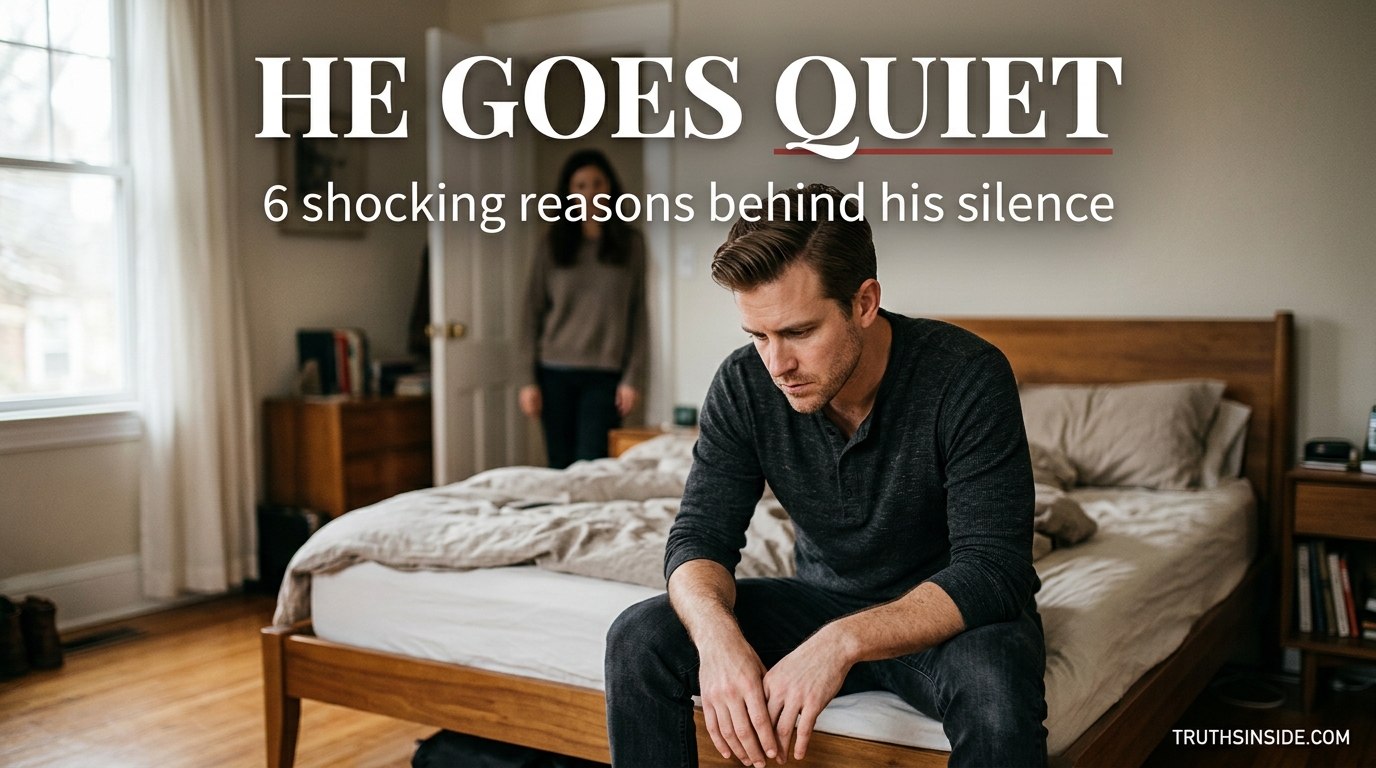
He Goes Quiet: 6 Shocking Reasons Behind His Silence
You’re mid-sentence, voice rising, heart pounding — and he goes quiet. Not calm, not composed. Quiet in a way that feels like a wall going up brick by brick. Psychologists who study conflict physiology have found that this kind of silence often isn’t emotional absence at all; it’s a measurable spike in heart rate, sometimes crossing 100 beats per minute, that shuts down a person’s ability to speak coherently.
Most people read silence as indifference. You’re pouring your heart out, and he goes quiet, and your brain fills that silence with the worst possible story: he doesn’t care, he’s checked out, he’s punishing me. But there’s a very different explanation hiding underneath that silence, one rooted in biology rather than character.
This is the story of what I learned after years of watching someone I love disappear mid-conversation — and the surprising psychological reason behind why he goes quiet the moment things get hard.
Why He Goes Quiet During Arguments (The Psychology Explained)
The most common reason he goes quiet during arguments has a name: flooding. Research popularized by Dr. John Gottman found that during high-conflict moments, the nervous system can become physiologically overwhelmed, flooding the body with stress hormones like cortisol and adrenaline. Once that happens, the brain’s reasoning center essentially goes offline, and words become nearly impossible to access.
This matters because men, statistically, tend to flood faster and recover more slowly than women in heterosexual conflict dynamics, according to Gottman’s decades of couples research. So when he goes quiet, it’s frequently not a choice made from a place of calm control — it’s an involuntary shutdown, similar to a circuit breaker tripping to prevent something from burning out completely.
Understanding this reframes the entire experience. He goes quiet not because the relationship doesn’t matter, but often because it matters so much that his body is trying to prevent him from saying something destructive in the heat of the moment.
📃 Related article: Couldn’t Accept Love: 7 Deep Reasons She Tested It First
It’s Not Coldness — Here’s What’s Happening in His Body When He Goes Quiet
When he goes quiet, his body is doing something specific and measurable. Heart rate climbs. Breathing becomes shallow. Blood moves away from the prefrontal cortex, the part of the brain responsible for language, empathy, and reasoned thought, and toward the muscles, preparing for a fight-or-flight response that has nowhere useful to go in a kitchen argument.
This is why articulate, emotionally intelligent men can suddenly seem to lose all their words during conflict. It isn’t a lack of feeling. It’s an overload of feeling, paired with a nervous system that hasn’t learned how to stay regulated while still communicating. He goes quiet because speaking, in that state, genuinely feels dangerous — like anything he says could make things irreversibly worse.
Knowing this doesn’t excuse checked-out communication in a relationship. But it does explain why yelling louder or demanding “just talk to me” almost never works. You can’t out-argue a nervous system that has already left the conversation.
“When he goes quiet, it’s rarely the absence of emotion — it’s often the presence of too much emotion with nowhere safe to put it.”
The Difference Between Stonewalling and a Healthy “He Goes Quiet” Pause
Not all silence is equal, and this distinction matters enormously. Gottman’s research identifies “stonewalling” as one of the four major predictors of relationship breakdown — a pattern where someone consistently shuts down communication as a way to avoid accountability or punish a partner. This is different from a temporary, biologically driven pause.
Healthy silence looks like this: he goes quiet, but signals that he needs a break and commits to returning to the conversation later. Unhealthy stonewalling looks like silence used as a weapon, repeated avoidance of hard topics indefinitely, or contempt hiding underneath the quiet. The presence or absence of a stated intention to reconnect is often the clearest signal of which one you’re dealing with.
If he goes quiet and later says, “I needed a minute, can we finish this tonight,” that’s regulation. If quiet becomes the permanent answer to every disagreement, that’s a pattern that needs direct, honest conversation — ideally with support from a couples therapist.

What the Research Says About Men Who Go Quiet During Conflict
Studies on gendered conflict patterns consistently show a pattern researchers call the “demand-withdraw cycle.” One partner, often statistically more likely to be a woman in heterosexual couples, pursues conversation to resolve tension, while the other partner, often statistically more likely to be a man, withdraws to self-regulate. The more one partner pursues, the more the other withdraws — and the more he goes quiet, the more urgent the pursuit becomes, creating a loop that neither partner can easily break alone.
Neuroscience research on emotional regulation also suggests men are, on average, socialized from childhood to suppress outward emotional expression more than women, which can mean fewer practiced tools for verbalizing distress in real time. So when conflict escalates, he goes quiet not because the tools don’t exist, but because they were never fully built. This isn’t a life sentence — regulation skills can absolutely be learned at any age — but it explains why silence is often the default first response before any healthier alternative has been practiced.
My Own Story: The Night I Finally Understood Why He Goes Quiet
I used to take it personally every time he goes quiet mid-argument. I’d raise my voice, ask “are you even listening to me,” and watch him retreat further into himself, which only confirmed my worst fear — that he simply didn’t care enough to fight for us. It took one particular night, after he’d gone completely silent for almost an hour, for everything to shift.
He finally said, quietly, “I wasn’t ignoring you. I genuinely couldn’t find words. My chest felt like it was closing.” That sentence changed how I saw every silent moment that came before it. He goes quiet not from apathy, but from an overwhelmed body doing the only thing it knew how to do under pressure. Once I understood that, I stopped chasing the silence and started giving it room to pass.
“I stopped asking why he goes quiet and started asking what his body needed in that moment to feel safe enough to speak again.”

How to Respond When He Goes Quiet (Without Making It Worse)
The instinct to demand immediate answers when he goes quiet is understandable, but it usually backfires. A more effective approach starts with naming the pattern out loud, calmly: “I notice you’ve gone quiet — I’m not trying to push, I just want us to come back to this.” This removes pressure while keeping the door open.
Agreeing in advance, during a calm moment, on a signal or phrase either partner can use when flooding starts can prevent silence from feeling like abandonment. Something as simple as “I need twenty minutes” gives both partners a shared script instead of leaving one partner to interpret silence alone. Research suggests roughly twenty to thirty minutes is often enough time for a flooded nervous system to physiologically settle before productive conversation becomes possible again.
It also helps to resist reading meaning into the silence itself. When he goes quiet, filling that gap with catastrophic assumptions rarely reflects what’s actually happening internally — and voicing those assumptions later, once he’s regulated, is far more productive than shouting them into the silence itself.
📃 Related article: Psychology of Ghosting: 7 Shocking Truths About Ghosters
When “He Goes Quiet” Becomes a Red Flag
There is an important line here worth naming directly. If he goes quiet occasionally during high-stress arguments but reliably returns to finish the conversation, that’s a nervous system doing its job. But if silence becomes a permanent avoidance strategy — if he goes quiet and stays quiet for days, refuses accountability, or uses withdrawal to control outcomes — that crosses from regulation into stonewalling, a pattern strongly linked to relationship breakdown in long-term research.
The difference isn’t about a single incident. It’s about the pattern over time, and whether both partners are willing to work on it together, ideally with professional support if the cycle feels stuck.

Frequently Asked Questions About Why He Goes Quiet
Q: Why does he go quiet instead of just talking it out?
When he goes quiet, it’s frequently a sign of physiological flooding — his nervous system has become overwhelmed to the point where verbal reasoning temporarily shuts down.
Q: Is it normal for him to go quiet during every argument?
Occasional silence during high-intensity conflict is common and often healthy, as long as he returns to the conversation afterward. Consistent, permanent silence is a different pattern worth addressing.
Q: How long should I wait when he goes quiet?
Research on emotional flooding suggests roughly twenty to thirty minutes is often enough for the body to physiologically calm down before conversation can resume productively.
Q: Is silence the same as stonewalling?
Not always. A temporary pause with an intention to reconnect is regulation. Repeated, indefinite silence used to avoid accountability is stonewalling, which is linked to relationship breakdown.
Q: Can someone learn to stop going quiet during conflict?
Yes. Emotional regulation and communication skills can be built at any age, often with practice, self-awareness, or support from a couples therapist.
If this helped you understand what’s really happening the next time he goes quiet, save it for your next hard conversation. Share it with someone who needs to hear that silence isn’t always rejection. And follow Truthsinside.com for more honest stories on psychology, relationships, and the truths hiding beneath the surface.
🎵 Music
Maren Lull is a singer-songwriter who writes from the places most people don’t talk about out loud.
Not the dramatic grief. Not the obvious heartbreak. The quiet kind — the ordinary Tuesday emptiness, the habit of reaching for someone who isn’t there anymore, the particular exhaustion of being strong for so long that the strength itself wears thin.
Her music lives at the intersection of emotional honesty and soft beauty — breathy vocals over gentle piano, slow tempos, lyrics that feel less like songs and more like something you wrote in a private notebook at two in the morning and never showed anyone.
Maren Lull writes for the people who feel everything deeply and say very little about it. For the ones who listen to sad music not because they want to feel worse — but because being understood, even by a song, makes the feeling easier to carry.
📱 Follow Maren Lull:
→ Spotify
→ Apple Music
→ Youtube
→ Audiomack