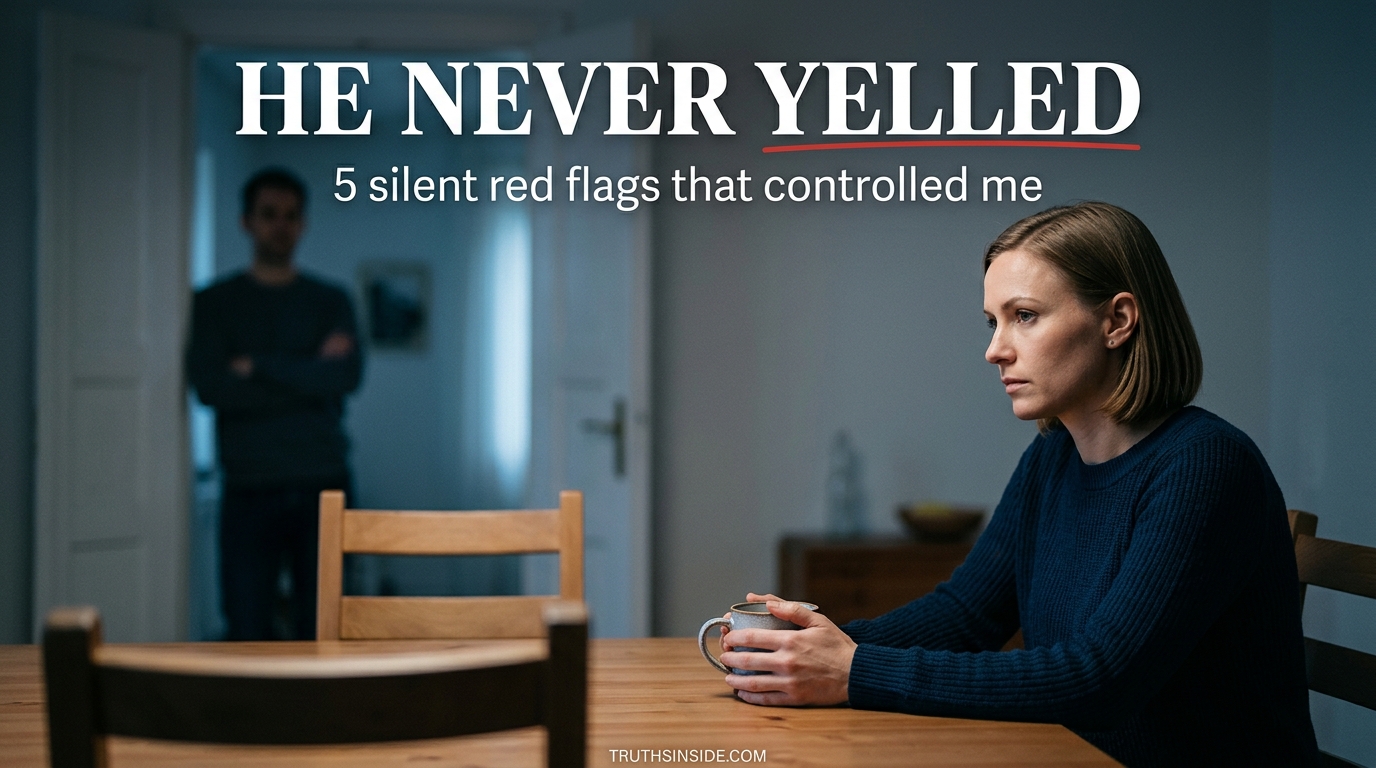
He Never Yelled: 5 Silent Red Flags That Controlled Me
He never yelled. Not once, in three years. If you’d asked me during the relationship whether I was in an unhealthy dynamic, I would have said no — because I was measuring harm by volume, and he never yelled loud enough to register as a warning sign. Researchers who study coercive control have found that psychological abuse often produces trauma symptoms as severe as physical abuse, even without a single raised voice.
That statistic didn’t mean anything to me while I was living it. What I noticed instead was smaller: a sigh here, a long silence there, a subtle correction of my version of events until I wasn’t sure what I actually remembered. He never yelled, so I assumed I was safe. I didn’t understand yet that control doesn’t require noise to work.
This is the story of what I missed for three years, and the five quiet red flags I finally recognized once I stopped waiting for him to yell.
What “He Never Yelled” Really Hid Underneath the Calm
The absence of shouting can create a dangerous illusion of safety. He never yelled, so every difficult conversation felt, on the surface, civil — even reasonable. But underneath that calm exterior was a consistent pattern of control: subtle criticism disguised as concern, decisions quietly made for me under the guise of “just handling it,” and a way of making disagreement feel exhausting enough that I usually gave up before it started.
Psychologists who study coercive control describe this as a system, not an incident — a pattern of behaviors designed to restrict a partner’s autonomy over time. He never yelled because yelling would have exposed the control too obviously. Silence, calm correction, and quiet withdrawal were far more effective, precisely because they didn’t look like anything at all.
📃 Related article: Just Protective: 8 Alarming Signs It Was Actually Control
Why Silence Can Be More Controlling Than Shouting
It sounds counterintuitive, but he never yelled was actually part of what made the dynamic so hard to name. Shouting is easy to identify as harmful — friends, family, even the person experiencing it can point to it and say, “that wasn’t okay.” Silence doesn’t offer that same clarity. When he never yelled but instead went cold for two days after a disagreement, I was left interpreting the punishment myself, filling in the meaning, usually landing on the conclusion that I had done something wrong.
Researchers on emotional withdrawal describe this as a form of covert punishment — one that avoids accountability because there’s no explicit act to point to. He never yelled, never slammed a door, never said a cruel word directly. He simply became unreachable until I apologized for something I often couldn’t even identify.
“The absence of shouting isn’t the same as the presence of safety — silence can control a room just as completely as noise ever could.”
The Night I Realized He Never Yelled Because He Didn’t Need To
There was one night I brought up something that had been bothering me for weeks — a small thing, really, about feeling dismissed in front of his friends. He never yelled in response. He simply went quiet, set down his fork, and said, calmly, “I think you’re overreacting again.” No anger in his voice. No raised volume. Just a flat, certain tone that made my concern feel small before I’d even finished explaining it.
That was the moment something shifted for me. He never yelled that night, and yet I left the conversation feeling smaller than I had after arguments in previous relationships that had involved actual shouting. I started to understand that control doesn’t need volume to land. Sometimes the quietest sentence in the room does the most damage.

The Psychology of Covert Control (Why He Never Yelled but Still Won)
Coercive control researchers, including sociologist Evan Stark, who pioneered much of the modern framework for understanding this pattern, describe it as a strategy built on isolation, monitoring, and the erosion of a partner’s confidence in their own perception. None of that requires yelling. He never yelled because his method worked through consistency and calm, not confrontation — small comments repeated often enough that I began adjusting my behavior preemptively, just to avoid the quiet disapproval.
This is part of why covert control is so difficult to identify from the outside. Friends would say, “but he seems so calm, so reasonable” — and he was, in front of them. He never yelled publicly, never raised his voice where anyone could witness it. The control lived entirely in private, in the space between us, where there were no witnesses to contradict the version of events he presented.
Signs He Never Yelled But Still Made You Feel Small
Looking back, there were consistent patterns I now recognize as red flags, even though he never yelled once. He would reframe my concerns as overreactions, calmly and confidently enough that I started doubting my own perception before I finished a sentence. He would go quiet for hours after minor disagreements, offering no explanation, until I apologized just to end the discomfort.
He never yelled, but he controlled our finances under the framing of “being responsible,” made major decisions and presented them to me as already settled, and subtly discouraged time with friends by making plans conveniently overlap. None of these moments looked dramatic individually. Together, they formed a pattern that slowly shrank the space I felt allowed to take up in my own relationship.
“Red flags don’t always look like danger — sometimes they look like someone who’s simply ‘never the type to raise their voice.'”

How I Started Noticing the Pattern Behind “He Never Yelled”
The turning point came slowly, not from one dramatic incident but from a friend casually asking, “does he ever just… let you disagree with him?” I remember pausing, genuinely unable to answer quickly. He never yelled, I said, almost defensively, as if that answered the question she was actually asking. It didn’t.
I started keeping a private note on my phone — not dramatic, just short observations after difficult conversations. Reading them back weeks later was the first time I saw the pattern clearly instead of experiencing it one moment at a time. He never yelled, but nearly every entry described the same feeling: smaller, uncertain, apologizing for things I couldn’t quite name. That written pattern did what individual memories couldn’t — it showed me the shape of something I’d been too close to see.
📃 Related article: Red Flags in Jokes: 5 Painful Truths I Learned Too Late
What Experts Say About Quiet Manipulation Tactics
Therapists who specialize in coercive control often describe a specific cluster of behaviors worth watching for, regardless of whether a partner ever raises their voice. These include consistent minimizing of a partner’s feelings, controlling access to money or social connections, subtly rewriting shared history during disagreements, and using calm, confident tones to make control feel like reason rather than manipulation.
He never yelled, and that absence of obvious aggression is exactly why experts warn that coercive control is frequently underreported and under-recognized, even by the people experiencing it. Without shouting, without physical aggression, many people — myself included — simply don’t have a category to file the experience under until someone names it directly, or until the pattern becomes undeniable through repetition.

Red Flags Hiding Behind “He Never Yelled”
If you recognize any of this, here are the patterns worth paying attention to. He never yelled, but conversations consistently ended with you apologizing for bringing something up in the first place. He never yelled, but disagreements were met with cold withdrawal rather than resolution. He never yelled, but your friendships and independence quietly shrank over time without a single dramatic moment marking the change.
None of these signs require volume to be real. If you find yourself constantly explaining away a partner’s coldness because “at least he never yelled,” it may be worth examining what that calm is actually protecting — and whether it’s safety, or simply a quieter form of the same control.
Frequently Asked Questions About “He Never Yelled” Relationships
Q: Can a relationship be unhealthy if he never yelled?
Yes. Coercive control and emotional manipulation can occur entirely without shouting, through patterns like silent treatment, minimizing feelings, and controlling decisions.
Q: Why didn’t I notice the red flags if he never yelled?
Most people associate danger with visible aggression. Quiet, consistent control is harder to identify because it lacks a dramatic moment to point to as proof.
Q: Is silent treatment considered a form of abuse?
Repeated, prolonged silent treatment used to punish or control a partner is recognized by many therapists as a form of emotional manipulation, particularly when paired with other controlling behaviors.
Q: How do I know if calm behavior is healthy or controlling?
Healthy calm includes space for disagreement and doesn’t leave you consistently apologizing or self-doubting. Controlling calm tends to shrink your confidence and independence over time.
Q: What should I do if I recognize this pattern in my relationship?
Consider speaking with a therapist who specializes in coercive control, and lean on trusted friends or family for outside perspective, since these patterns are often clearest from the outside.
If this story helped you recognize a pattern you’ve been quietly living with, save it to revisit later. Share it with someone who’s been told “but he never yelled” as if that settles the question. And follow Truthsinside.com for more honest stories on red flags, psychology, and the truths hiding beneath the calm.
🎵 Music
Maren Lull is a singer-songwriter who writes from the places most people don’t talk about out loud.
Not the dramatic grief. Not the obvious heartbreak. The quiet kind — the ordinary Tuesday emptiness, the habit of reaching for someone who isn’t there anymore, the particular exhaustion of being strong for so long that the strength itself wears thin.
Her music lives at the intersection of emotional honesty and soft beauty — breathy vocals over gentle piano, slow tempos, lyrics that feel less like songs and more like something you wrote in a private notebook at two in the morning and never showed anyone.
Maren Lull writes for the people who feel everything deeply and say very little about it. For the ones who listen to sad music not because they want to feel worse — but because being understood, even by a song, makes the feeling easier to carry.
📱 Follow Maren Lull:
→ Spotify
→ Apple Music
→ Youtube
→ Audiomack