
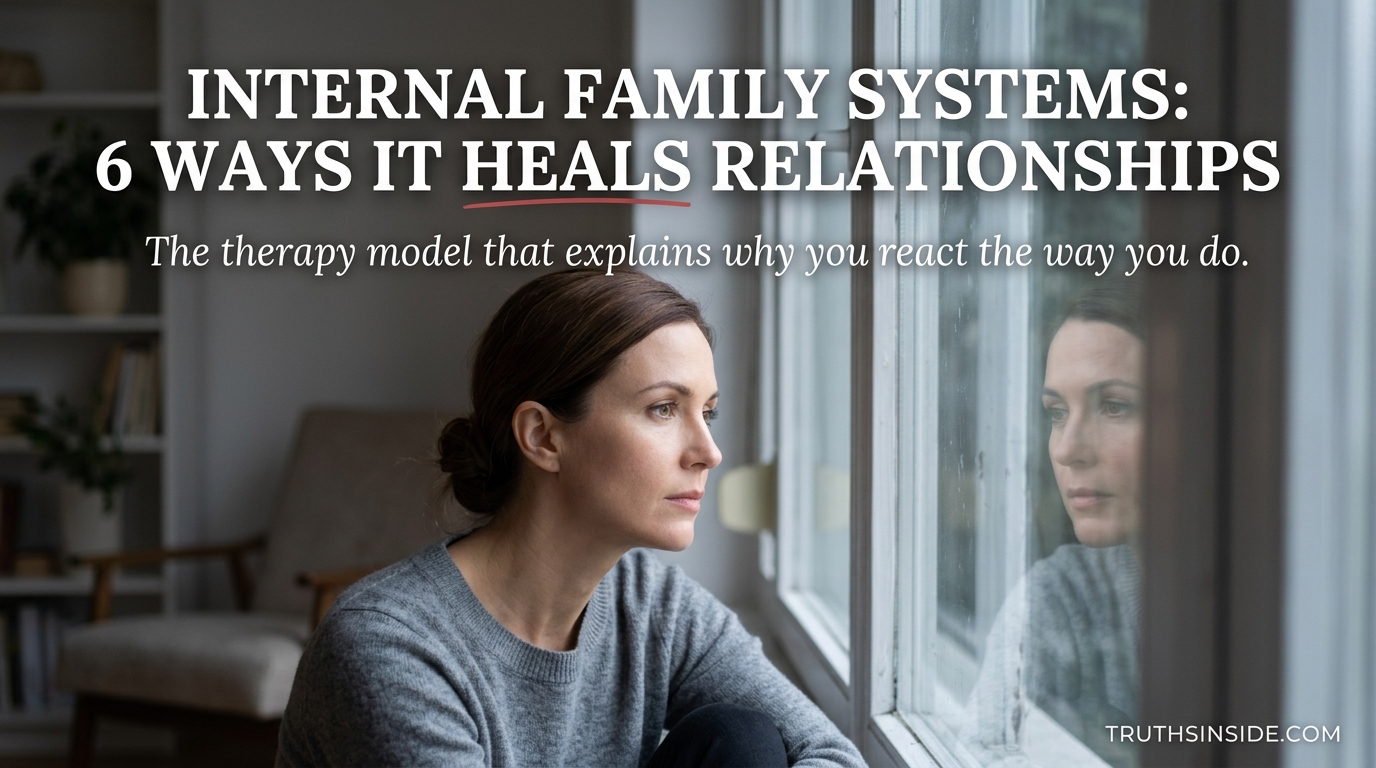
When Elena’s partner raised his voice during an argument, she didn’t just feel angry — she felt like a completely different version of herself took over, one she barely recognized. Later, calmer, she wondered why such a small disagreement had triggered such an outsized reaction. The answer came through Internal Family Systems, a therapy model that explains this exact experience by reframing the mind not as one unified voice, but as a system of distinct inner “parts,” each with its own role, fears, and protective strategies.
Developed by psychologist Dr. Richard Schwartz in the 1980s, Internal Family Systems has become one of the most widely used frameworks in modern trauma and relationship therapy. Clinical research has found this model to be effective for reducing anxiety, depression, and relational conflict, largely because it helps people understand their reactions rather than simply trying to suppress or control them. In relationships specifically, this framework offers a powerful lens for understanding why couples get stuck in the same painful patterns again and again.
This article breaks down what Internal Family Systems actually is, how it explains common relationship conflict, the core “parts” most people carry, and practical ways to apply this model to strengthen your own relationships.
WHAT IS INTERNAL FAMILY SYSTEMS?
Internal Family Systems is a therapeutic model built on the idea that the mind is naturally made up of multiple sub-personalities, or “parts,” rather than a single, unified self. Each part carries its own emotions, beliefs, and protective function, often formed in response to past experiences — particularly early relational wounds.
Unlike models that treat difficult emotions or behaviors as problems to eliminate, this framework treats every part as having a positive intent, even when its behavior causes harm. A part that triggers defensiveness during conflict, for example, isn’t seen as “bad” — it’s understood as a protector trying, in an outdated way, to prevent old pain from happening again.
At the center of this system is what Schwartz calls the “Self” — a core state of calm, curiosity, compassion, and clarity that exists beneath the parts. The goal of this work isn’t to eliminate parts, but to help the Self lead, so that protective or wounded parts no longer hijack behavior, especially during moments of relational stress.
📃 Related article: Partner Is Thinking About Marriage? 7 Shocking Signs
THE PSYCHOLOGY BEHIND INTERNAL FAMILY SYSTEMS
The Three Core Types of Parts
This framework identifies three broad categories of parts. Exiles are the younger, wounded parts that carry pain from earlier experiences, often shame or fear of abandonment. Managers are protective parts that work proactively to prevent exiles from being triggered, often through control, perfectionism, or emotional distance. Firefighters are reactive protectors that jump in during moments of overwhelm, often through anger, withdrawal, or impulsive behavior.
In relationships, these parts interact constantly. A partner’s sharp tone might activate an exile carrying old rejection wounds, which prompts a manager to shut down conversation to avoid further pain, or a firefighter to lash out defensively. Neither partner is choosing these responses consciously — the parts are reacting faster than deliberate thought allows.
Why Couples Repeat the Same Conflict
Internal Family Systems offers a clear explanation for why couples often have “the same fight” repeatedly, just with different surface content. If both partners have activated protector parts responding to old exile wounds, the conversation is no longer between two adults discussing a present issue — it’s between old, wounded parts trying to protect against pain that already happened long ago.
“You’re not always arguing about the dishes. Sometimes you’re arguing with an old wound wearing your partner’s face.”

SIGNS YOUR PARTS ARE DRIVING RELATIONSHIP CONFLICT
Recognizing when protective or wounded parts are active — rather than your grounded Self — is a core skill in this framework. Below are common signs.
1. Reactions Feel Bigger Than the Situation
If a minor disagreement triggers an intense emotional reaction, it’s often a sign that an old wounded part has been activated, not just the present moment.
2. You Feel Like “A Different Person” During Conflict
Feeling like you suddenly become someone else during an argument — harsher, colder, more anxious — often indicates a protector part has taken over.
3. The Same Argument Keeps Repeating
If conflicts follow a near-identical pattern regardless of the topic, entrenched protective parts on both sides are likely driving the cycle.
4. Difficulty Accessing Empathy Mid-Conflict
When compassion for a partner disappears entirely during disagreement, a protector part has likely taken over, since empathy is a quality of the calmer Self state.
5. Post-Conflict Regret or Confusion
Feeling confused or regretful about a reaction after the fact — “I don’t know why I said that” — often signals that a part, not your grounded Self, was driving the behavior.
HOW UNDERSTANDING YOUR PARTS TRANSFORMS RELATIONSHIPS
Applying this model to relationships shifts the entire framework of conflict. Instead of asking “why is my partner doing this to me,” couples learn to ask “which part is active right now, and what is it trying to protect?” This subtle shift reduces blame and increases curiosity, which research shows is strongly linked to more effective conflict resolution.
This approach also helps partners develop compassion for behaviors that once seemed frustrating or confusing. Understanding that a partner’s withdrawal comes from a protector trying to prevent old pain — rather than indifference — often defuses resentment far faster than simply trying to change the behavior directly. This reframe doesn’t excuse harmful patterns, but it does provide a starting point for addressing them with more understanding.
Over time, couples who apply this framework together often develop shared language for identifying triggered parts in real time — “my manager is showing up right now” or “that’s my exile talking.” This shared vocabulary allows couples to interrupt escalating conflict before it fully takes hold, creating space for the calmer Self to lead the conversation instead.

HOW TO APPLY INTERNAL FAMILY SYSTEMS IN YOUR RELATIONSHIP
Bringing this model into a relationship doesn’t require formal therapy training, though working with a trained practitioner can deepen the process significantly. Below are accessible starting points.
Notice the activation, not just the reaction. Before responding in conflict, pause and ask internally, “What part of me just got triggered?” This small shift builds awareness before reactive behavior takes over.
Get curious about your partner’s parts too. Instead of assuming intent, ask what old fear or wound might be behind a partner’s defensive or withdrawn behavior.
Build a shared vocabulary. Naming parts together — even informally — makes it easier to interrupt conflict patterns in the moment, since both partners recognize what’s happening.
Separate the part from the whole person. Remembering that a protective or wounded part isn’t your partner’s entire identity helps prevent conflict from turning into character judgment.
Consider working with an IFS-trained therapist. For deeper or more entrenched patterns, professional support using this specific model can help identify and heal the underlying exiles driving repeated conflict.
“Healing doesn’t mean getting rid of your parts. It means helping them trust that you — your calm, grounded Self — can finally handle what they’ve been protecting all along.”

FREQUENTLY ASKED QUESTIONS
What is Internal Family Systems in simple terms?
Internal Family Systems is a therapy model that views the mind as made up of distinct inner parts — wounded, protective, and reactive — all working around a calm core Self, rather than a single unified identity.
How does this framework apply specifically to relationships?
It helps partners understand that intense reactions often come from triggered protective or wounded parts rather than the present situation alone, which reduces blame and increases empathy during conflict.
Do I need a therapist to use Internal Family Systems?
While basic self-awareness practices can be done independently, working with a trained IFS therapist is recommended for deeper, more entrenched relational patterns tied to past trauma.
What’s the difference between a “part” and my actual personality?
Parts are aspects of the mind formed in response to experience, not fixed personality traits. The goal of this model is to help the core Self lead, rather than being controlled by any single part.
Can this model help with repeated arguments in a relationship?
Yes. Since many repeated conflicts stem from activated protector parts responding to old wounds, identifying these patterns often reduces the frequency and intensity of recurring arguments.
If this helped you understand your own reactions a little better, save this article to revisit it later, share it with someone navigating similar patterns, and follow Truthsinside.com for more research-backed relationship and psychology content.
🎵 Music
Maren Lull is a singer-songwriter who writes from the places most people don’t talk about out loud.
Not the dramatic grief. Not the obvious heartbreak. The quiet kind — the ordinary Tuesday emptiness, the habit of reaching for someone who isn’t there anymore, the particular exhaustion of being strong for so long that the strength itself wears thin.
Her music lives at the intersection of emotional honesty and soft beauty — breathy vocals over gentle piano, slow tempos, lyrics that feel less like songs and more like something you wrote in a private notebook at two in the morning and never showed anyone.
Maren Lull writes for the people who feel everything deeply and say very little about it. For the ones who listen to sad music not because they want to feel worse — but because being understood, even by a song, makes the feeling easier to carry.
📱 Follow Maren Lull:
→ Spotify
→ Apple Music
→ Youtube
→ Audiomack