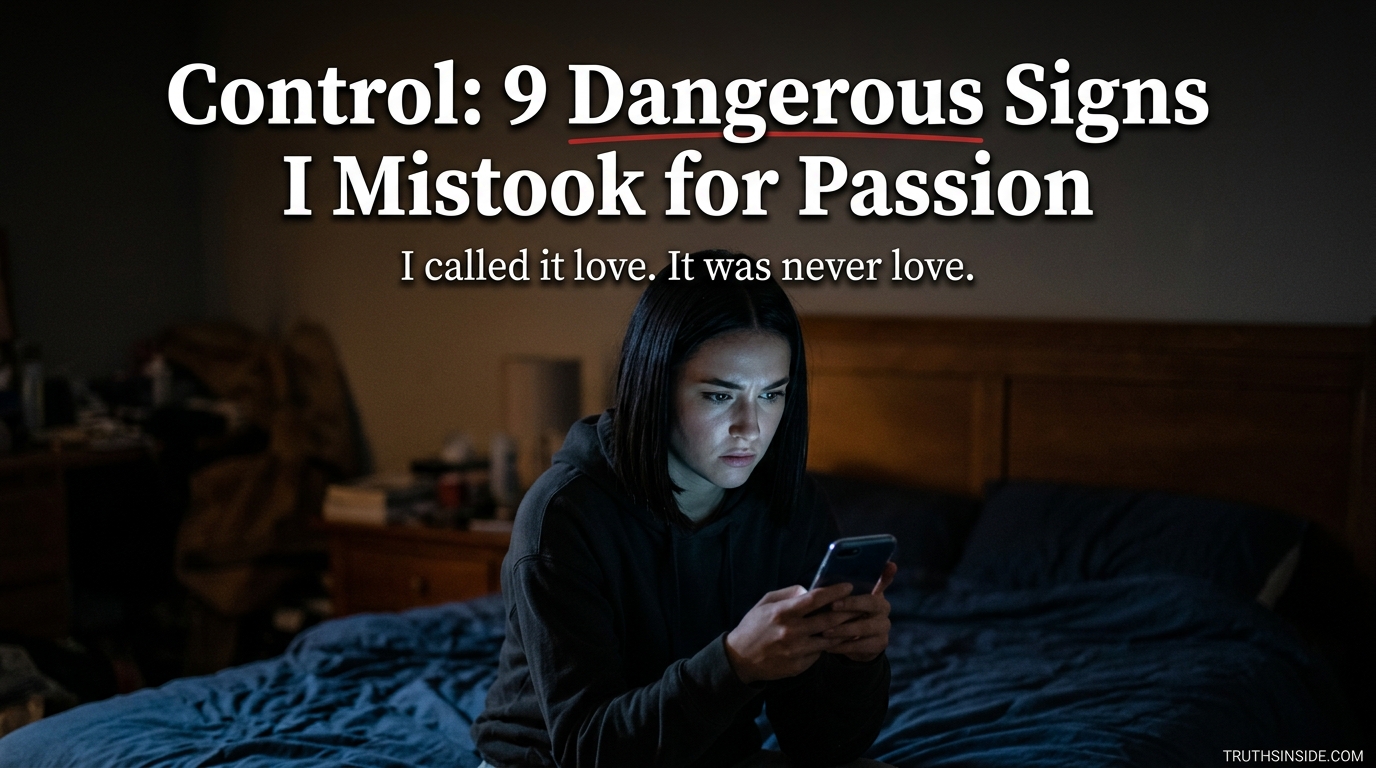
I Thought It Was Passion. It Was Control.
For the first six months, I told everyone I’d finally found a man who really paid attention. He texted constantly, wanted to know where I was, got quiet and hurt if I made plans without him. I called it passion. I told my sister it felt like being truly seen for the first time. What I didn’t have language for yet was control — and researchers who study intimate partner dynamics have long noted that controlling behavior is one of the most common early warning signs of an unhealthy relationship, and also one of the most consistently mistaken for devotion.
It rarely announces itself. It arrives dressed as love, patient and attentive, until one day you look up and realize the room has gotten smaller.
I want to walk through how that happened to me, because I think a lot of people are living inside a relationship that runs on control right now and calling it something else. The signs were there almost from the beginning. I just didn’t know what I was looking at.
It started small, the way control almost always does. He wanted to know who I was texting. He asked to see my location “just to feel connected.” I found it flattering before I found it suffocating.

By the third month, the control had a rhythm to it that felt, at the time, indistinguishable from care. He’d ask what I was wearing before I left the house, framing it as excitement to see me. He’d get quiet for hours if I hung out with male coworkers, and I’d spend the rest of the night trying to earn back his warmth. I didn’t call any of this control. I called it “he just really loves me,” which is exactly the sentence control depends on you saying.
Psychologists who study coercive control describe it as a pattern rather than a single incident — a slow accumulation of restrictions on someone’s autonomy, disguised as concern, jealousy, or protectiveness. Dr. Evan Stark, who pioneered much of the modern research on coercive control, has argued that this form of control can do as much psychological damage as physical violence, precisely because it’s so rarely recognized for what it is while it’s happening. It doesn’t look like a villain. It looks like someone who just can’t stand the thought of losing you.
“Control doesn’t usually arrive as a threat. It arrives as devotion, and by the time it feels like control, you’ve already rearranged your whole life around it.”
The turning point came on an ordinary Friday. A friend from college was in town, and I made plans to meet her for dinner. Nothing unusual — except when I told him, his face did the thing it always did, a kind of practiced disappointment that used to make me cancel plans just to fix his mood. This time, exhausted, I didn’t cancel. I went anyway. And that single evening became the moment everything about the control finally became visible to me.
How Control Disguises Itself as Passion
Looking back, I can trace the exact mechanisms that let his control hide in plain sight for so long. Every controlling behavior came wrapped in a reason that sounded like love. The constant texting wasn’t control, it was “I just miss you.” The jealousy wasn’t control, it was “I’ve been hurt before.” The location tracking wasn’t control, it was “I worry about your safety.” Each explanation was individually plausible. Stacked together, they formed a pattern of control so total that by six months in, I’d stopped seeing my friends without negotiating it first, stopped wearing certain clothes, stopped mentioning male colleagues by name.
This is, according to relationship researchers, exactly how control tends to escalate — not through one dramatic moment, but through a long accumulation of small concessions, each one reasonable enough on its own to explain away. By the time the pattern is undeniable, the person inside it has often already lost the external relationships and independent perspective that would have helped them name it sooner. Control works, in large part, by making isolation feel like intimacy.
📃 Related article: Just Protective: 8 Alarming Signs It Was Actually Control
The Dinner That Made the Control Impossible to Ignore
I came home from dinner with my friend to eleven texts and three missed calls. The messages started concerned — “are you okay, you’re not answering” — and escalated within an hour into accusations. Where was I really. Who else was there. Why hadn’t I texted back the second I sat down. I remember standing in my kitchen reading them, feeling the familiar guilt rising, already halfway into an apology I hadn’t earned, when a different thought cut through for the first time: this isn’t what love feels like.
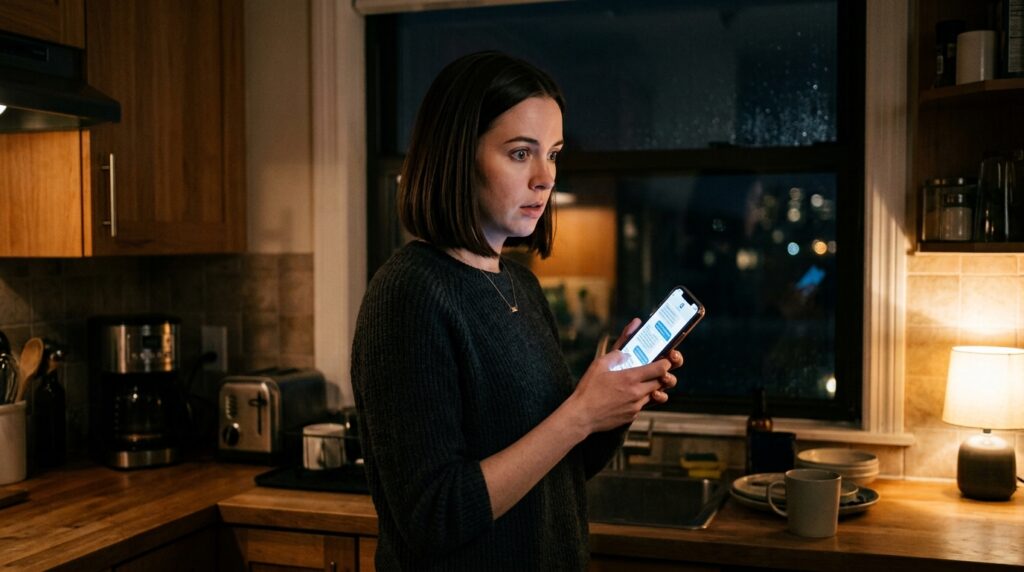
That night I finally said the word out loud to myself: control. Not passion, not love, not “he just cares a lot.” Control. And once I named it, I couldn’t unsee it. Every memory I’d filed under romantic reorganized itself under a different heading. The way he’d chosen the restaurant on every date. The way he’d slowly discouraged the two friendships he liked least. The way an ordinary dinner with a college friend had triggered eleven texts of interrogation. None of it had ever been about love. All of it had been about control.
Why It Took So Long to See the Control for What It Was
I’ve asked myself many times why it took six months to name something that, written down like this, seems obvious. Part of the answer is that control rarely presents itself all at once. It’s introduced gradually, in small enough doses that each one feels survivable, even flattering, on its own. Part of it is that our culture still often romanticizes jealousy and possessiveness as evidence of love, which makes it genuinely difficult to distinguish healthy attentiveness from control in the early stages. And part of it, honestly, was that admitting it was control meant admitting I’d have to leave, and I wasn’t ready for that yet.
“I kept waiting for the passion to come back. I didn’t understand yet that the passion and the control had been the same thing the whole time — I’d just given it a nicer name.”
Therapists who work with survivors of controlling relationships often describe a specific moment clients recall — not the worst incident, but the first moment the pattern became undeniable. Mine was standing in that kitchen. For you, it might be a comment from a friend, a canceled plan you didn’t get to make, a rule you suddenly noticed you’d been following without ever agreeing to it. Control tends to have a signature moment like that, if you’re willing to look for it honestly.
What I Wish I’d Known About Control Sooner
If I could hand my earlier self one piece of information, it would be this: real love does not require you to shrink. Genuine partnership can include closeness, even intensity, without demanding that you account for your whereabouts, apologize for your friendships, or manage someone else’s mood as a condition of your own freedom. Control often masquerades as those very qualities — closeness, intensity, devotion — which is exactly why it’s so hard to catch early. Learning to ask, “does this behavior expand my life or shrink it?” became one of the most useful tools I found for telling the difference between passion and control after the fact.
Leaving wasn’t instant. Recognizing the control was the first step, not the last one. It took another two months, several conversations with a therapist, and one honest conversation with the friend I’d had dinner with that night, who told me gently that she’d noticed the control long before I had. She just hadn’t known how to say it without me getting defensive on his behalf — which, it turns out, is another common feature of control: the person inside it often ends up defending the very behavior that’s hurting them.

I’m on the other side of it now, and the clearest marker of how far I’ve come is small and unglamorous: I can go to dinner with a friend and not think about my phone once. That absence of monitoring, of managing someone else’s reaction to my ordinary life, is what freedom from control actually feels like day to day. It’s quieter than I expected. It’s also the thing I’m most grateful for.
Frequently Asked Questions
How can I tell the difference between healthy attentiveness and control in a relationship?
Healthy attentiveness expands your life — it includes your friends, respects your independence, and doesn’t require constant reassurance. Control tends to shrink your world over time, gradually restricting who you see, what you wear, or how freely you move through your own life.
Why does control often feel like passion at the beginning of a relationship?
Control frequently presents itself through behaviors that culturally get read as romantic, like jealousy, constant communication, or wanting to know your whereabouts. Because these behaviors are often framed as evidence of love, it can take time to recognize the underlying pattern of control.
What are common early signs of control in a relationship?
Common early signs include frequent monitoring of your phone or location, discomfort with your friendships, subtle discouragement from spending time with certain people, and emotional withdrawal used to influence your decisions. Individually these can seem minor, but together they often form a pattern of control.
Is it possible for someone exercising control to genuinely believe it’s love?
Often, yes. Many people who exhibit controlling behavior sincerely believe their actions come from love or fear of loss, which doesn’t make the impact any less harmful. Understanding this can help you take the behavior seriously without needing to view the person as intentionally malicious.
What should I do if I recognize control in my own relationship?
Start by naming the pattern honestly to yourself, even before deciding what to do about it. Talking to a trusted friend or a therapist can help you gain outside perspective, since control often works by isolating you from the very people who might notice it first.
If this story sounds familiar, save it for the moment you need to remember what control actually looks like. Share it with someone who might be calling it passion right now. And follow Truthsinside.com for more real stories about the red flags we learn to see too late.
🎵 Music
Maren Lull is a singer-songwriter who writes from the places most people don’t talk about out loud.
Not the dramatic grief. Not the obvious heartbreak. The quiet kind — the ordinary Tuesday emptiness, the habit of reaching for someone who isn’t there anymore, the particular exhaustion of being strong for so long that the strength itself wears thin.
Her music lives at the intersection of emotional honesty and soft beauty — breathy vocals over gentle piano, slow tempos, lyrics that feel less like songs and more like something you wrote in a private notebook at two in the morning and never showed anyone.
Maren Lull writes for the people who feel everything deeply and say very little about it. For the ones who listen to sad music not because they want to feel worse — but because being understood, even by a song, makes the feeling easier to carry.
📱 Follow Maren Lull:
→ Spotify
→ Apple Music
→ Youtube
→ Audiomack