3 Years Together: One Conversation Changed Everything
After 3 years together, most couples believe they already know everything about each other — their coffee order, their childhood scars, the exact tone of voice that means “I’m not actually fine.” But according to relationship researcher Dr. John Gottman, couples often wait an average of six years before addressing a serious relationship problem, quietly letting resentment calcify in the silence. For Maya and Daniel, it took exactly one conversation — on an ordinary Tuesday night, over a cold cup of tea — to unravel three years of unspoken assumptions.
It didn’t start as a big moment. There was no anniversary, no fight, no ultimatum. Maya had simply asked, “Do you ever think about where this is actually going?” It was the kind of question that had been sitting at the bottom of her chest for months, disguised as contentment. Daniel’s answer — quiet, hesitant, and far more honest than either of them expected — became the hinge point of their entire relationship.
This is the story of what happened when two people who had spent 3 years together finally said the things they’d been too afraid to say. It’s also a reminder that longevity in a relationship isn’t proof of depth. Sometimes the most important conversation is the one you’ve been circling for years without realizing it.
The Silence Before 3 Years Together Nearly Ended It
Maya and Daniel met in their late twenties, at a mutual friend’s rooftop dinner in Austin. Their relationship moved with an ease that felt almost suspicious — no dramatic breakups, no on-again-off-again chaos, just a steady, comfortable rhythm. By the time they hit the two-year mark, friends were already asking about rings. By 3 years together, the question had gone from playful to pointed.
But comfort, Maya later admitted, had become a kind of hiding place. “We were so good at being easy with each other that we stopped being honest,” she said. Neither of them wanted to be the one to introduce friction into something that felt, on the surface, so stable. Daniel had unspoken fears about marriage rooted in his parents’ divorce. Maya had unspoken fears about being someone’s second choice, a residue from a previous relationship that had ended in ambiguity rather than closure.
Psychologists call this the “harmony trap” — a pattern where couples mistake the absence of conflict for the presence of intimacy. Research from the Gottman Institute has found that couples who avoid difficult conversations early in a relationship often experience a sharp rise in resentment once life pressures like careers, finances, or family expectations intensify. For Maya and Daniel, 3 years together had built a beautiful surface — and a growing crack underneath it that neither of them had named out loud.
📃 Related article: He Forgave Her: 7 Powerful Reasons Most Men Never Could
What 3 Years Together Really Taught Us About Communication
Looking back, Maya says the warning signs weren’t dramatic. They were small omissions. She’d mention a friend’s engagement and watch Daniel go quiet. He’d change the subject when his mother asked about “future plans.” Neither of them lied to each other — they simply stopped finishing sentences that felt too risky to complete. Over 3 years together, those unfinished sentences accumulated into a quiet distance that neither of them had a name for.
This is a pattern therapists see constantly, and it rarely announces itself as a crisis. Clinical psychologist Dr. Sue Johnson, founder of Emotionally Focused Therapy, has written extensively about how couples create “attachment injuries” — small emotional withdrawals that go unaddressed and slowly erode trust. It isn’t betrayal. It’s avoidance. And avoidance, left unchecked, can do just as much damage as an argument.
By month thirty-four, Maya noticed she had started rehearsing conversations in her head that she never actually had out loud. She’d imagine bringing up marriage, imagine Daniel’s reaction, imagine the fight that might follow — and then say nothing at all, choosing the comfort of not knowing over the risk of an honest answer. It’s a pattern psychologists refer to as “anticipatory avoidance,” and it is one of the most common reasons emotionally intelligent, otherwise communicative couples still end up stuck after 3 years together.
“We were so good at being easy with each other that we stopped being honest.” — Maya
The Conversation That Changed Everything After 3 Years Together
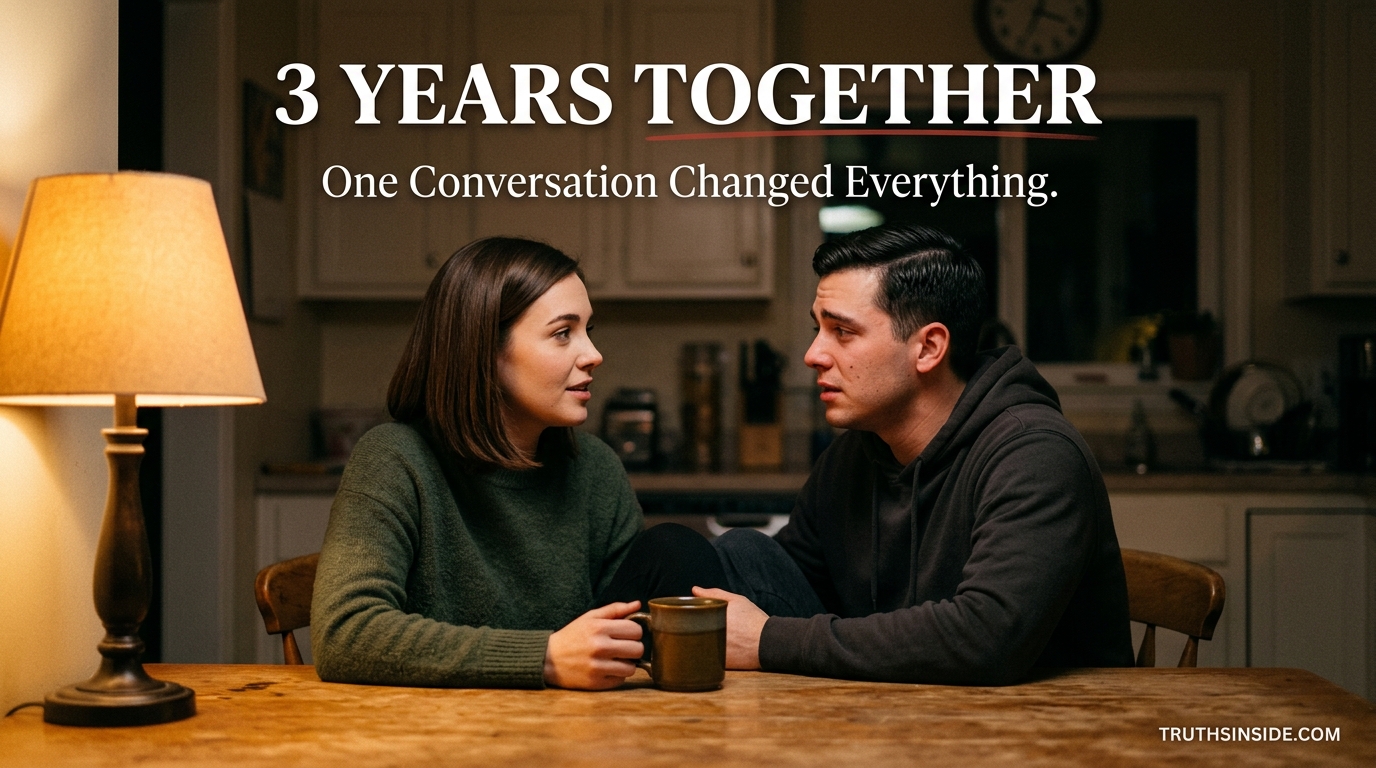
The night itself started unremarkably. Maya had come home from a wedding shower, emotionally raw from watching a friend get engaged, and Daniel could tell something was sitting heavy on her. Instead of asking “what’s wrong,” which usually got a deflecting “nothing,” he tried something different. He said, “You’ve been quiet since you got home. I don’t want to guess — can you just tell me?”
That small shift — from assumption to invitation — was enough to crack the surface. Maya asked the question she’d been avoiding for what felt like all 3 years together: “Do you ever think about where this is actually going?” The silence that followed felt enormous. Daniel didn’t answer right away, and for a moment, Maya assumed the worst.
But what came next surprised her. Daniel admitted he thought about their future constantly — and that his silence hadn’t been indifference, but fear. He told her about watching his parents’ marriage collapse when he was twelve, and how he’d quietly promised himself he would never propose to someone unless he was completely certain it wouldn’t end the same way. He hadn’t voiced this fear because he worried it would sound like he doubted her. In reality, he doubted himself.
For the first time in 3 years together, they weren’t performing stability. They were sitting in the mess of it — the fear, the history, the things neither of them had said because they were terrified of what saying them might change. According to relational researcher Brené Brown, vulnerability isn’t a weakness in relationships; it’s “the birthplace of connection.” That night, in their kitchen, over a cold cup of tea, that theory stopped being an abstraction and became something they lived.
“I hadn’t voiced this fear because I worried it would sound like I doubted her. In reality, I doubted myself.” — Daniel

Signs Your Relationship Needs This Conversation Too
Maya and Daniel’s story isn’t rare — it’s strikingly common among couples who reach 3 years together without ever having a direct conversation about long-term compatibility. Relationship therapists point to several signals that a couple may be avoiding, rather than resolving, an important conversation:
You change the subject when future plans come up. If mentions of marriage, moving in together, or long-term goals consistently get redirected to lighter topics, it’s often a sign that both partners sense unresolved tension underneath.
You feel calm on the surface but anxious underneath. Many couples describe feeling “fine” day-to-day while privately rehearsing worst-case scenarios about the relationship’s future. This gap between outward calm and internal anxiety is one of the clearest signs of avoidance.
You know facts about your partner’s past but not their fears. After 3 years together, most couples know each other’s biography. Fewer know each other’s active fears — the things their partner is currently afraid of, not just what happened to them years ago.
You assume you know the answer, so you never ask the question. Maya assumed Daniel wasn’t ready. Daniel assumed Maya wanted certainty he couldn’t give. Both assumptions were wrong, and both were built entirely on silence rather than conversation.
📃 Related article: Almost Lost Her Over Something Small — 5 Hard Lessons
How to Have Your Own “3 Years Together” Conversation
If you recognize any of these patterns, therapists suggest starting small rather than staging a dramatic sit-down. Maya and Daniel’s turning point didn’t come from a scheduled “relationship talk” — it came from Daniel simply naming what he observed and inviting Maya to fill in the rest, rather than guessing.
Experts recommend leading with observation instead of accusation. Instead of “why won’t you talk about the future,” try “I’ve noticed we don’t talk about the future much — can we?” This small linguistic shift lowers defensiveness and opens space for honesty rather than confrontation.
It also helps to name the fear behind the silence, not just the silence itself. Daniel’s breakthrough wasn’t simply admitting he thought about marriage — it was explaining why he’d been afraid to say so. Couples who reach 3 years together and beyond often find that naming the “why” behind avoidance does more to rebuild trust than the initial disclosure alone.

Where Maya and Daniel Are Now
Six months after that conversation, Maya and Daniel are engaged — not because the conversation magically resolved every fear, but because it gave them a shared language for the fears that remained. Daniel still gets quiet sometimes when his parents’ divorce comes up, but now Maya knows why, and she no longer interprets his silence as distance. Maya still occasionally spirals into worst-case thinking, but now she says so out loud instead of performing calm.
Their story is a reminder that 3 years together isn’t a milestone that automatically produces depth — it’s simply time. What actually deepens a relationship is the willingness to interrupt comfortable silence with honest, sometimes uncomfortable, questions. As Maya put it months later, “We didn’t need three more years to figure it out. We just needed one real conversation.”
Couples counselors often note that timing matters less than people think. Some couples have this conversation at six months; others, like Maya and Daniel, reach 3 years together before circumstances force the question into the open. What matters isn’t when the conversation happens — it’s whether it happens at all, before resentment quietly does the talking instead.

Frequently Asked Questions
How do you know when it’s time to have “the future” conversation?
Most therapists agree the right time isn’t tied to a specific milestone like 3 years together — it’s tied to noticing patterns of avoidance, like changing the subject or feeling anxious underneath outward calm.
What if my partner shuts down when I bring up the future?
Leading with observation rather than accusation, as Daniel did, tends to lower defensiveness. Naming what you’ve noticed, rather than demanding an answer, often opens the door more gently.
Is it normal to feel scared to ask about the relationship’s future?
Yes. Fear of the answer is one of the most common reasons couples avoid this conversation, even after 3 years together. The fear itself doesn’t mean something is wrong — it means the conversation matters.
Does having this conversation guarantee the relationship will work out?
No, and it shouldn’t be framed that way. What it guarantees is clarity — an honest shared understanding of where both people stand, which is a healthier foundation than comfortable silence.
What if we’ve been together even longer than 3 years and still haven’t had this talk?
It’s never too late. Many couples together for five, ten, or more years still benefit from finally naming the fears and assumptions they’ve been silently carrying.
If this story resonated with you, save it for later, share it with someone who needs to hear it, and follow Truthsinside.com for more real relationship stories.
🎵 Music
Maren Lull is a singer-songwriter who writes from the places most people don’t talk about out loud.
Not the dramatic grief. Not the obvious heartbreak. The quiet kind — the ordinary Tuesday emptiness, the habit of reaching for someone who isn’t there anymore, the particular exhaustion of being strong for so long that the strength itself wears thin.
Her music lives at the intersection of emotional honesty and soft beauty — breathy vocals over gentle piano, slow tempos, lyrics that feel less like songs and more like something you wrote in a private notebook at two in the morning and never showed anyone.
Maren Lull writes for the people who feel everything deeply and say very little about it. For the ones who listen to sad music not because they want to feel worse — but because being understood, even by a song, makes the feeling easier to carry.
📱 Follow Maren Lull:
→ Spotify
→ Apple Music
→ Youtube
→ Audiomack