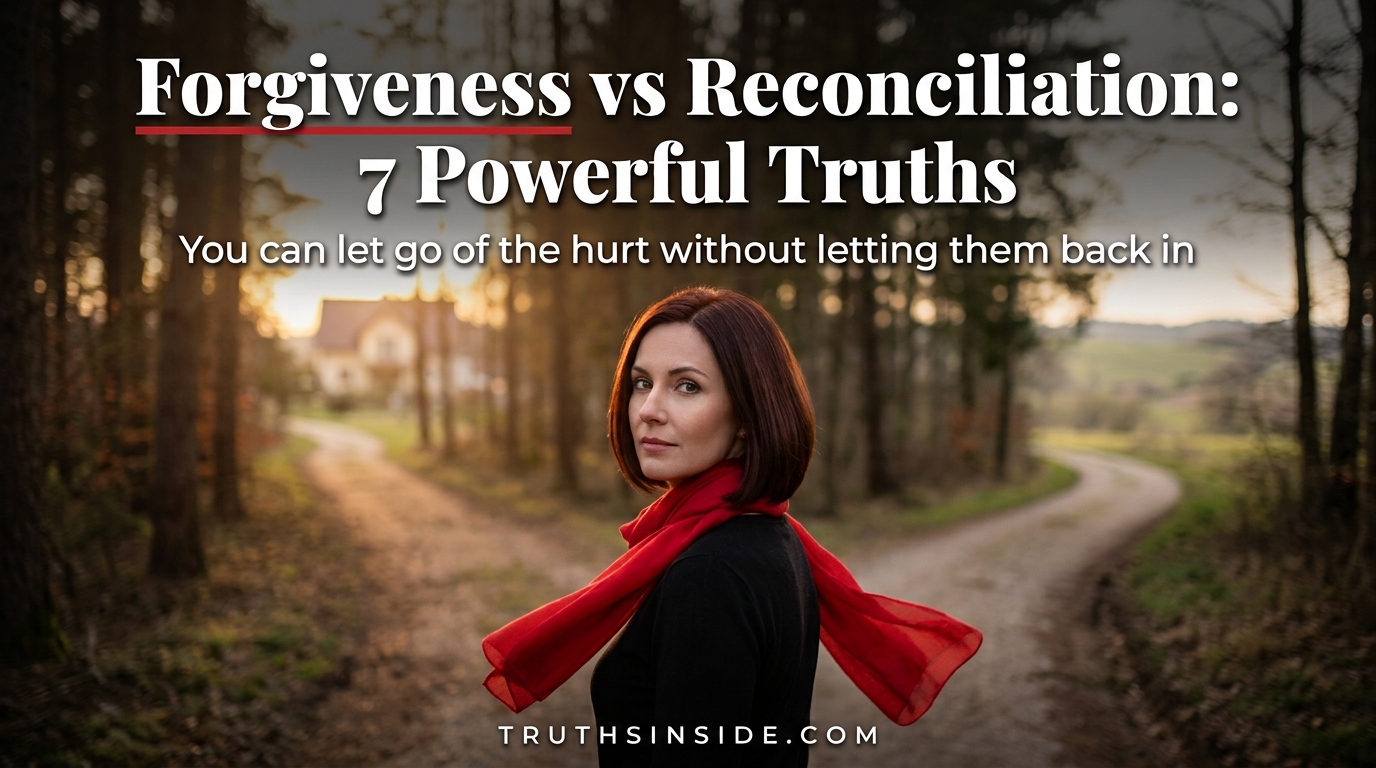
Forgiveness vs. Reconciliation: You Don’t Have to Do Both
Forgiveness vs reconciliation is one of the most painful confusions in love. Someone hurts you, and suddenly everyone around you has an opinion: “Just forgive and move on,” or “If you really forgave him, you would take him back.” You end up feeling guilty for staying hurt and guilty for wanting distance. If that sounds familiar, you are not being stubborn. You are being asked to do two different things as if they were one.
Researchers have been separating them for decades. Psychologist Everett Worthington, a leading forgiveness scientist, describes forgiveness as something that happens inside one person, a change in how you feel and think about the offense. Reconciliation, by contrast, is the restoration of a relationship, and it requires trust to be rebuilt by both people. Understanding forgiveness vs reconciliation can lift a weight you did not know you were carrying.
In this guide, you will learn how forgiveness vs reconciliation differ, seven truths that make the choice clearer, four paths you can take, questions to ask before letting someone back in, and what to do when it is not safe to reconcile at all.

What Is the Difference Between Forgiveness vs Reconciliation?
Forgiveness is an inner process. It means releasing the grip that resentment, bitterness, and the wish for revenge have on you. You can do it alone, in your own time, without the other person even knowing. Robert Enright, another pioneer of forgiveness research, describes it as a choice to offer goodwill to someone who wronged you, even though they may not deserve it.
Reconciliation is a shared process. It means restoring a relationship so that two people can be close again, and that takes more than one person’s decision. The one who caused harm has to take responsibility and change. The one who was hurt has to feel safe enough to trust again. If either piece is missing, reconciliation cannot honestly happen.
The easiest way to hold the difference in forgiveness vs reconciliation is this: forgiveness is something you give, and reconciliation is something you build together. You can give a gift without anyone agreeing to build anything. That is why forgiveness can be complete even if the relationship ends, and why reconciliation can sometimes begin before forgiveness feels finished.
📃 Related article: Intercultural Relationships: 7 Shocking Red Flags
Why Forgiveness vs Reconciliation Gets So Confused
The confusion has deep roots. Many of us grew up hearing “forgive and forget,” as if the two actions were one. Faith traditions often stress forgiveness, and well-meaning relatives may assume that forgiving means welcoming someone back to the table. Social pressure can make saying “I forgive you” feel like signing a contract you never agreed to.
The word itself adds to the problem. In everyday speech, “making up” blends both ideas: you stop being angry and you go back to normal. But the two parts move at different speeds. Anger can soften quickly while trust takes months. Or you may have no anger left and still know the relationship cannot return to what it was.
Knowing the difference in forgiveness vs reconciliation also protects you from manipulation. Some people use a quick “forgive me” to skip accountability, and some use your forgiveness as proof that you have agreed to stay. When you know that forgiving is not the same as returning, you can keep your compassion without losing your boundaries.
You can open your heart without reopening the door.
7 Truths About Forgiveness vs Reconciliation
These seven truths come from research on forgiveness, from couples therapy, and from the stories people tell after the worst moments of their lives. Take what fits your situation, and leave the rest.
1. Forgiveness Happens Inside You. Reconciliation Needs Two People.
The first truth in forgiveness vs reconciliation is about who is involved. You can forgive alone on a walk, in a journal, or in a therapist’s office. Nobody else has to participate. Reconciliation, on the other hand, cannot be done solo. If the other person is unwilling, unsafe, absent, or no longer alive, reconciliation is not available, but forgiveness still is.
This matters because many people wait years for an apology that never arrives, thinking they cannot heal until it does. They can. Your peace does not need to be hostage to another person’s willingness.
2. You Can Forgive Someone Who Never Apologizes
An apology makes forgiveness easier, but it is not a requirement. Forgiveness is your release, and it can happen without their words. What changes without an apology is reconciliation, because without ownership of the harm, there is nothing solid to rebuild on.
Be gentle about what this means. Forgiving someone who never says sorry does not mean pretending they were right. It means deciding that you will no longer let the offense run your life. In forgiveness vs reconciliation, this is the clearest example of how the two can separate.
3. Reconciliation Requires Safety and Accountability
Reconciliation is not a feeling. It is a process with conditions. The person who caused harm needs to name what they did, show real remorse, and change their behavior over time. Relationship researcher John Gottman describes repair after betrayal in three phases: atone, attune, and attach. The first step belongs to the person who caused the harm.
Without accountability, reconciliation becomes a loop: harm, apology, brief peace, harm again. If you see the loop, remember that forgiveness vs reconciliation can be answered separately. You can forgive and still decline to return to a pattern that keeps hurting you.
4. Trust Is the Bridge Between the Two
Worthington is fond of the line that forgiveness is granted, while trust is earned. That gap is where most of the pain lives. You might sincerely forgive your partner and still feel your stomach drop when their phone buzzes. That does not mean your forgiveness is fake. It means trust is a different muscle, and it rebuilds only through consistent behavior over time.
If you are weighing forgiveness vs reconciliation, look for small proofs, not grand promises: showing up when they say they will, telling the truth when it is uncomfortable, and respecting your boundaries without argument. Forgiveness vs reconciliation is, in many ways, a question of whether trust has been earned.
5. You Can Reconcile Without Fully Forgiving Yet
Sometimes life requires you to stay in contact before the healing is done. You may share children, a workplace, a family, or a home. In those cases, a limited reconciliation, such as polite cooperation or structured communication, can exist while forgiveness is still unfolding.
This is not hypocrisy. It is realism. Many people move through forgiveness slowly, and a functional relationship does not have to wait for perfect peace. Just be honest with yourself and the other person about what kind of reconciliation you are offering. Cooperation is not closeness, and that nuance is part of forgiveness vs reconciliation.
6. Forgiving Someone Does Not Mean You Owe Them Access
Access to you is a privilege that trust earns, not a debt that forgiveness creates. You can forgive an ex and decline their calls. You can forgive a parent and keep a distance. You can forgive a friend and no longer share your secrets.
This is the truth that gives many people the most relief when thinking about forgiveness vs reconciliation. You are allowed to wish someone well and still choose that they are not part of your daily life. Boundaries are not a failure of compassion. They are how compassion stays sustainable.
7. Choosing One Does Not Make You a Bad Person
If you forgive and reconcile, you are not weak. If you forgive and leave, you are not cold. If you cannot yet do either, you are not failing. Each of these is a valid response to deep hurt, and the right one depends on safety, the pattern of behavior, your values, and what you need to heal.
Be wary of anyone who says there is only one moral answer. Decide each on its own merits, at your own pace, with support from people who care about your wellbeing.

Four Paths Through Forgiveness vs Reconciliation
Because the two are separate, forgiveness vs reconciliation gives you four possible paths. Seeing them laid out can make the decision feel less like an all-or-nothing trap.
- Forgive and reconcile: You release resentment, and the relationship is rebuilt with accountability, new agreements, and time. This works best when the harm was not ongoing and both people are committed to change.
- Forgive and part ways: You let go of the hurt but decide the relationship cannot or should not continue. Many people experience this as the most peaceful ending.
- Reconcile without full forgiveness: You keep a functional relationship, perhaps as co-parents or colleagues, while forgiveness continues to develop.
- Neither yet: You are still in the thick of it. You do not have to decide today. Waiting is a legitimate choice, not a failure.
None of these paths is the “correct” one. In forgiveness vs reconciliation, the best choice is the one that protects your safety, honors your values, and lets you heal.
Questions to Ask About Forgiveness vs Reconciliation
If you are considering letting someone back in, slow down and ask yourself honest questions. These can help you separate hope from evidence:
- Have they named exactly what they did, without minimizing or blaming me?
- Have they shown remorse through changed behavior, not just words?
- Do I feel physically and emotionally safe around them?
- Is the harmful pattern over, or only paused?
- Am I choosing this freely, or out of fear, guilt, loneliness, or pressure?
- Are they willing to accept my boundaries and consequences without anger?
- Would I advise a friend in my situation to do the same thing?
If most of your answers are yes, reconciliation may be worth exploring, ideally with a couples therapist trained in betrayal and repair. If several answers are no, you can still honor forgiveness vs reconciliation by forgiving internally while keeping your distance.
When Forgiveness vs Reconciliation Is Not Safe to Combine
Some situations call for forgiveness at most, and never for reconciliation. If someone has been physically violent, sexually coercive, stalking you, threatening you, or controlling your money, movements, or contacts, safety must come first. Reconciliation in those situations can put you in real danger, and pressure to “forgive and go back” is a common tactic that keeps people trapped.
Forgiveness in these cases, if you choose it, is a private act of freeing yourself from carrying the other person’s harm. It does not require contact, a conversation, or a second chance. You are allowed to heal from a distance.
If you are in an unsafe relationship, the National Domestic Violence Hotline is available at 1-800-799-7233, or you can text START to 88788. If you are in immediate danger, call 911. An advocate can help you plan safely, and you do not have to decide anything about forgiveness vs reconciliation before you are safe.
How to Talk About Forgiveness vs Reconciliation
Sometimes the hardest part is finding words. Clear, kind language can prevent misunderstandings and protect your boundaries. Here are a few phrases you can adapt:
- When you forgive but are not reconciling: “I have let go of my anger, and I wish you well. I am not ready to be close again.”
- When you need more time: “I am working on forgiving you, but I need time and space before I can talk about us.”
- When you are open to reconciling with conditions: “I would be willing to try again if we go to counseling and you agree to full honesty.”
- When someone pressures you: “I hear that you want this to be over. My healing has its own pace.”
Notice that none of these scripts demand agreement. A person who respects you can accept a boundary even when they dislike it.
Pressure From Family, Faith, and Friends
Outside voices can make forgiveness vs reconciliation harder. A parent may say, “Family is family.” A friend may say, “He has changed.” A faith community may emphasize forgiveness and imply that distance is unforgiving. These messages usually come from love or discomfort, but they can leave you feeling cornered.
They may not see the full pattern, and they will not carry the consequences of your choice. Thank them for caring, and then protect your decision with a simple sentence: “I appreciate your concern. I have forgiven what I can, and I am deciding the rest at my own pace.”
Many faith teachers also draw this distinction, noting that forgiveness releases resentment while restoring trust depends on repentance and change.
📃 Related article: Forgive Your Partner: 7 Proven Steps to Heal
Forgiveness vs Reconciliation When You Share Children
Co-parenting can make the line blurry. You may need to communicate with someone you have not reconciled with, and that is possible. Many separated parents forgive their former partner for the sake of their own peace and keep a structured, respectful relationship focused entirely on the children.
Practical tools can help: communication through a shared app, clear schedules, short and factual messages, and a firm rule that old arguments do not belong in child-related conversations. Forgiveness vs reconciliation is not a barrier to good co-parenting, and forgiving internally can lower the tension children feel.
Healing When You Choose Forgiveness Without Reconciliation
Choosing to forgive and walk away can feel strangely lonely. There may be no dramatic closure, no conversation that ties everything together. Instead, you may find yourself grieving the relationship you hoped for, even while you feel clear about the decision.
Give the grief space. You can mourn what you lost and still know your decision is right. Rituals can help, like writing a letter you do not send or sharing your story with a therapist. Signs of healing include replaying the hurt less often, talking about it without shaking, and choosing based on your values rather than your anger.
Forgiveness frees your heart. Reconciliation is a separate decision that has to be earned.

FAQ: Forgiveness vs Reconciliation
What is the main difference between forgiveness vs reconciliation?
Forgiveness is an inner process of releasing resentment and the desire for revenge, and it can be done alone. Reconciliation is the rebuilding of a relationship, which requires trust, accountability, and willingness from both people. You can forgive without reconciling, but you cannot truly reconcile alone.
Can I forgive someone and still cut them off?
Yes. Forgiveness vs reconciliation are separate choices, so you can let go of anger and still decide not to keep the person in your life. Many people find this the healthiest outcome, especially when the harm was serious or repeated.
Does forgiving someone mean I have to forget what happened?
No. Remembering can protect you. Forgiveness means the memory no longer controls your emotions or choices, but you can still use what you learned to set boundaries and make wiser decisions.
How do I know if I am ready to reconcile?
Look for evidence, not promises: honest ownership of the harm, consistent changed behavior over time, respect for your boundaries, and a feeling of safety around the person. If you feel pressured, fearful, or unsure, it is reasonable to wait or to decide against it.
Is it okay to forgive someone who is still hurting me?
Forgiveness is your choice, but your safety comes first. If the harm is ongoing, reconciliation is not advisable, and staying in contact may be dangerous. A licensed therapist or domestic violence advocate can help you plan, and forgiveness can wait until you are safe.
Final Thoughts
Forgiveness vs reconciliation is not a test of how good a person you are. It is a decision about how you want to carry what happened and who you want beside you as you move forward. You can forgive and stay, forgive and go, or take all the time you need. What matters most is that your choice protects your safety, honors your values, and lets you breathe again.
Save this article for the day someone pressures you to “just forgive.” Share it with a friend who is torn between letting go and letting someone back in. Follow Truthsinside.com for more honest insight into relationships and psychology.
🎵 Music
Maren Lull is a singer-songwriter who writes from the places most people don’t talk about out loud.
Not the dramatic grief. Not the obvious heartbreak. The quiet kind — the ordinary Tuesday emptiness, the habit of reaching for someone who isn’t there anymore, the particular exhaustion of being strong for so long that the strength itself wears thin.
Her music lives at the intersection of emotional honesty and soft beauty — breathy vocals over gentle piano, slow tempos, lyrics that feel less like songs and more like something you wrote in a private notebook at two in the morning and never showed anyone.
Maren Lull writes for the people who feel everything deeply and say very little about it. For the ones who listen to sad music not because they want to feel worse — but because being understood, even by a song, makes the feeling easier to carry.
📱 Follow Maren Lull:
→ Spotify
→ Apple Music
→ Youtube
→ Audiomack