How Your Parents’ Relationship Became Your Template for Love
Your template for love was drawn long before your first crush. You may never have sat down and decided how to argue, how to show affection, or what a “normal” marriage looks like. You absorbed it at the dinner table, in the hallway outside a closed door, and in the quiet gaps between what your parents said and what they did. If you have ever caught yourself saying something your mother or father would say, you already know how deep this goes.
The science supports that feeling. Psychologist Albert Bandura’s work on observational learning showed that children learn powerfully by watching the people closest to them. Attachment researchers following people from infancy into adulthood, including the Minnesota Longitudinal Study led by Alan Sroufe and colleagues, have found that early caregiving experiences help predict how people later function in romantic relationships. Your parents’ relationship was your first, longest, and most detailed lesson in how love works.
In this guide, you will learn how your template for love forms, seven ways it shows up in adult relationships, what happens when your parents’ example was healthy, painful, or missing, and how to rewrite the parts that no longer serve you.
What Is a Template for Love?
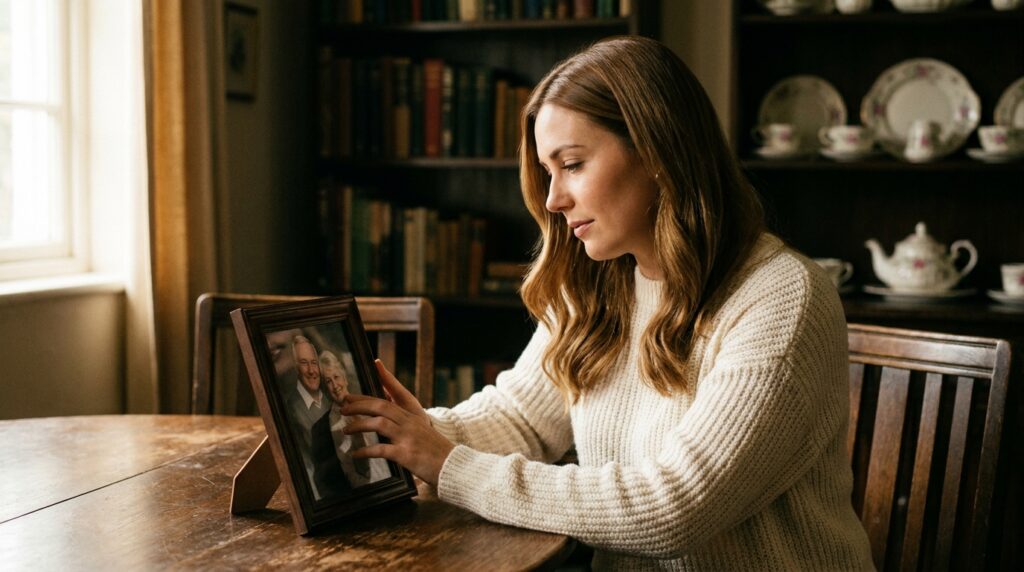
A template for love is the set of beliefs, expectations, and habits about romantic relationships that you formed in childhood, mostly by watching the adults around you. It includes the big questions: Is love safe or risky? Do people stay or leave? Do conflicts end in repair or in silence? Who gives, who takes, and who decides? You answered these long before you could put them into words.
Psychiatrist John Bowlby called the mental version of this an internal working model, a set of expectations about yourself and other people built from your earliest relationships. Later researchers added that children also learn from the relationship between their caregivers, not only from how those caregivers treat the child. When parents show warmth, respect, and repair, a child gains a template for love in which closeness is safe. When they show contempt, coldness, or chaos, the child learns something very different.
Importantly, a template for love is not a destiny. It is a starting draft. It shapes your instincts, but it does not decide your choices, and it can be revised at any age.
📃 Related article: Forgiveness vs Reconciliation: 7 Powerful Truths
How Your Parents’ Relationship Becomes Your Template for Love
Several processes work together to turn childhood observations into adult patterns. The first is modeling. Children copy what they see. If you watched your parents talk through disagreements, you learned that conflict can be survived. If you watched one of them storm out and the other go silent, you learned that a different script exists.
The second is emotional security. Psychologists Patrick Davies and E. Mark Cummings developed emotional security theory to explain how conflict between parents affects children. Their research suggests that it is not conflict itself that harms most, but how it is expressed and resolved. Children who see anger, threats, or withdrawal without repair can come to feel that relationships are unstable. Those who see disagreement followed by reconciliation learn that love can bend without breaking.
The third is repetition. Sigmund Freud called it the repetition compulsion, and modern clinicians describe a gentler version: we gravitate toward the familiar because it feels like home, even when home was difficult. Murray Bowen’s family systems theory adds that patterns can pass through generations, often unnoticed. This is how your template for love can quietly steer your choices.
You did not choose your first lessons in love. You can choose what you do with them.
7 Ways Your Template for Love Shows Up in Adult Relationships
Every family is different, and these patterns can look very different from one person to the next. Read them with curiosity rather than blame, and notice which ones feel familiar.
1. How You Handle Conflict
Your first lessons in arguing came from watching your parents. If they shouted and then made up, you may be comfortable with loud disagreements. If they avoided every difficult topic, you may feel panic when a partner raises a problem. If one parent dominated and the other gave in, you might find yourself playing one of those roles.
Gottman’s research on couples identifies patterns like criticism, defensiveness, contempt, and stonewalling as warning signs. Many people discover that these were the very patterns their parents used. Your template for love shows up the moment a disagreement starts, often before you have chosen a response.
2. How You Give and Receive Affection
Some homes were full of hugs and spoken love. Others showed care through actions, like packed lunches and fixed cars, with few words. Some homes offered little affection at all. Whatever you saw becomes your idea of what love looks and sounds like.
If your parents rarely said “I love you,” you might feel uneasy when a partner says it often, or you might assume love is absent if it is not spoken. If affection was constant, you might feel lost when a partner shows love differently. Noticing this helps you see that your template for love is one style among many, not the only valid one.
3. The Roles You Slip Into
Parents often divide roles: the planner and the dreamer, the one who handles money and the one who handles emotions, the peacemaker and the enforcer. Children absorb these divisions, including the unspoken rules about gender. As an adult, you may automatically take on a role you never agreed to.
You might become the caretaker who manages everyone’s feelings, the provider who feels worthless without achievement, or the one who withdraws to avoid being controlled. These roles are not wrong in themselves, but they feel strange to question because they came from your template for love.
4. What You Believe Love Costs
Did your parents sacrifice constantly for each other, or for the family? Did one person give up their dreams? Did love seem to require suffering, silence, or loyalty at all costs? The lessons you absorbed about what love demands can follow you into adulthood.
Some people learn that love means self-sacrifice, so they overgive and burn out. Others learn that love means losing control, so they hold back. Both are responses to a template for love that taught them closeness has a price.
5. How You Handle Power, Money, and Chores
Who made decisions in your home? Who controlled the money? Who did the invisible work of managing schedules, remembering birthdays, and cleaning up? Children notice these dynamics even when no one discusses them.
In adulthood, you may repeat your parents’ arrangement without realizing it, or rebel against it so strongly that you cannot cooperate. Conversations about fairness, money, and household labor often become painful because they touch your template for love and not just the dishes.
6. What You Expect After a Fight
Perhaps the most important question is what happened after conflict. Did your parents apologize, hug, or talk it through? Or did they leave the tension in the air for days, pretending it was over? Did one of them punish the other with silence?
Repair is a skill children learn by watching. If you never saw it, apologizing may feel unnatural, and you might expect every fight to threaten the relationship. If you did see it, you probably trust that rupture can lead to reconnection. Your template for love holds your beliefs about whether love survives conflict.
7. What Feels “Normal,” Even When It Is Not Healthy
The most powerful effect of any template for love is that it defines what feels normal. If your home was calm and respectful, a loud or controlling partner may feel alarming. If your home was unpredictable, a steady partner may feel boring, and a volatile one may feel like chemistry.
This is why people sometimes repeat patterns they swore they would avoid. Familiarity is not the same as safety, but the nervous system often treats it that way. Recognizing the difference is one of the most freeing steps in changing your template for love.

When Your Parents’ Relationship Was Painful
If your parents fought constantly, were cold, cheated, or separated bitterly, your template for love may be built around protection. You might expect betrayal and watch for signs of leaving. You might avoid conflict at all costs, or pick fights to test whether someone will stay. Some people vow never to love anyone, while others rush into relationships hoping to finally get the love they missed.
Research on the intergenerational transmission of divorce suggests that people whose parents divorced are somewhat more likely to divorce themselves, but the link is not destiny. Studies point to factors such as communication skills, commitment, and conflict habits as important in why the pattern repeats. Those are skills, and skills can be learned.
If your childhood involved abuse or serious violence, please know that what happened was not your fault, and that professional support can make a real difference. A licensed trauma-informed therapist can help you understand how those experiences shape your relationships today. In the United States, the National Domestic Violence Hotline is available at 1-800-799-7233, or by texting START to 88788.
When Your Parents’ Relationship Looked Perfect
A healthy example is a gift, but it can come with its own challenges. If your parents seemed flawless, you might believe that real love never involves conflict, and feel like a failure when your own relationship has hard moments. You may also feel pressure to live up to an ideal that you never saw behind the scenes.
Remember that children see only part of their parents’ relationship. Even strong couples argue, struggle, and repair, often out of sight. If your template for love is largely positive, you may have an advantage in trust and communication, but it still helps to talk openly about the differences between your upbringing and your partner’s.
📃 Related article: Fantasy in Love: 7 Powerful Ways It Helps or Hurts
When There Was No Example at All
Some people grew up with a single parent, in foster care, with grandparents, or in a home where partnership was not visible. Others lost a parent early. If you did not see a romantic relationship up close, your template for love may have come from other places: television, friends’ families, books, or imagination.
This is not a deficit. Many people in this position become thoughtful about love because they had to build their picture deliberately. Look at the relationships you admired, such as a teacher, a neighbor, or a grandparent, and ask what they got right. Any caring adult in your childhood can contribute to your template for love, and you can add new models at any age.
Why Siblings Can Have Different Templates for Love
Two children raised in the same home can walk away with different lessons. Birth order, temperament, and the way each child was treated all matter. One sibling may become the peacemaker who tries to fix every argument, while another becomes the rebel who learns to stay away from them. A parent may also have treated a daughter and a son differently, passing along different expectations about love.
This is why you may remember your parents’ relationship differently from your brother or sister. Neither memory is wrong. Each of you built a template for love from your own position in the family, and that perspective shapes the version you carry.
How to Rewrite Your Template for Love
Changing an old template takes patience, but it is entirely possible. Psychologist Mary Main described “earned security,” the pattern in which adults with difficult childhoods develop secure ways of relating by making sense of their past and experiencing safe relationships. These steps can help:
- Map your family’s patterns. Write down how your parents handled conflict, affection, money, and repair. Note what you admired and what you hope to change.
- Spot your triggers. When you react more strongly than the moment deserves, ask yourself, “Whose voice is this?” The answer often points to an inherited script.
- Choose what you keep. Not everything you learned is harmful. Keep the loyalty, humor, or generosity you saw, and let go of the rest.
- Learn new skills. Study healthy communication, repair, and boundary-setting. Books, workshops, and couples therapy can teach what you never saw.
- Seek new models. Spend time with couples whose relationships you respect, and notice how they handle disagreements.
- Talk with your partner. Share what you learned about love growing up and ask about theirs. When two templates meet, naming them turns arguments into curiosity.
- Consider therapy. Approaches such as schema therapy, developed by Jeffrey Young, and attachment-based therapy help people identify and change deep patterns.
Your parents handed you a first draft. You are allowed to be the editor.
A Quick Exercise to Understand Your Template for Love
Set aside twenty minutes and a notebook. Answer these questions honestly, without judging yourself:
- What did my parents do when they disagreed? What did they do afterward?
- How did they show affection, and how often?
- Who made decisions, and how did the other person respond?
- What did I learn about what love costs?
- What did I promise myself I would never do in my own relationship?
- Where do I see my parents’ patterns in my own relationships, for better and for worse?
Read your answers aloud or share them with a trusted friend or therapist. Often, writing them down reveals connections you had never noticed. The goal is not to blame your parents, but to see your template for love clearly enough to choose differently.

FAQ: Template for Love
What is a template for love in psychology?
It is the set of beliefs and habits about relationships that you formed in childhood, largely by watching your parents or caregivers. Psychologists describe related ideas such as internal working models and attachment styles. Your template for love influences how you handle conflict, show affection, and choose partners.
Do I automatically repeat my parents’ relationship?
No. Research suggests that childhood patterns influence adult relationships, but they do not decide them. Awareness, new skills, supportive partners, and therapy can all change your template for love. Many people consciously build relationships that look very different from the ones they grew up with.
Why am I attracted to people like my parent?
Familiarity often feels like chemistry. If your early relationships involved distance, criticism, or unpredictability, your nervous system may read those qualities as home. Understanding this helps you pause and ask whether you are attracted to the person or to the pattern.
Can a good relationship fix a difficult template?
Often it helps. Safe, consistent relationships can gradually teach your nervous system that love can be calm and trustworthy. Therapy, supportive friends, and a patient partner all contribute to rewriting your template for love over time.
How long does it take to change my template for love?
There is no fixed timeline. Many people notice small shifts within months, such as catching old reactions faster, while deeper change can take years. Progress usually looks like pausing before you react, repairing sooner, and trusting yourself more.
Final Thoughts
Your parents did not hand you a perfect blueprint, because no one has one to give. They handed you what they knew, through the example of their own relationship, and you absorbed it without ever being asked. Seeing your template for love clearly is not about blame. It is about choice. You can keep what is good, repair what is broken, and build something new for the person you love and for yourself.
Save this article for the days when old patterns feel loud. Share it with someone who is learning to love differently from how they were raised. Follow Truthsinside.com for more honest insight into relationships and psychology.
🎵 Music
Maren Lull is a singer-songwriter who writes from the places most people don’t talk about out loud.
Not the dramatic grief. Not the obvious heartbreak. The quiet kind — the ordinary Tuesday emptiness, the habit of reaching for someone who isn’t there anymore, the particular exhaustion of being strong for so long that the strength itself wears thin.
Her music lives at the intersection of emotional honesty and soft beauty — breathy vocals over gentle piano, slow tempos, lyrics that feel less like songs and more like something you wrote in a private notebook at two in the morning and never showed anyone.
Maren Lull writes for the people who feel everything deeply and say very little about it. For the ones who listen to sad music not because they want to feel worse — but because being understood, even by a song, makes the feeling easier to carry.
📱 Follow Maren Lull:
→ Spotify
→ Apple Music
→ Youtube
→ Audiomack