Signs Your Partner Doesn’t Respect You (And What to Do)
When your partner doesn’t respect you, it rarely arrives as one dramatic moment. It arrives as a pile of small ones: the eye roll, the half-listened conversation, the plan changed without asking, the joke that stings. Each one is easy to excuse alone. Together, they teach you to need less, ask for less, and expect less, and that slow shrinking is one of the most common reasons people feel lonely inside a relationship.
When a partner doesn’t respect you, the damage is real. Relationship researcher John Gottman identified contempt, an attitude of superiority expressed through sarcasm, mockery, or eye-rolling, as one of the strongest predictors of relationship breakdown. That finding matters here because a partner who doesn’t respect you is often showing a form of contempt, even when it looks like a harmless habit.
This guide covers seven clear signs your partner doesn’t respect you, why it happens, how to talk about it without starting a war, and what to do if nothing changes. You deserve to be treated as an equal, not as an afterthought.
“Disrespect rarely shouts. It usually shrugs.”
What It Means When Your Partner Doesn’t Respect You
When your partner doesn’t respect you, it helps to define the problem clearly. Respect in a relationship means treating your partner as a whole person: someone whose feelings, opinions, time, and boundaries matter as much as your own. It does not mean agreeing about everything. Two respectful people can disagree strongly and still treat each other with dignity.
So when your partner doesn’t respect you, the problem is not conflict. The problem is how conflict, and everyday life, are handled. Your needs get dismissed. Your boundaries get tested. Your opinions are treated as less valid. Over time, you may feel invisible, nervous about speaking up, or constantly asked to justify yourself.
Disrespect Is Not the Same as a Bad Day
Everyone is sometimes short-tempered, distracted, or thoughtless. One snappy comment after a rough day does not mean your partner doesn’t respect you. What matters is the pattern: how often it happens, whether it is acknowledged, and whether it changes when you raise it. Respectful partners notice and repair. Disrespectful patterns repeat and get defended.
Why Respect Matters So Much
It matters because a partner who doesn’t respect you slowly erodes your confidence. Research on relationship satisfaction consistently finds that feeling valued, understood, and respected is tied to how happy people are together. Respect is the soil that trust, intimacy, and affection grow in. When it is missing, even a relationship full of good memories can start to feel hollow.
📃 Related article: Psychological Reactance: 7 Shocking Ways It Backfires
7 Signs Your Partner Doesn’t Respect You
Read these with honesty and with kindness toward yourself. You are not collecting evidence for a trial. You are listening to what your own experience has been telling you.
Sign 1: They Dismiss or Mock Your Feelings
This is often the first sign your partner doesn’t respect you. “You’re overreacting.” “It’s not a big deal.” “Why are you so sensitive?” When your partner doesn’t respect you, your emotions are treated as an inconvenience. Mockery and eye-rolling are especially harmful. Gottman’s research found that contempt corrodes relationships more than almost any other behavior, because it communicates that you are beneath the other person.
Sign 2: They Ignore Your Boundaries
You say you do not want your phone checked, or that you need an evening to yourself, and the line is crossed anyway, perhaps with a smile or an excuse. A partner who respects you treats “no” as a complete sentence, and a partner who doesn’t respect you treats it as an opening bid. If your partner doesn’t respect you, your boundaries become negotiations, and you end up defending them again and again.
Sign 3: They Interrupt, Talk Over You, or Half-Listen
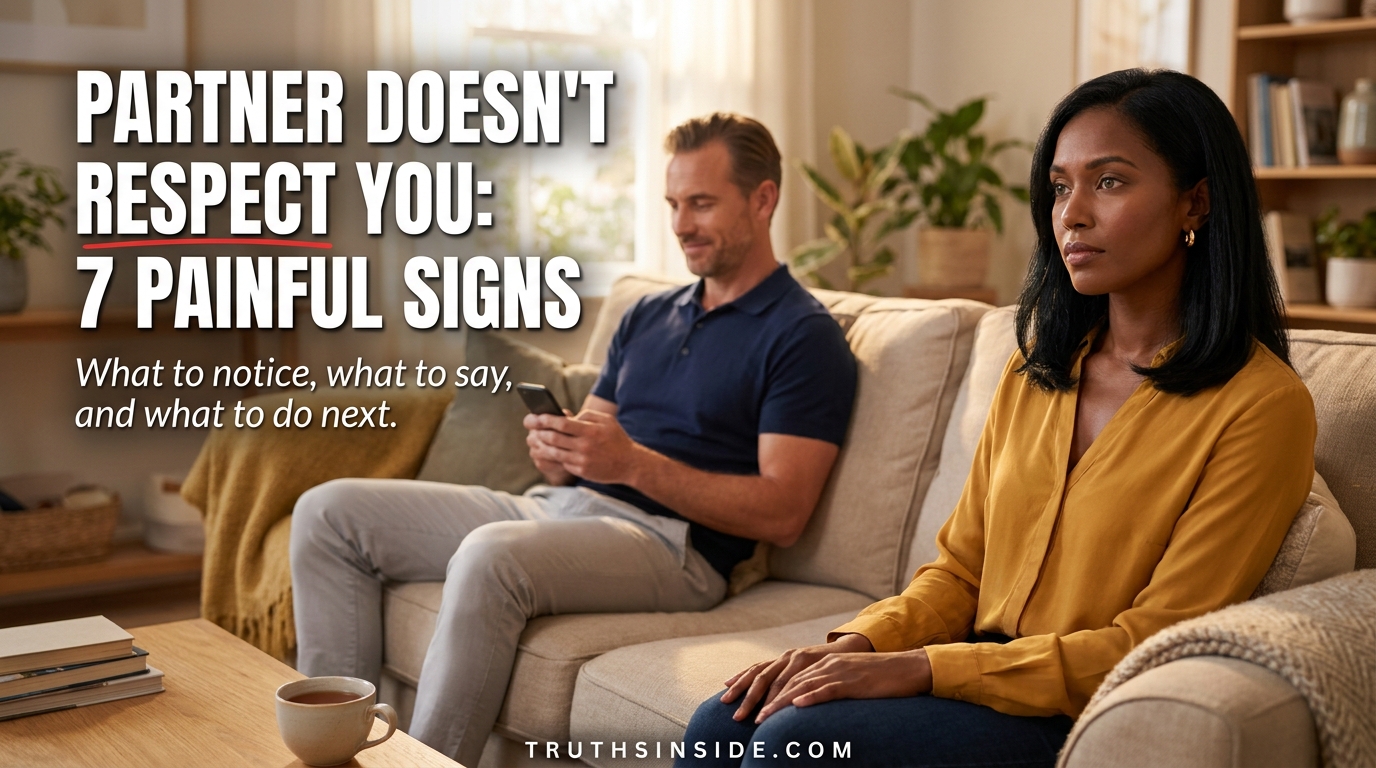
Notice how conversations feel. Do you finish your sentences? Does your partner look up from their phone when you speak? Constant interruption and distracted listening send a message: what I am doing matters more than what you are saying. A partner who doesn’t respect you may not mean to say that, but the message lands anyway.
Sign 4: They Criticize or Embarrass You in Front of Others
A teasing remark about your cooking at a dinner party, a story told at your expense, a correction that makes you smaller. Occasional playful teasing can be fine when both people enjoy it. When your partner doesn’t respect you, the jokes keep landing on the same sore spots, and you are expected to laugh along.

Sign 5: They Make Decisions Without You
It is a sign your partner doesn’t respect you when your voice is skipped. Big or small, plans that affect both of you are made alone: weekend trips, spending, who is invited to the house. You hear about it afterward. When your partner doesn’t respect you, your input is treated as optional, and “we” quietly becomes “I.” Shared decisions are one of the clearest signs of equality in a relationship.
Sign 6: They Break Promises and Disregard Your Time
Another sign your partner doesn’t respect you is how they treat your time. Late without a message, canceled plans, forgotten commitments, and a shrug instead of an apology. Occasional lapses are human. A repeated pattern tells you that your time and trust are cheap. If your partner doesn’t respect you, apologies may be rare, defensive, or turned back on you: “Well, you never said it was important.”
Sign 7: They Control or Belittle Your Choices
Where you go, who you see, how you dress, how you spend money, how you spend your time. A partner who respects you may share an opinion, but they do not try to run your life. If your partner doesn’t respect you, disagreement can turn into criticism, punishment, or the silent treatment when you choose differently.
“Respect is not a feeling they say they have. It is how they treat you when you disagree.”
Why Does Your Partner Not Respect You?
Understanding the reasons does not excuse the behavior, but it can help you respond clearly. In some relationships, a partner who doesn’t respect you learned habits growing up: parents who mocked, ignored, or controlled each other. In others, resentment has built up quietly, and disrespect has become the way anger leaks out.
Sometimes it comes from entitlement, an expectation that their needs come first. Sometimes it comes from stress, insecurity, or simple carelessness. And sometimes the disrespect has been allowed for so long that it became normal. You cannot always know the cause. What you can know is whether the behavior changes when you name it.
Have You Been Teaching Them What Is Okay?
This is a tender question, not a blame. Many people, out of kindness or fear of conflict, let small things pass again and again. Over time, the other person adjusts to what is tolerated. If you notice that you have been accepting less than you want, that is not a failure. It is information, and it means you can start changing the pattern today.
What to Do When Your Partner Doesn’t Respect You
You have more options than silence or a showdown. These steps move from calm conversation to firmer boundaries. Start where it feels right for your situation, and move forward only as needed.
Step 1: Name the Pattern Clearly and Calmly
If your partner doesn’t respect you, start by being specific. Choose a quiet moment. Describe what happened, how it affected you, and what you need. For example: “When you laughed about my mistake in front of our friends, I felt embarrassed. I need us to tease each other only when we both find it funny.” Specific, calm statements are harder to dismiss than general accusations.
Step 2: Set a Boundary and Follow Through
A boundary is not a threat. It is a statement about what you will do. “If you raise your voice, I will leave the room and we can talk when we’re both calm.” Then do exactly that. Boundaries only work when they are consistent. If your partner doesn’t respect you, they will test the first one.
Step 3: Watch What Changes
After you speak up, watch for a few weeks. Does your partner listen, apologize, and try? Or do they get defensive, minimize, or punish you for raising it? Change does not have to be perfect, but real effort should be visible. If your partner doesn’t respect you and nothing changes after clear conversations, that tells you something important.

Step 4: Rebuild Your Own Support System
Reconnect with friends, family, hobbies, and anything that reminds you of your worth. Disrespect makes people smaller and more isolated. Outside voices help you stay grounded. A trusted friend or counselor can also tell you whether what you are describing sounds normal, because it is easy to lose perspective inside the situation.
Step 5: Consider Couples Counseling
When a partner doesn’t respect you out of habit, outside help can break the cycle. If your partner is willing, a counselor can help you both break the pattern, especially when disrespect has become a habit. Counseling works best when both people want change. If your partner refuses to go or turns it into more blame, that is information too. You can also see a counselor on your own for support.
Step 6: Decide What You Can Live With
You are allowed to decide how much disrespect you will accept. If your partner doesn’t respect you, and years of honest effort do not change it, staying is a choice you make with open eyes, and leaving is not a failure. Choosing self-respect is one of the most important acts of love you will ever make.
📃 Related article: Demand Respect in a Relationship: 7 Fearless Ways
How It Feels When Your Partner Doesn’t Respect You
The emotional experience is often more telling than any checklist. People describe walking on eggshells, rehearsing conversations before they start, and apologizing for things that did not need an apology. They describe a growing sense of being managed instead of loved. If your partner doesn’t respect you, you may notice that you laugh less, speak less, and share less, because it feels safer.
Another common feeling is confusion. Your partner may be charming in public, generous with gifts, or affectionate in private, and then dismissive an hour later. That mix makes it hard to trust your own perception. You might think, “Maybe I am too sensitive.” But feeling hurt repeatedly by the same behavior is not oversensitivity. It is a signal worth taking seriously.
The Cost of Staying Quiet
Staying quiet can feel like keeping the peace, yet over time it carries a price. Resentment builds, intimacy fades, and your sense of self gets smaller. When a partner doesn’t respect you and you say nothing, the pattern gets reinforced without anyone intending it. Speaking up, kindly and clearly, is not starting a fight. It is offering the relationship a chance to be honest.
Everyday Examples: Disrespect Versus Respect
Sometimes a side-by-side comparison makes things clearer. Notice how each situation can go two very different ways.
- You share good news. Respect: “That’s wonderful, tell me everything.” Disrespect: a shrug, then a change of subject to their own day.
- You say you’re tired. Respect: “Let me take care of dinner tonight.” Disrespect: “Everyone’s tired. Don’t be dramatic.”
- You disagree about money. Respect: “Let’s look at the numbers together.” Disrespect: “I’ll handle it, you wouldn’t understand.”
- You ask them to stop a joke. Respect: “Sorry, I didn’t realize. I’ll stop.” Disrespect: “Lighten up, it’s just a joke.”
- You set a boundary. Respect: “Okay, thank you for telling me.” Disrespect: sulking, arguing, or testing it again next week.
When your partner doesn’t respect you, the second column starts to sound familiar. Seeing the contrast helps you name what is missing, and gives you language for what you are asking for.
What Respect Looks Like Instead
It helps to know what you are working toward. A respectful partner listens without interrupting, apologizes sincerely, accepts “no,” shares decisions, supports your growth, and disagrees without contempt. They are curious about your inner world. They do not need to win every argument.
Respect also shows up in small, warm ways: remembering what mattered to you, putting the phone down, asking, “How was your day?” and waiting for the answer. When your partner doesn’t respect you, those things shrink. When they do, you feel safe being fully yourself, and that safety is the foundation of real intimacy.
A Quick Respect Check
Ask yourself these questions:
- Can I disagree with my partner without being mocked?
- Are my boundaries accepted the first time?
- Do I feel heard when I speak?
- Are decisions that affect us both made together?
- Does my partner apologize and change?
If you answer no to most of these, your partner may not respect you, and the signs in this article deserve your attention.

When Disrespect Becomes Something More Serious
Disrespect can sometimes escalate into emotional abuse: constant humiliation, threats, monitoring, controlling money, isolating you from others, or making you afraid to disagree. If your partner doesn’t respect you in ways that make you feel afraid, trapped, or unsafe, this is no longer an ordinary communication problem.
In the United States, the National Domestic Violence Hotline offers free, round-the-clock support at 1-800-799-7233, and you can text START to 88788. If you are in immediate danger, call 911. You do not need to be physically hurt to deserve help.
Frequently Asked Questions
What are the signs your partner doesn’t respect you?
Common signs include dismissing your feelings, ignoring boundaries, interrupting or half-listening, embarrassing you in public, making decisions without you, breaking promises, and controlling or belittling your choices. Look for repeated patterns, not isolated bad moments.
Why does my partner not respect me?
Reasons vary: learned habits, built-up resentment, entitlement, stress, or years of unchallenged behavior. You cannot always know the cause. What matters is whether your partner acknowledges the problem and changes when you address it clearly.
Can a relationship survive when your partner doesn’t respect you?
It can, if both people recognize the problem and commit to changing it. Honest conversations, firm boundaries, and sometimes counseling can help. Without real effort from your partner, the pattern usually continues.
How do I tell my partner they don’t respect me?
Choose a calm time, describe specific behaviors, explain how they affect you, and state what you need. Using “I feel” statements and concrete examples reduces defensiveness and makes your message easier to hear.
When should I leave a partner who doesn’t respect me?
There is no single answer, but consider leaving if disrespect continues after clear conversations, if your boundaries are repeatedly violated, or if you feel afraid, controlled, or unsafe. Trust your own experience and seek support from people you trust.
Final Thoughts
If your partner doesn’t respect you, it does not mean you are too much, too sensitive, or not enough. It means something in the way you are being treated needs to change, and you are allowed to say so. Speak clearly, hold your boundaries, and notice what happens next. Love and respect belong together. You deserve both, every day.
Found this helpful? Save this article for the moments you doubt yourself, share it with someone who needs the reminder, and follow Truthsinside.com for more honest relationship advice every week.
🎵 Music
Maren Lull is a singer-songwriter who writes from the places most people don’t talk about out loud.
Not the dramatic grief. Not the obvious heartbreak. The quiet kind — the ordinary Tuesday emptiness, the habit of reaching for someone who isn’t there anymore, the particular exhaustion of being strong for so long that the strength itself wears thin.
Her music lives at the intersection of emotional honesty and soft beauty — breathy vocals over gentle piano, slow tempos, lyrics that feel less like songs and more like something you wrote in a private notebook at two in the morning and never showed anyone.
Maren Lull writes for the people who feel everything deeply and say very little about it. For the ones who listen to sad music not because they want to feel worse — but because being understood, even by a song, makes the feeling easier to carry.
📱 Follow Maren Lull:
→ Spotify
→ Apple Music
→ Youtube
→ Audiomack