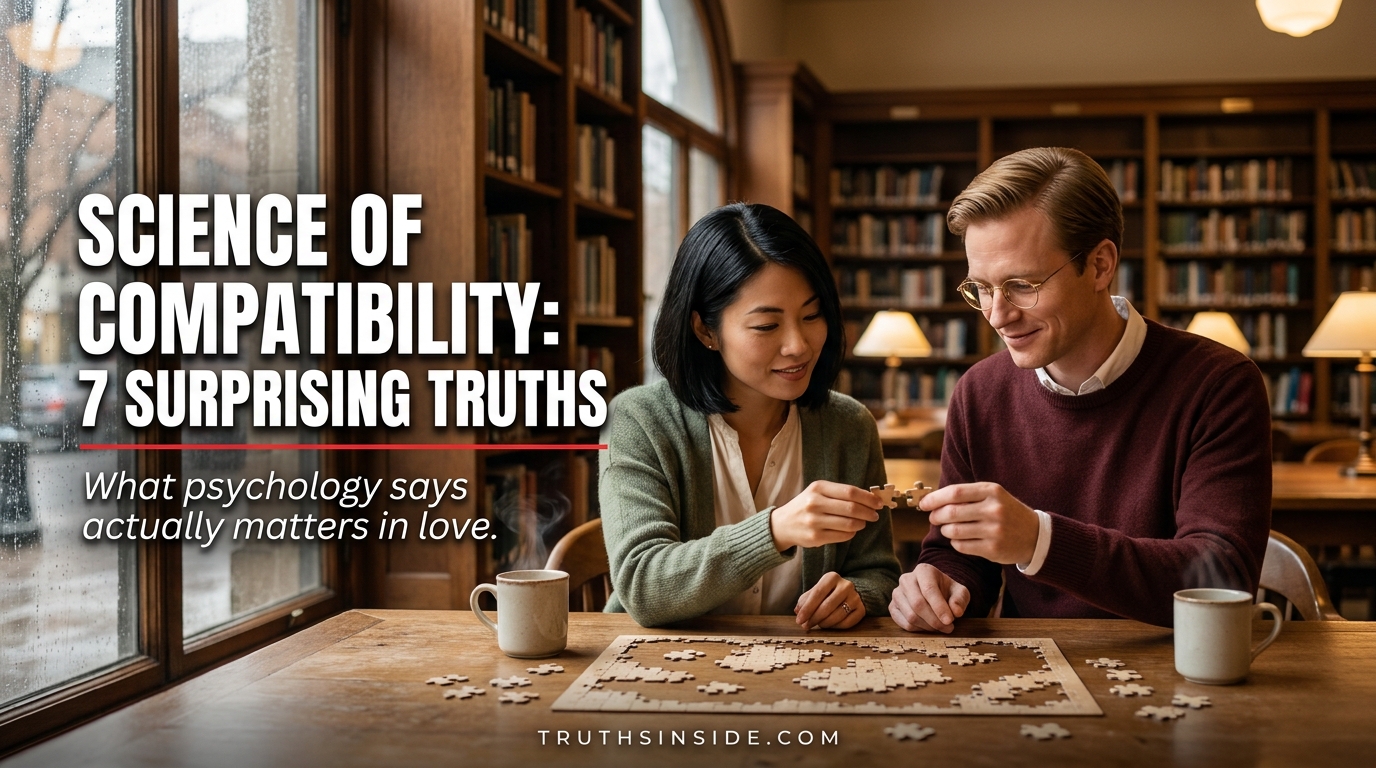
The Science of Compatibility: What Psychology Says Actually Matters
The science of compatibility has a surprising message for anyone who has ever filled out a long dating profile: the things we think matter most often matter less than we expect. The science of compatibility challenges what many of us were taught. Many of us were taught that love is about finding someone with the same hobbies, the same tastes, and the same star sign. Yet decades of relationship research suggest that lasting compatibility is built more than it is found.
A well-known review of online dating by psychologist Eli Finkel and colleagues concluded that matching algorithms promising to predict compatibility from personality profiles have little evidence behind them. That does not mean compatibility is a myth. It means the real ingredients are different from the ones we usually check on a first date.
In this guide, you will learn what the science of compatibility actually says: which similarities help, which differences are harmless, why how you handle conflict may matter more than what you argue about, and seven research-backed truths you can use today.
“Compatibility is less about who you meet and more about how you meet each other’s differences.”
What Is the Science of Compatibility?
The science of compatibility is the study of why some couples thrive while others struggle, and which factors predict a lasting, satisfying relationship. It draws on social psychology, personality research, attachment theory, and decades of studies that follow real couples over time. Its goal is not to produce a perfect formula for love, but to understand patterns.
One of the clearest lessons from this field is that compatibility is not a single trait. It is a blend of shared values, emotional security, communication habits, and how two people grow together. Researchers often separate who you are as an individual from how the two of you function as a pair, and the pair often matters more.
Why Compatibility Feels So Confusing
The science of compatibility starts by separating two things we often blend. We tend to confuse chemistry with compatibility. Chemistry is the spark: attraction, excitement, and the sense that someone is special. Compatibility is the fit: whether your lives, values, and habits can work together over time. The science of compatibility shows that the two can differ, and that some of the strongest relationships begin with a slower, quieter spark.
The Danger of the Checklist
A checklist of must-haves is tempting. But rigid lists can screen out good partners and let in poor ones who happen to tick the boxes. The science of compatibility suggests focusing on a small number of things that really matter, like respect, trust, and emotional safety, instead of a long wish list of preferences.
📃 Related article: Psychological Reactance: 7 Shocking Ways It Backfires
Truth 1: Similarity Helps, but Less Than You Think
It feels logical that similar people get along. And to a degree, they do. Research on the similarity-attraction effect shows that we tend to like people who share our attitudes. But when researchers have compared actual similarity with how happy couples really are, the link is smaller than most people expect.
In a widely cited review, Benjamin Montoya and colleagues found that perceived similarity, how similar we believe we are to someone, predicts attraction more strongly than actual similarity. In other words, feeling alike can matter more than being alike. The science of compatibility therefore treats similarity as a helpful nudge, not a guarantee.
Which Similarities Matter Most
Among similarities, the most useful tend to be deep ones: core values, life goals, and views on things like family, money, and how to treat people. Shared taste in movies or music is pleasant but far less important. If two people agree on how they want to live and be treated, a lot of smaller differences become easy to handle.

Truth 2: Personality Plays a Role, but Not the Role You Expect
The science of compatibility pays close attention to personality. Personality research, especially the Big Five traits, has been studied in couples for years. A meta-analysis by John Malouff and colleagues found that low emotional instability, meaning being calm and steady, and higher conscientiousness and agreeableness in both partners tended to be linked with greater relationship satisfaction.
Notice what is missing from that list: matching. The science of compatibility suggests that some traits are good for relationships no matter who you pair with. Being emotionally steady, reliable, and kind helps almost any couple. Opposites can attract, and similar people can bond, but individual traits like these often matter more than the match itself.
Introverts and Extroverts
A common worry is that an introvert and an extrovert cannot work. In practice, many do, as long as both respect each other’s needs for time alone or time with others. The science of compatibility points to flexibility and respect as the real predictors, not identical social styles.
Truth 3: Attachment Security Is a Quiet Superpower
Attachment theory, developed by John Bowlby and expanded by Mary Ainsworth, describes how early relationships shape the way we seek closeness. Adult attachment research suggests that people who feel secure tend to trust, communicate openly, and recover from conflict more easily. Anxious and avoidant patterns can make closeness harder, though they are not destiny.
For the science of compatibility, the key insight is that security can be learned and shared. A partner who responds warmly and reliably can help an anxious person feel safer over time. Two people who work at understanding their own patterns often become more compatible than two people who seem perfectly matched on paper but never talk about how they feel.
Can Attachment Styles Clash?
Anxious and avoidant pairings are often described as difficult, because one partner pursues closeness while the other pulls away. But awareness changes things. Couples who understand this dance can step out of it by naming it kindly. The science of compatibility favors curiosity over labels: “What do I need right now, and what do you need?”
“You do not need a partner who has no wounds. You need one who treats yours with care.”
Truth 4: Conflict Style Beats Conflict Topic
The science of compatibility has a surprising answer about arguments. Perhaps the most striking finding in the science of compatibility comes from John and Julie Gottman. After years of studying couples, they found that a majority of couples’ disagreements, roughly two-thirds in their research, are perpetual problems that never fully go away. These are differences in personality, lifestyle, or values that persist.
What separated happy couples from unhappy ones was not the absence of such problems. It was how they talked about them. Happy couples used gentle starts, showed humor and curiosity, and made repair attempts. Unhappy couples fell into criticism, contempt, defensiveness, and withdrawal. The science of compatibility therefore asks not “Do we agree?” but “Can we disagree well?”
Repair Is a Compatibility Skill
A repair attempt is any gesture that stops tension from spiraling: a joke, a touch, an “I’m sorry, let me try again.” Couples who repair successfully tend to stay together. This is good news, because repair is a skill, and skills can be learned.

Truth 5: Shared Values Matter More Than Shared Hobbies
Values are the beliefs that guide your decisions: honesty, family, ambition, faith, security, adventure, generosity. When two people hold similar core values, daily choices tend to line up, and big decisions feel like teamwork. When values clash, even loving couples may feel they are pulling in different directions.
Within the science of compatibility, values are different from interests. Hobbies can be shared or swapped. Values are harder to compromise on. It helps to talk early and honestly about topics like children, money, career, where to live, and how to handle loyalty. These conversations are not romantic in the moment, but they build a stronger foundation.
Differences You Can Live With
Not every difference is a problem. Some partners differ in how tidy they are, how they spend weekends, or what they like to eat, and still do very well. The science of compatibility encourages asking whether a difference is a preference or a principle. Preferences can flex. Principles usually cannot.
Truth 6: Growing Together Is More Important Than Starting Together
The science of compatibility also values growth. Psychologist Arthur Aron developed the self-expansion model, which suggests that people are motivated to grow, and that close relationships can help by allowing us to expand our identities through a partner’s perspectives and experiences. Couples who try new activities together often report greater closeness and satisfaction in his research.
That is a hopeful finding for the science of compatibility. It means compatibility is not fixed. A couple who are curious, who try things, and who support each other’s growth can become more compatible over time. Boredom, in contrast, can quietly erode connection, even when everything seems fine on the surface.
Small Novelty, Big Effect
You do not need a world tour. A new restaurant, a different walking route, a class, or a shared project can bring freshness. The key is doing something together that feels a little new and a little shared. It reminds both people that the other is still interesting.
Truth 7: Kindness and Respect Predict More Than Chemistry
Many relationship researchers, including Gottman, have pointed to kindness as a cornerstone of lasting love. Couples who regularly notice and respond to each other’s small bids for attention, a comment, a look, a request, tend to build trust. Those who often ignore or dismiss those bids tend to drift apart.
This is perhaps the simplest conclusion of the science of compatibility: lasting love relies on daily, ordinary kindness. Chemistry may start things, but respect, appreciation, and warmth keep them going. A partner who is kind when things are hard is often a better long-term match than one who is thrilling when things are easy.
“The best match is not the one who agrees with you. It is the one who is gentle with you when you disagree.”
How to Use the Science of Compatibility in Real Life
Knowing the research is useful. Putting it into practice is better. Whether you are dating, newly committed, or years into a relationship, these ideas can guide you.
If You Are Dating
Look past surface similarities. Pay attention to how someone treats waiters, handles stress, talks about past partners, and responds when you disagree. The science of compatibility suggests that these behaviors predict far more than a shared favorite band.
If You Are in a Relationship
Talk openly about values, and notice how you handle disagreements. Practice gentle starts, repair attempts, and daily appreciation. Try something new together every month. Small, consistent habits do more for compatibility than big dramatic gestures.
If You Are Unsure About Your Partner
Ask yourself: Do I feel safe being myself? Do we repair after conflict? Do we share core values? Do we both want to grow? If the answers are mostly yes, you likely have a lot of compatibility to build on. If they are mostly no, the science of compatibility suggests that conversations, and possibly counseling, are worth trying before any major decision.

A Real-Life Look at the Science of Compatibility
Consider Hana and Caleb. On paper, they look like opposites. She is a planner who loves routines. He is spontaneous and hates schedules. Early on, they worried they were incompatible. But when they talked honestly, they found they shared what mattered most: honesty, loyalty, a desire for a calm home, and a love of learning.
Their differences still caused friction, particularly over weekend plans. What helped was applying the science of compatibility in a practical way. They agreed on a simple rule: one planned day and one open day each weekend. They also learned to say, “I’m getting frustrated, can we pause?” before arguments grew. Over time, their differences became a source of balance instead of conflict.
What This Example Shows
Hana and Caleb were not a perfect match. They became a strong one. The science of compatibility explains why: shared values gave them a foundation, and good communication gave them a way to handle differences. Neither of them had to change who they were. They only had to learn how to meet each other.
Red Flags Versus Differences in the Science of Compatibility
It can be hard to tell a harmless difference from a real warning sign. A harmless difference is something like different music tastes, different sleep schedules, or different levels of tidiness. A real warning sign is contempt, dishonesty, controlling behavior, or repeated disrespect for your boundaries.
The science of compatibility draws a clear line here: differences in preference can be negotiated, but differences in basic respect cannot. If you find yourself feeling small, afraid, or constantly criticized, that is not an issue of compatibility. It is an issue of treatment, and it deserves serious attention and support.
📃 Related article: Identity Fusion in Relationships: 7 Warning Signs
Common Myths About the Science of Compatibility
Several popular beliefs do not hold up well against research. Knowing them can save you from unnecessary worry or from false confidence.
- Opposites attract and last. Attraction to differences can be exciting, but long-term satisfaction tends to depend on shared values and respect.
- Compatible couples never fight. Disagreements are normal. What matters is how you handle them.
- A test can predict your perfect match. The research suggests algorithms and quizzes add limited predictive value.
- If it takes effort, it is not meant to be. Most healthy relationships require ongoing work and communication.
- Compatibility is fixed. The science of compatibility shows it can grow with effort, curiosity, and care.
Frequently Asked Questions
What is the science of compatibility?
The science of compatibility is the psychological study of what makes couples fit well together and stay satisfied over time. It looks at values, personality, attachment, communication, and how partners handle conflict and grow together.
What matters most for compatibility in a relationship?
Research points to emotional security, shared core values, respectful communication, kindness, and the ability to repair after conflict. Hobbies and tastes matter far less than how partners treat each other.
Do opposites really attract?
Sometimes, at first. But the science of compatibility suggests that long-term satisfaction depends more on shared values, mutual respect, and good communication than on being opposite or identical.
Can compatibility be built over time?
Yes. Many researchers believe compatibility is partly developed through shared experiences, learning to communicate, and supporting each other’s growth. Couples who work at understanding each other can become more compatible over the years.
Are compatibility tests accurate?
Most evidence suggests they are limited. They may highlight interesting traits, but no test can fully predict how two people will relate over time. Real behavior, shared values, and how you handle conflict are better guides.
Final Thoughts
The science of compatibility offers a hopeful message: you do not have to find a perfect match. You have to find someone whose core values you respect, who treats you kindly, who can disagree without contempt, and who wants to grow with you. Compatibility is not a lightning strike. It is a garden you tend together, one small, honest, caring choice at a time.
Found this helpful? Save this article for your next date or difficult conversation, share it with someone who is wondering if they are a good match, and follow Truthsinside.com for more science-backed psychology insights every week.
🎵 Music
Maren Lull is a singer-songwriter who writes from the places most people don’t talk about out loud.
Not the dramatic grief. Not the obvious heartbreak. The quiet kind — the ordinary Tuesday emptiness, the habit of reaching for someone who isn’t there anymore, the particular exhaustion of being strong for so long that the strength itself wears thin.
Her music lives at the intersection of emotional honesty and soft beauty — breathy vocals over gentle piano, slow tempos, lyrics that feel less like songs and more like something you wrote in a private notebook at two in the morning and never showed anyone.
Maren Lull writes for the people who feel everything deeply and say very little about it. For the ones who listen to sad music not because they want to feel worse — but because being understood, even by a song, makes the feeling easier to carry.
📱 Follow Maren Lull:
→ Spotify
→ Apple Music
→ Youtube
→ Audiomack