Most relationships do not fall apart because of a single catastrophic event. They unravel slowly, through patterns of communication so common they feel almost ordinary — until the damage is already done. Gottman’s Four Horsemen are the four specific behavioral patterns that renowned relationship psychologist Dr. John Gottman identified as the most powerful predictors of relationship failure. After studying over 40,000 couples across four decades of research, Gottman could predict divorce with more than 90 percent accuracy — simply by observing how couples talked to each other. If you have ever wondered why love alone is sometimes not enough, this is why.
The term “Four Horsemen” is borrowed from the biblical apocalypse — four forces that signal the beginning of the end. In relationships, these four communication patterns are not dramatic or obvious. They are quiet destroyers that embed themselves into everyday interactions, slowly suffocating connection, trust, and emotional safety.
What makes this research so profound — and so urgent — is that most couples engage in at least one of these patterns without realizing it. You may recognize yourself in what follows. That recognition is not a reason for despair. It is the beginning of something better.
Understanding Gottman’s Four Horsemen is not about diagnosing your relationship as doomed. It is about seeing clearly — perhaps for the first time — the invisible architecture of damage being built inside your most important connection, and learning that every single one of these patterns has a researched, proven antidote.
What Are Gottman’s Four Horsemen in Relationship Psychology?
Before diving into each one individually, it helps to understand what Gottman’s Four Horsemen represent as a collective framework.
Dr. John Gottman, along with his wife and research partner Dr. Julie Gottman, developed this framework through the world-renowned “Love Lab” at the University of Washington — a research facility where couples were observed having real conversations, their physiological responses monitored, their facial microexpressions analyzed, their communication patterns coded in minute detail.
What Gottman found was that it was not the presence of conflict that predicted relationship failure. Conflict is inevitable in every relationship. It was the manner in which couples engaged with conflict — and specifically, the presence of these four patterns — that determined whether a relationship would thrive or deteriorate.
The Four Horsemen are:
- Criticism
- Contempt
- Defensiveness
- Stonewalling
Each one is distinct. Each one escalates the damage of the others. And each one, left unchecked, creates a self-reinforcing cycle that becomes increasingly difficult to break over time.
Let us look at each one with the depth and honesty it deserves.
The First Horseman: Criticism
What It Is
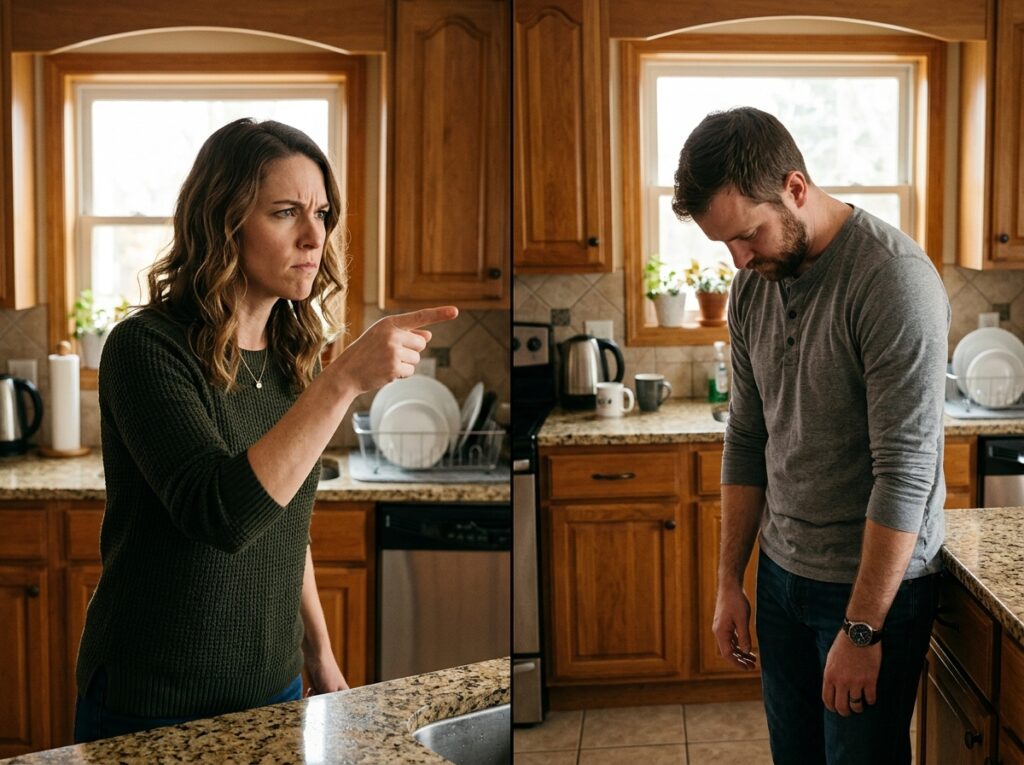
Criticism, in Gottman’s framework, is not the same as offering a complaint. This distinction is critical and widely misunderstood. A complaint addresses a specific behavior: “You forgot to call me when you said you would, and that hurt.” A criticism attacks the person’s character: “You never think about anyone but yourself. You are so irresponsible and selfish.”
Do you feel the difference? One is about an action. The other is an assault on identity.
Criticism typically uses language like “you always,” “you never,” “you are the type of person who,” or “why do you always have to be so…” It transforms a specific grievance into a global indictment of who your partner is as a human being.
Why It Is Destructive
When someone is criticized at the character level repeatedly, several things happen psychologically. First, they stop feeling safe being vulnerable with you. Second, they begin to internalize a negative self-narrative about the relationship — a growing sense that they are fundamentally inadequate as a partner. Third, and perhaps most importantly, criticism is almost always the gateway through which the other three horsemen enter.
Contempt, defensiveness, and stonewalling rarely emerge in a vacuum. They emerge most frequently as responses to sustained criticism.
Where It Comes From
Criticism often originates from a frustrated need that has not been effectively communicated. When people feel chronically unheard, their complaints escalate from specific to global. Instead of “I needed more help this week and I did not get it,” it becomes “You are always lazy. You never contribute to this household.” The underlying need is real. The delivery becomes corrosive.
The Antidote: Gentle Start-Up
Gottman’s research prescribes what he calls a “gentle start-up” — the practice of raising concerns about specific behaviors, using “I” statements that express your feelings and needs without launching an attack on your partner’s character.
Instead of: “You are so inconsiderate. You never listen to me.”
Try: “I feel lonely when our conversations feel one-sided. I need to feel like what I say matters to you.”
Same underlying message. Radically different emotional impact. One closes the door. The other opens it.

The Second Horseman: Contempt
What It Is
If criticism is an attack on your partner’s character, contempt is the declaration that you consider yourself superior to them. It is the most dangerous of Gottman’s Four Horsemen — the one most strongly correlated with relationship breakdown, and the one most strongly associated with physical illness in the partner on the receiving end.
Contempt manifests as mockery, sarcasm used as a weapon, eye-rolling, sneering, name-calling, and hostile humor. It communicates — explicitly or implicitly — that you find your partner disgusting, foolish, or beneath you. It is the emotional equivalent of saying “I do not just disagree with you. I look down on you.”
What separates contempt from anger is the element of moral superiority. Anger says “I am hurt and I am reacting.” Contempt says “I am better than you, and I am proving it by diminishing you.”
Why It Is the Most Destructive
Gottman calls contempt “sulfuric acid for love.” His research found that couples who displayed frequent contempt during conflict were significantly more likely to develop infectious illnesses — because sustained contempt in a relationship keeps both partners in a state of chronic physiological stress that weakens immune function.
Beyond the physical, contempt is devastating because it is impossible to problem-solve from a place of contempt. When you fundamentally disrespect your partner, there is no foundation for genuine repair. Every conversation becomes a performance of superiority rather than an attempt at connection.
Contempt also communicates to your partner — loudly and clearly — that they are not safe with you. And once someone does not feel safe with their partner, the relationship’s emotional core begins to die.
Where It Comes From
Contempt is almost always the result of long-standing, unresolved resentment and negativity that has accumulated over time. It is what happens when criticism goes unanswered, when grievances pile up without resolution, and when one partner begins to build a case against the other — cataloging their faults, replaying their failures, and gradually replacing love with a settled sense of disdain.
This is why Gottman emphasizes the importance of addressing resentment early. Contempt does not emerge overnight. It is built, slowly and systematically, out of the wreckage of unresolved pain.
The Antidote: Build a Culture of Appreciation
The antidote to contempt is not simply being nicer in conflict. It is building what Gottman calls a “culture of appreciation and respect” in the relationship during the times you are not in conflict.
This means actively, regularly, and specifically expressing genuine appreciation for your partner. Not generic praise, but real, noticed, articulated gratitude: “I noticed how hard you worked this week and I want you to know I see it. I appreciate you.” Over time, this rebuilds the reservoir of goodwill that contempt depletes.
When you genuinely admire and appreciate someone, it is neurologically difficult to sustain contempt toward them. The antidote works not by fixing the argument — but by changing the emotional climate the argument happens inside.
“Contempt is not just communication failure. It is the withdrawal of your partner’s fundamental dignity. And a relationship cannot survive long without dignity at its center.”
The Third Horseman: Defensiveness
What It Is
Defensiveness is the automatic self-protective response that arises when we feel attacked, criticized, or blamed. It is perhaps the most universally relatable of Gottman’s Four Horsemen — because almost everyone becomes defensive under certain conditions. It feels natural. It feels justified. That is exactly what makes it so insidious.
Defensiveness in relationships manifests in several specific ways:
- Denying responsibility: “That is not what happened. You are remembering it wrong.”
- Making counter-complaints: “Well, if you had not done X, I would not have done Y.” (Shifting blame back)
- Cross-complaining: Responding to a concern by immediately raising a separate grievance of your own, effectively refusing to hear what your partner said.
- Yes-butting: Offering a token acknowledgment followed immediately by a justification that erases it. “I hear you, BUT the reason I did that was…”
- Whining: “I try so hard and nothing I do is ever good enough.”
Why It Is Destructive
Defensiveness sends a devastating message to your partner: “Your concern is not valid. I am not going to take responsibility. And therefore, you are alone in this.” It stops communication dead. It prevents accountability. And it guarantees that whatever issue your partner was raising will never actually be resolved — it will simply be waiting to surface again, louder and more charged, next time.
Defensiveness also frequently triggers an escalation cycle. Your partner raises a concern. You respond defensively. They feel dismissed and escalate their intensity to be heard. Your defensiveness increases in response to their escalation. The original issue disappears beneath layers of mutual self-protection.
Where It Comes From
Defensiveness is often a deeply conditioned response rooted in childhood or past relationship experiences where vulnerability led to punishment, humiliation, or exploitation. When someone learned early that admitting fault meant shame, or that acknowledging mistakes resulted in further attack, defensiveness became an adaptive survival strategy.
In adult relationships, that protective mechanism misfires. The person who learned to defend themselves to survive cannot easily distinguish between a genuine attack and a partner who is simply hurting and trying to be heard. Every raised concern feels like an accusation. Every expression of pain feels like a threat.
The Antidote: Taking Responsibility
The antidote is disarmingly simple and genuinely difficult: take responsibility for your part, even if it feels like only a small part.
It does not mean accepting blame for everything. It means looking honestly at any piece of the dynamic you contributed to and naming it — genuinely, without immediately pivoting to your own grievances.
“You know what, you are right that I have been distracted lately. I can see how that would make you feel disconnected from me. I am sorry for that.”
This single response changes the entire trajectory of a conversation. It signals safety. It signals respect. It opens the door to genuine dialogue rather than mutual self-defense.

The Fourth Horseman: Stonewalling
What It Is
Stonewalling occurs when one partner completely withdraws from the interaction — shutting down, going silent, leaving the room physically or emotionally, or simply refusing to engage. The stonewaller stops responding. They look away. They offer monosyllabic non-answers. They become, for all practical purposes, a wall.
Stonewalling affects men and women differently in terms of frequency — Gottman’s research found that approximately 85 percent of stonewallers in heterosexual relationships are men, though this reflects cultural and socialization patterns rather than any inherent gender difference. What it shares across all genders is the same devastating impact on the partner left trying to reach someone who has gone entirely unreachable.
Why It Is Destructive
Stonewalling communicates abandonment. Even if the stonewaller is physically present, their emotional withdrawal signals to their partner: “I am done. I am not here for this. You do not matter enough for me to engage.”
For the partner on the receiving end, stonewalling triggers primal fears of abandonment and rejection that can be physiologically as painful as physical injury. Research in neuroscience confirms that social rejection and emotional exclusion activate the same neural pathways as physical pain — meaning being stonewalled by someone you love genuinely hurts in a measurable, biological sense.
The painful irony of stonewalling is that it is often not an act of aggression. Gottman’s research shows that most stonewallers are not being cold or cruel intentionally. They are overwhelmed. Their heart rate has exceeded what researchers call the “flooding threshold” — typically above 100 beats per minute — and their nervous system has gone into physiological shutdown to protect itself from further overwhelm.
But good intentions do not diminish the devastating impact of emotional abandonment on the person being stoned out.
Where It Comes From
Stonewalling is most commonly a response to emotional flooding — the state in which the nervous system becomes so overwhelmed by stress that the prefrontal cortex (responsible for rational thought, empathy, and communication) effectively goes offline. In this state, the person cannot think clearly, cannot access empathy, and cannot engage productively even if they want to.
It is also, for many people, a learned behavior from childhood environments where conflict was explosive or punishing — and withdrawal was the only safe response available.
The Antidote: Physiological Self-Soothing
The antidote to stonewalling is not to push through and force engagement when flooding has occurred. That makes things worse. The antidote is what Gottman calls “physiological self-soothing” — taking a deliberate, agreed-upon break of at least twenty minutes to allow the nervous system to genuinely calm down, before returning to the conversation.
The critical elements: the break must be agreed upon by both partners, not unilaterally imposed. It must come with a genuine intention to return. And it must involve actual calming activities — not replaying the argument in your head, not building your next case, but genuinely resting the nervous system through physical activity, breathing, or distraction.
When both partners understand that a requested break is not abandonment but nervous system management — the fear response to stonewalling begins to diminish.
“The goal is not to win the argument. The goal is to stay emotionally present for the person you chose. And sometimes staying present means knowing when to pause before you both say things that cannot be unsaid.”
How the Four Horsemen Work Together to Destroy a Relationship
Understanding each horseman individually is important. But it is equally important to understand how they interact — because they rarely appear in isolation.
A typical escalation cycle might look like this:
One partner raises a concern using criticism rather than a gentle complaint. The other partner, feeling attacked, responds with defensiveness. The first partner, feeling dismissed and unheard, escalates — perhaps into contempt, using sarcasm or mockery to express their frustration. The second partner, now completely overwhelmed, shuts down entirely — stonewalling.
This cycle — criticism leading to defensiveness, escalating to contempt, ending in stonewalling — is what Gottman describes as the “Cascade” model of relationship deterioration. And once couples fall into this cascade, they often struggle to find their way out without conscious intervention and real skill-building.
The most dangerous element of this cycle is that it becomes self-reinforcing. Each episode of the cascade lowers the couple’s baseline of emotional safety. Lower emotional safety means even minor conflicts trigger the cascade more easily. Over time, the threshold for these destructive patterns drops lower and lower — until what once required a major fight now only requires a mildly irritable morning.

The Antidotes — A Complete Summary
Because Gottman’s research is not only diagnostic but prescriptive, here is a clear summary of each horseman and its corresponding antidote:
Criticism → Gentle Start-Up
Shift from attacking character to expressing feelings and specific needs. Lead with “I feel” rather than “You always.”
Contempt → Culture of Appreciation
Actively and consistently build appreciation, admiration, and respect during everyday interactions — not just during conflict. Keep the positive-to-negative interaction ratio high.
Defensiveness → Taking Responsibility
Look honestly for your contribution to the dynamic and name it genuinely. Drop the counter-complaint. Hear your partner before defending yourself.
Stonewalling → Physiological Self-Soothing
Recognize when you are flooded. Request a break openly and with the commitment to return. Use that break to actually calm your nervous system — then come back.
Can a Relationship Survive All Four Horsemen?
The honest answer is yes — but only with awareness, genuine willingness, and sustained effort from both partners.
Gottman’s research does not suggest that the presence of these patterns means a relationship is irreparably broken. What it suggests is that without intervention, a relationship in which all four horsemen are active and unchallenged is following a predictable trajectory toward dissolution.
The crucial variable is not whether these patterns are present. It is whether both partners are willing to recognize them without defensiveness, take genuine responsibility for their role in them, and commit to practicing the antidotes — not perfectly, but consistently.
Couples therapy, particularly the Gottman Method, provides structured support for exactly this process. Many couples who have deeply embedded all four horsemen in their communication have rebuilt genuine emotional safety and lasting love with the right guidance and real commitment.
What does not work is knowing about these patterns and changing nothing. Knowledge without behavior change is simply a more articulate version of the same painful cycle.

Final Thoughts
Gottman’s Four Horsemen are not a verdict. They are a map.
They show you precisely where the erosion is happening, why it is happening, and — crucially — what to do about it. The couples who use this framework as a mirror rather than a weapon, who hold it up to their own patterns with humility and courage rather than using it to catalogue their partner’s failures, are the ones who genuinely transform.
You do not have to be the couple that the research predicted would fall apart. You can be the couple that looked honestly at the patterns, learned the antidotes, practiced them imperfectly but persistently, and built something stronger on the other side of that honesty.
Every relationship contains the seeds of its own failure. The question is whether you tend to them with avoidance, or face them with the kind of clear-eyed, compassionate courage that real love requires.
Save this article — come back to it the next time a conversation starts going sideways.
Share it with someone whose relationship deserves this kind of honest, research-grounded understanding.
Follow Truthsinside.com for more psychology-rooted content on love, communication, and building relationships that last.
Related article: Signs He Likes You But Is Scared: 18 Behaviors Men Show When Afraid to Commit
Frequently Asked Questions
Q1: Are Gottman’s Four Horsemen present in every struggling relationship?
Not necessarily all four simultaneously, but research shows that most struggling couples exhibit at least two or three of these patterns regularly. The presence of all four — particularly contempt — is the strongest indicator of relationship deterioration.
Q2: Is it possible to have these patterns and still have a healthy relationship?
Occasional criticism or defensiveness does not doom a relationship. Gottman’s concern is with chronic, repetitive patterns. He also identifies a specific ratio — five positive interactions for every one negative — as a buffer that healthy relationships maintain. The horsemen become most dangerous when they dominate the emotional climate of the relationship.
Q3: What if only one partner is willing to work on these patterns?
One partner changing their communication style can meaningfully shift the dynamic, even without both partners initially on board. If you stop responding to criticism with contempt, for example, you interrupt the cascade. That said, sustainable change almost always requires both partners’ genuine participation.
Q4: How do I bring this up with my partner without it becoming a fight?
Share it as something you discovered that made you think about your own patterns — not as a diagnosis of their behavior. “I read something interesting about how couples communicate and I recognized some things in myself I want to work on. Would you be open to reading it together?” leads very differently than “This article perfectly describes everything you do wrong.”
Q5: What is the most important of the Four Horsemen to address first?
Gottman’s research points clearly to contempt as the most damaging and the most urgent to address. If contempt is present in your relationship, building a deliberate, consistent culture of appreciation — even while other issues remain unresolved — can meaningfully shift the emotional foundation of the relationship.
🎵 Music
Maren Lull is a singer-songwriter who writes from the places most people don’t talk about out loud.
Not the dramatic grief. Not the obvious heartbreak. The quiet kind — the ordinary Tuesday emptiness, the habit of reaching for someone who isn’t there anymore, the particular exhaustion of being strong for so long that the strength itself wears thin.
Her music lives at the intersection of emotional honesty and soft beauty — breathy vocals over gentle piano, slow tempos, lyrics that feel less like songs and more like something you wrote in a private notebook at two in the morning and never showed anyone.
Maren Lull writes for the people who feel everything deeply and say very little about it. For the ones who listen to sad music not because they want to feel worse — but because being understood, even by a song, makes the feeling easier to carry.
📱 Follow Maren Lull:
→ Spotify
→ Apple Music
→ Youtube
→ Audiomack