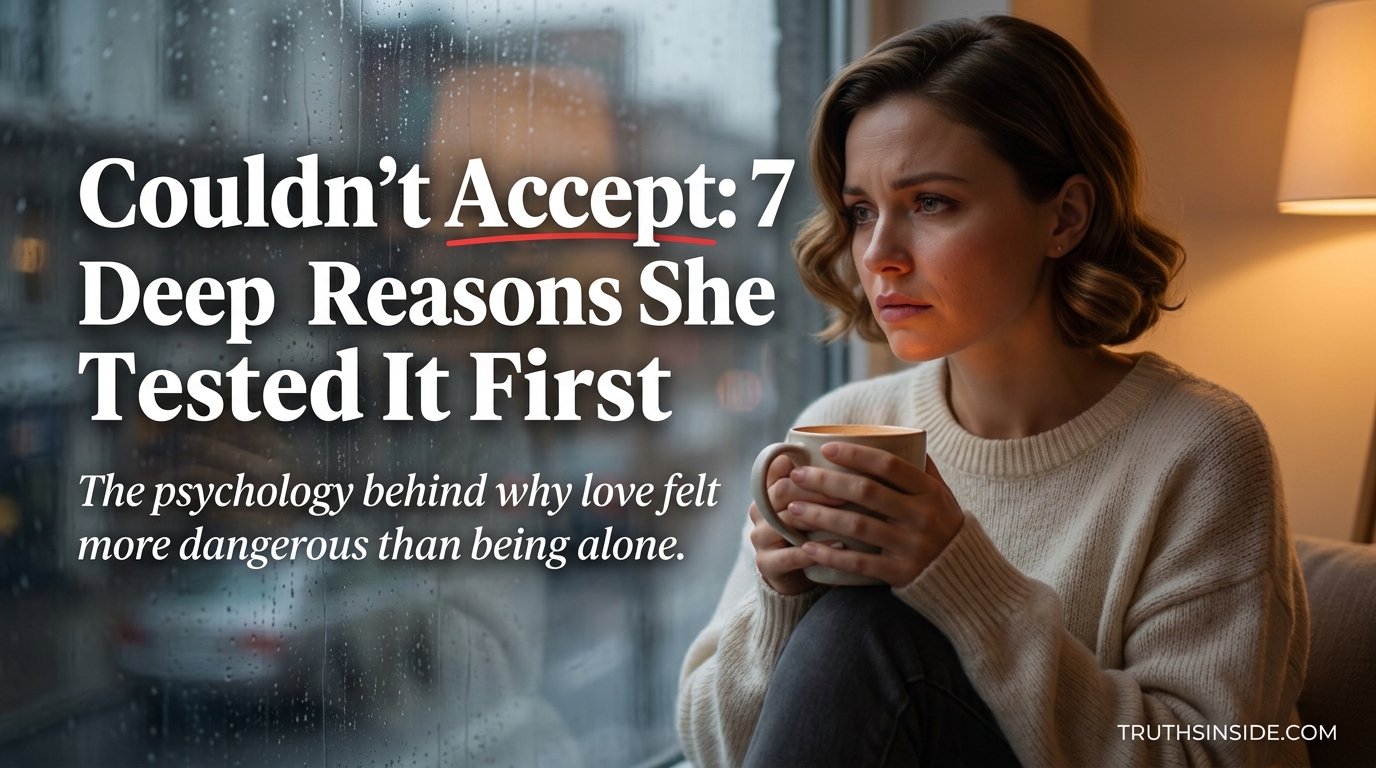
Couldn’t Accept Love: 7 Deep Reasons She Tested It First
The Paradox That Breaks the Best Relationships
She couldn’t accept love — not fully, not freely, not without first putting it through a series of invisible tests that she herself couldn’t always explain. This is one of the most quietly painful paradoxes in human psychology: the people who need love the most are often the ones who find it the hardest to receive. According to research from the American Psychological Association, nearly 40% of adults exhibit insecure attachment styles — patterns rooted in early childhood experiences that shape how they give and receive love for the rest of their lives.
That number is not small. It represents millions of people sitting inside relationships, desperately wanting connection, and simultaneously doing everything in their power — consciously or not — to make sure it can’t reach them.
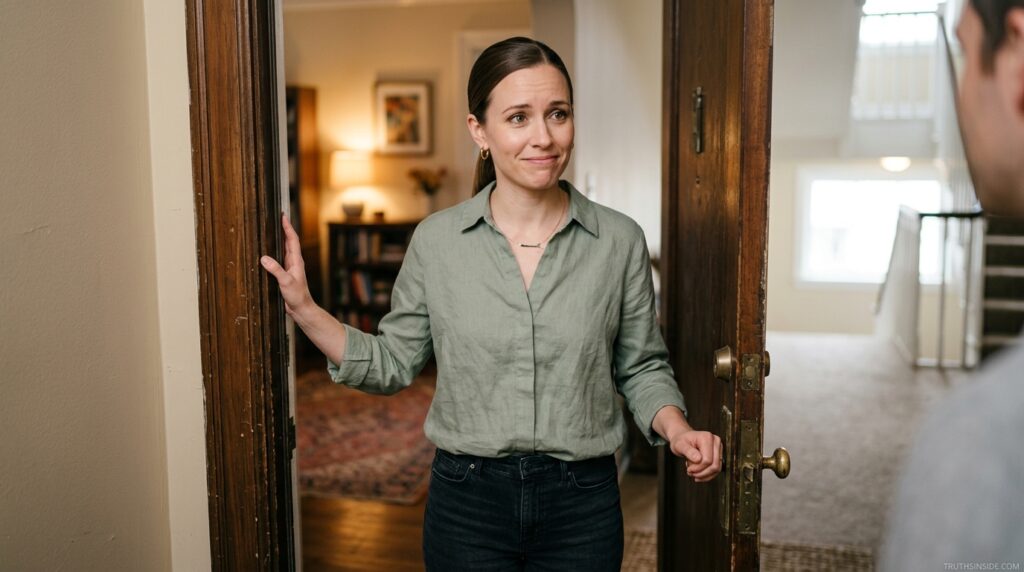
This is the story of one of those people. Her name was Maya. She was warm, funny, fiercely intelligent, deeply loving toward her friends, and capable of extraordinary empathy for everyone around her. And yet — in every romantic relationship she had ever been in — she couldn’t accept love without first testing whether it was real.
Her story is not unique. The psychology behind it is ancient, deeply human, and far more common than most people are willing to admit. Understanding it might be one of the most important things you do today — whether you recognize yourself in Maya, or recognize someone you love.
Who Was Maya — And What Did Her Tests Look Like?
Maya was thirty-two when she met Daniel. He was patient, consistent, and genuinely devoted to her from the beginning. He texted when he said he would. He showed up when it mattered. He remembered small details — the name of her childhood dog, the way she liked her coffee, the fact that she always got quiet before she got sad rather than after.
By every measurable standard, he was exactly what she had always said she wanted. And still — she couldn’t accept love the way he was offering it. Instead, without fully realizing what she was doing, she began to test it.
Sometimes the tests were small. She’d go quiet for a day to see if he’d reach out. Sometimes they were bigger. She’d pick a fight about something that didn’t matter, then watch carefully for how he responded. She’d share something vulnerable and immediately brace for him to use it against her. She’d mention an ex casually, then monitor his reaction for signs of insecurity or control.
He passed every test. And somehow — inexplicably, maddeningly — each time he passed, the anxiety got louder instead of quieter. Because the testing was never really about him. It was about something that happened long before he arrived.
1. She Had Learned Early That Love Was Conditional
The first and perhaps most foundational reason she couldn’t accept love without testing it is this: she had never been shown that love was safe to receive without earning it first. This pattern almost always begins in childhood — not necessarily through dramatic abuse or obvious neglect, but through the quieter, more insidious experience of conditional love.
Conditional love says: “I love you when you’re good.” “I love you when you don’t inconvenience me.” “I love you when you perform, succeed, stay small, or don’t ask for too much.” For a child whose nervous system is still forming, this creates a direct neurological association: love is not a constant. Love is a reward. And rewards must be worked for, earned, and constantly re-verified.
Maya’s parents weren’t cruel. They were human — stressed, distracted, doing their best with the emotional tools they had. But affection in her childhood home had often been tied to performance. Good grades earned warmth. Emotional needs were sometimes met with impatience. She had learned, without anyone explicitly teaching her, that love had terms and conditions. So as an adult — she couldn’t accept love that arrived without them. It felt too easy. Too risky. Like a trap she wasn’t smart enough to see yet.
📃 Related article: Psychology of Ghosting: 7 Shocking Truths About Ghosters
2. She Was Waiting for the Moment It Would Be Taken Away
She couldn’t accept love freely because some part of her was always preparing for it to disappear. This is one of the most telling signs of what psychologists call a “fearful-avoidant” or “anxious” attachment style — the constant low hum of anticipatory loss. If you’ve already braced for something to be taken away, then you’re never fully present for the moment you have it.
Psychologist John Bowlby, whose pioneering work on attachment theory changed the field of developmental psychology, described this as the child’s learned belief about the availability of their attachment figure. If caregivers were inconsistent — loving one moment, withdrawn or unavailable the next — the child’s nervous system learns to exist in a permanent state of emotional alert.
For Maya, this meant that even in the most peaceful, loving moments with Daniel, there was a voice underneath the warmth that whispered: “Enjoy it now. It won’t last.” That voice wasn’t cynicism. It was a scar. A deeply etched neurological prediction based on a pattern her young brain had observed and catalogued as truth. Testing him wasn’t cruelty. It was her nervous system trying to control the timing of the inevitable loss she was certain was coming.
“She wasn’t afraid of love. She was afraid of believing in it — and then being proven wrong again.”
3. Vulnerability Had Taught Her Danger, Not Safety
She couldn’t accept love without testing it because every time she had been truly vulnerable in the past, she had been hurt by it. Vulnerability — the act of being seen fully and honestly — is simultaneously the foundation of deep connection and the most emotionally exposed position a human being can occupy.
For people with secure attachment, vulnerability feels manageable because their early experiences taught them that being seen leads to being held. Their needs were met. Their tears were comforted. Their openness was reciprocated. Vulnerability built trust because it had repeatedly been met with care.
For Maya, it had not worked that way. The moments she had been most open — as a child, as a teenager, as a young woman in her first serious relationships — those moments had been met with dismissal, ridicule, or weaponization. Someone she trusted had shared a secret she’d confided. A partner had mocked something she’d cried about. A parent had used her fear against her during an argument.
Her psyche had done what any intelligent system does with repeated painful data: it had built a wall. Not to keep love out forever — but to keep pain from getting in again. The tests were the wall’s security system. Every passed test was a brick temporarily removed. Every failed one was confirmation that the wall should stay.
4. She Had Never Seen Healthy Love Modeled Closely
She couldn’t accept love partly because she had never seen what accepting it safely actually looked like. The relationships we observe growing up — between parents, between family members, between the adults who populate our formative years — become our first and most enduring template for how love operates.
If those templates show love as volatile, transactional, dramatic, or unpredictable, we absorb that as normal. Not just normal — expected. When something calmer and kinder eventually arrives, it doesn’t register as better. It registers as suspicious. As unfamiliar. As something that must not be what it appears to be.
Maya had grown up watching love that came with yelling, with long silences, with unpredictable warmth and inexplicable coldness. She had watched one parent love loudly and one parent withdraw quietly. She had learned that love meant intensity — that love meant constant vigilance, reading the room, managing someone else’s emotional temperature. Daniel’s steady, undramatic devotion confused her nervous system profoundly. It felt so foreign that it felt wrong. Her testing was partly an unconscious attempt to introduce the chaos her system recognized as love — to make the relationship feel familiar enough to trust.

5. Control Felt Like the Only Safety She Knew
She couldn’t accept love without testing it because testing gave her something that feeling loved didn’t: a sense of control. When you grow up in environments where your emotional safety depended on factors entirely outside your influence — a parent’s mood, a caregiver’s presence, an unpredictable home — control becomes precious. Desperately, almost addictively precious.
Testing a partner is, at its psychological core, an attempt to impose structure on something that feels dangerously uncontrollable. If I test you and you fail, I can leave on my own terms — before you leave me. If I test you and you pass, I’ve bought myself a little more data, a little more proof that this is real. Either way, I am not passive. I am not at the mercy of something I can’t predict.
For Maya, the moments she felt most anxious in the relationship were the moments she felt most out of control — when things were going beautifully and there was nothing to fix, nothing to watch for, nothing to manage. Paradoxically, happiness felt more dangerous than conflict because conflict gave her something to do. Her therapist once told her: “You’re more comfortable in the storm than the calm because at least in the storm you know what to hold onto.” That sentence cracked something open in her.
6. She Was Testing for the Truth Her Hope Was Afraid to Find
She couldn’t accept love without testing it because she carried a deep, unspoken belief that she might not be worthy of it. This is the belief that lives beneath so many of the patterns we’ve already discussed — the belief that if someone truly knew her, all of her, the inconvenient and difficult and messy parts — they would ultimately leave.
Psychologists call this “core shame” — not the ordinary shame of having done something wrong, but the more paralyzing belief that something about you fundamentally IS wrong. That you are too much. Not enough. Too complicated to be loved consistently. Maya had carried this belief so long and so quietly that she had stopped recognizing it as a belief. It felt like a fact.
Her tests, viewed through this lens, were not attempts to push Daniel away. They were desperate attempts to find out the truth before she fully invested. She was essentially asking him — over and over, in languages she couldn’t speak directly — “Will you stay when you see all of me? Will you still be here when I’m hard to love?” Every test was that question in disguise. Every passed test was an answer she wanted to believe and couldn’t quite bring herself to.
7. No One Had Ever Helped Her Learn to Receive
She couldn’t accept love, finally, because receiving had never been something she was taught. Giving love felt familiar — she was extraordinary at it. She poured herself into the people she cared about with a generosity that consistently left people around her feeling seen and valued. But receiving? Receiving made her deeply, physically uncomfortable.
Researcher and author Brené Brown writes extensively about what she calls “foreboding joy” — the tendency, especially among highly wounded people, to be unable to experience good things without immediately preparing for their loss. Receiving love purely and openly requires the capacity to tolerate joy without immediately armoring against it. For Maya, that capacity had never been built.
She deflected compliments. She minimized gestures of care. She laughed off moments of tenderness that left her feeling suddenly and inexplicably panicked. She was fluent in every language of love except the one where she was the recipient. And without the ability to receive, even the most genuine love in the world couldn’t fully land. It would arrive at the door of her heart and find no way in — not because she didn’t want it there, but because she had never learned how to open that particular door.
“Learning to receive love is not weakness. It is one of the bravest, most difficult things a wounded heart can ever attempt.”
What Changed for Maya
She couldn’t accept love — until she began to understand why. That shift — from confusion and self-blame to genuine psychological understanding — was not immediate. It happened over the course of about eighteen months of therapy, honest conversations with Daniel, several painful arguments that they managed to survive, and a lot of sitting with uncomfortable truths about her past.
The turning point came during a therapy session when her therapist asked her a simple but devastating question: “What would happen if you let yourself be loved without testing it first?” Maya’s answer surprised even herself. She said, quietly: “I’d have to trust that I was worth it. And I don’t know if I believe that yet.”
That was the real work. Not fixing her attachment style on a checklist. Not memorizing communication techniques. But slowly, carefully, with professional support and a patient partner, building the internal belief that she was worthy of love that didn’t have conditions. Worthy of warmth that didn’t require performance. Worthy of someone staying — not because she passed a test, but simply because she was there.
She didn’t get there overnight. But she got there. And Daniel — who had understood almost intuitively that her testing was never really about him — was there when she did.

What This Means for You
If you recognized yourself in Maya — if you read this article and felt a quiet, uncomfortable click of recognition — please hear this clearly: you are not broken. You are not difficult. You are not “too much” or fundamentally unlovable. You are someone whose psychology developed the most intelligent protective response it could with the information it had at the time. Those protections made sense once. They may be costing you now.
The path forward is not about dismantling your walls overnight. It’s about gently, with support, beginning to examine them. To understand where they came from. To ask yourself — as Maya eventually did — whether the threats they were built to protect against still exist in the same form they once did.
Sometimes they do. Some relationships, some people, require your walls. Discernment is wisdom. But sometimes — and this is the part worth sitting with — the person on the other side of your test is genuinely safe. And the only thing standing between you and the love you’ve always wanted is the belief, planted long ago by people and experiences that no longer define you, that you cannot trust yourself to receive it.
You Are Not Too Much to Be Loved
The deepest truth in Maya’s story — and in the story of everyone who couldn’t accept love without testing it first — is not about testing at all. It is about the universal human longing to be known completely and loved anyway. To be seen in your most difficult, most complicated, most unedited form — and to have someone look at all of it and choose to stay.
That is not too much to want. That is the most honest thing about being human. The work — the beautiful, painful, entirely worthwhile work — is learning to believe that it’s possible. For you. Right now. Exactly as you are.
Maya learned that. She couldn’t accept love for most of her adult life. And then, slowly, she could. Not because she became perfect. But because she became willing. And willing, it turns out, is more than enough to begin.
📃 Related article: 15 Signs She Is Testing You: Why Women Test Men and What to Do
💾 Save this article — it may answer questions you’ve been carrying for years.
📤 Share it with someone who needs to understand this about themselves or someone they love.
➕ Follow Truthsinside.com for psychology, love stories, and the kind of honesty that actually helps.
FAQ — Frequently Asked Questions
Q1: Is testing your partner always a bad thing in a relationship?
Not necessarily. A small degree of observing how a partner handles stress, conflict, or emotional situations is a natural part of getting to know someone. The concern arises when testing becomes compulsive, unconscious, and driven by unresolved fear — when no amount of passed tests creates genuine security. That pattern often signals unresolved attachment wounds that would benefit from professional support.
Q2: Can someone who couldn’t accept love learn to receive it in adulthood?
Absolutely. Attachment styles are not permanently fixed. Neuroscience research supports the concept of neuroplasticity — the brain’s ability to form new patterns throughout life. With self-awareness, intentional relational experiences, and often therapeutic support, people can develop what’s called “earned security” — a genuine capacity to give and receive love safely, even without having experienced it in childhood.
Q3: How should a partner respond when they realize they’re being tested?
With patience, consistency, and open communication — while also maintaining their own emotional boundaries. It’s important not to simply “pass tests” indefinitely without naming the pattern. Gently and compassionately raising the observation — “I notice that sometimes when things are going well between us, something shifts. Can we talk about that?” — can open a conversation that testing alone can never resolve.
Q4: What is the difference between anxious and fearful-avoidant attachment?
Anxious attachment tends to involve a high desire for closeness paired with intense fear of abandonment — these individuals often pursue and seek reassurance. Fearful-avoidant attachment involves both a desire for closeness AND a fear of it — leading to push-pull dynamics like testing. Both styles benefit from understanding their root causes and working toward more secure relational patterns.
Q5: When should someone seek professional help for love avoidance patterns?
When the patterns are consistently interfering with the ability to maintain satisfying relationships, causing significant personal distress, or when self-awareness alone hasn’t created meaningful change, professional support is genuinely valuable. Therapy modalities like Emotionally Focused Therapy (EFT), Internal Family Systems (IFS), and attachment-based therapy are particularly effective for these specific patterns.
🎵 Music
Maren Lull is a singer-songwriter who writes from the places most people don’t talk about out loud.
Not the dramatic grief. Not the obvious heartbreak. The quiet kind — the ordinary Tuesday emptiness, the habit of reaching for someone who isn’t there anymore, the particular exhaustion of being strong for so long that the strength itself wears thin.
Her music lives at the intersection of emotional honesty and soft beauty — breathy vocals over gentle piano, slow tempos, lyrics that feel less like songs and more like something you wrote in a private notebook at two in the morning and never showed anyone.
Maren Lull writes for the people who feel everything deeply and say very little about it. For the ones who listen to sad music not because they want to feel worse — but because being understood, even by a song, makes the feeling easier to carry.
📱 Follow Maren Lull:
→ Spotify
→ Apple Music
→ Youtube
→ Audiomack