Text I Almost Didn’t Send: How 9 Words Changed Everything
The Moment Everything Hinged on a Thumb
The text I almost didn’t send was nine words long. It sat in a compose window on a Tuesday night in November, cursor blinking patiently at the end of the sentence like it had all the time in the world — even though she felt like she had none. According to a study published in the Journal of Social and Personal Relationships, the fear of rejection is one of the most powerful inhibitors of human connection, suppressing the instinct to reach out even when the desire to do so is overwhelming. Most people, when faced with the possibility of vulnerability, choose silence.
They close the app. They tell themselves it’s too late, too risky, too much. They protect themselves from a wound that hasn’t happened yet — and in doing so, they close the door on something that might have been extraordinary.
Her name was Nadia. She was thirty-one, sitting cross-legged on her bedroom floor with her back against the bed frame, her phone screen the only light in the room. Outside her window, the city was doing what cities do at midnight — humming along, indifferent to the enormous smallness of her moment.
She had written the message four times. Deleted it four times. And now, on the fifth attempt, the words were there again, exactly the same as they’d always been, waiting for her to decide whether she was brave enough or foolish enough — and whether, at this hour, on this night, there was any meaningful difference between the two. This is the story of the text I almost didn’t send. It is also the story of everything that came after.

Who Was on the Other Side of That Message
Before we get to what happened when she finally pressed send on the text I almost didn’t send, it matters to understand who she was sending it to — and why the act of sending it felt so enormous.
His name was James. She had known him for four years, lost him for one, and spent the remaining three months since the loss understanding, slowly and painfully, that she had made a mistake in letting the distance grow without fighting for it. They had never been in a romantic relationship — not technically, not officially. What they had existed in the specific and devastating space between deep friendship and something more, where everything feels significant and nothing gets named because naming it would make it real enough to lose.
He had moved to Portland for work fourteen months ago. The texts had thinned — not from conflict or falling out but from the ordinary erosion of distance and busyness and the lie people tell themselves that there will be time later to catch up properly. She had watched his life continue on social media the way you watch a film you love through a window — present enough to follow the story, too far away to be part of it.
She had drafted the text I almost didn’t send for the first time three months before she finally sent it. She had told herself it was a bad idea each of those three months. She had been very convincing.
What the Message Actually Said
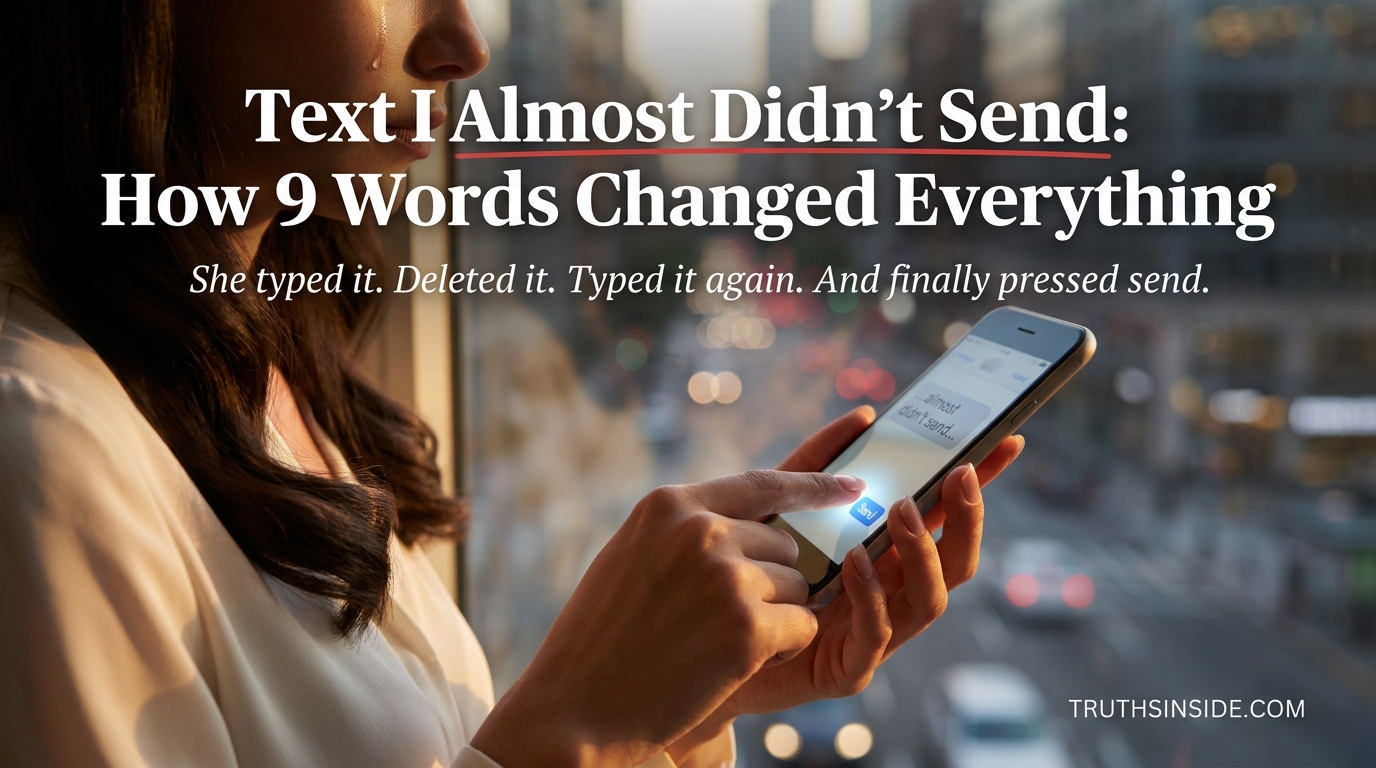
The text I almost didn’t send contained nine words. Simple, unadorned, and completely terrifying in their honesty. No clever opener. No protective layer of casual pretense. No “hey, random question” buffer designed to give her an exit if things went sideways.
Just this: “I miss you. And I think I always will.”
Nine words. She had spent three months and approximately forty-seven deleted drafts arriving at nine words. Earlier versions had been longer, more hedged, more carefully constructed to allow plausible deniability. One version read like a newsletter update — cheerful, informative, relentlessly safe. Another version opened with “Hey, been a while!” in the tone of someone who definitely had not been thinking about this person every day for ninety days straight.
The text I almost didn’t send in its final form had no armor. It was just the truth, exposed and clean and terrifying. She had realized somewhere around the forty-third deleted draft that any version with armor in it wasn’t really reaching out — it was performing reaching out while staying safe. And safe, she had finally decided at 11:47 PM on a Tuesday in November, was no longer something she was willing to choose over honest.
She pressed send at 11:53 PM. Then she put the phone face-down on the floor beside her and sat very, very still.
📃 Related article: He Waited 3 Years to Say This — Powerful Love Story
The Six Minutes After Sending
The six minutes between sending the text I almost didn’t send and receiving a reply were among the longest of Nadia’s adult life. She is not dramatic by nature — she will tell you this herself, readily and with mild self-deprecation. She does not catastrophize or spiral. She is, by most measurements, a grounded and emotionally regulated person.
And yet those six minutes were a masterclass in the complete failure of emotional regulation. She turned the phone face-up, then face-down. She stood up, walked to the kitchen, poured a glass of water she didn’t drink, walked back. She considered, briefly and seriously, whether she could somehow unsend the message and reconstruct the reality in which she had been sensible and gone to sleep.
She thought about the text I almost didn’t send and what it would mean if he didn’t reply tonight. If he read it tomorrow and decided the kindest response was a measured, friendly, slightly delayed reply that treated the message as something smaller than it was. If he had, at some point in the last fourteen months, met someone who gave him no occasion to think about the space between what they’d had and what it could have been.
She had just completed this particular circuit of thought for the third time when the phone lit up.
“Some messages carry the weight of everything unsaid for months. When they finally leave your hands, the waiting feels like holding your breath underwater — terrifying, necessary, and strangely clarifying.”
His Reply — Four Words at 12:03 AM
The text I almost didn’t send was answered at 12:03 AM. James had been awake — as it turned out, also lying in a dark room, also doing the specific and quietly miserable work of trying to convince himself he was fine. His reply contained four words.
“I was waiting too.”
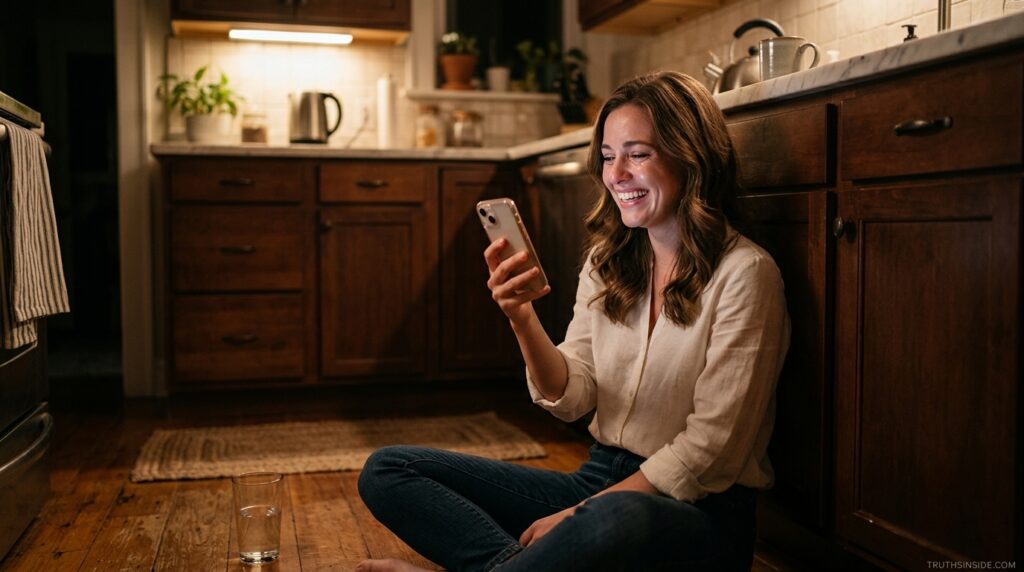
She read those four words five times in thirty seconds. Then she sat down on the kitchen floor — she had somehow migrated from the bedroom during the six minutes — and laughed. Not a performative laugh. Not a relieved laugh, exactly. The kind of laugh that comes out of you when something that has been coiled inside you for a very long time suddenly releases all at once. The kind of laugh that is also, barely, a cry.
The text I almost didn’t send had been a one-way door in her mind — a message sent into uncertainty with no guarantee of anything on the other side. His four words made it a conversation. And conversations, once started between two people who have been waiting this long to start them, tend not to be brief.
They talked until 4:17 AM. She knows the exact time because she looked at the clock when they finally said goodnight and thought, with the kind of clarity that only arrives at that hour: something just changed.
What They Said in Those Four Hours
The text I almost didn’t send opened a conversation that neither of them had known how badly they needed. They talked about the fourteen months. About the way distance had worked on them — not dramatically but through a thousand small omissions, a thousand moments where one of them had thought of the other and decided not to reach out for reasons that felt sensible at the time and absurd in retrospect.
James told her that he had started typing a message to her twice in the previous six months. Twice he had stopped. His reasons were different from hers but arrived at the same place: the fear that what he wanted to say was more than the situation allowed for. The fear that he had misread everything and would embarrass them both. The fear that she had moved on to a life that had no particular vacancy in it shaped like him.
She told him that she had written forty-seven drafts. He was quiet for a moment, and then he said: “Forty-seven.” And she could hear in those two syllables that it landed exactly the way it was meant to — not as evidence of obsession but as evidence of how much she had wanted to get it right. How seriously she had taken the risk of reaching him honestly.
The text I almost didn’t send had been nine words. The conversation it started ran to thousands — and covered more honest ground in four hours than most relationships cover in months.
Why She Almost Didn’t Send It — The Real Reasons
The text I almost didn’t send was almost never sent for reasons that, examined honestly, had very little to do with James and almost everything to do with fear. Fear, specifically, in three distinct forms that most people who have ever hovered over a send button will recognize immediately.
The first was the fear of misreading the situation — the terror that what felt significant to her was ordinary to him. That the connection she had catalogued and treasured had not registered with the same weight on his side of the distance. This fear is one of the most paralyzing available to human beings, because it cannot be resolved without the very action it prevents. You cannot know how your message will land without sending it. But sending it requires tolerating the uncertainty of not knowing. It is a loop with no exit except courage.
The second fear was the fear of changing the existing dynamic. Even an unsatisfying, undefined, slowly fading connection feels safer to many people than the risk of disrupting it. The text I almost didn’t send would change things regardless of his response — either toward something new or toward a conclusive ending. Both possibilities felt enormous. Silence felt, at least, like the preservation of something. Even if what was being preserved was slowly becoming nothing.
The third fear was the simplest and most honest: the fear of rejection. Of being the one who cared more visibly, more nakedly, with fewer protections in place. Of handing someone a piece of yourself and watching them decide what it was worth.
What Changed — In Both of Them
The text I almost didn’t send did not immediately resolve into a clean, simple narrative. Life rarely arranges itself that way. James was still in Portland. She was still in Chicago. The fourteen months of distance had created habits of independence in both of them that didn’t dissolve overnight just because a conversation had been started at midnight on a Tuesday.
But something fundamental had shifted. The text I almost didn’t send had established, irreversibly, that they were both still there. Both still present. Both still carrying something that hadn’t faded the way they had each privately feared and half-hoped it might — feared because its persistence was inconvenient, and half-hoped because its persistence was also, quietly, the most honest thing in their lives.
They started talking every day. Not performatively — not as a ritual commitment made in the rush of emotional momentum. They just kept finding that there were things they wanted to say to each other and that the other person was, reliably, the one they most wanted to say them to. The text I almost didn’t send had not created this. It had revealed it. It had named something that had been true for a long time without a name.
James flew to Chicago six weeks later. He stayed for a long weekend. On the last evening, sitting on her fire escape with takeout containers between them and the city below in its usual beautiful indifference, he said: “I keep thinking about how this almost didn’t happen.” She said: “I know.” He said: “Thank you for being braver than I was.” She said nothing for a moment. Then she said: “I almost wasn’t.”
The Psychology of Why We Don’t Send the Text
The text I almost didn’t send sits in millions of phones right now. It exists in compose windows and notes apps and voice memos that were never transcribed. It lives in the space between what people feel and what they can bring themselves to transmit — and understanding why that space exists is one of the most illuminating things psychology has to offer about human connection.
Researchers at the University of Chicago published findings showing that people dramatically overestimate how uncomfortable their attempts to reconnect will make the recipient — and dramatically underestimate how positively those attempts will be received. In plain terms: we assume reaching out will be awkward or unwelcome far more often than it actually is. We protect ourselves from a discomfort that, statistically, is unlikely to materialize.
The text I almost didn’t send lives in this gap — between the fear of how it will land and the reality of how it usually does. The gap is maintained by our negativity bias, our attachment wounds, our previous experiences of rejection, and the specific cruelty of imagining the worst outcome with extraordinary vividness while struggling to imagine the best with any conviction at all.
Nadia didn’t know the research that night on the kitchen floor. She just knew that the forty-eighth draft felt different from the previous forty-seven. It felt honest. And she had finally decided that honesty, even frightening honesty, was something she owed both of them.
What the Text I Almost Didn’t Send Taught Her
The text I almost didn’t send taught Nadia several things that she carries with her now, two years after that Tuesday in November. The first is that timing is not as fixed as it feels. The voice that says “it’s too late” is not a reliable narrator. It is fear performing certainty. It is the part of us that would rather grieve something quietly than risk disrupting it loudly. That voice deserves compassion — it is trying to protect you — but it does not deserve the final word.
The text I almost didn’t send also taught her that nine words can be enough. That brevity in the right moment is not insufficient — it is precise. She had spent three months constructing elaborate, well-defended messages when the truth, stripped of all its armor, fit in nine words. The real message was never about being articulate. It was about being willing.
The text I almost didn’t send taught her, finally, that the bravest thing she had done in years was not dramatic. It was not a grand gesture or a significant sacrifice. It was pressing a button on a Tuesday night when every sensible, self-protective instinct she had was telling her to close the app and go to sleep.
She didn’t go to sleep. She pressed send. And her life moved in a direction it could never have moved in if she had chosen, one more time, the safety of silence.
“The text I almost didn’t send wasn’t brave because it was perfect. It was brave because it was true — and she sent it anyway.”
Two Years Later
Two years after the text I almost didn’t send changed both their lives, Nadia and James live in the same city. He moved back — not exclusively for her, but not not for her either. They have the kind of relationship that was built on an honest foundation because its first real brick was laid on a Tuesday night in November when someone chose vulnerability over safety, truth over performance, send over delete.
They still talk about it sometimes — the text I almost didn’t send, the six minutes of waiting, the four words that came back, the conversation until 4:17 AM. They talk about it the way people talk about the moments they can trace everything back to. With a specific, quiet gratitude that doesn’t need to be embellished because the fact of it is already extraordinary enough.
The text I almost didn’t send was nine words. It built something that now has thousands of shared mornings, countless small moments, an entire architecture of dailiness that would not exist if a thumb had moved three inches to the left on a Tuesday night and closed the app instead.
She almost closed the app. She didn’t. And that — more than any grand romantic gesture, more than any perfectly constructed declaration — is the most honest love story she knows how to tell.

If You Have a Text You Almost Didn’t Send — Read This
Right now, somewhere in your phone or your heart, there is probably something you have been meaning to say to someone. A text you almost didn’t send — or haven’t sent yet. A message that exists in draft form, either literally on your screen or figuratively in the part of your mind that keeps returning to someone you haven’t let yourself fully reach for.
This story is not a guarantee that pressing send will give you the answer you want. Some messages go unanswered. Some windows do close. Some timing really has passed. Those outcomes are real and they hurt, and minimizing them would be dishonest.
But Nadia’s story — the story of the text I almost didn’t send — is a reminder that the voice telling you it’s too late is not always right. That the fear of how it will land is not the same as how it will actually land. That nine honest words can carry more weight than ninety protected ones. That the person on the other side of your hesitation may be sitting in their own dark room, waiting for exactly the courage you’re afraid you don’t have.
The text I almost didn’t send changed two lives. The text sitting in your drafts might be waiting to do the same. You don’t have to send it tonight. But when you’re ready — and you’ll know when you’re ready — know that ready is enough. Brave is enough. Honest is enough.
Send it.
📃 Related article: Emotional Aftershock of Cheating: 9 Raw Truths Revealed
💾 Save this story — you might need its reminder on a Tuesday night of your own.
📤 Share it with someone who has a message they’ve been afraid to send.
➕ Follow Truthsinside.com for love stories, emotional truth, and the kind of writing that makes you feel less alone.
FAQ — Frequently Asked Questions
Q1: What if I send the message and don’t get the response I hoped for?
That outcome is real and worth preparing for honestly. But consider this: the pain of rejection — while real — is finite and survivable. The pain of permanent wondering tends to compound over time. Most people, looking back, report that knowing — even painfully — was preferable to the slow erosion of not knowing. Sending the message gives you information. Silence just preserves the uncertainty.
Q2: How do you know when the right time is to send a vulnerable message to someone?
The honest answer is that there is rarely a moment that feels perfectly right — because vulnerability, by definition, carries risk, and risk never feels entirely safe. A useful internal question is this: Am I waiting for the right moment, or am I waiting for a guarantee that doesn’t exist? If it’s the latter, the right moment may never arrive on its own. Sometimes the act of sending creates the moment rather than the other way around.
Q3: Is it worth reaching out to someone after a long period of silence?
Research consistently shows that people underestimate how welcome a reconnection attempt will be. Whether the silence was caused by distance, drift, conflict, or circumstance — reaching out thoughtfully and honestly is almost always received more positively than the person reaching out anticipates. The length of the silence is rarely as significant as it feels from the inside.
Q4: What if the message changes the relationship in a way I’m not ready for?
Change in a relationship — even when it’s initiated by your own honest action — can feel destabilizing. But it helps to remember that the relationship was already being shaped by what was not being said. Sending an honest message doesn’t introduce change into a static situation. It makes visible the change that has already been quietly happening. That visibility, while sometimes uncomfortable, is almost always more workable than continued ambiguity.
Q5: How do I write a message that is honest without oversharing or putting too much pressure on the other person?
The most effective vulnerable messages tend to be short, clear, and free of expectation language. They express what is true for you without demanding a specific response from the other person. Nadia’s nine words — “I miss you. And I think I always will.” — work as a model because they communicate honestly without issuing an ultimatum or requiring the recipient to perform a specific emotional response. They leave space. The best honest messages always leave space.
🎵 Music
Maren Lull is a singer-songwriter who writes from the places most people don’t talk about out loud.
Not the dramatic grief. Not the obvious heartbreak. The quiet kind — the ordinary Tuesday emptiness, the habit of reaching for someone who isn’t there anymore, the particular exhaustion of being strong for so long that the strength itself wears thin.
Her music lives at the intersection of emotional honesty and soft beauty — breathy vocals over gentle piano, slow tempos, lyrics that feel less like songs and more like something you wrote in a private notebook at two in the morning and never showed anyone.
Maren Lull writes for the people who feel everything deeply and say very little about it. For the ones who listen to sad music not because they want to feel worse — but because being understood, even by a song, makes the feeling easier to carry.
📱 Follow Maren Lull:
→ Spotify
→ Apple Music
→ Youtube
→ Audiomack