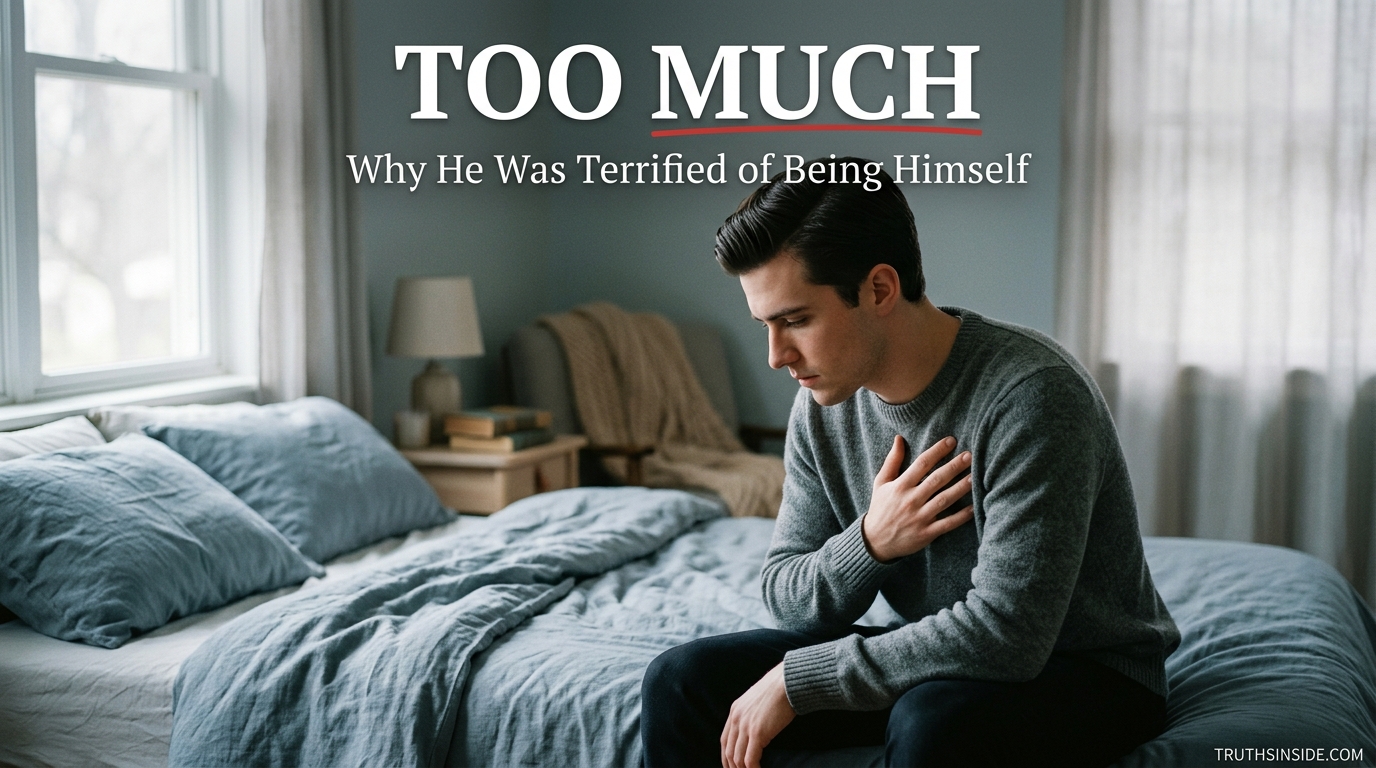
He Was Terrified of Being ‘Too Much’ — Until He Learned Where That Came From
Ethan had a habit he didn’t even notice anymore: shrinking. He’d laugh a little quieter than he wanted to, hold back opinions in meetings, apologize before asking for anything at all. For most of his adult life, he carried a quiet, constant fear of being too much — too emotional, too needy, too intense for the people around him. According to research from the American Psychological Association, chronic self-suppression of this kind is strongly linked to anxiety and low self-worth, yet it’s one of the most common — and least talked about — patterns in adult relationships.
Ethan didn’t think of himself as someone with a “problem.” He thought of himself as considerate. Easygoing. Low-maintenance. It wasn’t until his therapist gently asked, “Who taught you that your feelings were too much?” that something in him went completely still. He didn’t have an answer right away. But the question stayed with him for weeks, unraveling a pattern he’d spent almost thirty years building without ever realizing he was building it.
This is the story of how Ethan traced his fear of being too much back to its actual source — and what changed once he finally understood where it came from.
The Quiet Cost of Feeling ‘Too Much’
Ethan’s fear didn’t look like fear from the outside. It looked like generosity. He was the friend who never complained, the partner who never asked for reassurance twice, the coworker who absorbed extra work without pushing back. People often described him as “easy to be around,” a compliment he’d learned to lean on as proof that he was doing something right.
But privately, Ethan monitored himself constantly. Before expressing excitement, sadness, or frustration, a quiet internal voice would ask: is this too much? Will this be too much for them? The question ran so automatically that he rarely noticed it happening — he simply adjusted, softened, and stayed quiet, believing he was keeping the peace rather than losing himself.
Psychologists call this pattern “emotional self-monitoring,” and it’s especially common among people who grew up needing to manage a parent’s emotional reactions. Clinical psychologist Dr. Lindsay Gibson, author of Adult Children of Emotionally Immature Parents, describes this as a survival skill that gets built early and then mistaken, decades later, for personality.
📃 Related article: Couldn’t Accept Love: 7 Deep Reasons She Tested It First
Where the Fear of Being ‘Too Much’ Actually Started
In therapy, Ethan began tracing the feeling backward instead of just managing it forward. He remembered being eight years old, crying after a bad day at school, and his mother sighing, “Ethan, please, not right now — this is too much.” It wasn’t said with cruelty. She was overwhelmed, exhausted, doing her best in a hard season. But to an eight-year-old, the message landed as fact: my feelings are a burden.
That single sentence repeated itself in dozens of quiet variations over the years — a raised eyebrow when he got excited too loudly, a tired “we’ll talk about it later” that never came, a subtle preference for the version of him that needed nothing. None of it was abusive. Most of it wasn’t even memorable to the adults involved. But children don’t need cruelty to internalize a lesson; they need repetition. And Ethan repeated the lesson to himself for the next two decades: don’t be too much, and you won’t be left.
By the time he reached adulthood, the belief had fully detached from its origin. Ethan no longer remembered the specific moments that taught him to fear being too much — he simply carried the conclusion, applying it automatically to every relationship, every job, every friendship.
“Don’t be too much, and you won’t be left.” — the belief Ethan carried for over two decades without realizing where it came from

How Fear of Being ‘Too Much’ Shapes Adult Relationships
What made Ethan’s pattern so hard to see was that it didn’t announce itself as fear — it presented as easiness. He rarely started arguments. He rarely asked for anything. In early dating, partners often described him as refreshing, low-drama, mature. What they couldn’t see was the constant internal editing happening underneath that calm exterior.
This is one of the more misunderstood aspects of the fear of being too much: it doesn’t usually look like anxiety from the outside. It looks like generosity, flexibility, or emotional maturity — which makes it easy for both the person experiencing it and the people around them to miss entirely. Ethan’s girlfriend at the time, Priya, once told him, “You never seem upset about anything,” not realizing it was a symptom, not a strength.
Therapists note that people carrying this fear often burn out quietly. They give and give until resentment builds silently underneath the surface, then either withdraw completely or, ironically, have an emotional reaction that finally feels “too much” simply because it was suppressed for so long. Ethan recognized this pattern the moment his therapist described it — he’d had exactly two blowups in his adult life, both after months of unspoken frustration, both of which he later apologized for excessively, reinforcing the very belief that started the cycle.
📃 Related article: Psychology of Ghosting: 7 Shocking Truths About Ghosters
The Moment Everything Started to Shift
The turning point wasn’t dramatic. It happened in an ordinary Thursday therapy session when Ethan, describing a recent disagreement with Priya, said, “I probably shouldn’t have said anything, it was probably too much.” His therapist paused and asked him to say the sentence again, slower. Then she asked: “Whose voice is that? Is it yours, or is it someone else’s, borrowed a long time ago?”
Ethan sat with that question longer than any other in months of therapy. He realized, almost for the first time, that “too much” wasn’t a neutral description of himself — it was a verdict he had absorbed from a specific, exhausted moment in his childhood and had been applying to himself ever since, without ever questioning whether it was even true.
That distinction changed everything. Ethan began separating the belief from the fact. The belief said: your feelings are a burden. The fact was: a tired parent once said something in an overwhelmed moment, and an eight-year-old mistook it for a permanent truth about his worth. Recognizing that gap didn’t erase the fear of being too much overnight, but it gave him something he’d never had before — the ability to question it instead of automatically obeying it.
“Is it yours, or is it someone else’s, borrowed a long time ago?” — the question that finally cracked the pattern open

Unlearning the Fear of Being ‘Too Much’
Unlearning a belief that old doesn’t happen through insight alone — it happens through repeated, small acts of practice. Ethan’s therapist encouraged him to start with low-stakes moments: telling Priya he was disappointed about a canceled plan instead of saying it was fine, mentioning when a joke actually hurt his feelings instead of laughing it off. Each time, he braced for the reaction he’d expected his whole life — irritation, distance, someone deciding he was too much after all.
Instead, something unexpected happened. Priya, more often than not, responded with curiosity rather than withdrawal. “Thank you for telling me,” she said once, after he admitted a comment had stung more than he let on. It was such a small sentence, but it directly contradicted decades of internalized evidence. Slowly, through dozens of these small moments, Ethan began building a new set of data points — proof that honesty didn’t automatically cost him the relationship.
He also began noticing the difference between actual overwhelm in another person and his own automatic assumption of it. Not every tired sigh meant he was too much; sometimes it just meant someone was tired. Learning to separate other people’s temporary states from his own permanent self-worth became, in his words, “the actual work” — slower and less dramatic than the insight itself, but far more transformative over time.
Where Ethan Is Now
Ethan still notices the old instinct sometimes — the urge to shrink a feeling before it’s fully expressed, the reflex to apologize for taking up space. But now he recognizes it for what it is: an old survival strategy, not a fact about who he is. When the thought “this is too much” surfaces, he’s learned to pause and ask his therapist’s question instead — whose voice is that, really?
He and Priya are still together, and their relationship, he says, has become noticeably more honest since he stopped editing himself for her comfort. “I used to think being easy to love meant being invisible,” he said. “Now I think it means being known — actual mess and all.” His fear of being too much hasn’t vanished completely, but it no longer runs the show.
Psychologists emphasize that this kind of unlearning is rarely linear, and Ethan’s story isn’t a tidy before-and-after — it’s an ongoing practice. But naming the origin of the fear, rather than simply managing its symptoms, gave him something he hadn’t had in nearly thirty years: the ability to ask whether the belief was even true in the first place.

Frequently Asked Questions
Where does the fear of being “too much” usually come from?
It often traces back to childhood moments where a caregiver, even unintentionally, responded to a child’s emotions as a burden. Repeated over time, this can teach a child to suppress themselves to stay emotionally safe.
Is being afraid of being “too much” the same as low self-esteem?
They’re closely related but not identical. The fear of being too much is often specifically about emotional expression — the belief that one’s needs or feelings will overwhelm others — rather than a general sense of low worth.
Can this pattern really change in adulthood?
Yes. Therapists note that while the belief forms early, it can be unlearned through consistent, small experiences that contradict it — like expressing a feeling and being met with care instead of withdrawal.
How can I tell if I’m carrying this fear without realizing it?
Common signs include chronic over-apologizing, difficulty asking for help, minimizing your own needs, and a persistent internal question of whether your emotions are appropriate before expressing them.
What helped Ethan the most in overcoming the fear of being too much?
Separating the original belief from present-day reality — recognizing that a tired comment from childhood wasn’t a permanent truth about his worth — was the turning point that allowed real change to begin.
If this story resonated with you, save it for later, share it with someone who needs to hear it, and follow Truthsinside.com for more real psychology stories.
🎵 Music
Maren Lull is a singer-songwriter who writes from the places most people don’t talk about out loud.
Not the dramatic grief. Not the obvious heartbreak. The quiet kind — the ordinary Tuesday emptiness, the habit of reaching for someone who isn’t there anymore, the particular exhaustion of being strong for so long that the strength itself wears thin.
Her music lives at the intersection of emotional honesty and soft beauty — breathy vocals over gentle piano, slow tempos, lyrics that feel less like songs and more like something you wrote in a private notebook at two in the morning and never showed anyone.
Maren Lull writes for the people who feel everything deeply and say very little about it. For the ones who listen to sad music not because they want to feel worse — but because being understood, even by a song, makes the feeling easier to carry.
📱 Follow Maren Lull:
→ Spotify
→ Apple Music
→ Youtube
→ Audiomack