
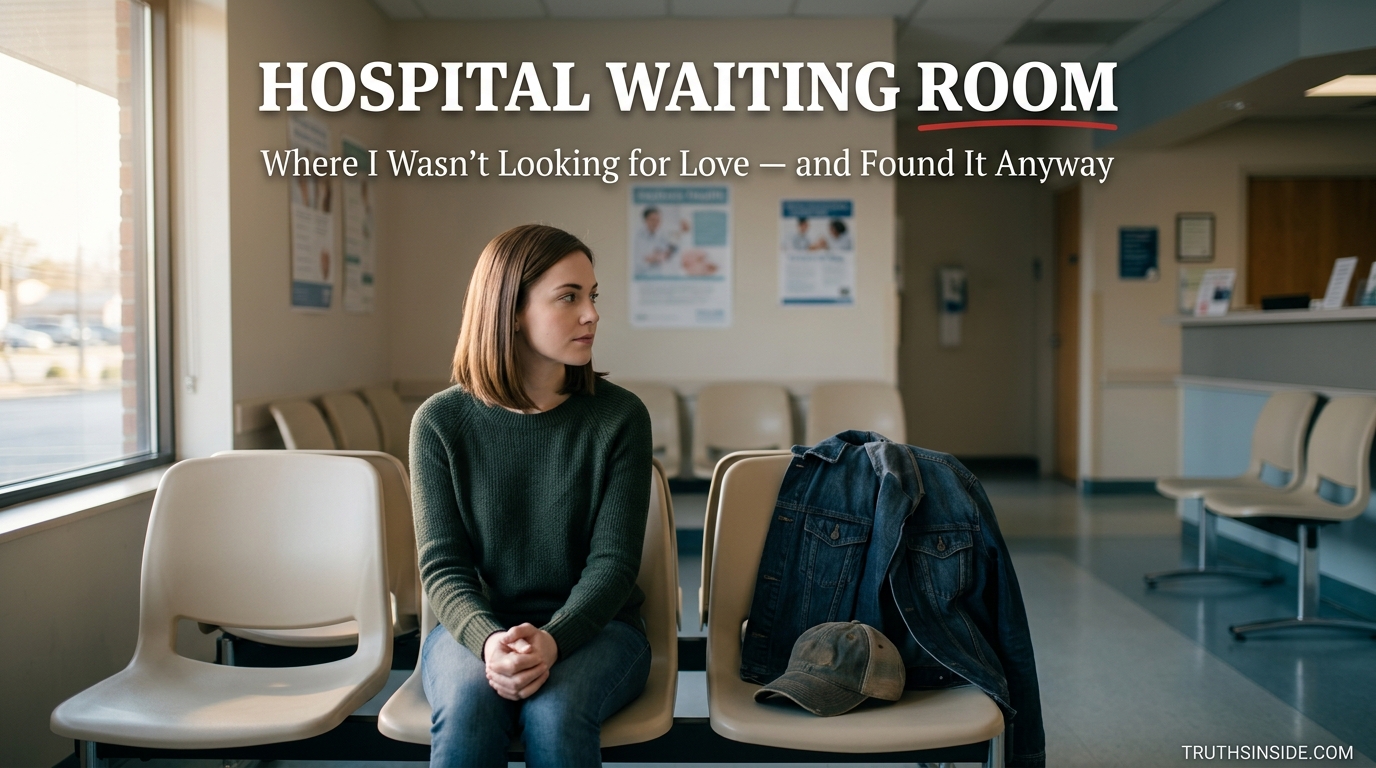
I Wasn’t Looking for Love. It Found Me in a Hospital Waiting Room.
I had been sitting in that hospital waiting room for almost four hours when he sat down two chairs away, holding a cup of vending-machine coffee he never drank. Research from the Journal of Social and Personal Relationships suggests that emotionally intense, high-stress environments can accelerate the sense of closeness between strangers, compressing what might normally take months into a single afternoon. I didn’t know that statistic at the time. I only knew that I was scared, exhausted, and completely unprepared for anyone to see me at my most undone — let alone fall for them.
My father was in surgery. I had driven to the hospital alone at six that morning, phone gripped so tightly my knuckles ached, and by the time Daniel sat down near me, I had cried twice, eaten nothing, and stopped pretending I was fine. A hospital waiting room has a way of stripping people down to something more honest than they usually allow themselves to be in public. I wasn’t performing composure anymore. I was just a person, waiting, afraid.
This is the story of how one ordinary, terrifying day in a hospital waiting room became the beginning of the most important relationship of my life — proof that love doesn’t always arrive when you’re ready for it, and sometimes finds you in the last place you’d think to look.
The Hospital Waiting Room Where Everything Started
The chairs in that particular hospital waiting room were bolted together in rows of four, upholstered in a faded blue vinyl that had clearly seen decades of nervous hands. A television in the corner played a muted morning show no one was watching. Every few minutes, a nurse would appear in the doorway and call a name, and the entire room would tense up together, then release, like one shared nervous system.
Daniel had been there for his younger sister, who was undergoing a procedure two floors up. He told me later that he almost sat on the other side of the room, near the window, but something made him choose the row where I was sitting instead. I didn’t notice him at first — I was too deep in my own fear to register another person’s presence in the hospital waiting room at all.
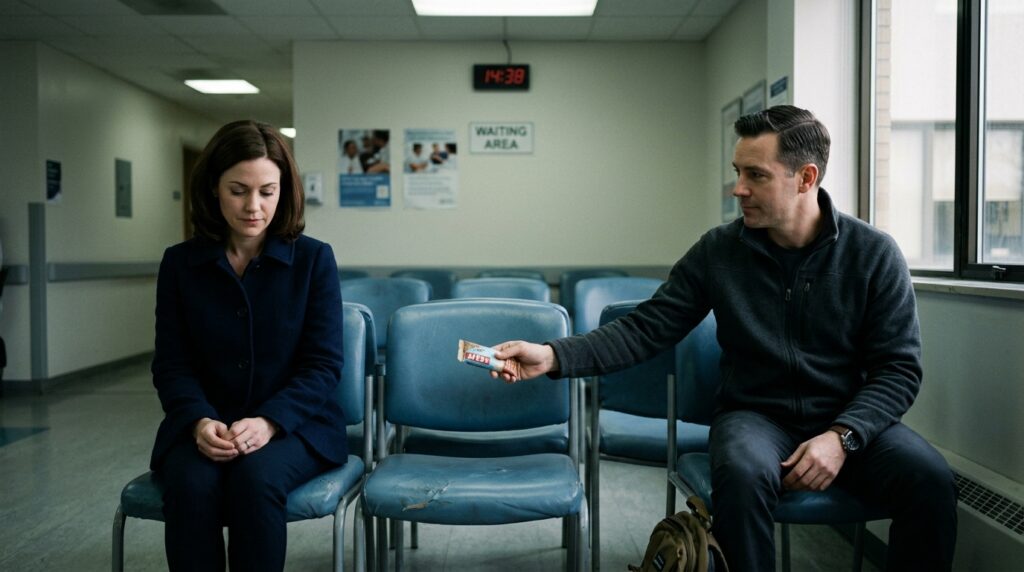
It wasn’t until he quietly offered me half of his protein bar, saying, “You haven’t eaten anything since I got here, and I’ve been here two hours,” that I actually looked at him. It wasn’t a pickup line. It wasn’t smooth. It was just someone paying attention to another exhausted human being in a hospital waiting room, and somehow, that small act of noticing broke through hours of numbness I hadn’t realized I’d built up.
📃 Related article: Text I Almost Didn’t Send: How 9 Words Changed Everything
Why a Hospital Waiting Room Strips Away the Performance
There’s something about a hospital waiting room that erases the usual social scripts. Nobody is trying to impress anyone. Nobody is checking their reflection or rehearsing a clever opening line. Everyone in that room is united by the same raw, unglamorous experience: waiting for news they can’t control, about someone they love.
Psychologist Dr. Arthur Aron, known for his research on closeness between strangers, has found that shared vulnerability under stress can create emotional intimacy far faster than typical social interactions. Sitting in a hospital waiting room, Daniel and I skipped almost all of the usual early-dating small talk. Within an hour, I had told him things about my father’s health, my fear of losing him, my complicated relationship with hospitals since my mother’s own illness years earlier — things I might not have shared with a stranger under any other circumstance.
He didn’t flinch, and he didn’t try to fix anything. He just listened, occasionally sharing small pieces of his own fear about his sister. In a hospital waiting room, comfort doesn’t look like solutions. It looks like someone simply staying present in the discomfort with you, refusing to look away.
“In a hospital waiting room, comfort doesn’t look like solutions. It looks like someone simply staying present in the discomfort with you.”
The Hours That Changed Everything
By the third hour in that hospital waiting room, Daniel and I had stopped being strangers in any meaningful sense. We talked about everything and nothing — his job as a high school teacher, my complicated relationship with my career, the strange rituals people develop while waiting for bad news that might not come. At one point we both laughed, actually laughed, at something absurd on the muted television, and I remember feeling almost guilty for it, as if joy wasn’t allowed in a hospital waiting room.
But Daniel gently pointed out something I hadn’t considered: that laughing didn’t mean I cared less about my father. It meant I was human, capable of holding fear and lightness at the same time. That reframe mattered more than he probably realized. I had spent years believing that love, connection, even basic joy, had to be earned through composure — and here, in the most uncomposed version of myself, in a hospital waiting room of all places, someone was showing me the opposite.
When the surgeon finally came out to tell me my father’s surgery had gone well, Daniel was the first person I turned to, before I even called my sister. He squeezed my hand once, briefly, and said, “I’m really glad.” Nothing more. It didn’t need to be more. That was the moment I understood something had genuinely shifted between us in that hospital waiting room, even if neither of us said it out loud yet.
📃 Related article: He Forgave Her: 7 Powerful Reasons Most Men Never Could
What I Almost Missed Because of Where We Met
For weeks afterward, I second-guessed the entire thing. A connection formed in a hospital waiting room, under extreme stress, during one of the most frightening days of my life — how could that be real? I worried I had simply latched onto the first source of comfort available, that what I felt was gratitude wearing the costume of attraction.
This is a common concern therapists actually address directly. Dr. Aron’s research notes that while high-stress bonding is real and measurable, it doesn’t automatically mean the connection is false — it simply means the usual timeline gets compressed. What we build afterward, away from the original stress, is what determines whether it lasts. So Daniel and I agreed to see each other again, outside of any hospital waiting room, in ordinary, low-stakes circumstances, specifically to test whether what we felt held up without the crisis attached to it.
It did. Coffee turned into dinner. Dinner turned into weekends. And slowly, the version of Daniel I’d met in a hospital waiting room — steady, attentive, unafraid of hard emotions — turned out to be exactly who he was in ordinary life too, not just in crisis. That consistency mattered more to me than the romantic circumstances of how we’d met.
“What we build afterward, away from the original stress, is what determines whether it lasts.”

Two Years Later
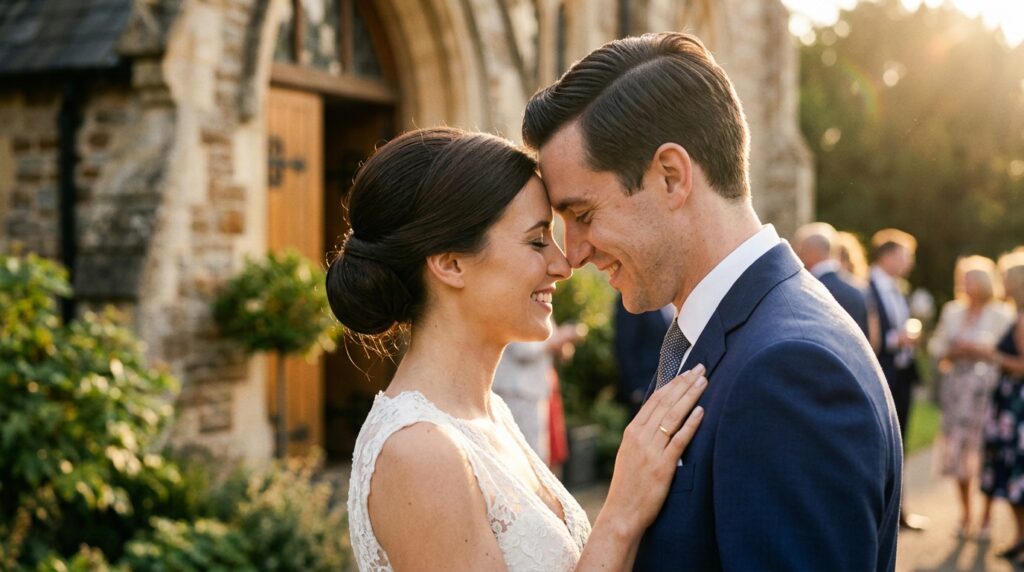
It’s been two years since that morning in the hospital waiting room, and my father, thankfully, is doing well. Daniel and I still laugh about the protein bar — he insists it was strategic, I insist it was just kindness, and honestly, I think we’re both right. We got married last spring, and at the reception, my father stood up and joked that Daniel had “waited in line” for our family longer than most people wait for anything.
What I’ve come to understand since that day is that love doesn’t always follow the timeline or setting we expect. I used to imagine meeting someone in more conventional circumstances — through friends, at a party, somewhere lighter. Instead, it found me in a hospital waiting room, at my most frightened and least polished, and somehow that turned out to be exactly the right place for it to start.
If there’s one thing I’d tell anyone going through their own version of that day — sitting in a hospital waiting room, scared and unsure — it’s that you don’t have to perform strength for the people around you. Sometimes the most meaningful connections happen precisely when you stop pretending to be okay, and let someone see you exactly as you are.
Frequently Asked Questions
Can real love actually start in a stressful place like a hospital waiting room?
Yes. Psychologists note that shared vulnerability under stress, like waiting together in a hospital waiting room, can create genuine emotional intimacy quickly, though it’s important to see how the connection holds up outside the crisis.
How do you know if a connection formed during a crisis is real?
Testing the relationship in ordinary, low-stress circumstances afterward is key. If the same warmth and attentiveness show up away from a hospital waiting room, that’s a strong sign the connection is genuine.
Is it normal to feel guilty about connecting with someone during a difficult time?
Very normal. Many people feel conflicted about experiencing comfort or even joy while waiting for difficult news, but emotional complexity in a hospital waiting room doesn’t diminish how much you care about the person you’re there for.
What made this particular connection different from a typical stranger interaction?
The shared vulnerability of a hospital waiting room removed the usual social performance, allowing both people to be unusually honest with each other far earlier than typical circumstances would allow.
Did the relationship stay strong after leaving the hospital waiting room?
Yes — the couple deliberately spent time together in ordinary settings afterward to confirm the connection wasn’t just a product of crisis, and two years later, they’re married.
If this story resonated with you, save it for later, share it with someone who needs to hear it, and follow Truthsinside.com for more real love stories.
🎵 Music
Maren Lull is a singer-songwriter who writes from the places most people don’t talk about out loud.
Not the dramatic grief. Not the obvious heartbreak. The quiet kind — the ordinary Tuesday emptiness, the habit of reaching for someone who isn’t there anymore, the particular exhaustion of being strong for so long that the strength itself wears thin.
Her music lives at the intersection of emotional honesty and soft beauty — breathy vocals over gentle piano, slow tempos, lyrics that feel less like songs and more like something you wrote in a private notebook at two in the morning and never showed anyone.
Maren Lull writes for the people who feel everything deeply and say very little about it. For the ones who listen to sad music not because they want to feel worse — but because being understood, even by a song, makes the feeling easier to carry.
📱 Follow Maren Lull:
→ Spotify
→ Apple Music
→ Youtube
→ Audiomack