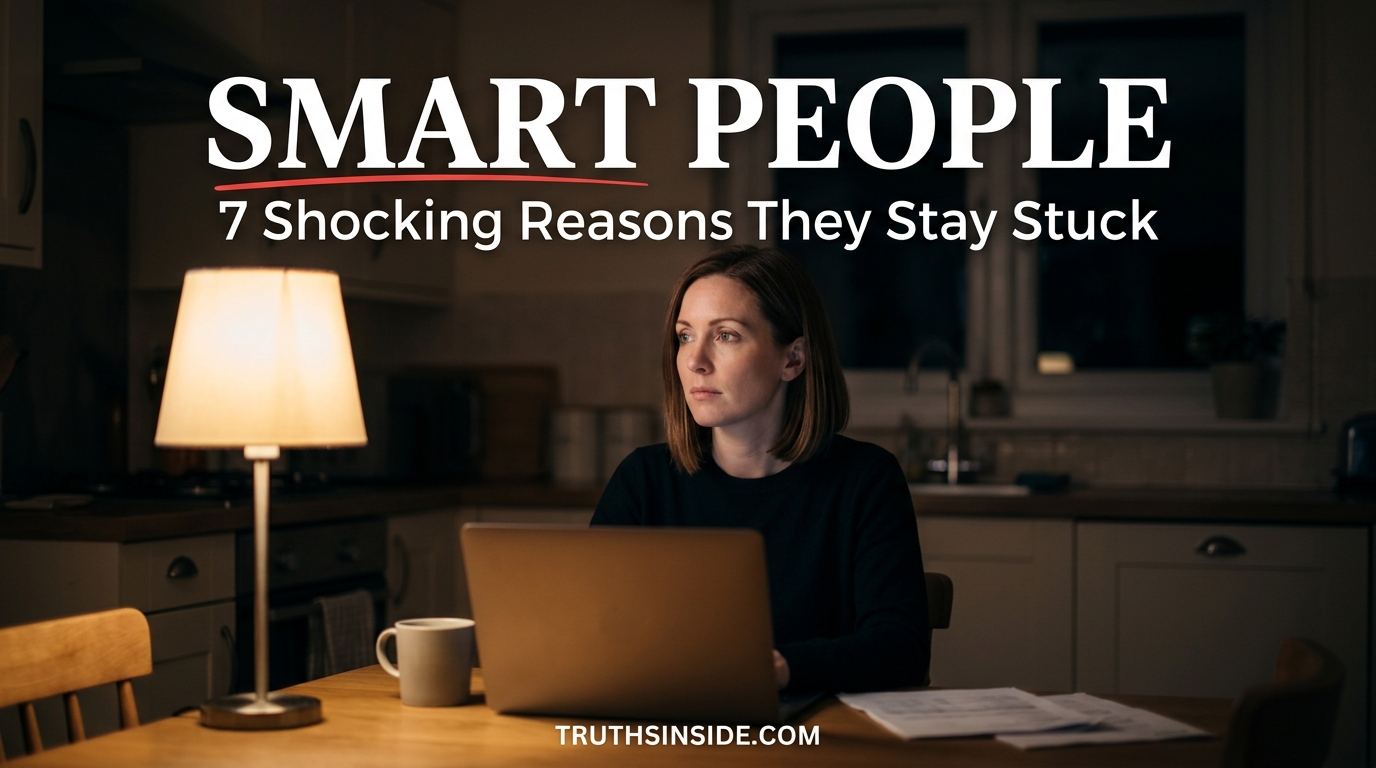
Why Smart People Stay in Bad Relationships: The Psychology
Smart people are supposed to know better. That’s the assumption most of us carry — that intelligence should act as a shield against heartbreak, manipulation, or years wasted on the wrong person. But psychologists have found that IQ has almost no correlation with relationship decision-making, and in some cases, high intelligence actually makes it easier to rationalize staying in a relationship that isn’t working.
If you’ve ever watched a brilliant friend — a doctor, an executive, someone who reads people for a living — stay in a relationship that was clearly hurting them, you’ve seen this paradox up close. It’s not a lack of awareness. Smart people usually see the problems clearly. What keeps them stuck isn’t ignorance; it’s a set of psychological mechanisms that intelligence doesn’t protect against, and sometimes even sharpens.
This article breaks down the real psychology behind why smart people stay in bad relationships — and why “just leave” is far more complicated than it sounds, even for the sharpest minds in the room.
1. Smart People Confuse Intelligence With Emotional Safety
Cognitive intelligence and emotional regulation live in different parts of the brain. Being able to solve complex problems at work doesn’t automatically translate into recognizing unhealthy patterns in a relationship, especially when those patterns trigger old emotional wiring rather than logical reasoning.
Smart people often assume that because they’re perceptive in other areas of life, they’d “obviously” notice if something were seriously wrong. That false sense of immunity can actually delay recognition, because admitting the relationship is unhealthy also means admitting their own perceptiveness failed them somewhere.
📃 Related article: Couldn’t Accept Love: 7 Deep Reasons She Tested It First
2. Smart People Fall for the Sunk Cost Fallacy Too
The sunk cost fallacy — continuing something because of what’s already been invested, not because of what lies ahead — doesn’t discriminate by intelligence. If anything, smart people are skilled at building elaborate justifications for why the years already spent make leaving harder, not easier.
“We’ve been together five years, I can’t just start over” is a logical-sounding sentence that ignores the actual math: staying five more years in a bad relationship costs more than the five already spent. Smart people are excellent at constructing reasoning that feels sound but leads to the wrong conclusion.
3. Smart People Rationalize Red Flags Better Than Anyone
This is one of the most counterintuitive findings in relationship psychology: higher verbal intelligence often correlates with a stronger ability to explain away red flags, not spot them faster. A sharp mind can build a compelling narrative around almost any behavior — “he’s just stressed,” “she didn’t mean it like that,” “it’s not really that serious.”
Smart people are, by nature, skilled storytellers. Unfortunately, that same skill can be turned inward to write a more comfortable version of a relationship than the one actually happening.

4. Smart People Often Have Unhealed Attachment Wounds
Attachment style, formed in early childhood, has far more influence over relationship choices than IQ ever will. Someone with an anxious attachment style may be brilliant professionally while still being wired to interpret inconsistency as passion and stability as boredom — a pattern rooted in early caregiving, not intellect.
Smart people are just as susceptible to insecure attachment as anyone else. In fact, some psychologists argue that highly analytical people are more likely to intellectualize their attachment wounds instead of feeling and processing them, which can make the underlying pattern harder to shift.
“Intelligence can explain a bad relationship in exquisite detail. It rarely stops someone from staying in one.”
5. Smart People Mistake Intermittent Reinforcement for Passion
Psychologists have long known that unpredictable rewards create stronger behavioral attachment than consistent ones — it’s the same mechanism behind slot machine addiction. In relationships, this shows up as a partner who is warm one day and cold the next, creating an addictive push-pull dynamic.
Smart people often mistake the resulting anxiety and longing for deep chemistry, when in reality it’s a well-documented psychological trap. The brain interprets the uncertainty as intensity, and intensity gets mislabeled as love.
6. Smart People Fear the Social Cost of Being Wrong
For many high-achieving, intelligent people, being wrong publicly feels almost unbearable — professionally and personally. Leaving a relationship can feel like admitting a major misjudgment in front of family, friends, and colleagues who’ve watched the relationship unfold.
This fear of being “wrong” keeps smart people invested longer than they otherwise would be, simply to avoid the discomfort of publicly reversing course, even when privately they already know the relationship isn’t working.
📃 Related article: Almost Lost Her Over Something Small — 5 Hard Lessons
7. Smart People Use Logic to Override Their Own Instincts
Gut feelings are data too — often processed faster than conscious reasoning can catch up to. Smart people, trained to trust logic over intuition, frequently talk themselves out of a gut instinct that something is wrong, because it can’t yet be articulated in a neat, rational argument.
By the time the logical case finally catches up with what their intuition knew months earlier, significant time and emotional investment have already been lost.

8. Smart People Often Underestimate Their Own Vulnerability
Perhaps the biggest blind spot: smart people frequently believe manipulation, love-bombing, or slow erosion of self-worth “wouldn’t work on someone like them.” That very confidence can become a vulnerability, since it lowers their guard against subtle psychological tactics that don’t require low intelligence to fall for — only a nervous system responding exactly as it’s designed to.
Manipulation tactics are engineered to bypass logic and target emotional needs directly. Intelligence offers little protection against a mechanism that was never aimed at the analytical brain in the first place.
Why Intelligence Doesn’t Protect the Heart
The uncomfortable truth is that relationships are processed largely by the emotional brain, not the analytical one. Smart people can out-argue almost anyone in a debate, yet still find themselves unable to out-argue their own attachment system, trauma responses, or fear of loneliness.
Recognizing this isn’t a failure of intelligence — it’s simply how the brain is built. Once smart people understand that staying in a bad relationship isn’t a contradiction of their intelligence but a completely separate psychological process, it becomes far easier to extend themselves compassion instead of confusion.

FAQ
Q: Why do smart people stay in relationships they know are bad for them?
Because relationship decisions are driven largely by attachment patterns, emotional wiring, and psychological biases like sunk cost — none of which intelligence directly overrides.
Q: Are smart people more likely to be manipulated?
Not more likely, but their confidence in their own perceptiveness can sometimes lower their guard, since manipulation tactics are designed to bypass logical thinking entirely.
Q: What’s the first step to breaking the pattern?
Recognizing that logic alone won’t resolve an attachment-driven pattern. Many people benefit from therapy focused specifically on attachment style rather than willpower or reasoning.
Q: Does this mean intelligence is useless in relationships?
No — intelligence helps with communication and problem-solving once someone is emotionally ready to act. It just isn’t a substitute for emotional and attachment work.
Final Thoughts
Staying in a bad relationship isn’t proof that someone is naive or foolish. For smart people especially, it’s often proof that intelligence and emotional wiring operate on two entirely different systems — and only one of them was ever designed to protect the heart.
If this gave you a new lens on your own patterns, save this article to revisit later, share it with someone who needs the reminder, and follow Truthsinside.com for more psychology-backed relationship insights.
🎵 Music
Maren Lull is a singer-songwriter who writes from the places most people don’t talk about out loud.
Not the dramatic grief. Not the obvious heartbreak. The quiet kind — the ordinary Tuesday emptiness, the habit of reaching for someone who isn’t there anymore, the particular exhaustion of being strong for so long that the strength itself wears thin.
Her music lives at the intersection of emotional honesty and soft beauty — breathy vocals over gentle piano, slow tempos, lyrics that feel less like songs and more like something you wrote in a private notebook at two in the morning and never showed anyone.
Maren Lull writes for the people who feel everything deeply and say very little about it. For the ones who listen to sad music not because they want to feel worse — but because being understood, even by a song, makes the feeling easier to carry.
📱 Follow Maren Lull:
→ Spotify
→ Apple Music
→ Youtube
→ Audiomack