The Strange Loop of Self-Sabotage: How to Break the Cycle in Relationships
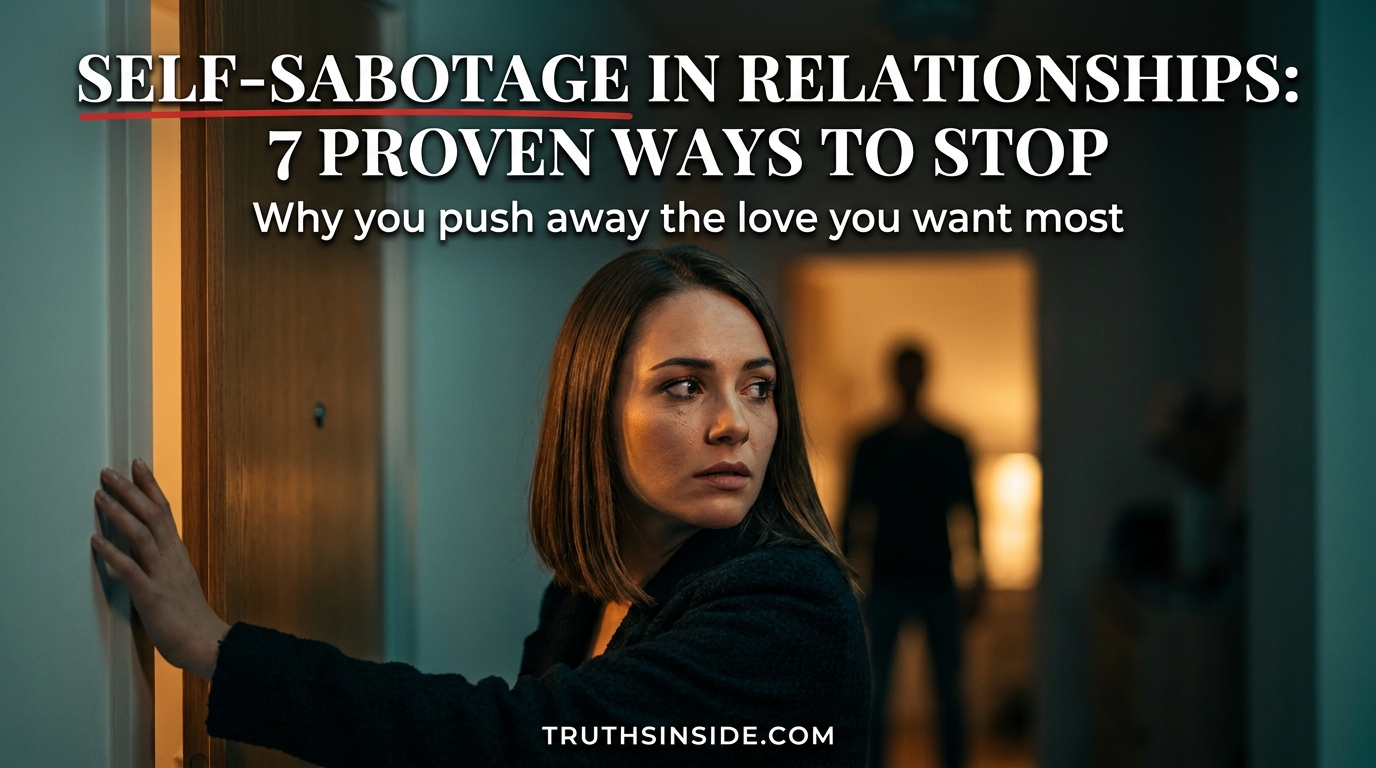
Self-sabotage in relationships can feel like watching yourself set fire to something you spent months building, while a quiet voice asks why you cannot stop. You wanted closeness, and then you picked the fight, went silent, or found a flaw big enough to justify leaving. Afterward comes the confusing mix of relief and grief. If you have lived this pattern more than once, you are not broken, and you are certainly not alone.
Psychology has been studying this puzzle for decades. Social psychologist William Swann’s research on self-verification shows that people often seek out feedback that matches how they see themselves, even when that view is negative. Being understood, even in pain, can feel safer than being loved in a way that does not fit the story we carry about ourselves. Familiar feels safe, even when familiar hurts.
In this guide, you will learn why the pattern forms, how the loop actually works, and seven practical, research-informed ways to interrupt it. You will also learn what to say to your partner, how to handle slips, and when to bring in professional support. The goal is not to become a perfect partner. It is to become a conscious one.

What Is Self-Sabotage in Relationships?
Self-sabotage in relationships is any pattern of thought or behavior that undermines your own connection, happiness, or long-term goals in love, usually without your full awareness. It is not laziness or a lack of caring. More often, it is a protective strategy that once made sense and now works against you.
The key word is “protective.” Every act of self-sabotage is, at some level, an attempt to avoid pain. You leave before you can be left. You criticize first so that no one can criticize you. You keep one foot out the door so the door can never slam on you. The strategy shields you in the short term and costs you dearly in the long term.
The Strange Loop Explained
The phrase “strange loop” comes from cognitive scientist Douglas Hofstadter, who used it to describe a system that moves through levels and somehow arrives back where it started. That is exactly what this pattern feels like. You climb toward intimacy, trust, and commitment, and then a hidden staircase drops you back at the bottom, in the same emotional spot as before.
What makes the loop so strange is that each turn feels like a fresh, logical decision. In the moment, you truly believe the argument matters, the partner is wrong for you, or the timing is off. Only when you zoom out do you see the same shape repeating across months, partners, and years.
Common Forms of Self-Sabotage in Relationships
Self-sabotage in relationships wears many disguises. Some people pick fights right after a tender moment. Others withdraw, going cold or vanishing for days. Some test their partner with impossible standards, such as “If they really loved me, they would know.” Others stay busy, chase perfection, or fall for unavailable people so real intimacy never has to happen.
Quieter forms exist too. You might downplay good news, refuse compliments, compare your partner to an idealized version, or scan for red flags until you find one. Each of these looks different, yet they share a single job: keeping you safe from the vulnerability that love requires.
📃 Related article: Feeling Unloved: 7 Reasons Why and How to Heal Now
Why We Sabotage the Love We Want
No one wakes up and decides to wreck a good thing. These habits are learned, usually early, in environments where closeness came with a cost. Understanding why self-sabotage in relationships takes hold does not excuse harm, but it turns a shameful mystery into a solvable problem. When you can say “this makes sense given what I learned,” self-compassion becomes possible.
Attachment Wounds
Attachment theory, pioneered by John Bowlby and Mary Ainsworth, explains that early caregiving shapes our expectations about closeness. Researchers Cindy Hazan and Phillip Shaver later showed that these same patterns appear in adult romantic love. Someone with an anxious style may cling, protest, and test. Someone with an avoidant style may retreat when intimacy deepens.
Both styles can fuel self-sabotage in relationships. The anxious partner may push so hard for reassurance that the relationship feels suffocating. The avoidant partner may pull away so completely that the other feels abandoned. Different strategies, same root fear: that closeness is not safe.
Familiar Over Happy
Swann’s self-verification theory adds another layer. Our sense of self works like an anchor, and we feel unsettled when someone treats us in a way that contradicts it. If you quietly believe you are unlovable, a devoted partner can feel strangely threatening, because their love challenges your core story.
So the mind looks for ways to restore consistency. You might provoke rejection, dismiss affection, or interpret neutral behavior as coldness. The result confirms the old belief, and the loop closes. It is not that you want to suffer. It is that certainty can feel safer than hope.
Fear of Being Truly Seen
Researchers in the 1970s described self-handicapping, where people create obstacles that protect their self-image if things fail. In love, this can look like not fully investing so that a breakup is not really your fault. If you never gave it everything, rejection stings less.
Underneath, many people carry a deep and often hidden fear: “If you see the real me, you will leave.” Sabotage becomes a way of controlling the ending, choosing the pain you can predict over the pain you cannot.
“You are not afraid of love. You are afraid of what it might reveal about you.”
The Hidden Cost of the Pattern
The damage is not only romantic. Repeated cycles erode trust in yourself, because you begin to believe you cannot be relied upon to keep what you want. Partners may feel confused, rejected, or exhausted by the hot-and-cold rhythm, and they may start protecting themselves in return.
Left unchecked, self-sabotage in relationships can also spill into friendships, work, and health, teaching you to abandon goals whenever they start to succeed. Seeing this cost is not meant to add guilt. It is meant to show why interrupting the loop is one of the kindest things you can do for your future self.
How the Loop Works, Step by Step
Seeing the loop as a sequence makes it far easier to interrupt. While each person’s version differs, most follow four beats that repeat over and over.
First comes the trigger, a moment of real closeness or a small sign of possible rejection, such as a delayed text or a serious conversation. Second comes the threat response. Your body reacts with anxiety, shame, or dread, often before your thoughts catch up. Third comes the protective behavior, whether picking a fight, withdrawing, or finding fault.
Fourth comes the confirmation. The distance or conflict you created seems to prove your fear right, and you conclude that relationships always go this way. That conclusion becomes the fuel for the next trigger. Each pass through the cycle makes the pattern feel more like fate and less like a habit, but it is a habit, and habits can change.
Signs of Self-Sabotage in Relationships
Self-awareness begins with noticing. You may be experiencing self-sabotage in relationships if relationships tend to fall apart right when they become serious, if you often feel a sudden urge to leave after a good day, or if you regularly find your partner “not quite right” once real commitment appears.
Other signs include starting arguments over small things when you feel most vulnerable, pulling away after being praised, checking your partner for signs they will leave, or feeling more comfortable when someone is a little unavailable. None of these alone proves anything. A recurring cluster, however, is worth taking seriously.

Seven Ways to Stop Self-Sabotage in Relationships
Overcoming self-sabotage in relationships does not require a personality transplant. It requires small, repeated moments of noticing and choosing differently. The seven steps below build on each other, so start wherever feels manageable and give yourself time.
Way 1: Name the Loop Out Loud
What we can name, we can begin to manage. Give your pattern a simple label, such as “the exit reflex” or “the test.” When the urge appears, silently say, “This is the loop, not the truth.” Naming creates a small gap between feeling and action, and that gap is where choice lives.
Write down your last few relationship endings or conflicts and look for shared features. Did they follow closeness? Did the same thoughts appear? Seeing the pattern on paper turns a vague sense of failure into clear information you can use.
Way 2: Pause Before You Act
Emotional surges are intense but short. Many psychologists note that the physical wave of an emotion peaks and fades within a couple of minutes if we do not feed it with rumination. When you feel the urge to send the cruel text, cancel the plans, or start the fight, wait.
Try a simple pause routine: breathe slowly for one minute, put your phone down, and walk around the block. Then ask, “What am I actually afraid of right now?” You do not have to suppress the feeling. You only have to avoid acting on it while it is at full volume.
Way 3: Map Your Triggers
Triggers are the specific situations that set off your protective reflex. Common ones include your partner saying “I love you” for the first time, meeting family, planning a future, or being unavailable for a few hours. Keep a short note on your phone each time you feel the urge to sabotage, recording what happened just before.
After a few weeks, patterns emerge. You might discover that evenings alone are riskier, or that praise triggers you more than criticism. Knowing your map lets you prepare, whether by scheduling extra support or planning a calming ritual for those moments.
Way 4: Challenge the Story Behind the Urge
Beneath every sabotaging impulse sits a prediction: “They will leave,” “I am too much,” or “This is too good to last.” Treat these thoughts as hypotheses, not facts. Cognitive behavioral therapy teaches people to examine the evidence for and against a thought and to build a more balanced alternative.
Ask, “What is the evidence? What would I say to a friend? What else could this mean?” If your partner is quiet, perhaps they are tired. If a conversation felt tense, perhaps it was simply hard. A balanced thought does not need to be cheerful, only fair.
Way 5: Practice Tiny Acts of Vulnerability
You cannot think your way out of a fear of closeness. You have to gather new experiences that contradict it. Start small, such as sharing a mild worry, asking for a hug, or accepting a compliment with a simple “thank you.” Each safe experience teaches your nervous system that intimacy does not always end in pain.
Gradually increase the depth. Share a memory that embarrasses you, or admit you felt scared. When your partner responds with warmth, notice it deliberately. Repeated evidence slowly rewrites the old story.
“Every time you stay open and nothing collapses, the loop loses a little of its power.”
Way 6: Tell Your Partner the Truth
Secret struggles grow stronger in the dark. Talking openly about self-sabotage in relationships with a trustworthy partner can transform it from a hidden threat into a shared project. You might say, “Sometimes when things get close, I pull away. It is not about you, and I am working on it. If I go quiet, please ask me gently what is happening.”
Give your partner a role that helps, such as a gentle check-in phrase or a request for a short break instead of a long silence. Honesty also invites accountability. Vulnerability is not a guarantee of perfect behavior, but it makes repair far more likely.

Way 7: Build Self-Worth From the Inside
The deepest work is about how you see yourself. As long as you believe you are unlovable, love will feel like a threat. Building self-worth means treating yourself with the kindness you would offer someone you care about, keeping small promises to yourself, and noticing your strengths without waiting for anyone else to confirm them.
Therapy can accelerate this process, and many therapists treat self-sabotage in relationships as a core focus. Approaches such as CBT, schema therapy, and attachment-focused therapy have helped many people understand and change relationship patterns. A qualified therapist offers something powerful: a steady relationship in which you can practice closeness safely.
📃 Related article: Esther Perel on Desire: 7 Truths About Long-Term Love
When Slips Happen, and They Will
Progress in breaking self-sabotage in relationships is rarely a straight line. You may still pick a fight or pull away sometimes, especially under stress. A slip does not erase your progress. It is data, and it is an invitation to repair.
After a slip, practice a simple repair sequence. Cool down, own your part without over-apologizing, explain what you were feeling, and describe what you will try next time. Repair itself is a skill, and couples who repair well often become stronger than those who never fight at all.
Over time, the space between trigger and reaction grows. What once took days to notice takes hours, then minutes, and eventually you catch the urge as it rises. That is what change looks like: not the absence of the pattern, but a new relationship with it.
Frequently Asked Questions
Is self-sabotage in relationships a mental illness?
No. It is a pattern of behavior, not a diagnosis. It can appear alongside anxiety, depression, or trauma responses, and a therapist can help you tell the difference. For most people, it is a learned protective habit that can be changed with awareness and practice.
Why do I sabotage good relationships but not bad ones?
Chaos and distance can feel familiar, while steady kindness can feel unsettling if it contradicts your inner story. Good relationships also carry more to lose, which activates fear. That is why the pattern often surfaces just as things become genuinely healthy.
Can I stop this pattern without therapy?
Many people make real progress through self-awareness, journaling, honest conversations, and consistent practice. Therapy is especially helpful when the pattern is deeply rooted, tied to past trauma, or causing serious distress. There is no shame in seeking support.
How long does it take to change?
There is no fixed timeline. Many people notice early shifts within weeks of practicing awareness, while deeper change often takes months or longer. Progress is measured by shorter recovery times and better repair, not perfection.
What if my partner is the one who sabotages?
Stay compassionate but keep your boundaries. Share how the behavior affects you, avoid taking it personally, and encourage professional help. You cannot fix another person, but you can decide what you will and will not accept.
Final Thoughts
The strange loop of self-sabotage in relationships is not a life sentence. It is a story your mind learned in order to protect you, and stories can be rewritten. Every pause, honest sentence, and small act of vulnerability adds a new line.
You deserve love that feels safe enough to stay in, free from self-sabotage in relationships. Start with one step this week, whether that is naming the loop, mapping a trigger, or telling someone you trust the truth. Change begins the moment you choose to notice.
Save this article so you can return to it whenever the urge to run appears. Share it with someone who needs to know the pattern has a name. Follow Truthsinside.com for more honest, research-backed psychology and relationship insights every day.
🎵 Music
Maren Lull is a singer-songwriter who writes from the places most people don’t talk about out loud.
Not the dramatic grief. Not the obvious heartbreak. The quiet kind — the ordinary Tuesday emptiness, the habit of reaching for someone who isn’t there anymore, the particular exhaustion of being strong for so long that the strength itself wears thin.
Her music lives at the intersection of emotional honesty and soft beauty — breathy vocals over gentle piano, slow tempos, lyrics that feel less like songs and more like something you wrote in a private notebook at two in the morning and never showed anyone.
Maren Lull writes for the people who feel everything deeply and say very little about it. For the ones who listen to sad music not because they want to feel worse — but because being understood, even by a song, makes the feeling easier to carry.
📱 Follow Maren Lull:
→ Spotify
→ Apple Music
→ Youtube
→ Audiomack