The Difference Between Neediness and Healthy Attachment in Love
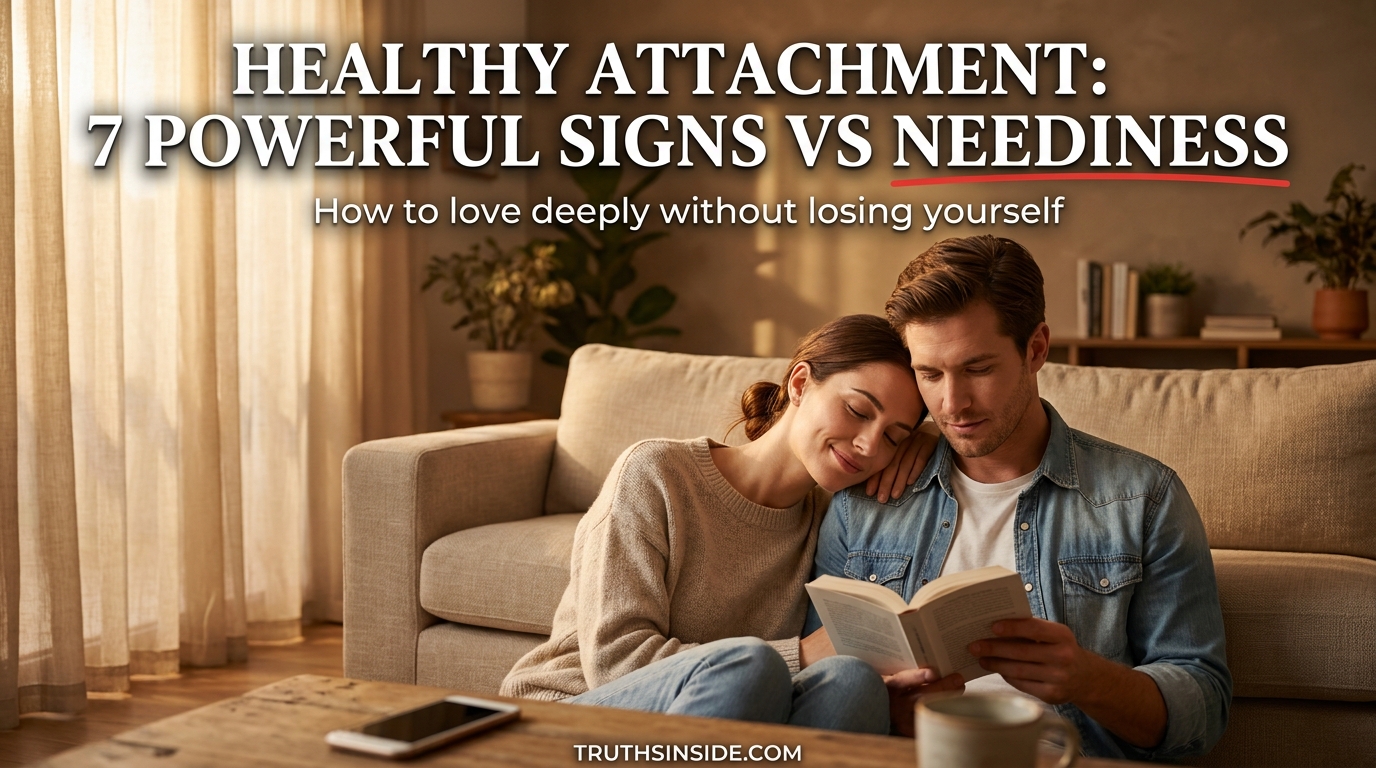
Healthy attachment is one of the most misunderstood ideas in modern love. You want to be close to your partner, you miss them when they are gone, and you feel a little uneasy when they go quiet. Then a friend, a podcast, or your own inner critic whispers that you are “too needy.” Suddenly you are not sure whether your feelings are normal, or whether wanting connection is somehow a flaw.
Psychology offers a reassuring answer. Attachment theory, developed by John Bowlby and Mary Ainsworth, shows that the need for emotional closeness is built into human biology. Later research by Brooke Feeney described a “dependency paradox”: people who feel free to lean on a responsive partner actually become more confident and independent. In other words, needing someone is not the enemy of strength.
The real question is not whether you need your partner, but how that need shows up. This guide explains the difference between neediness and healthy attachment, gives you seven clear signs to tell them apart, and offers practical steps to grow toward security. You deserve love that feels steady, not frantic.

What Healthy Attachment Really Means
Healthy attachment is a bond in which two people feel emotionally connected and also free to be themselves. You can express needs, receive comfort, and give support without fear of being abandoned or swallowed up. Closeness feels like a safe home base rather than a test you must keep passing.
Researchers often call this secure attachment. People with a secure style tend to trust that their partner will be there when it counts, so they can tolerate distance, disagreement, and time apart without panic. They are not free of emotion. They simply believe that love can survive discomfort.
The Secure Base Effect
Mary Ainsworth observed that securely attached children explore the world confidently when they know a caregiver is available to return to. Adults work the same way. When you trust your partner as a secure base, you take more risks, pursue goals, and handle stress with less fear.
This is why healthy attachment strengthens independence instead of shrinking it. Your partner becomes a launching pad and a landing place. You go out into life knowing there is someone to come back to, and that knowledge lowers anxiety instead of raising it.
The Dependency Paradox
Feeney’s research found that when partners respond warmly to each other’s needs, both people grow more self-sufficient over time. Accepting support does not weaken you. It builds the confidence to stand on your own.
Couples therapist Sue Johnson, founder of Emotionally Focused Therapy, described this as “effective dependence”: the ability to turn toward a partner in need and to be a reliable presence in return. Under this view, healthy attachment is not a compromise between closeness and independence. It is the foundation of both.
“Needing someone is not weakness. Being terrified of losing them is what turns a need into neediness.”
What Neediness Actually Is
Neediness is not a personality defect or a sign that you love too much. It is a pattern in which the need for closeness becomes so urgent, and so tied to fear, that it demands constant reassurance and leaves little room for the other person’s needs. It is love driven by anxiety rather than trust.
At the core of neediness is usually a belief such as “If they pull away, I am not lovable,” or “I cannot be okay unless they are okay with me.” The person is not trying to be difficult. They are trying to quiet a very loud alarm inside.
Where Neediness Comes From
Neediness often grows from early experiences in which love felt inconsistent. A caregiver who was sometimes warm and sometimes absent can teach a child that closeness must be chased and guarded. Later, that child, now an adult, may scan romantic partners for the slightest sign of withdrawal.
Attachment researchers Mario Mikulincer and Phillip Shaver describe this as hyperactivating strategies: intensifying emotions and behaviors, such as calling, texting, or protesting, to draw a partner closer. These behaviors are attempts to feel safe, even if they sometimes push people away.
Neediness Is Not a Moral Failing
It helps to remember that neediness is a strategy learned in the past, not proof of a flawed character. Shame usually makes it worse, because shame increases fear of rejection, which increases the urge to seek reassurance. Compassion, on the other hand, calms the alarm.
You can hold two truths at once: your behavior may be affecting your relationship, and you are still worthy of love. Growth starts when you can look at the pattern without hating yourself for it.
One Delayed Text, Two Different Stories
Imagine two people who each send a message and receive no reply for three hours. The first feels a flicker of disappointment, remembers that their partner has a busy day, goes for a walk, and enjoys a call later that evening. Nothing dramatic happened, and the bond stayed intact.
The second feels their chest tighten. They reread the message, check the app for “last seen,” and begin composing theories: they are angry, they are losing interest, they met someone else. By the time a reply arrives, the anxious person may be defensive or cold, and a simple delay has become a conflict.
Both people love their partner. The difference is not the depth of feeling but the story the mind tells about distance. Learning to question that story is one of the most powerful skills in love.
Why Modern Dating Makes Neediness Louder
Technology has quietly raised the stakes. Read receipts, last-seen timestamps, and constant social media updates give the anxious mind endless material to interpret. What once required waiting for a phone call now turns into minute-by-minute surveillance, and ambiguity becomes a source of distress.
If this sounds familiar, consider building small boundaries with your devices. Turn off read receipts, mute notifications during work, and set specific times to connect. These steps are not about withholding love. They are about protecting your nervous system from constant false alarms.
📃 Related article: Feeling Unloved: 7 Reasons Why and How to Heal Now
Seven Signs That Separate Neediness From Healthy Attachment
Comparing the two patterns side by side makes the difference easier to feel. Keep in mind that everyone shows both sides at times. What matters is the overall direction and how quickly you can return to steadiness.
1. How You Handle Distance
With healthy attachment, time apart feels manageable. You may miss your partner, but you can enjoy your day, trust that they will reply when they can, and reconnect warmly. Neediness treats distance as a threat. A delayed text can trigger a spiral of worst-case stories.
Ask yourself: when my partner is busy, do I feel curious and trusting, or panicked and suspicious? The answer says a great deal about which pattern is active.
2. How You Ask for Reassurance
Everyone wants reassurance sometimes. Healthy attachment asks openly and accepts the answer: “I had a rough day and could use a hug.” Neediness asks repeatedly, and the answer never seems to be enough. “Do you still love me?” becomes a daily ritual because the comfort fades within minutes.
If reassurance feels like a bucket with a hole in it, the work is usually inside you rather than in more words from your partner.
3. How Much of Yourself You Keep
Healthy attachment leaves room for friends, hobbies, goals, and quiet time. You share your life with your partner without disappearing into it. Neediness can shrink your world until your partner is the only source of your happiness, and your mood rises and falls with theirs.
A useful test is to notice whether your life outside the relationship is growing, holding steady, or shrinking. Love should add to your life, not replace it.
4. How You Behave in Conflict
In healthy attachment, conflict is uncomfortable but survivable. You can voice a complaint, listen, and repair. Neediness may treat every disagreement as a sign the relationship is ending, leading to pleading, panicking, or giving in immediately to restore peace.
John Gottman’s research shows that stable couples do not avoid conflict; they repair after it. Repair is far easier when you believe love can survive an argument.
5. Whether You Ask or Demand
Healthy attachment expresses needs clearly and allows for a no. “I would love more time together this week. Can we plan something?” Neediness tends to express needs through pressure, guilt, or tests: “If you really cared, you would have known.”
The difference is respect for choice. A request leaves your partner free. A demand punishes them for saying no, and over time that erodes the very closeness you crave.

6. How You Relate to Trust and Jealousy
Healthy attachment does not mean never feeling jealous. It means noticing the feeling, sharing it kindly if needed, and not treating your partner as a suspect. Neediness may lead to checking phones, monitoring social media, or interrogating, all in a desperate attempt to feel safe.
Surveillance never creates security. It only proves that the fear is winning. Trust is built through openness on both sides and through your own ability to tolerate uncertainty.
7. Where Your Self-Worth Comes From
This may be the deepest difference. In healthy attachment, your partner’s love feels wonderful but does not define your value. You have an inner foundation. In neediness, your worth rises and falls with their attention, so every sign of distance feels like a verdict.
Building an inner foundation does not mean needing less love. It means being able to stay yourself while receiving it.
📃 Related article: Surviving Romantic Rejection: 8 Steps to Heal Fast
How to Move Toward Healthy Attachment
Change begins with awareness and grows through practice. You do not need to become a different person. You need to build a calmer relationship with your own emotions so that closeness stops feeling like an emergency.
Notice the Alarm and Name It
When the urge to text, check, or seek reassurance appears, pause and say to yourself, “My attachment alarm is going off.” This simple naming creates space between feeling and action. Then take a slow breath and ask what you actually need in that moment: comfort, connection, or simply a distraction.
Soothe Yourself First
Build a short toolkit of calming habits: a walk, music, journaling, a call with a friend, or a grounding exercise. Self-soothing does not mean ignoring your needs. It means proving to your nervous system that you can be okay for an hour without a response. Over time, that proof rebuilds trust in yourself.
Ask Clearly and Kindly
Practice replacing tests with direct requests. Instead of sulking, try “I have been missing you. Could we have a call tonight?” Then let your partner respond honestly. If the answer is no, treat it as information, not rejection, and offer yourself some care.
Grow Your Own Life
Reinvest in friends, interests, and goals that have nothing to do with the relationship. A fuller life naturally reduces the pressure on any one person to meet all your emotional needs. You become someone who chooses love rather than clings to it.

Consider Support
Therapy, especially attachment-focused approaches, schema therapy, or Emotionally Focused Therapy, can help you understand your patterns and build secure habits. Many people find that even a few months of guided work changes how they experience love.
Support does not have to be formal. A trusted friend who listens without judgment, a support group, or a well-chosen book on attachment can also help you feel less alone. What matters is having at least one place where you can be honest about your fears and practice new responses before you use them in your relationship.
If You Are Loving Someone Who Feels Needy
If your partner tends toward neediness, compassion and clarity go together. You can reassure them warmly while still keeping your own boundaries. Consistency helps enormously: doing what you say, communicating plans, and repairing after conflict all build trust.
At the same time, you are not responsible for managing your partner’s emotions all day. It is fair to say, “I care about you, and I cannot be available every minute. Let us find a rhythm that works for both of us.” Encourage your partner to build self-soothing skills and consider support, while remembering you cannot heal them.
The Opposite Trap: Pretending You Have No Needs
Some people, afraid of being labeled needy, overcorrect. They suppress their needs, avoid asking for anything, and insist they are fine. This is not healthy attachment. It is avoidance, and it can leave both partners lonely.
Healthy attachment includes the courage to say, “I need you,” and to hear it in return. The goal is not to need less. The goal is to need well.
Common Myths About Attachment and Neediness
Myth one is that secure people never feel anxious. In truth, they feel anxiety like everyone else, but they recover faster and interpret events more generously. Myth two is that needing reassurance means you are broken. Everyone needs comfort at times, and asking is part of a strong bond.
Myth three is that independence is the opposite of intimacy. As the research shows, the two grow together. The final myth is that attachment patterns are fixed for life. They are not. With awareness, supportive relationships, and sometimes professional help, people move toward security at any age.
Frequently Asked Questions
Is being needy the same as being anxious in love?
Not exactly. Anxious attachment is a pattern of feeling and thinking, while neediness describes behaviors that can arise from it. Many anxiously attached people can love in healthy ways, especially with self-awareness and a responsive partner.
Can healthy attachment develop later in life?
Yes. Researchers describe “earned security,” in which people who began with insecure patterns build secure ones through supportive relationships, therapy, and self-reflection.
How much reassurance is too much?
There is no fixed number, but a helpful sign is whether reassurance actually settles you. If you need it repeatedly and still feel uneasy, the anxiety may be coming from within.
Is wanting to spend a lot of time together unhealthy?
Not at all. Enjoying lots of time together is fine when both people want it and life outside the relationship stays alive. Problems arise when closeness becomes pressure or when one person’s world shrinks.
What if my partner and I have different needs for closeness?
That is very common. Talk openly, look for a middle rhythm, and treat each other’s needs as valid. Couples counseling can help you find a balance both of you can feel good about.
Final Thoughts
Wanting closeness does not make you weak, and asking for love does not make you a burden. Healthy attachment is not about needing less. It is about feeling secure enough to give and receive love without fear running the show.
Be patient with the process. Old patterns took years to form, and they will not disappear in a week, but each calm response strengthens a new one. Progress often looks like recovering faster, not never feeling afraid.
Start small. Notice your alarm, soothe yourself, ask kindly, and keep your own life growing. Each time you do, you send a message to your nervous system: love is safe, and I am enough.
Save this article for the moments when your anxiety speaks louder than your trust. Share it with someone who needs to know their need for love is normal. Follow Truthsinside.com for more honest, research-backed insights on love and emotions every day.
🎵 Music
Maren Lull is a singer-songwriter who writes from the places most people don’t talk about out loud.
Not the dramatic grief. Not the obvious heartbreak. The quiet kind — the ordinary Tuesday emptiness, the habit of reaching for someone who isn’t there anymore, the particular exhaustion of being strong for so long that the strength itself wears thin.
Her music lives at the intersection of emotional honesty and soft beauty — breathy vocals over gentle piano, slow tempos, lyrics that feel less like songs and more like something you wrote in a private notebook at two in the morning and never showed anyone.
Maren Lull writes for the people who feel everything deeply and say very little about it. For the ones who listen to sad music not because they want to feel worse — but because being understood, even by a song, makes the feeling easier to carry.
📱 Follow Maren Lull:
→ Spotify
→ Apple Music
→ Youtube
→ Audiomack