Red Flags That Someone Is Emotionally Cheating
Emotional cheating rarely feels like betrayal from the inside. There is no hotel room and no lipstick on a collar, only a slow shift: your partner’s best stories, deepest worries and funniest thoughts begin flowing toward someone else. If you have felt a cold, confusing sense that something is off but could not prove it, you are not paranoid. You are paying attention.
Psychologist Shirley Glass, who spent years studying infidelity, documented how many affairs grow out of ordinary friendships that slowly cross an invisible line, often with people who never planned to hurt anyone. Emotional cheating lives in the gap between what we call innocent and what actually bonds two people together.
This guide explains what emotional cheating is, the seven red flags that matter most, how to tell it apart from a healthy friendship, and what to do next, calmly and without losing yourself.
What Is Emotional Cheating?
Emotional cheating happens when one partner invests intimacy, vulnerability and emotional energy in someone outside the relationship in a way that rivals or replaces what they share with their partner. There may be no physical contact at all. The betrayal lies in the redirection of closeness, trust and secrecy that was supposed to belong to the couple.
Researchers and therapists often call it an emotional affair. It usually has three ingredients: deep personal sharing, a special chemistry or sense of being uniquely understood, and some level of secrecy or minimizing. When all three appear together, the friendship has become something else, even if both people insist it is “just talking.”
Why does it hurt so much? Because many people feel that emotional closeness is the very thing that makes a relationship theirs. Many surveys find that large numbers of people say emotional betrayal can wound as deeply as, or even more than, a physical one. Emotional cheating tells you that the person you trust most has chosen someone else to confide in, and that can feel like losing your place in their world.

How Emotional Cheating Differs From a Healthy Friendship
You are allowed to have friends, including friends of any gender. Healthy friendships add to a life without taking from the couple. So the question is never “does my partner have friends?” The better question is “what is this connection doing to our relationship?”
A useful rule of thumb comes from Glass’s “walls and windows” idea. In a healthy relationship, there are walls around the couple that protect their privacy and windows to the outside world that stay open. In emotional cheating, the pattern flips. A wall goes up between you and your partner, while a window opens wide to the other person, and secrets and intimacy flow through it.
Ask three questions. Would my partner share the same details with me that they share with this person? Would they be comfortable if I read the whole conversation aloud? Has this connection grown while our connection shrank? If the answers are no, no and yes, you may be looking at emotional cheating rather than friendship. None of these questions is proof, but together they point at the pattern.
Why Emotional Cheating Happens
Most people who drift into emotional cheating do not wake up planning it. It usually begins with something small and unmet: a feeling of being unseen at home, stress, boredom, loneliness or a long stretch without real conversation. Then someone appears who listens closely, laughs at the right moments and asks the questions the partner stopped asking.
The slope is slippery because each step feels harmless. A friendly chat becomes a daily check-in. The check-in becomes a place to vent about home. Venting becomes a feeling of being understood. By the time the closeness has a charge, the person is already invested, and the secrecy has begun to protect it.
This explanation does not excuse the behavior. Emotional cheating is a series of choices, and each one could have gone another way. But understanding the pattern helps in two ways. It shows that betrayal can grow in ordinary, decent people, and it points toward the real repair: rebuilding the connection that went quiet long before the other person arrived.
📃 Related article: Charisma as a Red Flag: 7 Dangerous Signs to Spot
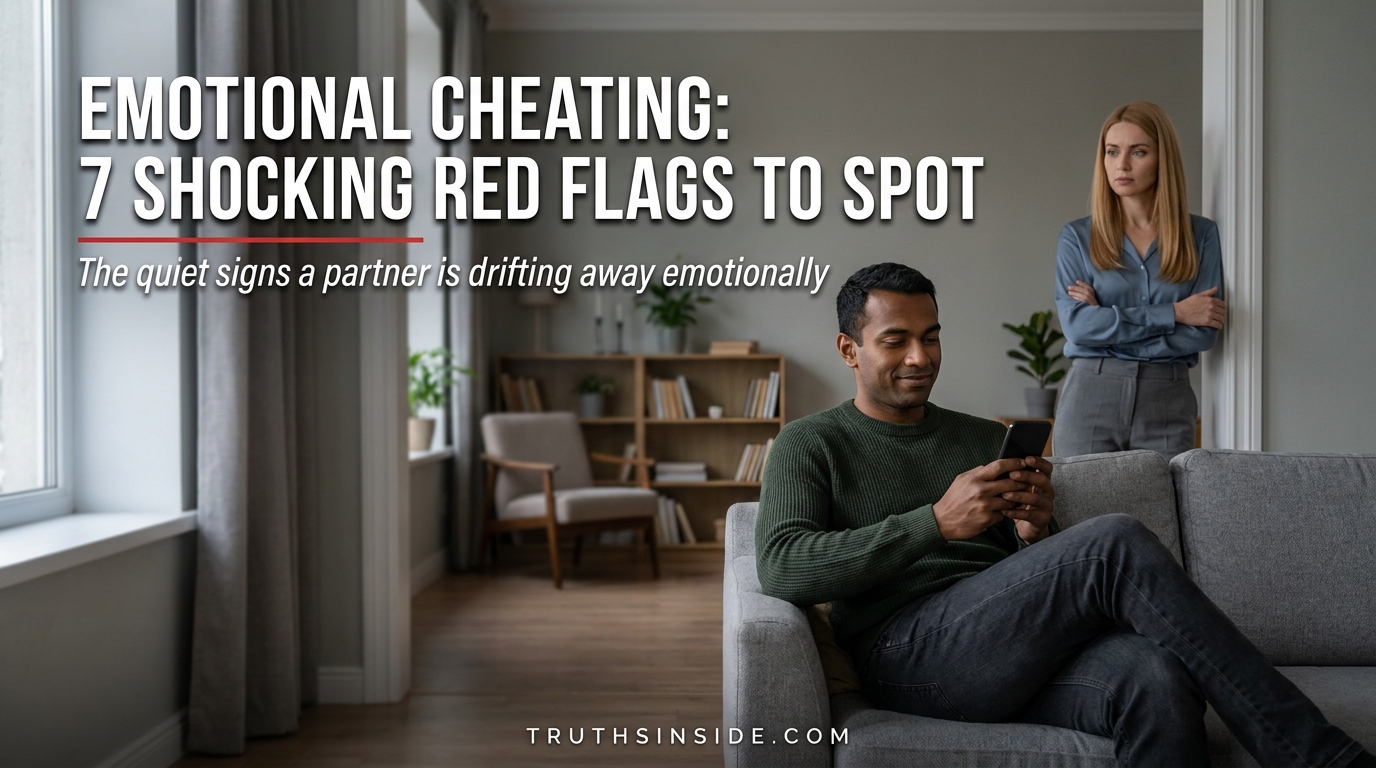
7 Shocking Red Flags of Emotional Cheating
One warning first. Any single sign below can have an innocent explanation, and these are patterns, not proof. Look for clusters that appear together and last over time, especially a sudden change from how your partner usually behaves.
Red Flag 1: Secrecy Around One Specific Person
Everyone deserves privacy, so the flag is not a locked phone. The flag is targeted secrecy about one person. Your partner angles the screen away when a certain name appears, leaves the room to reply, changes the subject when that person comes up or gives vague answers to simple questions. Emotional cheating survives on secrecy, because honesty would force the closeness to be named and examined.
Red Flag 2: They Share Their Inner World With Someone Else First
Pay attention to who hears the news first. When your partner gets a promotion, a scare or a funny idea, whose name do they think of? In emotional cheating, the outside person becomes the first call, and you learn important things secondhand. You may even hear “you would not understand” or “they just get it.” That sentence is a window opening while the wall goes up.
Red Flag 3: Constant Contact and Disappearing Time
Texts all day, late-night chats, long “work” calls that do not seem like work and a phone that is always within reach all signal a connection with high priority. Emotional cheating tends to eat time and attention that once belonged to the relationship. Notice whether the other person gets the energetic, curious version of your partner while you get the tired one.
Red Flag 4: Visible Excitement When the Other Person Appears
Watch the small physical signals. A soft smile at a notification, a brightening of mood after a message, extra care over appearance on days they will meet, and a protective or irritated tone when you ask about them all matter. Real friendships can produce joy too, but emotional cheating often produces a particular lit-up, almost guilty glow that is missing at home.
Red Flag 5: Pulling Away From You
As emotional energy flows outward, less is left for you. Your partner may become distracted, less affectionate, less interested in your day, or slow to initiate conversation and intimacy. They may seem irritable at small things or oddly flat in your presence. When the distance appears at the same time as the new closeness, emotional cheating becomes a serious possibility.
Red Flag 6: Comparing You or Complaining About You
If your partner begins to criticize you more, hold you against someone else’s qualities or hint that they are misunderstood at home, take note. People in an emotional affair often rehearse a story in which the relationship is the problem, which makes the outside bond feel justified. You may also learn that the other person knows detailed information about your private struggles.
Red Flag 7: Defensiveness, Blame and Gaslighting When You Ask
Your gentle question is met with anger, mockery or a flip of the script. “You are jealous.” “You are controlling.” “You are imagining things.” Defensiveness alone is not proof, since being accused hurts. But a pattern of blame instead of reassurance, especially paired with changing stories, is a strong sign that emotional cheating may be present. A partner with nothing to hide can usually answer calmly and offer openness.
The loudest betrayal in a relationship is often the quietest: the day your partner’s heart starts living somewhere you are not invited.

Emotional Cheating or Just a Close Friendship? A Quick Test
Because the line is blurry, use this simple test before drawing conclusions. It works best when you answer honestly about patterns, not single moments.
Look at transparency first. A true friendship usually survives daylight. You know the person’s name, you have met them, and your partner talks about them casually. Emotional cheating usually thrives in the shadows, where the person is hidden, minimized or described with conflicting stories.
Look at priority next. Does this connection take time, energy or emotional intimacy that your partner used to give you? Then look at exclusivity. Is your partner saying things to this person that they never say to you? Finally, look at impact. Has the relationship become colder, more tense or more secretive since this person grew closer? The more of these questions that raise concern, the more likely it is that the situation has moved beyond friendship and into emotional cheating territory.
What to Do If You Suspect Emotional Cheating
First, breathe. Your stomach may be telling you something, but a gut feeling is a reason to talk, not a verdict. Resist the urge to spy, check devices secretly or confront your partner in public. Those moves usually damage your own sense of dignity and make honest conversation harder, even if your suspicion is right.
Write down specific, factual examples of what you have noticed, such as the last three times your partner hid a conversation or the evenings you spent alone. This keeps you grounded and helps you stay calm. Then pick a private, unhurried time when neither of you is tired or angry, and plan to speak about your experience, not to prosecute.
Check in with yourself, too. Ask what you need: honesty, a boundary, a change in behavior, couples therapy or some space. Knowing your own bottom line before the conversation gives you steadiness when emotions run high. It also helps you notice whether your partner responds with care or with blame.
How to Talk About Emotional Cheating Without Starting a War
Open with your feelings and observations instead of accusations. For example: “I have felt a distance between us lately, and I have noticed you seem closer to Jordan than to me. I am not trying to blame you. I want to understand what is happening.” This invites an honest answer instead of a defensive one.
Then listen. A trustworthy partner will usually show concern, answer directly and be willing to create transparency, even if the news is uncomfortable. They may admit that the friendship went further than it should have and offer to set limits. Those are good signs, because they show that the bond with you still matters.
Be ready for defensiveness, too. If your partner dismisses you, mocks your feelings or turns every point back on you, stay with the facts. Say, “I am not calling you a bad person. I am telling you what I have seen and how it feels.” If they refuse to discuss it at all, that response is also information about how safe the relationship is.

Can a Relationship Recover From Emotional Cheating?
Many couples do recover, but recovery takes honesty and effort from both people. Studies and clinical experience suggest that healing usually requires the partner who crossed the line to end or sharply limit the outside connection, take responsibility without excuses and answer questions openly. Without that, the hurt partner is left guarding a door that never stays closed.
Trust is rebuilt through consistent small actions, not one big apology. That might include transparency about communication, regular check-ins, showing up when they say they will and willingness to listen to pain without defending. The hurt partner also needs time. Trust returns slowly, and anger, sadness and doubt may come in waves.
Couples therapy can help enormously, because a trained professional can guide the conversation when emotions are too raw. It can also explore what was missing before the outside bond formed, so that the repair is not only about removing a person but about rebuilding closeness. Emotional cheating is serious, yet it is not always the end of a relationship. Whether it becomes the end depends on what both people do next.
Trust is not rebuilt by promises. It is rebuilt by a thousand small moments of being exactly where you said you would be.
When Emotional Cheating Is a Reason to Walk Away
Some situations deserve a firmer decision. If your partner keeps denying obvious facts, continues the secret bond after promising to stop, shifts blame onto you repeatedly or turns every honest conversation into a punishment, staying may cost more than it gives. Repeated deception wears away your sense of reality as well as your trust.
Ask yourself a few questions. Do I feel respected? Can I believe what I am told? Has my partner shown real change, not just words? You do not need perfect certainty about every detail to decide that the relationship no longer meets your basic needs. Your peace and self-respect count as evidence too.
If the dynamic ever includes threats, intimidation or controlling behavior, please treat it as a safety matter. In the United States, the National Domestic Violence Hotline is available at 1-800-799-7233. Leaving a relationship is hard, but you deserve a partner who treats your heart as precious.
If You Are the One Drifting Into Emotional Cheating
It takes courage to ask whether you are the person crossing the line. If several red flags in this article sounded like you, pause and be honest about what the connection gives you that you feel is missing at home. The answer matters more than the label, because it shows what needs attention.
Then act. Reduce contact or end it, tell your partner the truth rather than waiting to be caught, and put your energy into the relationship that deserves it. A confession is painful, but secrecy is the soil in which emotional cheating grows. Seeking therapy can help you understand your patterns and avoid repeating them.
Remember that wanting to feel seen is human. The question is where you bring that need. Bring it to your partner first, even when the conversation is awkward, because that single choice often separates a relationship that heals from one that quietly breaks.
📃 Related article: Red Flags in New Relationships: 7 Alarming Signs
FAQ: Emotional Cheating
What is emotional cheating?
Emotional cheating is a form of infidelity in which someone gives deep emotional intimacy, secrecy and attention to a person outside their relationship, often without physical contact. It takes the closeness that should belong to the couple and sends it elsewhere.
Is emotional cheating as bad as physical cheating?
Many people say it can be just as painful, and sometimes more so, because it involves trust and emotional closeness. How it feels depends on each couple’s values and boundaries, which is why discussing expectations openly is so important.
What are the first signs of emotional cheating?
Early signs include targeted secrecy, sharing news with someone else first, more time spent texting, a lit-up mood around that person and growing distance at home. Look for clusters and changes from your partner’s usual behavior.
Can emotional cheating happen with a coworker or online friend?
Yes. Emotional cheating can happen anywhere intimacy grows, including workplaces, social media and gaming communities. The setting matters less than the secrecy, the emotional depth and the way it affects your relationship.
Should I check my partner’s phone if I suspect emotional cheating?
Secretly checking devices usually deepens mistrust and can lead to conflict without answering the real question. A calm, honest conversation, perhaps with a couples therapist, is more likely to reveal the truth and protect your dignity.
Final Thoughts
Emotional cheating is painful because it hides in plain sight. It rarely arrives with proof, only with a feeling that you have been moved from the center of someone’s world to its edge. Naming that feeling is not weakness. It is the first step toward clarity.
Whatever you decide, protect your self-respect, speak honestly and seek support from trusted people or a therapist. You deserve a relationship where closeness is shared openly, where your voice matters and where you never have to compete for a place in your partner’s heart.
Found this helpful? Please do three things:
- Save this article so you can come back to the seven red flags whenever you need clarity.
- Share it with someone who may be doubting their instincts.
- Follow Truthsinside.com for more honest relationship insights and red flag guides.
🎵 Music
Maren Lull is a singer-songwriter who writes from the places most people don’t talk about out loud.
Not the dramatic grief. Not the obvious heartbreak. The quiet kind — the ordinary Tuesday emptiness, the habit of reaching for someone who isn’t there anymore, the particular exhaustion of being strong for so long that the strength itself wears thin.
Her music lives at the intersection of emotional honesty and soft beauty — breathy vocals over gentle piano, slow tempos, lyrics that feel less like songs and more like something you wrote in a private notebook at two in the morning and never showed anyone.
Maren Lull writes for the people who feel everything deeply and say very little about it. For the ones who listen to sad music not because they want to feel worse — but because being understood, even by a song, makes the feeling easier to carry.
📱 Follow Maren Lull:
→ Spotify
→ Apple Music
→ Youtube
→ Audiomack