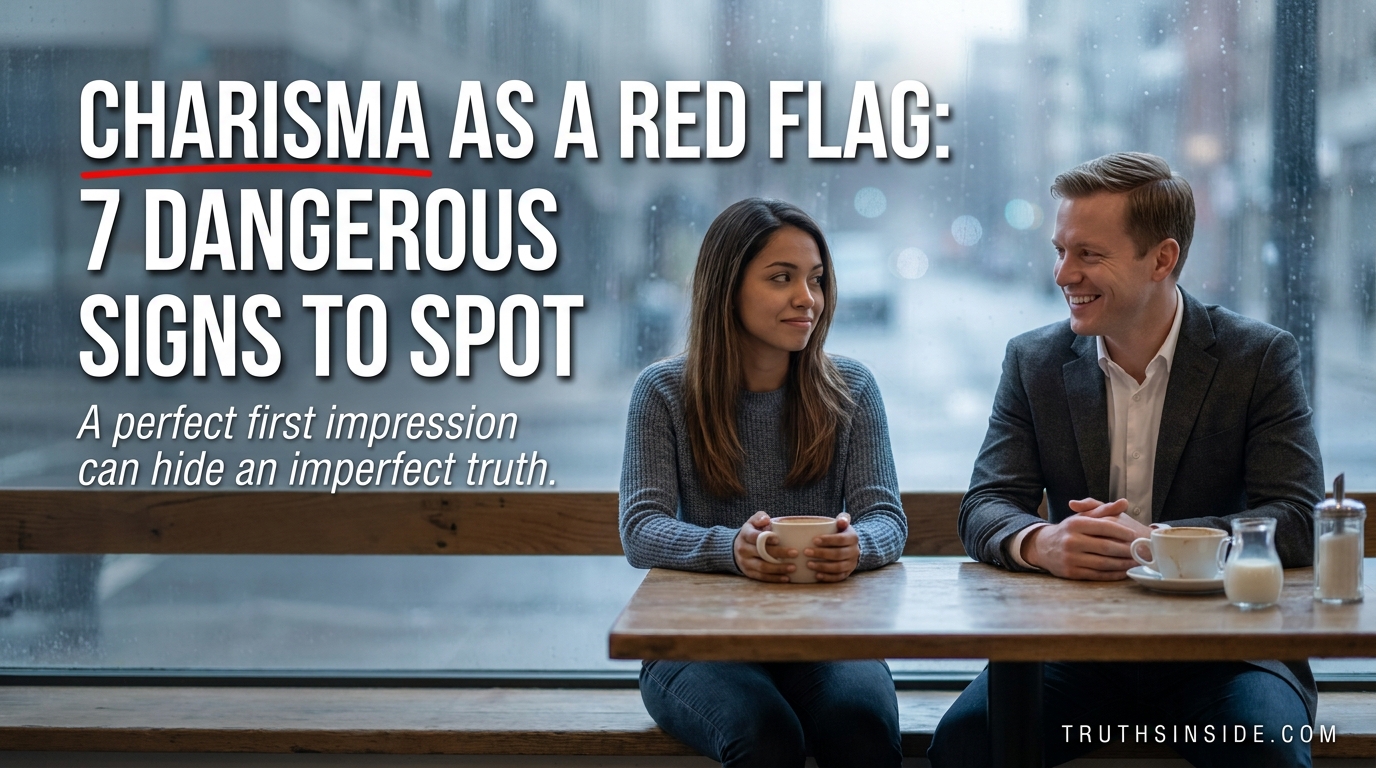
Charisma as a Red Flag: When Being Charming Is Actually Dangerous
Treating charisma as a red flag sounds almost unfair. Charm is usually a gift, and many of the warmest, funniest, most magnetic people are also kind and trustworthy. But charm is also a tool, and in the wrong hands it can be used to disarm, flatter, and control. If someone swept you off your feet so quickly that you never had time to think, it may be time to look a little closer.
Science offers a clue. In a well-known study by Back and colleagues, 73 students who had never met introduced themselves to their class. Those who scored higher on narcissistic traits were liked more at first sight, partly because of charming expressions, confident voices, and polished appearances. Over time, that advantage faded. Charisma as a red flag does not mean charm is bad. It means charm should be tested by time, consistency, and character.
This guide explains what charisma as a red flag really means, why we fall for charm so easily, and seven dangerous signs to watch for. You will also learn how to protect yourself and what to do if you already feel hooked. This is education, not diagnosis, and it is meant to help you trust your instincts.

What Does Charisma as a Red Flag Really Mean?
Charisma as a red flag does not mean that every charming person is dangerous. Charisma is a real social skill, and countless people use it to lift others up, lead teams, and make friends. The warning sign appears when charm is used as a substitute for honesty, empathy, or accountability. Charm becomes a red flag when it works like a mask rather than a window.
Think of it this way. A genuinely kind person is charming because they care about you. A manipulative person is charming because it gets them what they want. On the surface, both may smile, compliment, and listen. The difference shows up over time, in how they handle your boundaries, your “no,” and your needs when those needs are inconvenient.
That is why charisma as a red flag is a question of pattern, not personality. One magnetic first date proves nothing in either direction. But when charm is intense, fast, and strangely consistent only when it benefits them, it deserves attention. The goal is not to distrust everyone attractive or funny. It is to stay curious until their actions match their words.
📃 Related article: Red Flags in New Relationships: 7 Alarming Signs
Why We Fall for Charm So Easily
Humans are wired to trust warm, confident people. Psychologists describe the halo effect, in which one appealing quality, such as a great smile, makes us assume other positive qualities. A charming person seems more intelligent, kind, and honest simply because they feel good to be around. That shortcut is usually harmless, but charisma as a red flag exploits it.
Charm also meets emotional needs. If you are lonely, tired, or recovering from heartbreak, being chosen with enthusiasm feels like relief. Flattery lights up the same parts of us that crave belonging. A skilled charmer may sense this and mirror your interests, finish your sentences, and make you feel uniquely understood, which can bypass the slower, more careful part of your thinking.
Finally, we tend to forgive early warning signs when the experience feels wonderful. We tell ourselves that the odd comment was a joke, or that the quick pace is just chemistry. Understanding why we fall for charm is not about blaming yourself. It is about recognizing that charisma as a red flag works precisely because it feels so good.
“Charm is not the problem. Charm without accountability is.”
7 Dangerous Signs of Charisma as a Red Flag
None of these signs prove that someone is dangerous on their own. Treat them as questions to explore. When several appear together, and especially when they persist over weeks and months, they suggest that the charm may be covering something more concerning.
Sign 1: It Moves Unusually Fast
Constant texts, grand gestures, declarations of love within days, and talk of a shared future after a few dates can feel thrilling. This pattern is often called love bombing. In the context of charisma as a red flag, speed matters because it leaves little time for you to observe their character. Intensity can feel like intimacy, but real trust takes time to build.
Notice how you respond when you ask to slow down. A respectful partner says, “Of course, let’s go at your pace.” A person using charm as a tool may sulk, guilt you, or turn cold. Their reaction to a simple boundary tells you more than their romantic words ever could.
Sign 2: The Flattery Feels Too Perfect
Compliments are lovely, but flattery that is constant, over-the-top, or oddly tailored to your insecurities deserves attention. If they seem to know exactly what you want to hear, you may be seeing a performance rather than genuine curiosity.
Healthy admiration is specific and balanced. It also includes honesty. A person who respects you can disagree, offer gentle feedback, and tolerate your independence. When praise is non-stop and disappears the moment you disagree, charisma as a red flag may be at work. Real affection is not a reward system.
Sign 3: Charisma as a Red Flag Is Selective
Watch how they treat people who cannot benefit them: servers, assistants, strangers, or an ex. A charismatic person who is warm to you but dismissive, rude, or contemptuous toward others is showing you part of their character. How someone treats people with less power is a powerful clue.
Also pay attention to how they talk about the past. If everyone who ever hurt them is “crazy,” “toxic,” or “jealous,” and they take no responsibility, it suggests the charm may disappear when you stop serving their story. People who are consistently kind show it in every room, not just the ones where they are being watched.

Sign 4: The Stories Do Not Add Up
Smooth talkers sometimes tell smooth stories, and those stories can shift. Dates change, details differ, and explanations appear conveniently when you ask a direct question. One inconsistency may be an honest mistake. A pattern of small lies, exaggerations, or vague answers is something else.
Pay attention to how they react when you ask for clarity. Someone who is honest can say, “You’re right, let me explain.” Someone who relies on charm may deflect with humor, flip the question onto you, or make you feel unreasonable for asking. Your questions are not an attack. They are a normal part of getting to know a person.
Sign 5: They Rarely Take Responsibility
Accountability is one of the strongest tests of character. When a charming person makes a mistake, notice what happens next. Do they apologize sincerely and change their behavior? Or do they blame circumstances, minimize your feelings, or say, “You’re too sensitive”?
In charisma as a red flag situations, apologies often sound beautiful but lead nowhere. They may be dramatic, tearful, or poetic, followed by the same behavior again. A real apology includes ownership and change. If the pattern repeats and the charm is used to smooth things over, it may be a way of avoiding responsibility.
Sign 6: Your Boundaries Become Obstacles
Early in a relationship, boundaries reveal who someone is. When you say no, need space, or choose to spend time with friends, how do they respond? A respectful person adapts. A person using charm as control may sulk, joke about it, or make you feel guilty.
Be especially alert if charm turns into pressure or “testing” of your limits. Subtle comments such as, “If you really cared, you’d…” can slowly shift your sense of what is normal. Healthy charm supports your freedom. Charisma as a red flag tends to reward you for giving it up.
Sign 7: You Feel Confused or Drained Afterward
Your body often notices what your mind explains away. After spending time with them, do you feel energized and calm, or anxious, confused, and unsure of yourself? Do you replay conversations, wondering what happened to the person who seemed so perfect?
Feeling drained after intense charm is a common sign of charisma as a red flag. Trust that feeling. You do not need proof or a dramatic incident to take your instincts seriously. A relationship that is good for you should leave you feeling more like yourself, not less.
“Real charm leaves you feeling safe. Dangerous charm leaves you feeling confused.”
Charisma as a Red Flag vs. Character: How to Tell the Difference
Charm is what someone shows you. Character is what they do when it costs them something, and charisma as a red flag appears when the two do not match. The contrasts below can help you tell the two apart when you are not sure what to think.
- Speed: Character allows time to unfold. Dangerous charm rushes you toward commitment.
- Consistency: Character is the same in public and private. Charm adapts to whoever is watching.
- Boundaries: Character respects your “no.” Charm negotiates, sulks, or punishes.
- Accountability: Character admits mistakes and changes. Charm apologizes and repeats.
- Curiosity: Character asks about you and listens. Charm talks about itself and uses what you share.
- Kindness to others: Character is courteous to everyone. Charm saves warmth for people who are useful.
If most answers lean toward the charm column, charisma as a red flag may be present, so take your time and stay cautious. You are allowed to slow everything down.
How Charisma as a Red Flag Turns Into Control
Understanding the pattern of charisma as a red flag can protect you. In many harmful relationships, the early phase is intense warmth, attention, and promises. Then small changes begin. A joke that stings, a sudden coldness, a criticism wrapped in humor. When you react, the charm returns, along with apologies and reassurance, and hope returns with it.
This cycle can be disorienting because the good moments are so convincing. You begin working to bring back the early version of the person, adjusting yourself to avoid their disapproval. Over time, charisma as a red flag shifts from a pleasant first impression to a method of managing you.
Some people act this way out of habit, insecurity, or learned behavior. Whatever the reason, the effect on you is what matters. If your world is shrinking and your confidence is shrinking with it, those are signs worth taking seriously.

Where Charisma as a Red Flag Shows Up: Dating, Work, and Friendship
Charisma as a red flag is not limited to romance. At work, it may appear as a boss or coworker who wins everyone over, then quietly takes credit, spreads rumors, or punishes anyone who questions them. Admiration from the crowd can make it hard to speak up, because everyone else seems to adore them.
In friendships, charisma as a red flag can look like a magnetic friend who makes you feel chosen, then withdraws warmth when you are not useful. In family settings, a charming relative may be a hero to outsiders while those closest to them know a different story. The setting changes, but the pattern is the same: charm in public, and a very different experience in private.
If several people quietly share the same concern, or you notice a gap between a person’s public image and your private experience, it is worth paying attention.
How to Protect Yourself From Charisma as a Red Flag
Start by slowing down. Time is the best filter, because genuine character shows up consistently while a performance eventually slips. Resist pressure to commit, move in, or share finances quickly, since charisma as a red flag thrives on speed. Try to spend time with them in different settings, including stressful ones.
Next, keep your support system close. Introduce them to friends and family, and listen when people who love you share concerns. Be careful if they try to isolate you or criticize your loved ones. A secure person does not need you to give up your other relationships.
Finally, trust your boundaries and your body. Set a small limit early, such as asking for a day to think, and observe the reaction. Keep notes if something feels off, and ask yourself, “Would I accept this from a friend?” Protecting yourself from charisma as a red flag is not paranoia. It is self-respect.
What to Do If You Already Feel Hooked
If you recognize these patterns in your relationship, be gentle with yourself. Being fooled by charisma as a red flag does not mean you were foolish. Skilled charm works on thoughtful, intelligent, loving people every day. What matters now is the next step, and you can take it at your own pace.
Talk to someone you trust, such as a friend, family member, or therapist, and share specific examples. An outside perspective can help you see what is hard to see from inside. Begin to document patterns, and rebuild routines and friendships that remind you who you are.
If you ever feel afraid, threatened, or controlled, contact support. In the United States, the National Domestic Violence Hotline is available at 1-800-799-7233, and you can text START to 88788. Trained advocates can help you think through options and safety planning, whatever you decide. You do not need to be certain, and you do not have to do it alone.
📃 Related article: Moving Too Fast Red Flags: 7 Alarming Signs
Frequently Asked Questions About Charisma as a Red Flag
Is being charming always a red flag?
No. Many charming people are kind, honest, and reliable. Charisma as a red flag applies when charm appears together with other warning signs, such as moving too fast, avoiding accountability, or disrespecting boundaries. Charm alone is not a problem. Charm used to avoid honesty is.
Why do narcissists seem so charming at first?
Research suggests that people high in narcissistic traits often make strong first impressions through confident expressions, a lively speaking style, and polished appearance. That appeal tends to fade over time as their self-focus becomes clearer. This is one reason charisma as a red flag is best judged by long-term behavior.
How can I tell genuine charm from manipulation?
Look at consistency, accountability, and respect for boundaries. Genuine charm remains steady when you say no or disagree. Manipulative charm often changes into guilt, sulking, or pressure. Time, observation, and trusted outside opinions are your best tools.
What should I do if I realize I am dating a manipulative charmer?
Start by trusting your perception and reaching out to someone safe. Consider speaking with a therapist or advocate, and slow or pause the relationship if you can do so safely. If you feel afraid, prioritize safety planning. You deserve a partner whose actions match their words.
Final Thoughts: Let Time and Character Do the Talking
Charm can be wonderful, and it is not your enemy. The point of understanding charisma as a red flag is not to become suspicious of joy. It is to keep your eyes open while you enjoy it. When someone is truly good for you, their kindness will survive time, boundaries, and ordinary bad days.
Trust the pattern more than the performance, and trust yourself more than the sales pitch. If something feels too fast, too perfect, or confusing, you are allowed to pause. A person worth your heart will be happy to earn it slowly and honestly.
Save this article so you can return to it when your instincts need backup. Share it with a friend who is dating someone dazzling. Follow Truthsinside.com for more honest guides to love, psychology, and the red flags worth knowing.
🎵 Music
Maren Lull is a singer-songwriter who writes from the places most people don’t talk about out loud.
Not the dramatic grief. Not the obvious heartbreak. The quiet kind — the ordinary Tuesday emptiness, the habit of reaching for someone who isn’t there anymore, the particular exhaustion of being strong for so long that the strength itself wears thin.
Her music lives at the intersection of emotional honesty and soft beauty — breathy vocals over gentle piano, slow tempos, lyrics that feel less like songs and more like something you wrote in a private notebook at two in the morning and never showed anyone.
Maren Lull writes for the people who feel everything deeply and say very little about it. For the ones who listen to sad music not because they want to feel worse — but because being understood, even by a song, makes the feeling easier to carry.
📱 Follow Maren Lull:
→ Spotify
→ Apple Music
→ Youtube
→ Audiomack