Learned Helplessness in Toxic Relationships: Why You Feel Stuck
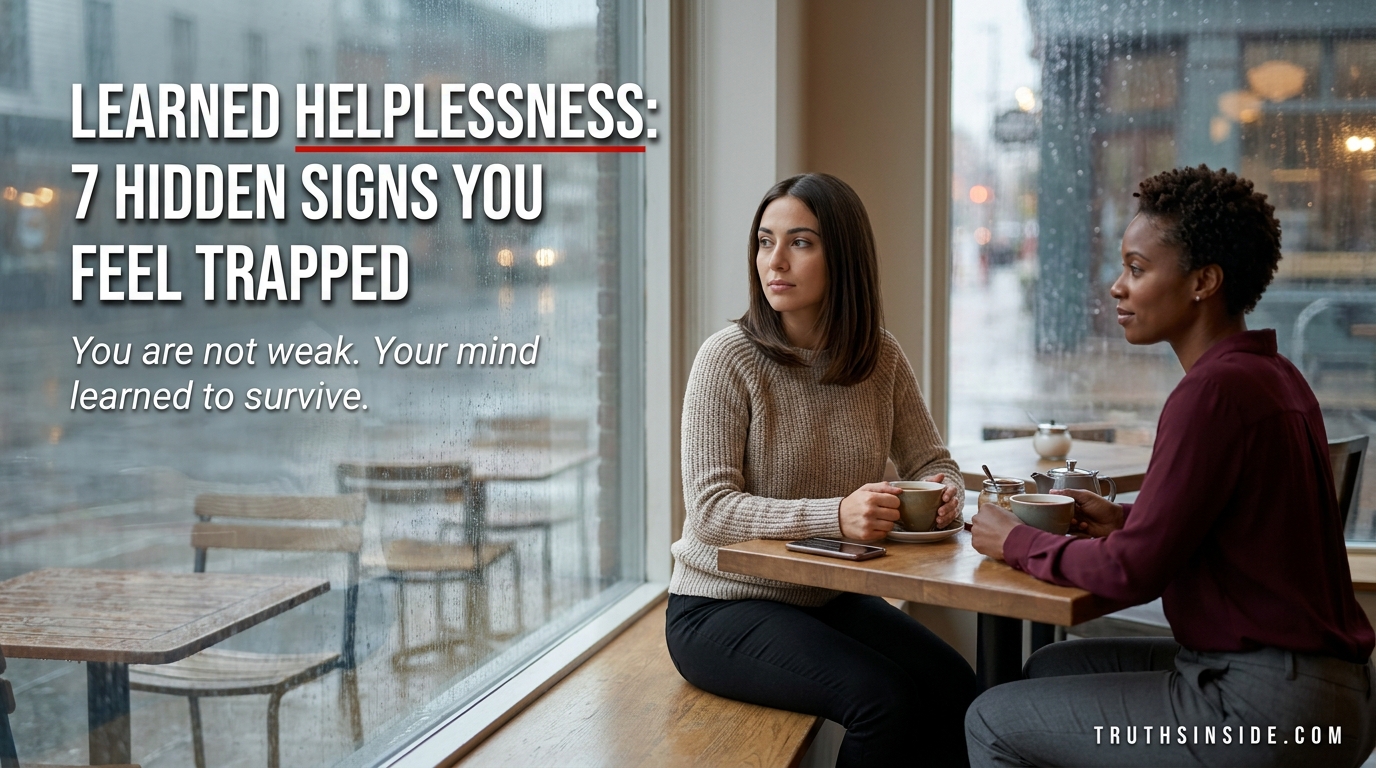
Learned helplessness is one of the most misunderstood reasons people stay in toxic relationships. From the outside, the answer looks simple: just leave. From the inside, every option feels blocked, every attempt to change things seems pointless, and a quiet voice insists that nothing you do will matter. If that voice sounds familiar, please know that you are not weak, lazy, or foolish.
The concept comes from psychologists Martin Seligman and Steven Maier, who in the 1960s observed that animals exposed to repeated, inescapable shocks later stopped trying to escape, even when escape became possible. Decades later, the same researchers revised the theory, suggesting that passivity is the brain’s default response to prolonged adversity, and that what must be learned is a sense of control. In relationships, learned helplessness can grow when nothing you do seems to change how you are treated.
This guide explains how learned helplessness develops in toxic relationships, seven hidden signs to recognize, and gentle steps to regain a sense of control. It is for education, not diagnosis, and support resources are included below.

What Is Learned Helplessness?
Learned helplessness is a psychological state in which a person comes to believe that their actions cannot change what happens to them. After enough experiences of effort leading nowhere, the mind stops trying. This is not laziness or weakness. It is the brain’s attempt to conserve energy and avoid repeated disappointment when the environment feels uncontrollable.
In the original laboratory studies, animals that could not escape painful shocks later made little effort to escape even when an exit was available. Later work refined the explanation. Maier and Seligman’s revised view suggests that passivity is the default reaction to ongoing stress, and that a sense of control must be actively learned and maintained. When control is repeatedly taken away, that learning can fade.
It is important to apply this idea carefully to human lives. People in difficult relationships are not passive animals, and many try again and again to seek help, change their partner’s behavior, or leave. Learned helplessness is one lens for understanding why hope can wear down over time. It does not mean the person is to blame, and it does not explain every situation.
How Learned Helplessness Develops in Toxic Relationships
A toxic relationship often teaches helplessness through unpredictability. One day your partner is warm and loving, and the next day they are cold, critical, or explosive, with no clear reason. You try to adjust. You become more careful, more accommodating, more quiet. Yet the mistreatment continues anyway. Over time, your mind learns a painful lesson: nothing I do makes a difference.
Blame and confusion deepen the effect. When a partner twists the story so that you are always at fault, you may begin to doubt your memory and judgment. Attempts to explain yourself are met with anger or silence. Each failed attempt chips away at your confidence. This is why learned helplessness is so common in relationships marked by manipulation, gaslighting, or control.
Isolation completes the cycle. If a partner discourages friendships, criticizes your family, or monitors your time, you lose the voices that would remind you what healthy treatment looks like. Add fear, shame, and the occasional kindness that keeps hope alive, and learned helplessness can settle in quietly, long before you realize what is happening.
“Learned helplessness is not a character flaw. It is what repeated powerlessness can do to a human mind.”
How a Toxic Relationship Differs From Ordinary Conflict
Every couple argues, disappoints each other, and has hard seasons. A toxic relationship is different because the harm follows a pattern. Criticism becomes constant, apologies rarely lead to change, and one person’s needs are repeatedly treated as unimportant. The relationship leaves you feeling smaller, more anxious, and more alone over time.
Healthy conflict leaves room for repair. Both people can say, “I was wrong,” and mean it. In toxic dynamics, accountability disappears, and the person who is hurt ends up apologizing, explaining, or managing the other person’s reactions. That imbalance is a crucial clue.
Ask yourself a few honest questions. Do I feel afraid to disagree? Do I censor myself to avoid retaliation? Has my world gotten smaller since this relationship began? Answering yes to several of these does not decide anything for you, but it can show why your sense of control has been shrinking.
📃 Related article: Science of Compatibility: 7 Surprising Truths
7 Hidden Signs of Learned Helplessness in a Relationship
These signs can be subtle, and they often feel like personality traits rather than responses to an unhealthy situation. Read them with compassion. Recognizing them is not about blaming yourself. It is about seeing clearly what you have been carrying.
Sign 1: You Stop Trying to Change Things
One of the clearest signs of learned helplessness is the thought, “What’s the point?” You may have tried to talk, to compromise, to set boundaries, or to leave, and each effort ended in disappointment or punishment. Eventually, you stop trying, not because you do not care, but because trying costs too much.
Notice whether you have stopped asking for what you need. If you rarely bring up problems, or you drop issues quickly to avoid conflict, your mind may be protecting you from further pain. Learned helplessness often looks like calm from the outside, but inside it feels like resignation.
Sign 2: You Walk on Eggshells
Constant vigilance is exhausting. You monitor your partner’s mood, rehearse what you say, and adjust your behavior to avoid setting them off. You may apologize automatically, even when you have done nothing wrong, simply to keep the peace.
This hypervigilance is a survival strategy, yet it reinforces learned helplessness because it teaches your nervous system that you are always one mistake away from trouble. Over time, your own needs fade into the background. You become an expert on your partner and a stranger to yourself.
Sign 3: You Doubt Your Own Judgment
When someone repeatedly tells you that you are overreacting, forgetful, or too sensitive, you may stop trusting your own perceptions. You might ask friends, “Am I the problem?” or feel unable to decide whether something was truly harmful.
Self-doubt is a hallmark of learned helplessness in toxic relationships. It makes leaving feel risky, because you no longer trust the instincts that would guide you. Rebuilding trust in your own mind is often the first step toward regaining control.
Sign 4: Decisions Feel Impossible
Even small choices, such as what to eat or what to wear, can feel overwhelming. Part of you fears making the wrong choice and facing criticism. Another part feels that choosing does not matter anyway, because the outcome is out of your hands.
Indecision is not a flaw. It is what happens when decisions have been punished or overridden. If you notice yourself saying “I don’t care, you pick” about nearly everything, learned helplessness may be shaping your sense of agency.

Sign 5: You Minimize or Excuse the Mistreatment
“It’s not that bad.” “They had a hard childhood.” “They only do it when they’re stressed.” Excuses like these can make the unbearable feel manageable. They are a way of coping when escape feels impossible.
Minimizing is a common feature of learned helplessness because it reduces distress in the short term. The cost is that it keeps the pattern hidden. A helpful question is, “If a friend described this treatment to me, what would I say?” Your answer often reveals what part of you already knows.
Sign 6: You Feel Numb, Tired, or Hopeless
Chronic stress drains the body and mind. You may feel exhausted even after sleeping, find joy hard to access, or feel emotionally flat. Hobbies you once loved may seem pointless. Some people describe it as watching life through glass.
Persistent hopelessness, sadness, or thoughts of not wanting to live deserve immediate care and are not signs of weakness. They are signals that you need support. If you recognize this in yourself, please reach out to a mental health professional or a crisis line right away.
Sign 7: You Cannot Picture a Different Future
When learned helplessness takes hold, the future can feel like a blank wall. You may believe that no one else would want you, that you could not cope alone, or that things will never change. Your imagination narrows to what you already know.
This does not mean a better life is impossible. It means your mind has been trained to expect more of the same. Even small acts of imagining, such as writing down what you would like a peaceful day to look like, can begin to widen that narrowed view.
Why You Feel Stuck: Forces Beyond Learned Helplessness
Learned helplessness is only one part of why people stay. Practical barriers matter just as much. Shared finances, housing, children, immigration concerns, and fear of losing your support system can make leaving feel enormously risky. These are real obstacles, not excuses, and they deserve real solutions.
Safety is a major factor. Leaving a controlling or abusive partner can carry genuine risks, which is why planning with a trained advocate is so important. Fear of retaliation, stalking, or escalation keeps many people cautious, and that caution is a rational response to danger.
Emotional bonds add another layer. Cycles of tension, apology, and affection can create powerful attachment, sometimes called trauma bonding. You may love the person you hope they can become, while fearing the person they are. Shame also keeps many people silent. Understanding these forces helps replace self-blame with compassion for yourself.
How to Break Free From Learned Helplessness
Recovery from learned helplessness begins with small, safe experiences of control. You do not need a dramatic escape plan on day one. The goal is to teach your mind, step by step, that your actions can matter again. Here are practical ways to begin:
- Name what is happening. Writing “I feel stuck because my efforts haven’t been respected” can reduce confusion and self-blame.
- Practice tiny choices. Choose your own breakfast, music, or walking route. Each choice rebuilds a sense of agency.
- Reconnect with someone safe. A trusted friend, relative, or counselor can remind you what respectful treatment looks like.
- Keep a private record. Notes about incidents, dates, and feelings can protect your memory when doubt creeps in.
- Seek professional support. A licensed therapist, especially one experienced with relationship trauma, can offer tools and safety planning.
- Make a safety plan. If you may leave, an advocate can help you plan safely, including documents, money, and a safe place to go.
Progress may feel slow, and setbacks are normal. Every small act of choice is evidence against the old belief that nothing you do matters. Learned helplessness was learned, which means a sense of control can be learned again.

How to Support Someone Experiencing Learned Helplessness
If someone you love seems trapped, resist the urge to say, “Just leave.” That advice, however well meant, can increase shame and push them away. They may already have tried to leave or change things many times. Learned helplessness thrives on being told what to do, so your role is to help them feel heard, believed, and respected.
Listen without judgment and avoid criticizing their partner in ways that force them to defend the relationship. Offer specific, low-pressure help: a place to talk, a ride, a phone number, or a safe place to keep important documents. Keep the door open, and stay in contact even when progress is slow.
Celebrate small steps and trust their timeline. People are often the best judges of their own safety. Your steady presence may be the first sign in a long time that someone still believes in their strength.
“You don’t rescue someone from learned helplessness. You remind them that their voice still counts.”
When to Seek Help Right Now
If you feel unsafe, fear for your life, or are being threatened, contact emergency services. In the United States, the National Domestic Violence Hotline is available at 1-800-799-7233, and you can text START to 88788 or chat online. If you are having thoughts of harming yourself, call or text 988 to reach the Suicide and Crisis Lifeline.
You do not have to be certain that your situation is “bad enough” to ask for help. Trained advocates can listen, explain your options, and help you plan safely, whatever you decide. Reaching out is a way of reclaiming control, and it is one of the strongest acts against learned helplessness.
📃 Related article: Psychological Reactance: 7 Shocking Ways It Backfires
Frequently Asked Questions About Learned Helplessness
What is learned helplessness in a relationship?
It is a state in which repeated experiences of powerlessness lead someone to believe that nothing they do can change their situation. In a toxic relationship, it can show up as giving up on conversations, expecting blame, and feeling unable to leave. Learned helplessness is a pattern of coping, not a personal failing.
Is learned helplessness the same as being weak?
No. People with learned helplessness are often exceptionally strong and resourceful. They have usually tried many strategies before feeling stuck. It is a natural response to chronic uncontrollable stress, and it can affect anyone, regardless of intelligence, education, or personality.
Can you recover from learned helplessness?
Yes. Because it is learned, a sense of control can be rebuilt through safe experiences of choice, supportive relationships, and therapy. Research on stress suggests that experiencing control can protect against passivity. Recovery takes patience, but many people regain confidence and hope over time.
Why can’t I just leave a toxic relationship?
Leaving is rarely simple. Fear, finances, children, safety risks, emotional attachment, and learned helplessness all play a part. It is not a lack of willpower. If you want to leave, a domestic violence advocate or therapist can help you create a safe, realistic plan.
Final Thoughts: Your Mind Learned to Survive, and It Can Learn to Hope
Learned helplessness is not a verdict on your worth. It is a sign that you have endured something heavy for a long time, and that your mind did its best to protect you. Seeing the pattern clearly is a powerful step, because what was learned can be gently unlearned.
Begin where you are, even if where you are feels messy, uncertain, or small. Healing rarely arrives in one dramatic moment. It arrives in quiet decisions, in honest conversations, and in the slow return of trust in yourself. Name what you feel, make one small choice for yourself, and reach out to one safe person. Each action tells your mind a new story: that your voice matters, your needs are real, and your future is not fixed. You deserve respect, safety, and a life where your efforts count.
Save this article so you can return to it when you need a reminder of your strength. Share it with someone who may feel stuck and deserves to be heard. Follow Truthsinside.com for more honest guides to psychology, love, and healing.
🎵 Music
Maren Lull is a singer-songwriter who writes from the places most people don’t talk about out loud.
Not the dramatic grief. Not the obvious heartbreak. The quiet kind — the ordinary Tuesday emptiness, the habit of reaching for someone who isn’t there anymore, the particular exhaustion of being strong for so long that the strength itself wears thin.
Her music lives at the intersection of emotional honesty and soft beauty — breathy vocals over gentle piano, slow tempos, lyrics that feel less like songs and more like something you wrote in a private notebook at two in the morning and never showed anyone.
Maren Lull writes for the people who feel everything deeply and say very little about it. For the ones who listen to sad music not because they want to feel worse — but because being understood, even by a song, makes the feeling easier to carry.
📱 Follow Maren Lull:
→ Spotify
→ Apple Music
→ Youtube
→ Audiomack