
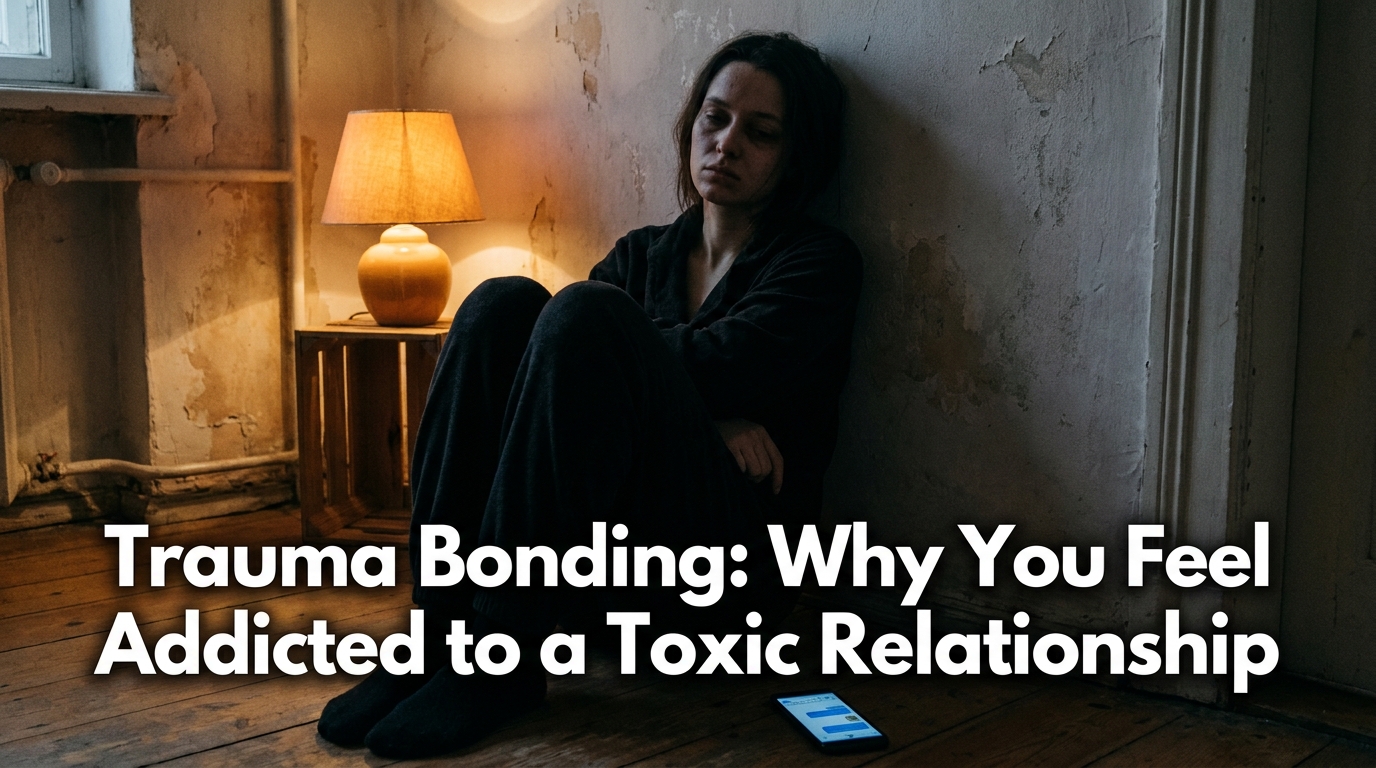
You know it is not good for you.
You have known for a long time. Your friends know. The part of you that thinks clearly, that can see the pattern from the outside — that part knows too.
And still you cannot leave. Or you leave, and then you go back. Or you leave and stay away, but the pull does not go away — the longing for the person who hurt you, the inability to stop thinking about them, the grief that does not feel proportionate to the relationship’s actual worth.
This is not weakness. It is not stupidity. It is not love in the ordinary sense of the word.
It is trauma bonding — one of the most misunderstood and most clinically significant psychological phenomena in relationship research.
Research published in the Journal of Trauma Practice found that trauma bonding produces neurochemical patterns similar to addiction — activating the same reward and withdrawal systems as substance dependency, and producing the same compulsive return to the source of harm.
Understanding trauma bonding does not instantly break it. But it is the first and most essential step toward doing so.

What Trauma Bonding Actually Is
Trauma bonding is a psychological response in which a person develops a powerful emotional attachment to someone who is hurting them — as a direct result of the specific pattern of that harm.
The term was first developed by psychologist Patrick Carnes, who identified the phenomenon in the context of hostage situations, cult dynamics, and abusive relationships. It describes not simply the difficulty of leaving a harmful relationship, but a specific, neurologically driven attachment formed through the particular cycle of abuse and affection.
Trauma bonding is not a sign of weakness or poor judgment. It is a specific neurological and psychological response to a specific set of relational conditions — conditions that the human nervous system was not designed to recognize as harmful because they exploit the very attachment mechanisms that are essential to human survival.
It is important to understand what trauma bonding is not. It is not ordinary relationship difficulty. It is not the normal complexity of loving someone imperfect. It is not the understandable reluctance to end a long relationship or the grief that follows significant loss.
Trauma bonding is the specific, neurologically driven compulsive attachment that forms in response to a cycle of intermittent abuse and affection — and that persists as a genuine addiction-like phenomenon even when the person experiencing it is fully aware that the relationship is causing harm.
“Trauma bonding is not a failure of intelligence or character. It is the predictable result of a nervous system doing exactly what it was designed to do — in an environment that has learned to exploit that design.” — Trauma Psychology Research
The Cycle That Creates the Bond
Trauma bonding does not occur in relationships that are consistently harmful. It occurs in relationships that alternate — between harm and affection, between cruelty and warmth, between the infliction of pain and the relief of its removal.
This cycle — not the harm itself, but the pattern of harm followed by relief — is the mechanism that creates the bond.
Stage 1 — The Idealization Phase
The relationship begins with extraordinary warmth. Intense attention. The overwhelming feeling of being seen, chosen, wanted. This is the love bombing phase — and the neurochemical state it produces is genuine. The dopamine surge, the oxytocin flood, the intoxicating sense of being entirely known and entirely loved.
This phase creates the attachment. And it creates the template — the memory of what this relationship can feel like — that the trauma-bonded person will spend the rest of the relationship trying to recapture.
Stage 2 — The Incident
Something shifts. An outburst of anger. A significant cruelty. A humiliation. A violation that is clearly wrong, clearly harmful, clearly not what the relationship had seemed to be. The person experiencing it is disoriented — because the person doing this is the same person who was extraordinary in the first phase. The cognitive dissonance is immediate and profound.
Stage 3 — The Reconciliation
Following the incident, the abusive partner returns to something resembling the warmth of the first phase. An apology. Expressions of remorse. Affection, attention, the specific behaviors that signal the return of the person who was there at the beginning. Sometimes called the honeymoon phase of the abuse cycle.
This reconciliation is neurologically significant. The relief of the threat being removed — the cortisol dropping, the attachment need being met after the terror of its withdrawal — produces a neurochemical response that is more powerful than ordinary affection. The warmth after harm feels more profound than warmth alone.
Stage 4 — The Calm
A period of relative peace follows. The person who was harmed is vigilant, watchful, hopeful that this time the calm will last. It provides enough relief to make staying feel survivable — and enough hope to make leaving feel unnecessary.
Stage 5 — The Return
The cycle repeats. The incident returns — perhaps the same, perhaps escalated. And the attachment that has been built through the idealization, the incident, the relief, the calm, is now stronger rather than weaker — because each cycle has deepened the neurochemical conditioning.
This is the counterintuitive and critical feature of trauma bonding: the cycles do not weaken the bond. They strengthen it. Each repetition deepens the conditioning. Each return of warmth after harm makes the warmth more meaningful and the leaving more difficult.

The Neuroscience of Why You Cannot Simply Leave
The most common response from people who have never experienced trauma bonding is a version of: why don’t you just leave? And the most common response from people who have experienced it is a version of: I don’t know. I know I should. I cannot explain why I can’t.
The neuroscience provides the explanation.
Intermittent Reinforcement — The Most Powerful Conditioning Known to Psychology
Intermittent reinforcement — the unpredictable alternation of reward and non-reward — produces stronger behavioral conditioning than consistent reward. This is the principle behind gambling addiction, and it is the principle behind trauma bonding.
When warmth, affection, and kindness are unpredictably available — when the relationship alternates between harm and extraordinary care — the dopamine system becomes intensely focused on the source of the unpredictable reward. The pursuit of the reward becomes compulsive. The absence of the reward produces the craving and the distress of genuine withdrawal.
The person trauma-bonded to an abusive partner is not simply attached to the partner. They are addicted — neurologically, biochemically — to the unpredictable reward that the partner intermittently provides.
The Cortisol-Dopamine Loop
Each harmful incident produces a significant cortisol spike — the stress response activating fully. When the abusive partner then provides relief — the reconciliation, the warmth, the return of affection — the cortisol drops and dopamine surges simultaneously.
This combination — the relief of a significant stress response alongside the reward signal of returned affection — is neurologically more powerful than ordinary positive experience. The nervous system does not experience this as: this person relieves the harm they cause. It experiences it as: this person provides the most significant relief I know.
This is why trauma-bonded people frequently describe their abusive partner as the one person who truly understands them, who truly sees them, who is the only one who can make them feel better. The partner has become both the source of the dysregulation and the only known source of its relief. The dependency this creates is real and is neurochemical.
Attachment System Activation
Threat activates the attachment system — the neurological drive to seek proximity to an attachment figure for protection. In an environment in which the attachment figure is also the source of threat, this creates the specific confusion of trauma bonding: the instinct toward the abusive partner intensifies precisely when the harm is greatest.
The person who has been hurt does not experience the pull toward their abusive partner as perverse or irrational — because neurologically it is not. It is the attachment system doing exactly what it was designed to do. The tragedy is that it is doing it in response to a person who is not safe.

Signs You May Be Trauma Bonded
Because trauma bonding does not feel like what people expect it to feel like — it feels, from inside, like love — recognizing it requires looking at specific patterns rather than at the quality of feeling.
You cannot leave even though you know you should. Not the normal difficulty of ending any relationship. The specific inability to act on a clear understanding that the relationship is causing harm — despite genuinely wanting to, despite having tried, despite knowing exactly what staying costs.
You feel more attached after incidents of harm than before them. The abuse cycle’s reconciliation phase produces a specific intensification of feeling — not despite the harm but because of it. If the periods of warmth after harm feel more significant than the periods of warmth before it, that pattern is the signature of trauma bonding.
Your partner is both the source of your distress and the primary thing that soothes it. The specific circularity in which the person causing the harm is also the person whose presence most reliably relieves the distress — and in which no other person or activity provides comparable relief.
You make excuses for behavior that you would find unacceptable in any other context. The capacity to clearly identify harmful behavior in other people’s relationships while consistently explaining, minimizing, or contextualizing it in your own.
You have left and returned multiple times. Each return feeling like a genuine decision rather than a compulsion, each accompanied by the belief that this time things will be different.
The thought of permanently losing this person produces terror disproportionate to anything else in your life. Not ordinary grief at the end of a relationship. Genuine, acute terror — the activation of the attachment system at maximum intensity.
You feel more yourself in this relationship than anywhere else — even though the relationship is harming you. The specific paradox of trauma bonding: the relationship that is most harmful is also the one in which the attachment is most total, in which the sense of being known and connected is most intense.
The Role of Childhood Attachment in Trauma Bonding
Trauma bonding does not occur equally in all people — and understanding why some people are more susceptible than others requires understanding the role of early attachment experiences.
People who experienced inconsistent caregiving in childhood — who learned that love is unpredictable, that affection is intermittent, that you cannot count on the presence of warmth but must pursue and maintain it — have a nervous system that is specifically calibrated to the intermittent reinforcement pattern that trauma bonding exploits.
For these people, the cycle of harm and affection does not feel alarming. It feels familiar. It feels, at the deepest level of neurological conditioning, like home.
This is not their fault. It is the direct consequence of the earliest relational experiences — experiences that shaped the nervous system’s template for what love looks and feels like before the person was old enough to choose or understand.
People with anxious attachment — formed through exactly this kind of inconsistent early caregiving — are significantly more vulnerable to trauma bonding precisely because their nervous system is already primed for the intermittent reinforcement pattern. They have been practicing for it, without knowing it, since childhood.
Disorganized attachment — formed when the caregiver was both the source of comfort and the source of fear — creates perhaps the deepest vulnerability to trauma bonding, because the association between love and threat is the most fundamental feature of that attachment style. The abusive relationship, for someone with disorganized attachment, does not represent a departure from their template for love. It represents its most accurate replication.

Breaking the Trauma Bond — What It Actually Takes
This is the section most people are looking for — and the one that requires the most honesty, because breaking a trauma bond is not simply a matter of deciding to leave or understanding intellectually that the relationship is harmful.
The bond is neurological. Breaking it requires neurological updating — which happens through specific, supported processes rather than through willpower or intellectual understanding alone.
1. No Contact — The Neurological Necessity
The most essential and most difficult element of breaking a trauma bond is sustained no contact with the abusive partner. Not because cutting contact is emotionally easy — it is not. But because every contact — even negative contact, even a difficult phone call, even reading their social media — reactivates the reward system and restarts the withdrawal cycle.
The nervous system cannot update its conditioning while the conditioning stimulus is still present. No contact creates the gap in which the neurological rewiring becomes possible.
This is why people who go back repeatedly after leaving are not failing — they are experiencing the genuine withdrawal of a neurochemical addiction, and finding that the withdrawal is more painful than the contact they are trying to avoid. Understanding this reframes the return not as weakness but as the predictable response of a nervous system in withdrawal.
2. Trauma-Informed Therapy — The Non-Optional Support
Breaking a trauma bond without professional support is possible but significantly harder than breaking it with support. The specific dynamics that created the bond — the childhood attachment wounds it exploited, the neurological conditioning it produced, the identity disruption it caused — require more than time and distance to address.
Trauma-informed therapists — particularly those using EMDR, Somatic Experiencing, IFS, or EFT — work directly with the nervous system’s stored experience, helping it update the threat assessment that trauma bonding has distorted. This work cannot be done through cognitive understanding alone, because the bond is not primarily cognitive.
3. Understanding the Cycle — Naming What Happened
One of the most powerful early interventions in breaking a trauma bond is the simple act of giving the pattern a name. Understanding that what happened was a cycle — not random, not caused by something you did, not evidence of something wrong with you — begins to disrupt the narrative that the abusive partner’s behavior has constructed.
When you can say “this is the reconciliation phase” rather than “this is love returning,” the neurological power of the reconciliation is reduced. Not eliminated — but reduced. Named patterns are patterns you can observe from the outside rather than being swept inside them.
4. Building External Support — The Counter to Isolation
Trauma bonding almost always coexists with some degree of isolation from the support network that would provide perspective and practical assistance in leaving. Rebuilding that network — reaching back to friends and family who knew you before the relationship, finding support groups for people recovering from abusive relationships — provides both the emotional sustenance of genuine connection and the practical support that makes leaving feel survivable.
5. Rebuilding Identity Outside the Relationship
Trauma bonding frequently produces a profound erosion of identity — the sense of who you are becomes inseparable from the relationship, from the abusive partner’s version of you, from the role you have been assigned within the cycle. Rebuilding identity — reclaiming the interests, the opinions, the sense of self that existed before the relationship and has been suppressed within it — is both a practical step and a neurological one. A stronger identity is a more resilient defense against the pull of the trauma bond.
6. Grieving What Was Real
One of the most important and most counterintuitive elements of healing from trauma bonding is allowing the grief for what was real in the relationship to be honored rather than dismissed.
The love that was felt was real — neurochemically, experientially, genuinely. The hope for what the relationship could be was real. The moments of warmth that felt significant were significant — they were produced by real neurochemical events. Dismissing all of it as manipulation or illusion does not honor the experience and does not make the grief go away. It drives it underground.
Grieving the real loss — of the warmth that was present in the idealization phase, of the relationship that was promised, of the version of yourself that existed in that relationship before the harm — is a necessary part of healing. Grief processed is grief that can be moved through. Grief dismissed becomes the unresolved longing that draws people back.

A Note on Leaving — The Most Dangerous Moment
Leaving a trauma-bonded relationship — particularly one involving a controlling or abusive partner — is not only emotionally difficult. It can be physically dangerous. Research consistently shows that the period of leaving or immediately after is the most dangerous time in an abusive relationship, when the risk of escalation is highest.
If you are considering leaving a relationship in which there has been any physical threat, coercive control, or behavior that makes you fear for your safety, please reach out to professional resources before taking action alone.
The National Domestic Violence Hotline — 1-800-799-7233 — is available 24 hours a day, seven days a week, and provides confidential support, safety planning, and practical guidance regardless of whether the abuse has been physical. Emotional abuse, coercive control, and trauma bonding are all recognized forms of domestic abuse and are taken seriously.
You do not have to figure this out alone. And you do not have to leave without a plan.
You Are Not Broken — You Were Bonded
If you recognize yourself in this article — if the pattern it describes is your pattern, if the pull it names is the pull you have been living with — there is something important to hear clearly.
You are not weak. You are not stupid. You are not broken. You are not failing to love yourself enough or thinking clearly enough or wanting your freedom enough.
You are a person whose nervous system was conditioned by a specific relational pattern that is designed — consciously or not — to exploit the deepest mechanisms of human attachment. The bond that formed is real. The difficulty of breaking it is real. And neither of these things is your fault.
The path out is not through judgment of yourself for not having left sooner, or for having gone back, or for still feeling the pull after everything. The path out is through understanding — clear, compassionate, supported understanding — of what happened to you and what it will take to update the nervous system that is holding the conditioning.
That updating is possible. It happens daily, in thousands of people, with the right support and the genuine commitment to building something different.
It will not happen all at once. It will not happen without difficulty. But it will happen.
The trauma bond is not proof that you loved the wrong person. It is proof that you are human — that your nervous system did exactly what it was built to do in conditions that exploited that design. Healing is the process of teaching your nervous system that a different kind of love is possible. And it is.
CALL TO ACTION
💾 Save this — it may be the explanation you have been searching for. 📤 Share it quietly with someone you are worried about who cannot seem to leave. 👣 Follow Truthsinside.com for honest, deeply researched content on psychology, trauma, and the path back to yourself.
Frequently Asked Questions
Q1: Is trauma bonding the same as codependency? They overlap but are not identical. Codependency describes a relational pattern in which one person’s sense of identity and wellbeing becomes excessively organized around another person’s needs — often developed in families where one member had addiction or significant dysfunction. Trauma bonding is more specifically the neurological and psychological attachment formed through the cycle of intermittent harm and affection. Both can coexist in the same relationship. Both involve difficulty leaving and excessive focus on the other person. But trauma bonding has a specific neurochemical mechanism — the intermittent reinforcement cycle — that produces the addiction-like compulsion to return. Codependency does not require an abusive cycle to develop.
Q2: Can trauma bonding happen in relationships that are not physically abusive? Yes — and this is one of the most important things to understand about trauma bonding. Physical abuse is not required. Trauma bonding can form in relationships characterized by emotional abuse, psychological manipulation, coercive control, extreme inconsistency, and the specific cycle of idealization, devaluation, and intermittent affection — without any physical harm occurring. The neurological mechanism — intermittent reinforcement producing addiction-like attachment — functions identically regardless of the type of harm. Many people in trauma-bonded relationships have never experienced physical abuse and therefore do not recognize their experience as abuse, which delays both recognition and recovery.
Q3: Why do I miss someone who hurt me so badly? Because the bond that formed between you was real — neurochemically, experientially, genuinely real. The attachment system does not distinguish between good and harmful attachment figures. It attaches, and the loss of that attachment produces genuine grief regardless of whether the person was good for you.
Additionally, the intermittent reinforcement of the trauma bond creates a specific kind of longing — the compulsive seeking of the unpredictable reward — that is neurologically identical to the withdrawal cravings of substance addiction. Missing someone who hurt you is not evidence that you should return to them or that they were good for you. It is evidence that your nervous system formed a genuine bond and is experiencing genuine withdrawal from its removal.
Q4: How long does it take to break a trauma bond? There is no honest universal answer. The timeline depends on the length and intensity of the relationship, the depth of the trauma bond, the presence of childhood attachment wounds that made the bond more susceptible, the quality and consistency of therapeutic support, and the degree to which no contact is sustained.
What consistent research shows is that the active neurochemical withdrawal — the most intense phase of the pull — typically diminishes significantly over several weeks to months of sustained no contact. The deeper healing — the identity rebuilding, the childhood wound processing, the development of new internal working models — is a longer process, often taking years. Progress is real and significant even when it does not feel complete.
Q5: If I understand that I am trauma bonded, why can’t I just leave? Because understanding is cognitive and the trauma bond is neurological. The part of you that understands — the prefrontal cortex, the rational mind — is not the part that generates the pull. The pull comes from the limbic system, from the attachment system, from the deeply conditioned reward pathways that were shaped by the intermittent reinforcement cycle.
These systems operate faster and more powerfully than rational understanding, which is why understanding alone is insufficient to break the bond. It is necessary — naming what is happening is the beginning of every recovery — but it is not sufficient. The nervous system requires new experience, not just new information, to update its conditioning. That new experience comes through sustained no contact, therapeutic support, and the gradual accumulation of evidence that a different kind of relationship is possible.
🎵 Music
Maren Lull is a singer-songwriter who writes from the places most people don’t talk about out loud.
Not the dramatic grief. Not the obvious heartbreak. The quiet kind — the ordinary Tuesday emptiness, the habit of reaching for someone who isn’t there anymore, the particular exhaustion of being strong for so long that the strength itself wears thin.
Her music lives at the intersection of emotional honesty and soft beauty — breathy vocals over gentle piano, slow tempos, lyrics that feel less like songs and more like something you wrote in a private notebook at two in the morning and never showed anyone.
Maren Lull writes for the people who feel everything deeply and say very little about it. For the ones who listen to sad music not because they want to feel worse — but because being understood, even by a song, makes the feeling easier to carry.
📱 Follow Maren Lull:
→ Spotify
→ Apple Music
→ Youtube
→ Audiomack